Act I
Elena Vargas did not look like someone who had come to destroy anyone.
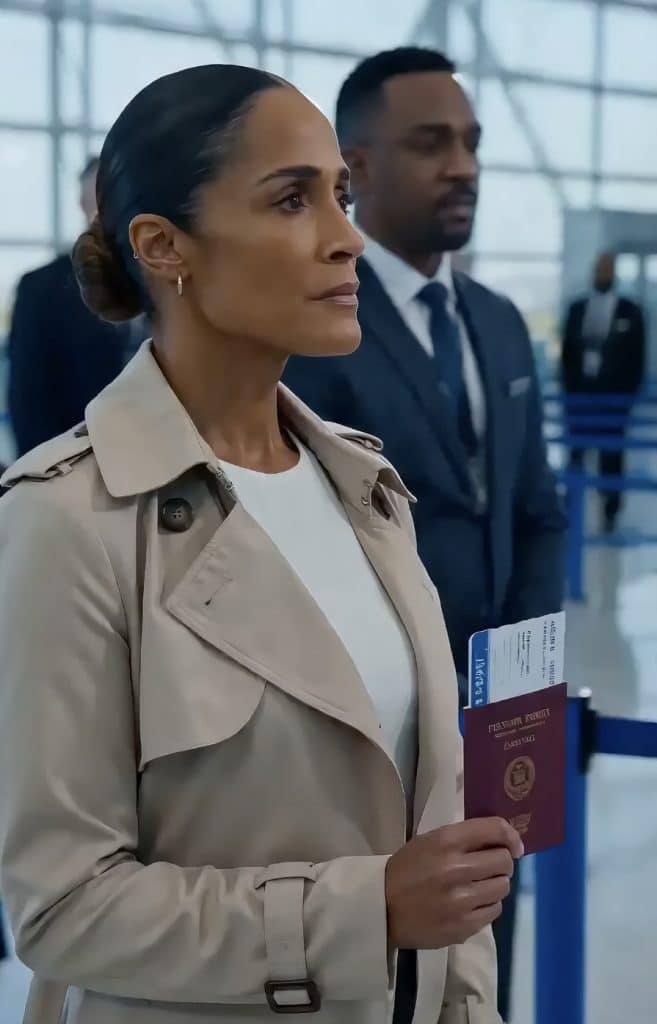
She stood quietly in the first-class lane of the international terminal, one hand resting on the strap of her brown leather shoulder bag, the other holding a folded boarding document she had printed at home out of habit. Her dark hair was pinned into a neat bun. Her off-white trench coat was clean but understated, the kind of elegance that did not beg to be noticed.
Around her, the terminal glittered with polished steel, glass walls, and enormous digital boards rolling through departures to Paris, Dubai, New York, Madrid.
People moved quickly. Wheels clicked over tile. Families whispered. Men in suits checked watches. Security guards watched the premium lanes with blank professionalism.
Elena was next.
She had waited without complaint behind a man arguing about an upgrade and a woman whose dog had its own designer carrier. When the agent at the first-class counter finally lifted her eyes and smiled politely, Elena stepped forward.
That was when the blonde woman cut across the lane.
She came fast, perfume arriving before she did. Slicked-back hair, gold hoops, black vinyl dress trimmed with faux fur at the wrists, Gucci bag swinging from her shoulder like a weapon.
She looked Elena up and down once.
Then she laughed.
“You in first class?” the blonde woman said.
Elena blinked. “Excuse me?”
The woman reached forward and snatched the document from Elena’s hand.
It happened so suddenly that the agent behind the counter froze with her fingers still over the keyboard.
The blonde woman lifted the boarding paper high enough for the passengers behind them to see, as if she had caught Elena holding a forged invitation to a private world.
“This lane is for people who actually belong here,” she said.
Elena’s face changed, but only slightly. A small tightening around the mouth. A flicker behind the eyes.
“Please give that back,” she said.
The woman smiled.
Then she tore it in half.
The sound was thin and vicious.
A paper ticket was nothing, really. A boarding pass could be reprinted. A document could be replaced. But humiliation had a different weight when it was done in public, in a place built to separate people by money, status, and permission.
The two halves floated down between them.
For one second, no one spoke.
Elena looked at the paper on the floor.
The blonde woman leaned closer, voice low enough to feel private but loud enough to perform.
“Go find economy. Or better yet, go find a cleaning cart. You look more comfortable near those.”
A man in line muttered, “That’s enough.”
The blonde woman spun toward him. “Mind your business.”
The airline agent’s lips parted, but no words came out. Her name tag read Mara. She looked young, tired, and frightened in the particular way employees look when the person behaving badly has money, status, or the power to complain to someone above them.
Elena saw that fear.
She had seen it before.
Too many times.
The blonde woman turned away, satisfied, and strutted toward the counter as if the lane had corrected itself by removing Elena from it.
Elena remained where she was.
Her eyes lowered briefly. Not in surrender. Not in shame.
In memory.
Because years earlier, in another airport, her mother had stood just like this while a man in a cashmere coat told her to use the service entrance because “passengers shouldn’t have to see the help.”
Elena had been twelve then. She had watched from behind a vending machine, clutching a backpack with broken straps, learning in silence how cruel people became when they believed a uniform made someone smaller.
Now, twenty-seven years later, she stood in a first-class lane wearing no uniform at all.
And still, someone had decided she did not belong.
Behind her, the flight information board flickered.
At first, no one noticed. The departures list disappeared. The advertisements faded. The bright blue airline branding dissolved into a white-and-gold welcome graphic stretched across the center of the terminal.
Then Elena heard the first gasp.
A child pointed upward.
A businessman lowered his phone.
The agent at the counter went pale.
Across the massive digital wall, Elena’s own portrait appeared above six words that changed the temperature of the room.
WELCOME OUR NEW GLOBAL CEO
ELENA VARGAS
The blonde woman had already reached the counter when the silence hit her.
She turned, irritated.
Then she looked up.
Her face emptied.
Elena bent down, picked up the torn halves of her boarding document, and walked toward her.
This time, no one stood in her way.
Act II
The blonde woman’s name was Vivienne Cross, and she was used to being recognized before she introduced herself.
She was not famous in the way actors were famous. She had no talent that could fill a theater, no invention with her name on it, no work that lasted beyond a social feed.
But she belonged to the luxury class of airports, hotels, galas, and boardroom-adjacent power. Her father owned a private aviation brokerage. Her ex-husband sat on two hospitality boards. Her closest friends described cruelty as “high standards.”
At Meridian International Airways, she was treated like royalty.
Not because she was royalty.
Because she complained like royalty.
She knew which executives answered late-night texts. She knew the head of premium client relations by first name. She knew how to turn a delayed champagne refill into a five-email crisis. And most importantly, she knew that employees in premium service were trained to apologize before they were trained to breathe.
So when Vivienne saw Elena in the first-class lane, calm and composed and unfamiliar, something in her recoiled.
It was not the coat.
It was not the bag.
It was the quiet.
Vivienne hated quiet confidence because it could not be easily bought, borrowed, or copied.
She had spent her life mistaking volume for status. Elena had no volume at all.
That offended her.
The irony was that Elena Vargas had never cared about first class.
She had grown up measuring distance not by miles but by sacrifice. Her mother, Rosa, cleaned terminals after midnight. Her father drove airport shuttle buses until his knees gave out. Elena learned English by reading safety cards left in seat-back pockets and learned ambition by watching people board planes to cities she could barely imagine.
Her mother used to bring home small things passengers forgot.
A ribbon from a gift box. A magazine from London. A postcard of Rome.
“Look,” Rosa would say, smoothing the postcard on the kitchen table. “The world is bigger than this night shift.”
Elena believed her.
She studied on buses. She worked three jobs through college. She started in aviation logistics because it was the closest she could get to the sky without a ticket. By thirty-two, she was restructuring broken routes across Latin America and Europe. By thirty-eight, she was known as the woman companies called when the brand was beautiful but the inside was rotting.
Meridian needed her badly.
Behind its glossy ads and velvet lounges, the airline was bleeding trust. There were discrimination complaints in premium lanes. Viral videos of passengers being profiled. Staff burnout. Executives blaming “isolated incidents” while quietly rewarding the very culture that caused them.
The board wanted a savior who looked safe.
They did not expect Elena.
Some fought her appointment until the last hour.
One board member asked whether she had “the right presence” for global leadership.
Elena smiled and asked him to define presence.
He did not.
By dawn, the final vote was complete. Elena Vargas was named Global CEO of Meridian International Airways. The announcement was scheduled to appear across every major airport at 9:00 a.m. local time, beginning with the flagship terminal where she would board a flight to London for her first investor meeting.
Her assistants had begged her to use the private entrance.
Elena refused.
“No,” she said. “I want to see what our passengers see.”
That was why she stood in line with everyone else.
No entourage. No security detail at her shoulder. No announcement before she arrived. Only a printed boarding document, a passport in her bag, and the quiet hope that maybe the company she had inherited was not as broken on the ground as it looked on paper.
Then Vivienne Cross tore her ticket in half.
And in doing so, she exposed more than her own arrogance.
She exposed the disease Elena had been hired to remove.
At the counter, Vivienne tried to recover.
People like her always tried to recover by pretending the room had misunderstood.
She forced a laugh, too high, too sharp.
“Oh my God,” she said, looking from the screen to Elena. “This is embarrassing. I thought you were someone else.”
Elena stopped in front of her.
The torn halves of the document rested between her fingers.
“Who?”
Vivienne blinked.
“What?”
“You said you thought I was someone else,” Elena said. “Who did you think I was?”
The question had no safe answer.
A line of passengers watched. Security watched. Mara, the agent, watched with the tense stillness of someone who had waited years to see consequences arrive wearing a trench coat.
Vivienne’s smile trembled.
“I just meant there are rules for these lanes.”
Elena looked at the first-class sign above them.
Then back at Vivienne.
“There are.”
Vivienne’s eyes brightened with desperate hope.
Elena stepped closer.
“But none of them say a passenger must look rich enough to satisfy you.”
The terminal stayed silent.
Then Vivienne made the mistake that finished her.
She lifted her chin and snapped, “Security!”
Act III
Two security officers moved immediately, but not toward Elena.
They moved toward Vivienne.
That was the moment her panic became real.
“No,” Vivienne said quickly. “Not me. Her. She’s harassing me.”
The older officer glanced at Elena, then at the enormous screen still glowing above the terminal.
“Elena Vargas?” he asked.
“Yes.”
His posture changed.
“Ma’am.”
Vivienne heard the word and flinched.
Ma’am.
Not miss. Not passenger. Not problem.
Authority had shifted so smoothly that she could not grab it back.
Elena turned to Mara behind the counter. “Did this woman take my boarding document from my hand and tear it?”
Mara’s eyes flicked toward Vivienne.
Vivienne stared at her with a warning sharpened by years of practice.
Mara swallowed.
Elena saw the fear again. The employee fear. The don’t-risk-your-job fear. The people-like-her-always-win fear.
So Elena softened her voice.
“Mara, your answer will not cost you your position.”
The young agent’s eyes filled with sudden tears, not enough to fall, just enough to show how long she had been waiting for someone to say that.
“Yes,” Mara said. “She took it. She tore it. And she insulted you.”
Vivienne exhaled in disbelief.
“Mara. Be careful.”
Elena’s gaze snapped back.
“No. You be careful.”
The words were not shouted. They did not need to be.
A man in a navy suit near the back of the line began recording. A woman holding a toddler whispered, “That’s the CEO.” Someone else said, “She tore up her ticket.”
The story was already escaping the terminal.
Elena knew how quickly public humiliation became spectacle. She also knew spectacle without truth changed nothing.
“Mara,” she said, “has Ms. Cross behaved this way before?”
Vivienne laughed. “This is absurd.”
Mara hesitated.
Elena waited.
Finally, Mara nodded.
“She has yelled at staff before. She once threw a coffee at the counter. She told my coworker he looked like he belonged loading bags, not serving premium customers.”
Vivienne’s face hardened.
“That employee was incompetent.”
“He was promoted last month,” Mara said quietly. “To training supervisor.”
A small ripple moved through the line. Not applause. Not yet. But recognition.
Elena looked at Vivienne’s Gucci bag, her gold hoops, the faux fur, the armor of someone terrified of being ordinary.
“Do you know what I was doing before I came here?” Elena asked.
Vivienne’s lips pressed together.
“I was reading a file,” Elena continued. “Three years of passenger complaints. Not complaints from people like you. Complaints about people like you. And about the employees who were told to keep smiling while being degraded.”
Vivienne’s eyes darted toward the counters, the cameras, the security officers.
“I want my lawyer.”
“You should call one.”
That frightened her more than any threat.
Elena turned to the security officer.
“Please escort Ms. Cross to the customer relations office. She is not to enter any Meridian premium area until this incident is reviewed.”
Vivienne’s mouth fell open.
“You can’t ban me. I’m a Platinum Sovereign member.”
Elena looked up at the screen with her own face on it, then back at Vivienne.
“Not anymore.”
The officer stepped forward.
Vivienne backed away, humiliated now in the same lane where she had tried to humiliate Elena.
But she still had one card left.
“You have no idea who I know,” she said.
Elena’s expression did not change.
That line had followed her all her life. In boardrooms. In hotels. In airports. In rooms where men smiled politely while deciding whether a woman named Vargas could be trusted with power they believed sounded better in someone else’s accent.
Elena stepped closer, lowering her voice so only Vivienne and the people nearest could hear.
“I know exactly who you know.”
Vivienne went still.
Because the truth was, Elena’s first morning as CEO had not begun with the ripped ticket.
It had begun with a sealed folder marked internal misconduct network.
And Vivienne Cross’s name was on the first page.
Act IV
The customer relations office sat behind a frosted glass wall near the premium lounge, close enough to the champagne bar that wealthy passengers never had to feel too close to consequences.
Vivienne was placed inside with a bottle of water she did not touch.
Elena entered five minutes later with Mara, the head of airport operations, and a senior security manager. She had changed nothing about herself. Same trench coat. Same bun. Same torn boarding document in her hand.
That bothered Vivienne most.
Elena did not need a costume change to become powerful.
She had been powerful the whole time.
The head of operations, Daniel Reeves, looked like a man trying not to sweat through his suit.
“Ms. Vargas,” he said, “first, let me apologize on behalf of the entire terminal team. This was unacceptable.”
Elena did not sit.
“Has Ms. Cross been flagged before?”
Daniel’s silence answered.
Elena waited anyway.
“Yes,” he admitted. “Several times.”
Vivienne scoffed. “Flagged for what? Expecting service?”
Mara’s voice came from beside Elena, small but steady.
“For abuse.”
Vivienne turned on her. “You’re enjoying this, aren’t you?”
Mara flinched.
Elena moved one step forward.
“Mara is not on trial.”
Daniel opened a tablet. “Ms. Cross has had multiple behavioral reports. Verbal harassment. Threats to have staff fired. Two lounge incidents. One complaint from a flight attendant after she refused to let a passenger sit beside her because she said he made the cabin look cheap.”
Vivienne’s cheeks flushed.
“That was taken out of context.”
Elena looked at Daniel.
“Why wasn’t action taken?”
Daniel’s jaw tightened. “She had executive protection.”
There it was.
Not a misunderstanding. Not a bad morning.
A system.
“From whom?” Elena asked.
Daniel looked like he would rather disappear through the floor.
“Adrian Cross.”
The name changed Vivienne’s face.
Adrian Cross was not just Vivienne’s brother. He was Meridian’s Senior Vice President of Premium Experience, the man responsible for the airline’s first-class redesign, loyalty policies, and elite passenger culture. He was charming in interviews, beloved by luxury magazines, and infamous among staff for turning cruelty into brand language.
He had once written in an internal memo that premium customers should feel “protected from discomfort, friction, and visual inconsistency.”
Elena had circled that phrase at 4:18 that morning.
Now she understood its real meaning.
Vivienne smiled faintly, regaining a piece of herself.
“You’re new,” she said to Elena. “You’ll learn. Airlines survive because people like us pay for comfort.”
Elena finally sat across from her.
“No,” she said. “Airlines survive because thousands of people load bags in the rain, clean cabins at midnight, calm frightened children, fix engines, reroute storms, and absorb insults from people who think a seat number is a personality.”
Vivienne’s smile vanished.
Elena placed the torn boarding document on the table.
“My mother cleaned terminals for twenty-two years,” she said. “She used to come home with swollen feet and still iron her uniform before dawn because she believed dignity was something you brought with you, even when others tried to take it.”
No one spoke.
“She died before she ever flew first class,” Elena continued. “Not because she didn’t belong there. Because she spent her life making sure other people got where they needed to go.”
Mara looked down.
Daniel looked ashamed.
Vivienne looked trapped.
A knock came at the glass door.
A tall man in a gray suit entered without waiting for permission. He had perfect hair, expensive shoes, and the polished irritation of someone summoned from a lounge.
Adrian Cross.
“Vivienne,” he said, then turned to Elena with a smile designed for boardrooms. “Ms. Vargas. What an unfortunate first impression. My sister can be impulsive, but I’m sure we can handle this privately.”
Elena studied him.
“Can we?”
Adrian lowered his voice.
“The last thing you need on day one is a viral scene suggesting instability at the top.”
Vivienne looked relieved.
There he was. The rescue she expected. The machine closing around her mistake.
Adrian continued, “We apologize, of course. Upgrade the affected passenger. Offer miles. Move on.”
Daniel stared at the floor.
Mara’s hands clenched.
Elena leaned back.
“The affected passenger is me.”
Adrian’s smile froze.
“Yes, well. Even so.”
“Even so?”
He adjusted his cuff. “The Cross family represents a meaningful portion of Meridian’s premium network. I would hate to see a misunderstanding become a governance issue.”
Elena almost smiled.
Not from amusement.
From disbelief that arrogance could be this poorly timed.
She opened her brown leather bag and removed the sealed folder she had carried all morning.
Adrian’s eyes dropped to it.
For the first time, he looked unsure.
Elena placed it on the table.
“This is a governance issue,” she said. “It was one before your sister touched my ticket.”
Act V
By 11:30 a.m., Adrian Cross was removed from operational authority pending investigation.
By noon, Vivienne’s Platinum Sovereign membership was suspended.
By 12:07, a video of the torn ticket had reached millions of views, but the part Elena cared about was not the slap of paper ripping or Vivienne’s stunned face beneath the CEO announcement.
It was Mara’s voice.
“She has done this before.”
Four words. Quiet. Terrified. True.
They became the center of everything.
For years, Meridian had trained employees to soften the truth until it became usable. An abusive passenger became “high-touch.” A racist complaint became “sensitivity around seating preferences.” A staff member crying in the break room became “service fatigue.”
Elena ended that language before sunset.
Her first company-wide memo was not polished by public relations. She wrote it herself in a quiet airport office while rain streaked the windows and flights kept boarding beyond the glass.
She wrote that no ticket class gave anyone the right to degrade another human being.
She wrote that staff reports would no longer disappear to protect revenue.
She wrote that premium service would mean better care, not permission for worse behavior.
And then she wrote the sentence her mother would have understood best.
No one who works for this airline is paid to surrender their dignity.
The memo spread faster inside Meridian than the video did outside it.
Employees printed it and taped it inside staff rooms. Flight attendants sent it to each other between routes. Baggage handlers shared screenshots. Gate agents who had spent years swallowing humiliation read it twice, not because it fixed everything, but because for the first time the person at the top had named the wound correctly.
Vivienne tried to fight.
Of course she did.
She released a statement claiming Elena had “weaponized identity politics” over a “minor travel disagreement.” Then the full security footage came out. Then former employees began speaking. Then Adrian’s internal memos leaked, including the one about “visual inconsistency.”
The public did not need much translation.
Meridian’s board, which had chosen Elena partly because they needed a symbol, discovered they had hired something far more dangerous to old habits.
They had hired someone who meant what she said.
Within a month, the airline created a passenger conduct ban policy that applied equally to economy and first class. Employee incident reports were reviewed by an independent ethics office. Premium staff were given authority to deny service without begging three layers of management for permission. Adrian resigned before the investigation concluded.
Vivienne vanished from the luxury travel circuit for a while.
Not forever. People like her rarely vanish forever.
But she no longer moved through airports like they belonged to her.
And at Meridian, her name became shorthand for a certain kind of passenger: the ones who believed money made them taller until someone finally held up a mirror.
Three months later, Elena returned to the same terminal for a late flight to Madrid.
No announcement flashed across the board this time. No cameras followed her. No dramatic reveal waited above the check-in lanes.
She arrived early and stood near the first-class counter, watching.
Mara was there.
The young agent looked different. Not louder. Not hardened. Just steadier. When a passenger complained sharply about a seat change, Mara listened, solved what she could, and refused what she could not with calm professionalism.
The passenger muttered something rude.
Mara lifted her eyes and said, “Sir, I can help you with your flight. I will not accept being insulted.”
Elena smiled.
That was the change.
Not perfection.
Permission.
Mara saw her then and froze.
“Ms. Vargas.”
“Elena,” she said.
Mara came around the counter. For a moment, she looked as if she might say something formal. Thank you. Congratulations. Welcome back.
Instead, she reached into a drawer and pulled out a small clear sleeve.
Inside were two torn pieces of paper.
Elena’s boarding document.
“I thought you might want it,” Mara said. “I don’t know why I kept it.”
Elena took the sleeve carefully.
The paper that Vivienne had tried to turn into humiliation now looked almost fragile. Ordinary. Powerless unless someone gave it meaning.
“My mother used to keep things too,” Elena said. “Receipts from places she dreamed of visiting. Napkins from airport cafés. A baggage tag from a passenger who once told her thank you.”
Mara’s eyes softened.
“She would be proud of you.”
Elena looked toward the departure board.
For a moment, she saw Rosa Vargas not as she had last seen her, tired and small in a hospital bed, but as she had been in the terminal after midnight, pushing a cleaning cart beneath lights bright enough to imitate morning.
Rosa had never needed first class to belong in an airport.
She had belonged because she helped it breathe.
Elena slipped the torn document into her bag.
Then she looked at Mara.
“Walk me to the gate?”
Mara laughed, surprised. “Me?”
“Yes. I’d like to hear how things are really going.”
As they walked through the terminal, passengers moved around them without knowing the whole story. Some recognized Elena. Most did not. A few glanced at her coat, her bag, her quiet stride, and made whatever assumptions people make when they believe they can read a life from the outside.
Elena no longer cared.
At the gate, the agent scanned her newly printed boarding pass and smiled.
“Welcome aboard, Ms. Vargas.”
Elena paused before entering the jet bridge.
Behind her, the terminal shone with glass and light and motion. First class, economy, crew doors, service corridors, security lines, baggage belts. A thousand invisible systems carrying a thousand visible lives.
Once, a woman had torn her ticket to prove she did not belong.
Instead, she had given Elena the first test of her leadership.
And Elena had answered it not by demanding special treatment, but by changing what treatment meant.
Vivienne Cross had believed first class was a place for people like her.
Elena Vargas knew better.
First class was just a seat.
Dignity was the destination.