Act I
The wolves came before the priest finished his final prayer.
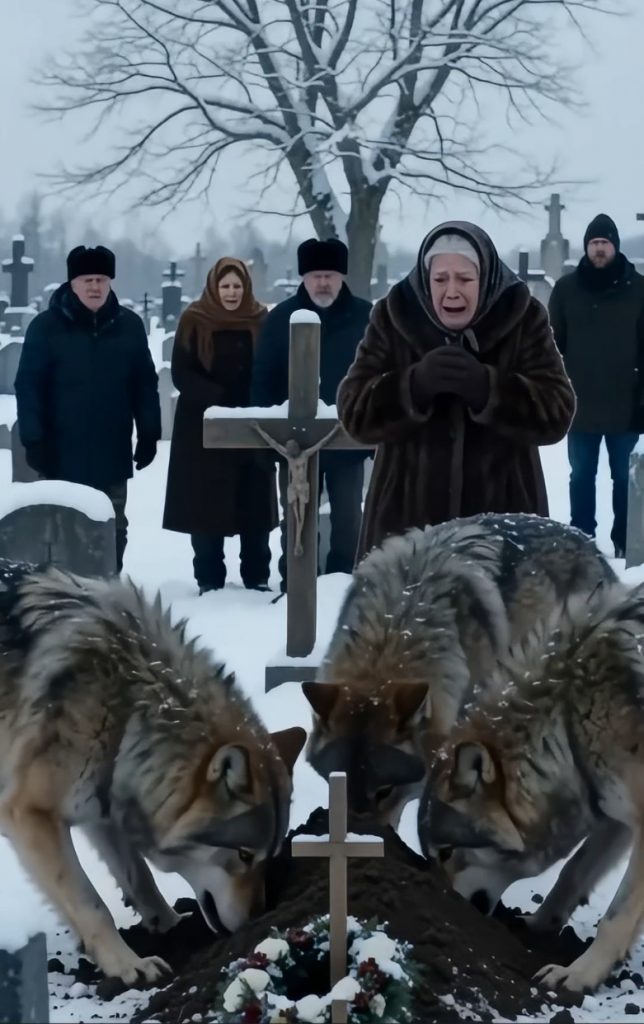
Three of them moved through the snow like shadows given teeth, their gray-brown coats dusted white, their breath smoking in the frozen air. At first, the mourners thought they were seeing ghosts between the headstones.
Then the first wolf stepped onto the fresh grave and began to dig.
The old woman screamed.
“What are they doing?”
Her voice cracked across the cemetery, raw with grief and terror. She clutched both hands to her chest as dark soil flew into the snow. The grave was new, the mound still loose, the wooden cross still straight. A wreath hung from it, green branches stiff with frost.
The name carved into the temporary marker read:
ANNA MOROZ
1991–2026
Beloved Daughter. Beloved Wife. Beloved Keeper of the Forest.
Her mother, Zoya, had chosen the words herself through tears she could barely swallow.
Now three wolves were tearing into the earth above her daughter.
“Stop them!” Zoya cried. “Somebody stop them!”
No one moved.
The mourners stood frozen in their black coats, breath rising from their mouths, faces twisted with horror. A younger woman in a gray scarf covered her mouth. An old man near the bare tree crossed himself over and over. Somewhere behind them, someone whispered that this was a curse.
Mikhail Moroz, Anna’s husband, stepped forward.
He wore a dark blue winter jacket, camouflage trousers, and a black fur hat pulled low over his forehead. His left arm was wrapped protectively around Katya, Anna’s younger sister, who stood rigid beside him, gloved hands pressed together at her chest.
Mikhail’s face was tight with anger.
“Stop,” he shouted at the wolves. “Enough!”
The wolves ignored him.
Their paws struck the grave with furious purpose. Dark, wet earth scattered across the snow. One of them lowered its head into the hole and growled, not at the mourners, but at something beneath the soil.
Zoya stumbled forward.
Two women grabbed her arms before she could reach the grave.
“My child,” she sobbed. “My Anna…”
Mikhail looked toward the men in the crowd. “Get them away!”
But still, no one dared approach.
These were not village dogs. They were wild, powerful, scarred by winter and hunger. Their shoulders rolled under thick fur. Their claws cut through the loose dirt as if the grave were not sacred earth, but a door they had been ordered to open.
Then one wolf stopped digging.
It raised its head.
Something hung from its jaws.
Not cloth.
Not bone.
A red scarf.
Katya made a small, broken sound.
Zoya went silent.
Everyone in the cemetery knew that scarf. Anna had worn it every winter since she was eighteen, bright red against the snow, tied around her neck whenever she walked into the forest.
But Anna had not been buried with it.
Mikhail had insisted the scarf was lost the day she died.
The wolf dropped it onto the snow at Zoya’s feet.
And wrapped inside the frozen fabric was a key.
Act II
Anna Moroz had never been afraid of wolves.
That was what people said after she died, as if courage explained tragedy cleanly. As if loving wild things meant accepting that one day they might drag you into silence.
But Anna had not loved wolves foolishly.
She had studied them. Tracked them. Treated their wounds. Learned their paths through the birch forest north of the village. She knew which pack had pups, which male limped after an old snare injury, which den flooded during spring thaw.
She had built a small rescue station at the edge of the woods with grant money, stubbornness, and help from no one who wanted credit.
The village mocked her at first.
They called it Anna’s Wolf Church.
She did not mind.
Every morning, she carried feed, medicine, notebooks, and her red scarf into the trees. Every evening, she returned with snow on her boots and quiet in her eyes. Children loved her. Hunters distrusted her. Officials tolerated her because tourists liked stories about conservation, as long as those stories did not interfere with logging contracts.
Then Anna found the pits.
Not natural pits.
Not old traps.
Fresh ones.
Deep holes covered with branches and snow, baited with meat, lined with wire. Illegal capture pits set along the wolf trails. At first, she thought poachers were taking pelts. Then she found something worse: crates with sedative vials, transport tags, and foreign shipping labels hidden in an abandoned forestry shed.
Someone was capturing wolves alive.
Selling them.
And the paperwork pointed toward men with uniforms, permits, and enough power to make complaints vanish.
Anna started taking photographs.
She stopped telling people where she walked.
She began locking her field notebooks in a metal box beneath her rescue station floor.
Only one person knew about the box.
Her sister, Katya.
And only one person had asked too many questions about what was inside it.
Mikhail.
He had not always seemed dangerous. When Anna married him, Zoya tried to believe he was simply serious. A practical man. A former forestry inspector with strong hands, a quiet voice, and the kind of smile that appeared only when others were watching.
Anna said he understood her work.
Zoya wondered if he understood Anna at all.
In the final month of her life, Anna changed.
She stopped sleeping. She brought her notebooks home and then took them away again before dawn. She hugged her mother too tightly. Once, while washing cups in Zoya’s kitchen, she whispered, “If anything happens, don’t believe the first story.”
“What story?” Zoya asked.
Anna looked toward the window, where Mikhail waited in the truck outside.
“The one they’re already preparing.”
Three days later, Anna vanished in the forest.
By dusk, men from the village found blood on the snow, torn fabric, and wolf tracks scattered everywhere. Mikhail identified the scarf. The forestry office declared it a wild animal incident. The coffin was sealed.
No viewing.
No questions.
Mikhail said it was kinder that way.
Zoya had been too shattered to fight him.
But Katya fought.
She told anyone who would listen that Anna’s wolves would never attack her. That the tracks looked wrong. That her sister had found something. That the coffin was too quickly arranged and too heavily guarded by Mikhail’s friends.
People pitied her.
Grief, they said, makes patterns where none exist.
Then the wolves came to the funeral.
And now one of them had dropped Anna’s red scarf at Zoya’s feet with a key wrapped inside it.
Katya stepped toward the scarf, trembling.
Mikhail grabbed her wrist.
“Leave it.”
The word came too quickly.
Too sharply.
Every mourner turned toward him.
Katya looked down at his hand on her wrist, then slowly up at his face.
For the first time since Anna’s death, fear left her eyes.
In its place came recognition.
“You knew,” she whispered.
Mikhail released her.
But the wolves had already begun digging again.
Act III
The oldest wolf reached the coffin first.
Its claws struck wood with a dull scrape that made the mourners recoil. Zoya closed her eyes, but Katya kept hers open. She had spent too many nights imagining the truth to look away when it finally clawed toward daylight.
The coffin lid appeared beneath the broken soil.
The wolves backed away.
Not far.
Just enough.
As if they had done their part.
The priest murmured a prayer under his breath. The funeral director looked like he might faint. Mikhail stepped forward, his face flushed with fury.
“This has gone far enough,” he said. “Cover it.”
No one obeyed.
The silence that followed was worse than refusal.
Katya bent and picked up the red scarf. The key inside was small, brass, and marked with a strip of blue tape. She recognized it instantly.
Anna’s rescue station key.
The one Mikhail claimed had been lost.
Zoya reached for Katya’s arm. “What does it open?”
Katya looked at Mikhail.
“Everything.”
Mikhail’s jaw tightened. “Your sister is dead. Let her rest.”
Katya’s voice shook. “You never let her rest.”
The youngest wolf suddenly growled.
Not at the coffin.
At Mikhail.
A low, warning sound that rolled across the snow and turned every spine stiff.
Mikhail took one step back.
The coffin shifted slightly in the exposed earth.
Too light.
The pallbearers noticed it before anyone else. They had carried it that morning with solemn effort, but now, seeing it half-uncovered, seeing the way it moved when the ground loosened, their faces changed.
One of them whispered, “It’s not heavy enough.”
Zoya heard him.
Her grief-stricken face went still.
“What did you say?”
The man swallowed. “When we carried it, I thought… I thought it was strange. But Mr. Moroz said the body was prepared differently because of the accident.”
Katya turned on Mikhail. “Open it.”
“No.”
The single word fell into the cemetery like a stone.
Zoya stepped toward him.
She was old, bent by winter and mourning, but something in her rose with terrifying force.
“I gave birth to her,” she said. “Open it.”
Mikhail looked around the crowd, searching for allies.
He found none.
The funeral director moved first. Perhaps from guilt. Perhaps fear. Perhaps because the wolves stood watching with yellow eyes, and even cowardly men understand when nature has become a witness.
With shaking hands, he cleared the latches.
The lid opened.
Zoya made no sound.
Katya staggered backward.
The coffin did not hold Anna.
Inside lay stones, folded blankets, and a sealed plastic evidence bag containing a strip of torn coat fabric stained dark and stiff from the cold.
No daughter.
No wife.
No body.
Just a performance buried beneath holy words.
The cemetery erupted.
Some mourners cried out. Others cursed. The priest crossed himself, face gray with shock. The wolves stood in the snow, ears forward, silent now.
Mikhail turned to run.
The middle-aged men nearest him grabbed his arms before he reached the path.
He struggled once, then stopped when the oldest wolf stepped closer.
Katya held up the key.
“The rescue station,” she said. “Anna kept records there.”
Zoya looked at the empty coffin.
Then at Mikhail.
Her voice came out quieter than snow.
“Where is my child?”
Mikhail did not answer.
But deep in the forest beyond the cemetery, a fourth wolf began to howl.
Act IV
They found Anna’s rescue station before dusk.
Not because Mikhail helped.
He said nothing after the empty coffin was opened. He sat in the back of the village police truck with mud on his cuffs and hatred in his eyes while the local chief pretended not to be shaken by what everyone had seen.
Katya led the way through the trees with Zoya beside her, refusing every offer to stay behind.
The wolves went first.
That was what no one could explain later. They did not flee once the grave was opened. They moved toward the forest, then stopped and looked back as if waiting for the humans to become useful.
So they followed.
Snow fell lightly through the birches. The rescue station appeared between the trees, a low wooden building with a green roof and a hand-painted sign half-covered in frost.
MOROZ WILDLIFE CARE
The door was locked.
The brass key fit.
Inside, the air smelled of hay, antiseptic, and cold ashes. Cages lined one wall, empty now. Medical supplies sat neatly on shelves. Anna’s handwriting covered labels, charts, feeding logs, maps.
Katya went straight to the floorboard beneath the medicine cabinet.
She lifted it with a screwdriver.
The metal box was still there.
Inside were notebooks, memory cards, photographs, and a letter addressed to Zoya and Katya.
Zoya held the envelope for a long moment before opening it.
Her daughter’s handwriting blurred through her tears.
Mama. Katya. If you are reading this, Mikhail has either failed to scare me or succeeded in silencing me.
Zoya pressed the page to her chest, then forced herself to continue.
Anna had discovered that Mikhail was not merely aware of the wolf trafficking. He was helping organize it. He used his old forestry contacts to mark patrol routes, falsify animal attack reports, and move crates through inspection points. The operation involved officials, traders, and men from outside the region.
But Anna had also discovered a second crime.
The wolves were not the final product.
They were cover.
The illegal routes through the forest were being used to move stolen medical supplies, forged documents, and cash across the border. The wolves gave the men a frightening story to explain noise, tracks, and locked sheds.
Anna had planned to meet a regional investigator the morning she disappeared.
She never arrived.
Katya inserted one of the memory cards into a battered laptop on Anna’s desk.
The first video showed Mikhail in the forestry shed at night, speaking to two men beside covered crates.
The second showed license plates.
The third showed Anna herself, face pale, red scarf wrapped around her neck, whispering into the camera.
“If I vanish, the wolves will know the way back.”
Katya covered her mouth.
Anna continued on the screen.
“I left the scarf with Bor, because he follows scent better than any man follows truth. If they fake my burial, he’ll find what they try to bury. If they hide me…”
The video froze for a second, then resumed.
Anna looked off-camera, startled by a sound outside.
“If they hide me, check the old ranger cellar under Station Three.”
The room went still.
The police chief swore softly.
Mikhail had told everyone Station Three burned years ago.
He had lied.
They moved fast then.
The rescue station files were copied and sent to regional authorities before anyone could interfere. Two officers stayed with Zoya and Katya. The rest drove toward the abandoned ranger outpost at the edge of the ravine.
The wolves followed through the trees.
Station Three was half-collapsed, its roof sagging under snow. Beneath it, hidden by brush and a rusted hatch, was a cellar.
Inside, they found blankets.
A lantern.
A bowl.
And carved into the wooden wall with what looked like a nail were three words:
I AM ALIVE.
Zoya fell to her knees.
Not in defeat.
In shock so powerful it became prayer.
Then, from behind the far wall, they heard a faint knock.
Act V
Anna was alive.
Weak. Cold. Feverish. Hidden in a narrow storage space behind a false panel where the old ranger cellar met the stone foundation. She had survived on water from a cracked pipe and scraps left by someone too frightened to kill her but too trapped to free her.
That person, investigators later learned, was one of Mikhail’s younger accomplices.
He had believed the plan was only to scare Anna, destroy her records, and force her to disappear. When Mikhail ordered the fake funeral, the young man panicked. He left food when he could. He left the pipe loose. He did not become innocent by being less cruel than the others, but he became useful when guilt finally found a voice.
Anna barely opened her eyes when they carried her out into the snow.
Zoya ran to her, sobbing so hard no words came.
Anna’s lips moved.
At first, no one understood.
Then Katya leaned close.
“Bor,” Anna whispered.
The oldest wolf stood at the tree line.
Massive. Still. Snow caught in the fur along his shoulders.
Anna lifted one trembling hand.
The wolf lowered his head.
Not close enough to frighten the rescuers. Close enough for Anna to see him.
“You found it,” she breathed.
Bor blinked slowly, as if that had never been in doubt.
The story broke open by morning.
The empty coffin. The wolves. The hidden rescue station files. The cellar. The wife who was supposed to become a sealed grave before she could testify.
Mikhail Moroz was arrested before sunrise. So were two forestry officials, a transport contractor, and several men who had stood at Anna’s funeral pretending to mourn a woman they knew had not been buried.
The village did not recover quickly.
Places built on silence rarely do.
People had to remember their own fear. Their own suspicion. Their own willingness to accept the cleanest version of a woman’s death because the truth would have demanded courage from them.
Zoya remembered too.
She remembered screaming at the wolves. Begging someone to stop them. Thinking they were desecrating her daughter’s grave when they were the only ones refusing to let the lie stay buried.
When Anna woke properly in the hospital two days later, her mother sat beside her bed, holding the red scarf.
“I thought they were hurting you,” Zoya said.
Anna’s voice was thin but steady. “They were bringing me home.”
Katya turned toward the window so no one would see her cry.
Weeks passed before Anna could stand without help. Months passed before she returned to the forest. By then, the rescue station had been repaired, guarded, and renamed in the official reports as a protected evidence site.
Anna hated that.
“It is not an evidence site,” she said. “It is a place where frightened animals learn people are not always monsters.”
Katya smiled. “That sentence may be too long for a sign.”
The first time Anna saw Bor again, it was late afternoon. Snow had begun to melt along the southern edge of the trees. He stood beyond the fence, older than he had looked in winter, one ear torn, eyes bright.
He did not come closer.
He did not need to.
Anna sat on a wooden bench with a blanket over her knees and lifted one hand.
The wolf lowered his head.
That was all.
The village held a second service in spring.
Not a funeral.
A gathering.
The empty grave was filled properly and the wooden cross removed. In its place, the villagers planted a rowan tree. Zoya insisted on placing the wreath there one last time, not for the dead, but for the truth that had nearly been buried alive.
Mikhail’s trial lasted through summer.
The evidence Anna collected was impossible to dismiss. The videos showed too much. The ledgers named too many people. The fake coffin turned public sympathy into fury. But it was the image of the wolves digging through snow that stayed with everyone.
Men with titles had lied.
Animals had refused.
Anna testified in a simple blue dress with her red scarf folded on the table before her. When Mikhail’s attorney suggested she had misunderstood her husband’s involvement, Anna looked at the judge and said, “I understood him too late. That is not the same as misunderstanding.”
No one in the courtroom forgot it.
Mikhail never looked at Zoya.
That suited her.
She had no interest in his shame unless it became useful.
Years later, children in the village would ask about the rowan tree in the cemetery. Their parents would lower their voices and tell them the story of the wolves who opened a grave.
Some versions became too dramatic.
Some made the wolves into spirits.
Some made Anna into a saint.
Anna corrected them when she heard it.
“They were wolves,” she would say. “Not angels. That is better. Angels are expected to save people. Wolves owe us nothing.”
But Bor and his pack remained near the forest edge for many winters after that.
Never tame.
Never owned.
Sometimes, on cold mornings, Zoya would visit the cemetery and find paw prints circling the rowan tree. She would stand there in her dark coat and headscarf, touching the place where her daughter’s name had once marked a lie.
She no longer screamed when she saw the tracks.
She smiled.
Not happily. The memory still hurt too much for happiness.
But with gratitude.
The grave had been empty.
The truth had not.
And on the bleakest winter morning of Zoya’s life, when humans stood frozen by fear, three wolves had dug through the snow, through the soil, through the ceremony, through every lie men had arranged so carefully.
They were not digging for the dead.
They were digging for the living.