Act I
Bob hit the suitcase before anyone understood what was happening.
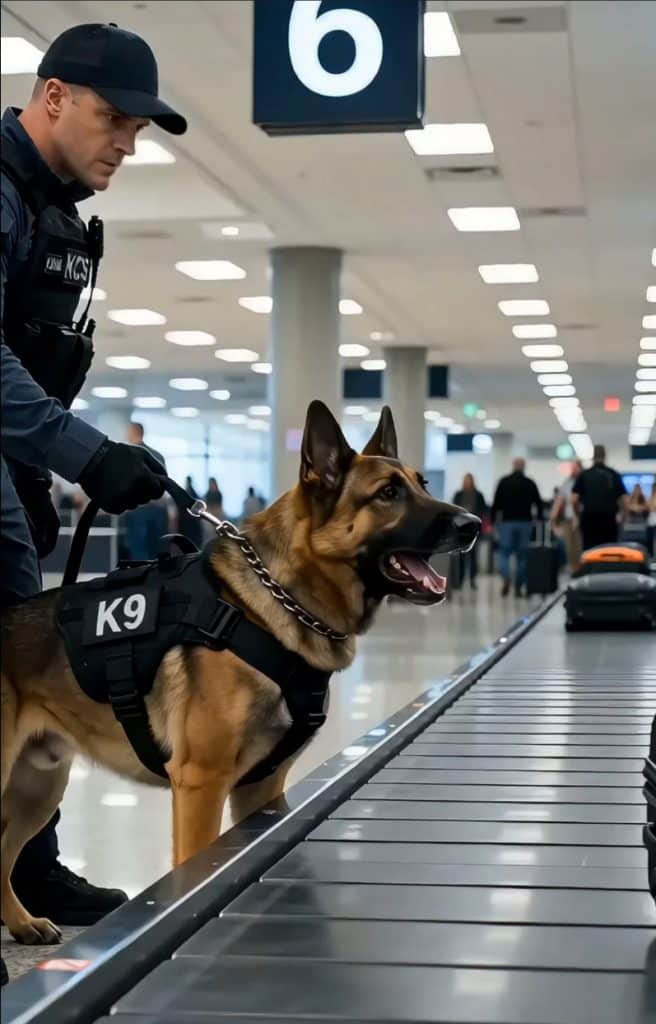
The black hardshell bag was moving slowly along carousel six, squeezed between a red duffel and a silver carry-on. Around it, tired passengers waited under the bright airport lights, checking their phones, rubbing their eyes, pretending baggage claim was not the loneliest place in the world.
Then the German Shepherd exploded.
He barked so hard the sound cracked across the terminal.
Officer Noah Kaimlcek tightened the leash with both hands. “Bob, stop! Enough!”
But Bob did not stop.
The dog lunged forward, front paws striking the moving belt. His black K9 harness pulled tight across his shoulders. His claws scraped the suitcase shell as he pinned it against the rubber slats, barking with a fury that made people stumble backward.
Noah felt the leash burn against his palm.
“Bob!”
The suitcase jerked under the dog’s weight.
Two officers in dark blue uniforms turned from across the baggage area and started moving fast. A woman dropped her coffee. A man dragging a stroller pulled his child behind him. The overhead sign with the number 6 glowed above them like a warning nobody had read in time.
Noah crouched, one knee on the polished floor, and pulled Bob back just enough to reach the zipper.
Bob barked in his ear.
Not a drug alert.
Not explosives.
This was different.
This was the sound Bob made only when something alive was in danger.
Noah grabbed the zipper tab.
“Shut down the belt!” he shouted.
The carousel slowed.
Then stopped.
The officers behind him formed a wall as passengers froze around them.
Noah pulled the zipper.
The teeth parted with a heavy rasp.
At first, he saw only clothes. Folded shirts. A gray jacket. A plastic toiletry bag. Too neat. Too staged.
Bob whined.
Noah shoved the top layer aside.
Underneath was a false panel.
His heartbeat changed.
He ripped it open.
Then he stopped breathing.
Inside the hidden compartment was a little girl.
She was curled on her side, wrapped in a thin blanket, her dark hair stuck to her forehead. Her eyes were closed, but her fingers moved weakly against a stuffed blue rabbit clutched to her chest.
For one impossible second, the whole airport disappeared.
Noah saw only the child.
Then he saw the hospital bracelet on her wrist.
MILA HART. AGE 6.
His mouth fell open.
Because every officer in King County knew that name.
Mila Hart had vanished eleven months earlier from a pediatric clinic while her mother was signing discharge papers. Her case had been on every screen, every patrol briefing, every missing-child poster in the city.
And now she was breathing inside a suitcase at carousel six.
Noah’s voice came out rough.
“Medic. Now.”
Bob lowered his head beside the suitcase and stopped barking.
He rested his nose near the child’s hand.
Mila’s fingers twitched once and touched his fur.
Then she whispered one word.
“Ellie.”
Noah froze.
Ellie was not in the missing poster.
Ellie was his daughter.
Act II
Noah had not heard his daughter’s name spoken by a stranger in two years.
Not since the night his marriage broke apart under the weight of fear, silence, and one unsolved case that followed him home like a shadow.
Ellie Kaimlcek had been five when she disappeared.
No crowded park. No dark alley. No dramatic scene anyone could explain afterward. She vanished from the back hallway of a children’s charity gala where Noah had been working security off-duty. His wife, Hannah, had turned away for less than a minute to answer a call from her mother.
When she turned back, Ellie was gone.
The cameras in that hallway failed for seventy-three seconds.
Seventy-three seconds.
Noah had counted them so many times they became a number carved into his skull.
There were searches. Interviews. Alerts. Helicopters. Dogs. Divers. Anonymous tips. False sightings. Hope that rose just high enough to hurt worse when it fell.
Nothing.
After six months, people began using softer voices around him.
After a year, they stopped asking.
Hannah left because staying in the same house with Ellie’s untouched bedroom was killing her. Noah did not blame her. He had wanted to leave too. He simply did not know how to abandon the last place his daughter had laughed.
Bob came into his life after that.
The German Shepherd had been reassigned from a federal search unit after an injury ended his field deployment. He was stubborn, too intense for routine patrol work, and famous among trainers for refusing to release a scent until someone listened.
Noah understood him immediately.
A dog that could not let go of the missing.
A man who had forgotten how.
Together, they became sharp. Efficient. Quiet. Noah worked airport interdiction because movement comforted him. Bags came and went. People arrived and left. Every face had a destination. Every suitcase had a tag.
And every once in a while, Bob stopped the world.
But nothing like this.
Mila Hart was lifted carefully from the suitcase and placed on a stretcher. She was alive, weak, and disoriented, but alive. The paramedics moved fast, shielding her from the crowd while officers locked down the baggage area.
Noah stayed beside her until a medic told him to step back.
Bob refused to move.
“Sir,” the medic said gently, “your dog—”
“He stays,” Noah said.
The medic looked at Bob, then at Mila’s small hand resting against his harness.
She did not argue.
Noah’s supervisor arrived within minutes. Airport police sealed the carousel. Detectives took control of the bag. Passengers were moved away, questioned, separated. Every camera angle from the terminal began downloading.
Then Mila opened her eyes.
Noah leaned close.
“Mila, I’m Officer Kaimlcek. You’re safe.”
Her gaze moved slowly to his face.
She looked confused.
Then frightened.
Then certain.
“Ellie said Bob would find me.”
Noah felt the floor tilt beneath him.
His supervisor touched his shoulder. “Noah.”
But Noah could not move.
He had not told Mila his dog’s name.
And Ellie had never met Bob.
Act III
The suitcase tag belonged to a man named Adrian Vale.
Business class passenger. One-way ticket to Zurich. No checked baggage declared at departure, according to the system, even though the suitcase had somehow entered the carousel from an international transfer belt.
That was the first lie.
The second was waiting in security footage.
At 9:42 p.m., a uniformed airport baggage technician pushed the black suitcase through a service corridor. His badge belonged to someone else. His face was half-hidden beneath a cap. He moved like a man who knew where every camera was supposed to point.
But he did not know about Bob.
Bob had caught the scent before the bag completed one full loop.
In an interview room near the airport police office, Mila sat wrapped in a warm blanket, sipping water through a straw. A child advocate knelt beside her. Noah stood behind the glass, hands clenched so tightly his knuckles ached.
Detective Ruth Bell arrived just before midnight.
She had worked Ellie’s case.
She looked older now. So did Noah. Grief had a way of aging everyone assigned to a missing child.
“What did she say?” Ruth asked.
Noah stared through the glass. “She knows Ellie.”
Ruth said nothing for a moment.
Then she opened a file and slid a photograph across the table.
It was a still frame taken from Mila’s initial medical check.
The stuffed blue rabbit.
Noah knew it before Ruth spoke.
Ellie had owned one just like it.
Same stitched ear. Same faded ribbon. Same tiny black button eyes.
Noah’s throat closed.
“That could be common,” he said.
Ruth’s expression told him she had already checked.
“It was handmade,” she said quietly. “Your wife ordered it from a craft seller after Ellie was born. Only two were made. One for Ellie. One replacement, never delivered because the seller died before shipping it.”
Noah looked back at Mila.
The girl held the rabbit against her chest like it was the only solid thing left in the world.
Ruth continued. “There’s something inside it.”
The toy had been scanned but not opened in front of Mila. When the child advocate finally persuaded her to let go for just a few seconds, the officers found a seam in the rabbit’s back.
Inside was a folded strip of cloth.
And a memory card.
The cloth was pink.
Noah recognized it immediately.
A piece of Ellie’s winter scarf.
The one she had been wearing the night she vanished.
Noah sat down before his legs failed him.
The memory card held three video files.
The first showed Mila in a small room with painted walls and no windows. She was younger, frightened, but unharmed. Another child sat beside her, facing away from the camera.
The second showed documents laid out on a table: passports, adoption papers, clinic records, donor lists, transportation schedules.
The third video began with a girl whispering into the camera.
Noah’s heart stopped.
Ellie.
Older now. Thinner. Hair longer. Eyes sharper. Alive.
“Dad,” she said, voice trembling but clear, “if Bob found this, it means the plan worked.”
Noah made a sound that was not a word.
Ruth covered her mouth.
On the screen, Ellie glanced toward a door.
“They move kids through airports in suitcases when they’re small, wheelchairs when they’re weak, and fake family groups when they can pass. Mila is going tonight. I hid the card in Rabbit. I told her to say Bob because I heard them talk about you. They said you work K9 at the airport now.”
Her voice broke, but she forced herself to continue.
“They said you stopped looking.”
Noah bent forward as if struck.
Ellie shook her head at the camera.
“I know you didn’t.”
Act IV
The room became command.
Noah was removed from active decision-making because he was too close to the case. He did not argue, because a part of him understood procedure still mattered. Another part wanted to tear the airport apart with his bare hands.
Bob stayed with him.
The dog pressed against Noah’s leg as the video continued.
Ellie named a charity.
Bright Harbor Children’s Relief.
The same charity gala where she disappeared.
The organization had built its reputation helping sick children, displaced families, and international adoption networks. It had smiling billboards, celebrity donors, and board members who spoke beautifully about hope.
Hope had been their disguise.
The files on the memory card showed something colder: forged guardianship transfers, false medical transport orders, bribed clinic staff, airport access codes, and private donors paying to move children across borders under invented identities.
Mila Hart had not been random.
Her mother had reported irregularities at the pediatric clinic where she worked. Days later, Mila vanished. The official theory was a stranger abduction.
It was never a stranger.
It was a system.
At 12:41 a.m., airport security identified the fake baggage technician entering a restricted lounge.
At 12:48, officers detained him before he reached a service exit.
His real name was Colin Mercer.
Former Bright Harbor logistics coordinator.
Inside his phone were messages from someone saved only as A.V.
Adrian Vale.
The passenger attached to the suitcase tag.
Vale had not boarded.
He was still in the airport.
At 1:03 a.m., Bob lifted his head.
No one had said anything. No alarm sounded. No one moved toward the door.
But Bob stood.
Noah felt the leash tighten.
“What is it?” Ruth asked.
Bob stared down the corridor, ears forward.
Then he barked once.
Not frantic now.
Certain.
Noah looked at Ruth.
She hesitated for half a second, then unclipped the leash from the chair.
“Follow him.”
They moved through the airport’s service corridors with four officers behind them. Bob led hard, nose low, body focused. Past customs storage. Past a staff break room. Past a locked door marked MAINTENANCE.
Then he stopped in front of a private medical lounge used for high-profile passengers.
Inside, a man in a charcoal coat stood beside a teenage girl in a wheelchair.
The girl’s head was bowed beneath a knit cap.
A blanket covered her lap.
The man looked up as the officers entered.
Calm. Annoyed. Polished.
“I’m sorry,” he said. “This is a private medical transfer.”
Bob growled.
Noah did not look at the man.
He looked at the girl.
Her fingers were curled around the edge of the blanket. On her wrist was a faded pink thread bracelet, the kind children make with clumsy knots and enormous pride.
Noah knew that bracelet.
He had worn its twin for six months after Ellie disappeared, until the thread broke in the shower and he sobbed on the bathroom floor like something inside him had finally given way.
His voice came out as a whisper.
“Ellie?”
The girl lifted her head.
For one second, she looked at him as if faces from old dreams could not be trusted.
Then her mouth trembled.
“Dad?”
Noah crossed the room before anyone could stop him.
He dropped to his knees in front of the wheelchair, not touching her at first, afraid she might vanish if he moved too quickly.
Ellie reached for him.
Then she was in his arms.
Alive.
Real.
Shaking.
Bob pushed between them, whining, tail low, pressing his head into Ellie’s side as if he had been searching for her all his life too.
Adrian Vale stepped backward.
Ruth blocked the door.
“Going somewhere?”
His polished expression cracked.
For the first time that night, the men behind Bright Harbor began to understand that the airport was no longer theirs.
Act V
By sunrise, the terminal had changed.
Passengers still arrived. Bags still circled. Coffee still burned in paper cups. Announcements still echoed from the ceiling as if ordinary life had not been interrupted by a suitcase, a dog, and a child brave enough to hide the truth in a stuffed rabbit.
But behind the public noise, an empire was collapsing.
Adrian Vale was arrested before dawn. Colin Mercer began talking before breakfast. Bright Harbor’s offices were raided in three states. Clinic directors, airport contractors, donor intermediaries, and legal coordinators were pulled into the investigation one by one.
Some claimed they thought the paperwork was legitimate.
Some claimed they were only following procedure.
Some cried.
None of that mattered to Noah when he sat beside Ellie’s hospital bed and watched her sleep.
She was twelve now.
Not five.
Twelve.
Time had moved through her without him. It had changed her face, lengthened her hands, sharpened her cheekbones. She had scars no doctor could see and habits no child should have needed to learn: counting exits, listening before speaking, hiding food, trusting dogs faster than humans.
Hannah arrived at the hospital at 7:16 a.m.
Noah saw her in the doorway and stood.
For a moment, they were two people broken by the same missing child, unsure how to stand in the same miracle.
Then Ellie opened her eyes.
“Mom?”
Hannah crossed the room with a sound that came from somewhere deeper than speech.
The reunion was not clean. Nothing that painful ever is. There were tears, apologies, shock, questions no one could answer yet. Ellie clung to both of them, and Bob settled on the floor beside the bed with his head on his paws, refusing to sleep until everyone he had found remained in sight.
Mila Hart survived too.
Her mother arrived later that morning, nearly collapsing when she saw her daughter alive. Mila asked for the blue rabbit as soon as she woke. When officers explained that it had helped save other children, she nodded seriously and said Ellie told her Rabbit was brave.
Noah stepped into the hallway then.
He pressed one hand against the wall and cried where no one but Ruth could see him.
“You didn’t stop looking,” she said.
Noah wiped his face. “Bob didn’t.”
Ruth glanced through the window at the German Shepherd sleeping beside Ellie’s bed.
“Good thing he’s better at this than all of us.”
Weeks later, Ellie gave her full statement with Bob lying at her feet. She told investigators how older children protected younger ones. How names were changed. How fear was used. How she overheard travel plans and waited for the one airport where she knew her father might be.
She had seen Noah on a news clip months earlier, standing with Bob after a routine K9 inspection.
That was how she knew.
That was why she taught Mila the name.
Bob.
Say Bob when they open the suitcase.
He’ll understand.
And somehow, impossibly, he had.
The case went public slowly at first, then all at once. The suitcase at carousel six became a symbol before anyone was ready for it. People argued about security, charity oversight, airport access, private adoption networks, and how evil often survives by wearing respectable clothes.
Noah did not watch much of the coverage.
He was learning his daughter again.
Her favorite breakfast had changed. She hated being surprised from behind. She still remembered the lullaby Hannah used to sing, but pretended she didn’t until one night Hannah hummed it from the kitchen and Ellie began crying into Bob’s fur.
Healing did not arrive like a happy ending.
It arrived in fragments.
A door left open.
A full night of sleep.
A laugh that startled everyone.
A trip to the grocery store where Ellie made it through the whole cereal aisle without panic.
Mila visited once, holding Rabbit in both arms. She and Ellie sat on the hospital lawn while Bob watched them from the shade. They did not talk much. Children who survive impossible things do not always need words to recognize each other.
Months later, a small plaque was installed near carousel six.
Not large. Not dramatic.
Just a simple marker beside the baggage claim wall:
IN HONOR OF THE CHILDREN WHO WERE FOUND,
THE ONES STILL BEING SEARCHED FOR,
AND K9 BOB, WHO REFUSED TO LET A SUITCASE PASS.
Noah stood before it with Ellie on one side and Hannah on the other.
Bob sat proudly at his feet, harness shining under the airport lights.
The carousel hummed nearby.
Bags moved in an endless loop, ordinary and harmless again to everyone else. But Noah knew he would never hear that sound the same way. He would always remember the black suitcase, Bob’s paws pinning it down, the zipper opening, Mila’s weak whisper.
Ellie reached for his hand.
He held it carefully, as if learning the shape of a miracle.
“Dad,” she said.
He looked down.
“Yeah?”
She nodded toward Bob. “He found us.”
Noah swallowed hard.
“Yes,” he said. “He did.”
Bob leaned against Noah’s leg, tail thumping once against the polished floor.
All around them, travelers rushed past with tickets, coffee, backpacks, children, complaints, reunions, ordinary worries.
Most did not stop at the plaque.
Most never knew what had happened there.
That was all right.
Some stories do not need every passerby to understand them.
They only need the truth to stay visible.
And every time carousel six began to move, Noah remembered the night a dog heard what everyone else missed, stopped a suitcase in the middle of an airport, and brought the missing home.