Act I
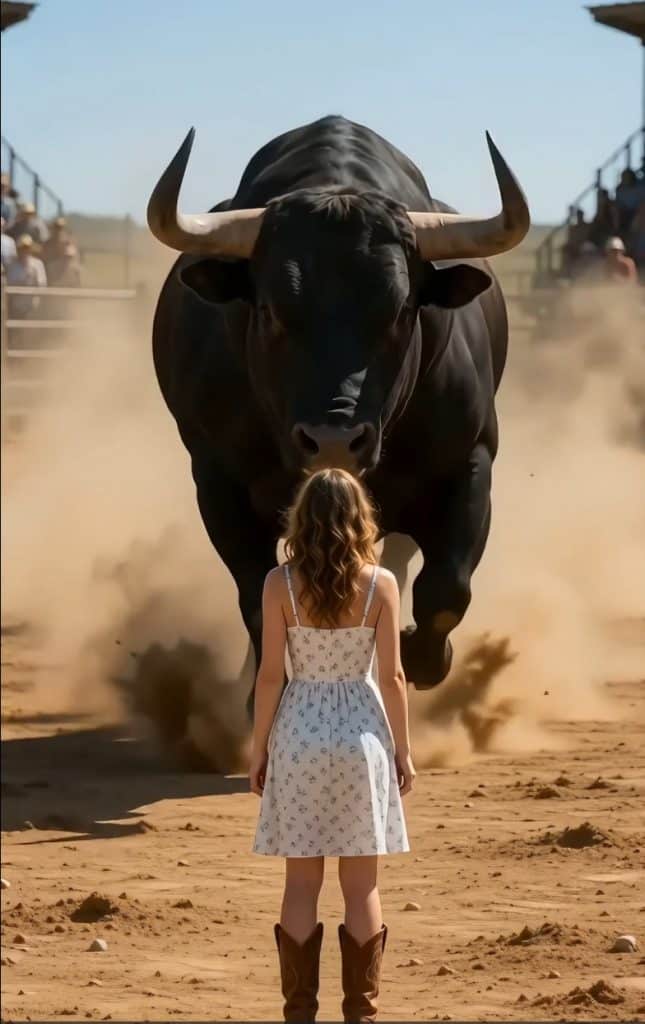
The bull came at her like a storm with horns.
Dust rose beneath its hooves in violent bursts, turning the bright arena into a blur of brown sand and white sunlight. The spectators behind the wooden fence leaned back as one, some shielding their eyes, others too horrified to move.
In the center of the ring stood a young woman in a white sundress.
Blue flowers climbed the thin fabric like something too delicate for a place built on cruelty.
Her name was Clara Reyes.
Her hands hung at her sides. Her brown cowgirl boots were planted in the dirt. Her dark hair blew across her face as the black bull lowered its head and charged straight toward her.
Behind the fence, an elderly man in a gray suit whispered, “Poor girl.”
Beside him, a woman covered her mouth with both hands.
On the raised wooden platform above the ring, Victor Drayton laughed.
He sat in a tufted brown leather armchair as if the arena were his private theater. His black suit was spotless. His sunglasses reflected the ring below. A cigar burned between his fingers, smoke curling lazily into the air while five bodyguards in matching black suits stood behind him, weapons held low but ready.
Victor did not look frightened.
He looked entertained.
The bull’s hooves hammered closer.
Clara’s breath caught in her throat.
The animal was enormous, glossy black, with a white star stamped on its forehead and horns wide enough to turn a human body into a warning. Its nostrils flared. Its shoulders rolled under its hide. Every muscle seemed built for impact.
“Run!” someone screamed.
Clara did not run.
Victor leaned forward, grinning.
“That’s it,” he murmured. “Stand there and make it beautiful.”
Clara heard him, even over the thunder of the bull.
She had heard his voice in courtrooms, in banks, in the funeral home, in the hallway outside her father’s hospital room. Always calm. Always certain. Always wrapped around the same message.
Give me what I want, and this ends.
The bull closed the final distance.
Its horns dipped.
Clara’s face twisted with terror, but her feet stayed where they were.
Then, at the very last second, she lifted one trembling hand.
Not to protect herself.
To show the bull the blue flowers on her dress.
And the entire arena held its breath.
Act II
Three years earlier, that bull had slept with his head in Clara’s lap.
He had been a calf then, all legs and stubbornness, born during a spring storm that flooded half the lower pasture. Clara’s father, Mateo Reyes, found him tangled near the creek bed, shivering beneath a fallen fence rail.
The mother cow would not come near him.
The ranch hands said he would not make it.
Mateo carried him into the barn anyway.
Clara was seventeen and furious at the world in the ordinary way teenagers are before life gives them real reasons. She sat beside the calf all night with a blanket across her knees, feeding him from a bottle and whispering nonsense whenever thunder cracked over the roof.
By morning, the calf had stopped shaking.
By noon, he had tried to bite her sleeve.
Mateo laughed so hard he cried.
“Name him something grand,” he said. “He clearly thinks he owns us.”
Clara named him Atlas.
Because even as a calf, he looked like he was carrying the world on his back.
Atlas grew into a legend on Reyes land. He was too large, too smart, too aware of people. He would not let strangers rush him. He would not tolerate shouting. But with Clara, he lowered his head like a child asking for a secret.
She wore blue flowers often back then.
Her mother’s old sundresses hung in a cedar wardrobe, soft from years of washing and sun. After Clara’s mother died, those dresses became a kind of prayer. When Clara wore them, Mateo would go quiet for a moment, then smile with an ache he tried to hide.
Atlas learned the pattern.
Blue flowers meant Clara.
Blue flowers meant safety.
Blue flowers meant the girl with warm hands and a voice that never struck.
Then Victor Drayton arrived.
He did not come in boots. He came in polished shoes, with survey maps and lawyers and a smile that never reached his eyes. He wanted Reyes Ranch. Not for cattle. Not for horses. Not for anything that grew from the soil.
There was mineral money beneath the land.
The kind that made men stop seeing pastures and start seeing numbers.
Mateo refused him.
Victor returned with a better offer.
Mateo refused again.
Then came pressure.
The bank suddenly questioned old loans. Feed suppliers delayed deliveries. A county inspector found problems no one had noticed before. Men in dark vehicles parked near the gates at night.
Mateo still refused.
“This land is not for sale,” he told Clara. “And neither are we.”
Two months later, he was dead.
The official report called it heart failure.
Clara believed that for exactly one day.
Then she found the bruises on the office door where someone had forced it open, the missing pages from her father’s ledger, and the envelope tucked behind a loose brick in the barn.
Inside was a copy of the true deed.
Mateo had never owned the ranch alone.
Half of it had belonged to Clara’s mother.
And when she died, her half passed to Clara.
Victor could buy bankers, frighten officials, and pressure grieving widows.
But he could not take Clara’s signature.
So he created a spectacle.
He called it a private rodeo charity event. He invited half the county, then surrounded the arena with armed men and locked Clara inside the ring. He told everyone she had agreed to a “test of courage” before accepting his settlement.
No one believed him.
No one challenged him either.
That was Victor’s real talent.
He made decent people feel alone.
But Clara had not come to the arena empty.
Under the blue-flowered dress, tucked against her ribs, was the deed her father had hidden.
And inside the ring was Atlas.
Only Victor did not know the bull he had released was not a monster.
He was a witness.
Act III
Atlas stopped so close that dust hit Clara’s dress.
His horns hovered inches from her waist.
The sound that came from the crowd was not a cheer. It was one stunned, broken breath from hundreds of people realizing the impossible had happened.
The bull did not strike.
He stared at Clara.
His nostrils flared. His sides heaved. His ears twitched forward.
Clara’s hand shook in the air between them.
“Atlas,” she whispered.
The bull tossed his head once, agitated, confused, fighting whatever fear or pain had been driven into him before the gate opened.
Clara saw it then.
A raw mark near his neck where a rope had been pulled too tight. Foam drying at the corner of his mouth. The wildness in his eyes was not rage. It was panic.
Someone had hurt him.
Someone had made sure he entered that arena terrified.
Victor’s smile began to fade.
Behind him, one bodyguard shifted.
Clara took one slow step forward.
Atlas snorted, and the spectators flinched, but Clara did not. Tears filled her eyes as she lowered her hand to his muzzle.
“Easy,” she said. “It’s me.”
The bull’s breathing changed.
Not calm.
Not yet.
But the thunder inside him faltered.
His massive head dipped slightly.
The crowd went silent.
Clara touched the white star on his forehead.
The same mark she had kissed when he was a calf too weak to stand.
A sound rose from Atlas’s chest. Low. Rough. Almost grieving.
Clara leaned her forehead against his.
The arena erupted.
Not in applause, but in shock.
People stood. Some cried out her name. Others turned toward Victor’s platform, their fear beginning to sharpen into outrage.
Victor rose from his chair.
The cigar fell from his hand onto the wooden boards.
“Get that animal away from her,” he snapped.
No one moved.
He turned to his bodyguards. “Now.”
Clara looked up at him.
For the first time that day, Victor was not laughing.
She reached into the bodice of her dress and pulled out the folded deed.
Victor’s face tightened.
Clara lifted it high enough for the nearest spectators to see.
“My father did not sell this ranch,” she called, her voice shaking but clear. “He hid the deed because he knew Victor Drayton would try to steal it.”
The crowd stirred.
Victor’s expression turned cold.
“You stupid girl.”
The elderly man in the gray suit stepped closer to the fence.
“I was Mateo’s attorney,” he said, voice trembling but loud. “And that is his seal.”
Victor pointed at him.
“Sit down, Harlan.”
But Mr. Harlan did not sit.
He gripped the fence with both hands and looked around at the crowd.
“I wrote that deed,” he said. “And I was told it had been destroyed.”
The woman beside him gasped.
Clara’s throat tightened.
She had thought she was alone.
She had been wrong.
Victor had made everyone afraid separately.
Atlas had made them witness together.
Act IV
Victor lifted one hand.
The bodyguards stepped forward behind him.
That was enough to turn the crowd’s outrage back into fear. People moved away from the fence. Parents pulled children behind them. The wooden stands creaked as bodies shifted backward.
Victor smiled again, but it was thinner now.
“Enough theater,” he said. “Clara is grieving. She’s confused. That animal is dangerous, and she is endangering every person here.”
Atlas stomped once.
The bodyguards raised their weapons slightly.
Clara’s blood went cold.
“Don’t,” she said.
Victor ignored her.
He looked toward the arena gate. “Put the bull down if he moves.”
The words cut through the dust like a blade.
Atlas sensed the change. His head rose. His body tensed. Clara stepped in front of him without thinking, one hand still pressed to his neck.
“No,” she shouted. “You don’t get to kill him too.”
Too.
The word escaped before she could stop it.
Victor heard it.
So did everyone else.
Mr. Harlan’s face changed.
“Clara,” he called. “What did you find?”
She looked toward the attorney, then toward the crowd, then back at Victor.
And suddenly the fear that had held her all morning cracked.
“My father knew,” she said. “He knew Victor had bribed the bank officer. He knew the inspection reports were false. He knew men had been coming onto our land at night.”
Victor laughed sharply. “Lies.”
Clara unfolded the deed, then removed a second paper hidden inside it.
A letter.
Mateo’s last letter.
Her hands trembled as she read.
If anything happens to me, give this to Harlan. Drayton is not buying land. He is covering theft. The old wells are not dry. He has been extracting under the south ridge through the abandoned claim. He needs our deed to make the crime disappear.
The crowd went completely still.
Victor’s face lost its color.
Mr. Harlan whispered, “My God.”
Clara looked up.
“He wasn’t trying to buy the ranch,” she said. “He was trying to erase what he had already stolen.”
Victor’s mask shattered.
“Take her.”
Two bodyguards moved toward the stairs.
Atlas moved faster.
He did not charge the crowd.
He did not go for Clara.
He turned toward the platform and drove his hooves into the dirt with a bellow that shook the arena.
The bodyguards stopped.
Atlas advanced one step.
Then another.
The platform was raised, but not far. Its wooden supports had been built for spectacle, not for a furious bull who had finally understood where the threat stood.
Victor backed toward his chair.
“Control it!” he screamed.
But nobody in that arena controlled Atlas except the girl in the blue-flowered dress.
And Clara did not tell him to stop.
Not yet.
Atlas slammed his horns into the lower platform rail.
Wood cracked.
The bodyguards scattered, stumbling away from the edge. The chair toppled backward. Victor grabbed the railing, his sunglasses falling into the dust below.
The crowd surged to its feet.
Then the arena gates burst open.
Sheriff’s deputies flooded in from the side entrance, weapons drawn but pointed down, shouting for everyone to stay back.
Mr. Harlan had called them before the event began.
He had not known what Victor planned.
But he had known enough to be afraid.
And fear, this time, had not kept him silent.
Victor tried to run down the rear stairs.
The woman in the beige top pointed.
“There! He’s going!”
Two deputies intercepted him at the bottom.
Victor shouted about lies, trespassing, forged papers, unstable women, dangerous animals. But his voice no longer filled the arena the way it had from the platform.
It sounded small in the open air.
Clara walked to Atlas and placed one hand against his shoulder.
“Easy,” she whispered.
The bull stopped.
Just like that.
The deputies stared.
So did the crowd.
Atlas lowered his great head until his forehead rested lightly against Clara’s chest.
And in front of everyone Victor had invited to watch her break, Clara wrapped both arms around the bull who had refused to become his weapon.
Act V
The investigation did not end in the arena.
It began there.
Deputies searched Victor’s offices before nightfall. By morning, state investigators had arrived. By the end of the week, the south ridge was sealed off and guarded, its old wells inspected, its hidden pipes photographed, its records seized.
Victor Drayton had not only tried to steal Reyes Ranch.
He had already been stealing from beneath it for nearly two years.
The forged reports, the bank pressure, the sudden debts, the threats, even Mateo’s final weeks of fear—all of it fit together now. Not as bad luck. Not as grief making Clara imagine enemies.
As a plan.
A plan that failed because a bull remembered love.
Victor’s lawyers tried to make the story ridiculous.
They called Clara emotional. They called the arena event a misunderstanding. They said Atlas was unpredictable, that the crowd had panicked, that an animal’s behavior could not prove anything.
But the documents proved plenty.
So did the hidden extraction records.
So did the payments.
So did the testimony of men Victor had paid and discarded.
And then there was the video.
Hundreds of people had recorded it.
Victor laughing while Atlas charged.
Victor ordering the bull killed.
Victor commanding his men to take Clara after she read her father’s letter.
The footage spread faster than any lie could catch.
By the time the case reached court, Victor no longer looked like a powerful man wrongfully accused.
He looked like what he was.
A thief who had mistaken fear for ownership.
Clara testified in the same white dress.
Not because it was easy to wear again. The first time she put it on after the arena, her hands shook so badly she had to sit on the edge of the bed and breathe until the room stopped spinning.
But she wore it anyway.
For her mother.
For her father.
For the girl she had been when she believed evil would look obvious and justice would arrive on time.
On the witness stand, she spoke of Mateo carefully. Not as a saint. Not as a legend. As a man who forgot birthdays but remembered every horse’s favorite scratch spot. A man who sang badly when fixing fences. A man who trusted the land more than banks and taught his daughter that courage was not the absence of fear.
“It’s doing the right thing while fear stands beside you,” he used to say.
Clara repeated that in court.
Then she looked at Victor.
“And that day, fear stood beside me in the shape of a bull.”
Victor was convicted on fraud, intimidation, illegal extraction, and multiple conspiracy charges. Other charges followed as more people came forward.
The bodyguards took deals.
The banker resigned before he was arrested.
The county inspector cried during his statement and said he had only taken the money because he was scared.
Clara did not forgive him.
Not then.
Maybe not ever.
Forgiveness, she learned, was not a debt victims owed to people who finally felt bad after getting caught.
Reyes Ranch returned to her fully by autumn.
The first thing she did was tear down Victor’s raised platform.
She did not sell the wood.
She did not burn it dramatically.
She had it cut into fence posts and used them along the south pasture, where the land dipped toward the old creek bed where Atlas had once been found in the storm.
Let cruelty hold something useful for once, Hank Harlan said.
Clara liked that.
Atlas recovered slowly.
For weeks, he startled at sudden sounds. He refused the arena. He would not pass through narrow gates unless Clara walked ahead of him. The marks on his neck healed before the fear left his eyes.
Clara understood.
Healing was not the moment the danger ended.
Healing was the long, stubborn work of teaching the body that the danger was truly gone.
Every evening, she went to the pasture in one of her mother’s blue-flowered dresses. Atlas would lift his head from grazing and watch her approach. Some days he came immediately. Some days he waited.
Clara let him choose.
That was love too.
One year after the arena, the town gathered at Reyes Ranch for a different kind of event.
No raised platform.
No armed men.
No locked gates.
Just families, food, music, and a new sign over the entrance to the old ring.
The Mateo Reyes Memorial Arena
No animal enters in fear. No person leaves without dignity.
Mr. Harlan stood near the fence, older and thinner now, but smiling. The woman who had covered her mouth that day brought flowers. Even the elderly man who had whispered “Poor girl” came to Clara with tears in his eyes.
“I was wrong,” he said.
Clara tilted her head.
“You were in danger,” he admitted. “But you were never poor.”
Clara looked across the ring at Atlas standing calm in the sun.
“No,” she said softly. “I was not.”
Later, when the crowd thinned and the music faded into evening, Clara walked alone into the arena.
The dirt had been freshly turned. The sky was turning pink. The fence cast long shadows across the ground where she had once stood waiting for impact.
Atlas followed her in.
He stopped in the exact place where he had stopped that day.
Clara turned to face him.
For a moment, the memory returned with brutal clarity.
The hooves.
The dust.
Victor’s laughter.
The certainty that no one was coming.
Then Atlas lowered his head.
Clara stepped forward and pressed her hand to the white star on his forehead.
“You knew me,” she whispered.
The bull breathed softly against her palm.
She smiled through tears.
Everyone had seen a beast charging a helpless woman.
Victor had seen a weapon.
The crowd had seen a tragedy seconds from happening.
But Atlas had seen blue flowers.
He had seen the girl who stayed with him through thunder.
He had seen home.
And in the end, that was stronger than fear.