Act I
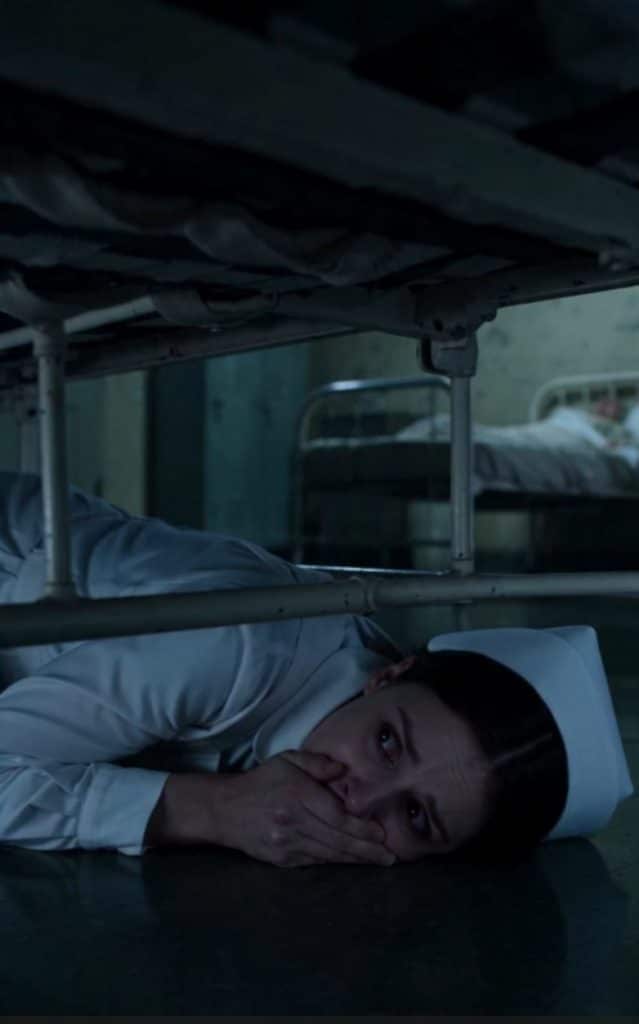
The nurse had one hand over her mouth when the screaming began.
She lay flat on the cold floor beneath the second hospital bed, her white uniform pressed against the dust and her cheek inches from the dark metal frame. Above her, the mattress sagged just enough to hide her from the doorway.
Barely.
The room was old, too old for a working hospital. Paint peeled from the walls in long strips. The floor reflected the flicker of a dying fluorescent light. An empty metal cabinet leaned in the corner like it had been abandoned there decades ago.
Across the room, in the real patient’s bed, Mrs. Evelyn Hart was crying.
“Don’t touch me,” the old woman screamed. “Please!”
Nurse Mara Ellison squeezed her eyes shut for half a second.
She wanted to run.
She wanted to climb out from under the bed, throw herself between Evelyn and whatever was coming, and become the brave person she had once imagined nurses naturally became.
But fear had pinned her to the floor.
The old woman’s scream broke into a weak sob.
“Help me…”
Mara’s breath came too fast. She forced it down, pressing her palm harder against her lips. If she made a sound, he would know. If he looked under the second bed, he would see the white hem of her uniform, her trembling hands, her wide terrified eyes.
Then the door crashed open.
The sound slammed through the room.
Evelyn screamed again.
Heavy footsteps crossed the threshold. Slow. Measured. Echoing against the hard floor.
From her hiding place, Mara saw only the bottom of the figure at first.
Black shoes.
Long black coat.
The edge of a shadow dragging behind him.
Then he stepped fully into the room, tall enough that his silhouette seemed to touch the ceiling. A vintage top hat sat low over his face, hiding everything above his mouth.
He did not speak.
He did not hurry.
He walked toward Evelyn’s bed like he had all night.
Like he had all the power.
Evelyn pulled the sheets to her chest, shrinking into the pillow.
“No,” she sobbed. “I told you I won’t sign.”
The man stopped beside her bed.
Mara’s heart jolted.
Sign.
This was not a ghost.
This was not the fevered vision the doctors had dismissed all week.
This was a man.
And he had come for something.
Mara shifted slightly, just enough to see under the gap between bed rail and shadow. Evelyn’s hand was clenched around something white.
Paper.
The tall man reached into his coat.
Mara nearly whimpered.
But what he removed was not a weapon.
It was a fountain pen.
Then he bent over the old woman and whispered something Mara could not hear.
Evelyn’s face twisted in horror.
“No,” she said. “Not her. Leave the girl out of this.”
The tall man turned his head.
Slowly.
Toward the bed where Mara was hiding.
And for one terrible second, she thought he could hear her heartbeat.
Act II
Mara had been at Saint Adelaide’s Hospital for only eleven days.
Long enough to learn which elevator stuck between floors. Long enough to learn that the night staff drank burnt coffee from paper cups and pretended not to hear sounds from the old east wing. Long enough to understand that some rooms were still used not because they were safe, but because the hospital was too broke to close them.
Room 317 was the worst.
The nurses called it the winter room.
No matter the season, it stayed cold.
Patients complained of drafts, shadows, strange dreams. Orderlies avoided it unless forced. One night nurse swore she saw a man in a top hat standing at the foot of an empty bed, though everyone laughed at her until she transferred to another floor.
Mara did not believe in hospital legends.
She believed in understaffing, bad wiring, trauma, sleep deprivation, and the way fear became a story when people needed something to blame.
Then Evelyn Hart arrived.
She was eighty-one, frail, sharp-eyed, and furious at everyone who spoke over her. Her gray hair spread across the pillow in tangled wisps, but her mind was clearer than the doctor’s notes claimed.
The file said confusion.
Mara saw terror.
On the first night, Evelyn gripped her wrist during medication rounds.
“Do not let him in,” she whispered.
“Who?”
“The man with the hat.”
Mara glanced toward the door.
“No one is coming in without authorization, Mrs. Hart.”
Evelyn’s fingers tightened.
“They all say that before they open the door.”
The next morning, Mara told Dr. Pell.
He barely looked up from the chart.
“Delirium. She’s elderly, under stress, and resisting transfer.”
“Transfer where?”
“To private hospice care.”
Mara frowned. “She doesn’t look terminal.”
Dr. Pell finally looked at her.
“You’re new here, Nurse Ellison. Try not to diagnose the whole hospital in your second week.”
That should have ended it.
It did not.
Evelyn got worse only when visitors were mentioned. She refused phone calls. Refused papers. Refused the lawyer who came twice and left smiling too easily.
On the third night, Mara found Evelyn awake, staring at the ceiling.
“I was a nurse here once,” Evelyn said.
Mara paused with the water cup in her hand. “Here?”
“When this place still had a soul.”
“You worked at Saint Adelaide’s?”
“Forty years. Babies, mostly.” Evelyn turned her head slowly. “I knew your mother.”
Mara went still.
“My mother died when I was little.”
“No,” Evelyn whispered. “That is what they told you.”
The cup trembled in Mara’s hand.
She had grown up with a thin folder from the county and three facts about herself: born at Saint Adelaide’s, mother deceased, no known family. She had no photographs. No letters. No one who remembered her first cry.
Mara stepped closer.
“What are you talking about?”
Evelyn’s eyes filled with tears.
“I tried to stop it,” she said. “I was young. I was afraid. But I saved the ledger.”
Before Mara could ask more, footsteps sounded in the hallway.
Evelyn’s face went white.
“Hide,” she breathed.
“What?”
“Under the bed. Now.”
Mara should have refused.
But then the lights flickered, and someone tried the locked door from the outside.
Not a knock.
A test.
Evelyn shoved a folded paper into Mara’s hand.
“If I don’t leave this room alive,” she whispered, “take this to Judge Rowan. Not the police desk. Not administration. Rowan.”
The handle turned again.
This time, harder.
Mara slipped beneath the perpendicular bed just as Evelyn began to scream.
And the legend of the tall man became flesh.
Act III
The tall man stood motionless beside Evelyn’s bed.
Mara could not see his face, but she could see his gloved hand resting on the bed rail. His fingers tapped once, lightly, almost politely.
“You are making this unpleasant,” he said.
His voice was soft.
That made it worse.
Evelyn’s voice shook. “You stole enough from that child.”
“That child,” he replied, “became nobody.”
Mara’s stomach turned cold.
“An orphan. A nurse. A forgettable girl in a forgettable uniform.” His tone sharpened slightly. “Until you decided guilt was more important than silence.”
Evelyn spat at him.
It landed on his coat.
He looked down slowly.
Mara bit the inside of her cheek to keep from making a sound.
The tall man removed a handkerchief and wiped the fabric with maddening calm.
“You always were sentimental,” he said. “That was your weakness.”
“No,” Evelyn whispered. “My weakness was fear. I’m done with that.”
He leaned closer.
“Then sign the transfer. Give me the ledger. Tell the girl nothing. You can spend whatever time you have left somewhere comfortable.”
“I told the girl enough.”
The room seemed to freeze.
The man’s head turned again.
Mara stopped breathing.
Evelyn realized her mistake too late.
The tall man straightened.
“What girl?”
Evelyn looked toward the ceiling and closed her eyes.
“Old women ramble.”
He stepped away from her bed.
Toward Mara’s.
One step.
Then another.
The hem of his black coat entered her narrow view.
Mara’s body went rigid.
She could see his shoes now, polished so brightly they reflected the flickering light. One stopped inches from her hand.
He stood at the headboard of the bed she was hiding under.
Directly in front of the door.
Directly above her.
Mara’s lungs burned.
Then Evelyn did the only thing she could.
She screamed.
Not a weak scream.
Not the frightened plea of a helpless patient.
A full, tearing cry that dragged the tall man’s attention back across the room.
“Help!” Evelyn shouted. “Help me!”
The man cursed under his breath and turned away.
Mara moved before courage could abandon her.
She slid the folded paper Evelyn had given her into the front of her uniform, then reached slowly into her pocket for her phone.
Her thumb shook so badly she nearly dropped it.
No signal.
Of course.
The old east wing swallowed signal like it swallowed light.
But the camera worked.
Mara pressed record.
The tall man was back at Evelyn’s bed now, his shoulders blocking the old woman from view.
“You should have died with your secrets,” he said.
Evelyn’s voice was thin but steady.
“And you should have died with shame.”
He laughed softly.
“You think a ledger matters after all these years?”
“Yes,” Evelyn said. “Because blood still matters to men like you.”
Mara stared through the gap, barely understanding.
The tall man reached for the paper in Evelyn’s hand.
Evelyn clutched it to her chest.
“The heir is alive,” she said.
His silence confirmed it.
Mara’s skin prickled.
The heir.
The child.
The forgettable girl.
Her.
Act IV
The door opened again.
Not with a crash this time.
With a key.
The tall man snapped upright.
Dr. Pell entered first, his white coat thrown over street clothes, his face damp with sweat. Behind him came a woman in a dark suit Mara did not recognize.
The hospital administrator.
Vivian Cross.
Mara had seen her portrait in the lobby beside donors, board members, and smiling men with buildings named after them.
“Why is she screaming?” Vivian demanded.
The tall man’s voice turned cold. “Because your doctor misjudged the dosage.”
Mara’s hand tightened around her phone.
Dr. Pell flinched. “She’s old. She’s unstable. We can still move her tonight.”
“No,” Vivian said. “Not if she has been talking.”
Evelyn laughed once, weak and bitter.
“There she is,” the old woman whispered. “Saint Adelaide’s finest.”
Vivian stepped closer to the bed.
“Where is the ledger?”
“Safe.”
“With whom?”
Evelyn smiled through tears.
“With someone you overlooked.”
Mara watched Vivian’s face harden.
Dr. Pell moved toward the metal cabinet and began opening drawers, searching roughly. The tall man stood still, but his anger had changed the room. He was no longer a ghost, no longer a legend, no longer a shadow.
He was a cornered man in costume.
Vivian lowered her voice.
“Evelyn, listen to me. This hospital survives because families like the Blackwells fund it. You really want to destroy all that over a woman who died forty years ago?”
“My sister,” Evelyn whispered.
Mara’s eyes burned.
Sister.
The word entered her like a key in a lock.
Evelyn Hart was not a stranger.
She was family.
The tall man removed his hat at last.
His face was older than Mara expected, pale and narrow, with silver hair combed perfectly back. She knew him from plaques and newspaper photographs.
August Blackwell.
Chairman of the Saint Adelaide’s Foundation.
The man whose name was on the new surgical wing.
The man the city called generous.
Evelyn looked at him with exhausted disgust.
“You took my sister’s baby,” she said.
August’s jaw tightened.
“She was an unwed maid with no prospects.”
“She was a mother.”
“She was an inconvenience.”
Mara’s eyes filled, but she kept the phone steady.
Evelyn’s voice trembled. “You switched the records. You gave her child away. Then you told her the baby died.”
“She became hysterical.”
“She died of grief.”
Vivian snapped, “Enough.”
But it was too late.
The confession was alive now.
Alive in the room.
Alive on Mara’s phone.
August leaned over Evelyn, his calm finally cracking.
“And where is the child now?”
Mara knew she should stay hidden.
She knew survival depended on silence.
But Evelyn turned her head slightly, looking not at the bed, but near it. Near the floor. Near Mara.
And in that look was apology.
Love.
Permission.
Mara crawled out from under the bed.
Dr. Pell stumbled backward.
Vivian gasped.
August Blackwell froze.
Mara stood slowly, dust on her white uniform, phone raised in her shaking hand.
“She’s here,” Mara said.
The room went silent.
Evelyn began to cry.
Not from fear this time.
From relief.
Act V
For three seconds, no one moved.
Then everyone moved at once.
Dr. Pell lunged toward Mara’s phone. She jerked back, but he caught her wrist. The phone tilted. Vivian shouted for him to stop. August stepped toward the door, already calculating escape.
Evelyn used the last of her strength to knock the metal tray from her bedside table.
It crashed to the floor.
The sound rang down the hallway.
Then came footsteps.
Real ones.
Multiple.
Fast.
Mara twisted free and screamed, “Help! Room 317!”
Two orderlies reached the door first. Then a night supervisor. Then security. Within moments, the old room filled with witnesses who could not unsee what they had walked into.
August Blackwell tried to become dignified again.
It did not work.
There is no crown for a man caught in the dark at a terrified woman’s bedside.
The phone recording survived.
So did the folded paper.
Inside it was a page from the original maternity ledger, removed and hidden by Evelyn Hart forty years earlier. It listed a birth. A mother’s name. A false death entry. A transfer code. A signature belonging to August’s father, and a second signature belonging to a young hospital administrator who later became part of the Blackwell circle.
But the final line was in Evelyn’s handwriting.
Child alive. Female. Sent to county under name Mara Ellison.
Mara read it in the hospital chapel at dawn.
She sat alone in the last pew while the city woke outside the stained-glass windows. Her uniform was still dusty. Her hands still shook. There was a bruise forming on her wrist where Dr. Pell had grabbed her.
But none of that felt real.
What felt real was the name written beneath her mother’s.
Lydia Hart.
Her mother had not abandoned her.
Her mother had not died without anyone loving her.
Her mother had been lied to.
And somewhere inside Saint Adelaide’s decaying walls, an old nurse had carried the truth for forty years until fear finally became less powerful than love.
Evelyn survived the night.
Barely.
She was moved to a monitored room with security outside the door and a judge at her bedside before noon. Judge Rowan, retired but still formidable, arrived with silver hair pinned tight and fury in every line of her face.
“I knew your mother,” she told Mara. “And I wondered all my life why the records never made sense.”
The investigation tore through Saint Adelaide’s like daylight through a boarded window.
Dr. Pell was suspended, then charged. Vivian Cross resigned before police finished the first round of interviews. August Blackwell’s name came down from the surgical wing within a week.
The city was shocked.
Mara was not.
Shock was for people who had believed rich men became saints by putting their names on buildings.
Mara had seen him in the dark.
Top hat. Black coat. Fountain pen.
A man dressed like death because no one had ever forced him to answer to the living.
The newspapers wanted Mara’s picture.
She refused.
They wanted Evelyn’s story.
Evelyn gave only one statement from her hospital bed.
“I was afraid for forty years. I am not afraid now.”
That was enough.
Weeks later, Mara visited Evelyn in a smaller, brighter care facility outside the city. There were no peeling walls. No flickering lights. No old metal beds arranged like hiding places.
Evelyn looked smaller in daylight.
Fragile.
Human.
Mara stood beside her bed, unsure what to call her.
Aunt felt too intimate.
Mrs. Hart felt too cold.
Evelyn solved it by reaching for her hand.
“Your mother had your eyes,” she said.
Mara sat down.
For a long time, she said nothing.
Then she asked the question that had followed her since the chapel.
“Did she know I lived?”
Evelyn’s face crumpled.
“No,” she whispered. “I tried to tell her. I swear I tried.”
Mara closed her eyes.
The answer hurt.
But it was cleaner than the lie.
Evelyn squeezed her hand weakly.
“She held you once. Before they took you. She said you were the loudest little thing she had ever heard.”
A laugh broke through Mara’s tears.
“She would have liked that I became a nurse?”
Evelyn smiled.
“She would have said you were too stubborn to be anything else.”
Outside the window, morning light touched the trees.
For the first time in her life, Mara had a memory of her mother that had not been invented from paperwork.
Not enough.
But something.
Months later, Saint Adelaide’s closed its east wing permanently. Room 317 was emptied. The old beds were removed. The metal cabinet hauled away. The walls stripped and repainted until no shadow could pretend it had always belonged there.
Mara returned once before the renovation finished.
She stood in the doorway and looked at the spot where she had hidden under the bed, one hand over her mouth, certain fear would be the last thing she ever felt.
She had been wrong.
Fear had not been the end of her.
It had been the place where the truth found her.
A young maintenance worker passed in the hallway carrying a bucket of paint.
“You okay in there?” he asked.
Mara looked at the room one last time.
The bed was gone.
The shadows were gone.
The man in the top hat was gone.
But Evelyn’s voice seemed to remain, not screaming now, not pleading, but telling her what she had spent her whole life needing to know.
You were wanted.
Mara stepped back into the hall.
“Yes,” she said softly. “I’m okay.”
Then she walked out of the old wing and into the bright corridor beyond it, carrying her mother’s name like a lantern.