Act I
The men laughed before the dog barked.
That was what made it cruel.
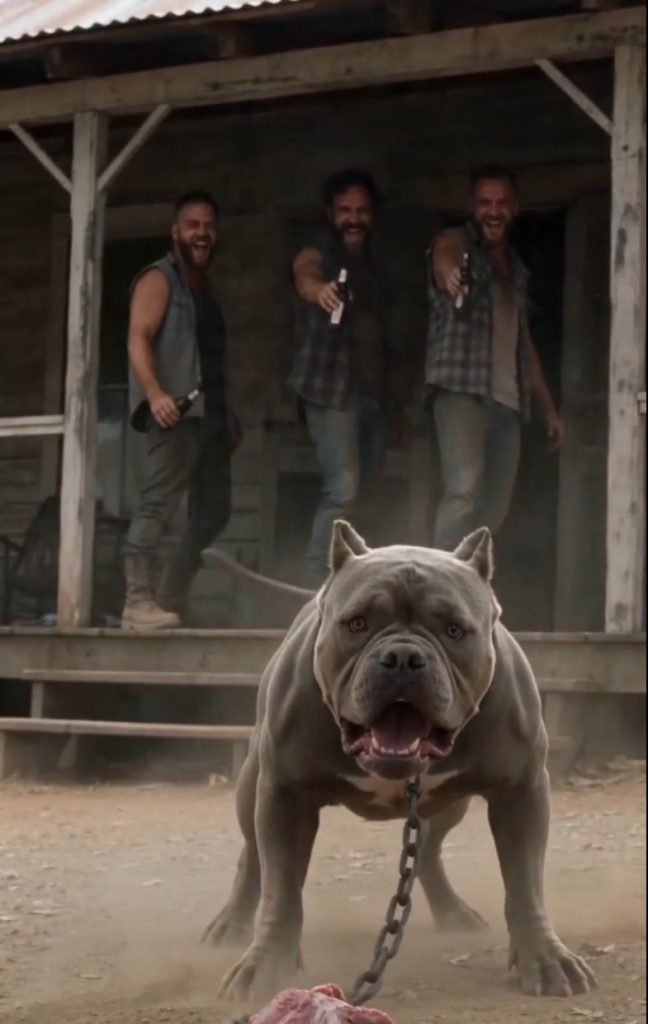
They stood on the sagging porch of the old rural house, beer bottles dangling from their hands, boots scraping over loose boards, shoulders loose with the kind of confidence only cowards found in groups. Behind them, the screen door hung crooked on its hinges. In front of them, the dusty yard stretched under hard daylight.
And near the big tree, the dog sat chained.
He was a large gray Pitbull, broad-chested and tense, with dust clinging to his paws and a thick metal chain running from his collar to the base of the tree. His body was still, but his eyes were not. They tracked every laugh, every bottle clink, every step the men took off the porch.
He did not look vicious.
He looked cornered.
One of the men lifted a piece of raw meat and waved it like a joke.
“Come on!” he shouted. “Eat, idiot!”
The other two burst into laughter.
The meat hit the dirt near the dog’s feet with a heavy thud. Dust jumped around it. The dog flinched forward, hungry enough to notice, afraid enough not to trust it.
The chain scraped.
The men laughed harder.
From behind the tree, Mara Ellis tightened both hands around the wire cutters.
She was half-hidden in the shade, dirt smudged across one cheek, her dark hair stuck to her forehead. A wrench hung from one hand, heavy-duty cutters from the other. She had been crouched there for twelve minutes, waiting for the men to go inside.
Waiting for one chance.
The dog’s name was Bishop.
He had not always barked like that.
Mara knew because she remembered him as a puppy sleeping under the front desk at the county shelter, his paws twitching while volunteers stepped over him with laundry baskets. He used to greet people with his whole body, tail whipping so hard it knocked over water bowls.
Now he sat in the dust with a chain around his neck and men laughing at his fear.
One man stepped off the porch and swaggered closer.
Bishop’s body lowered.
The man grinned.
Then he scraped his boot hard through the dirt, kicking a spray of dust straight into the dog’s face.
Bishop jerked back, blinked wildly, then lunged with a sharp bark.
The chain snapped tight so violently the sound cracked across the yard.
The men roared with laughter.
Mara’s breath caught in her throat.
Her grip tightened until the metal cutters bit into her palm.
The dog coughed, shook his head, and growled low, not because he wanted to attack, but because every escape had been taken from him.
The man on the porch lifted his bottle.
“See?” he said. “Mean as sin.”
Mara closed her eyes for one second.
No, she thought.
Not mean.
Made afraid.
The men finally turned back toward the house, still laughing, still clinking bottles, still proud of themselves for terrifying a chained animal. Their boots thumped up the porch steps. The screen door creaked open, then slammed behind them.
The yard went quiet.
Bishop kept panting, eyes fixed on the porch, chain trembling against the dry ground.
Mara stepped out from behind the tree.
The cutters clicked once in her hand.
And Bishop turned his head toward her like he did not know whether she had come to save him or become the next reason to be afraid.
Act II
Mara had been told not to come alone.
She came anyway.
Three days earlier, a boy from the neighboring property had slipped into the clinic where Mara worked and handed her a folded note. He could not have been more than twelve, all elbows and fear, with red dust on his sneakers and a bruise-colored shadow beneath one eye.
“They got a dog out there,” he whispered. “Chained all day. They mess with him.”
Mara asked who.
The boy looked at the floor.
“The Pike brothers.”
That was enough to chill the room.
Everyone in Alder County knew the Pikes.
Three brothers, one crumbling house, too many complaints, not enough consequences. They fixed engines when they felt like it, sold scrap when they needed cash, and frightened neighbors into minding their own business.
Animal control had been called before.
So had the sheriff.
By the time anyone official arrived, the yard was clean, the dog was gone, and the men smiled like misunderstood citizens.
Mara had tried the proper way first.
She filed a report. She called Deputy Hensley twice. She sent photos the boy had taken from behind his fence, blurry but clear enough to show the chain, the empty water bowl, the dog’s ribs too visible beneath gray fur.
The answer came back the same way it always did.
We need probable cause.
We need access.
We need the owner’s cooperation.
Mara wanted to scream.
Dogs did not have time for paperwork when cruelty lived on the porch.
Then the boy returned with one more detail.
“He has a white patch on his chest,” he said. “Like a crooked star.”
Mara froze.
Bishop.
The shelter had lost him eight months earlier.
Not officially. Officially, he had been adopted by a man with a fake address and a clean smile. The paperwork looked real enough until it didn’t. By the time the shelter realized the contact number was dead, Bishop was gone.
Mara had been the one who handed over the leash that day.
She never forgave herself.
Bishop had come to the shelter after being found under an abandoned grain truck, thin, shaking, but gentle. The first night, Mara sat beside his kennel and read out loud from a battered paperback because the sound of a human voice calmed him.
For weeks, he followed her around the shelter yard with cautious hope.
He learned sit.
He learned stay.
He learned that hands could carry food instead of fear.
When the adoption application came in, everyone celebrated. A home. A yard. A second chance.
Mara remembered kneeling in front of him before he left, pressing her forehead gently to his.
“Be good, Bishop,” she whispered.
He had licked her chin.
Now she was staring at him across a hostile yard, watching him bare his teeth because men had taught him kindness was a trap.
The guilt nearly knocked her sideways.
But guilt was not useful unless it moved.
So she waited until the Pike brothers started drinking on the porch. She parked half a mile down the road, cut through the dry creek bed, and came up behind the big oak with cutters, a wrench, and a phone set to record in her back pocket.
She did not intend to steal a dog.
She intended to retrieve one the world had failed.
Bishop watched her from beside the tree.
His lips lifted slightly.
Mara stopped immediately.
“Easy,” she whispered.
His growl deepened.
She lowered the cutters to the ground where he could see them.
“I know,” lifted slightly.
Mara stopped immediately.
“Easy,” she whispered.
His growl deepened.
She lowered the cutters to the ground where he could see them.
“I know,” she said softly. “I know. I’d hate people too.”
Bishop’s ears twitched.
From inside the house came muffled laughter.
Mara looked toward the porch.
She did not have long.
She reached into her pocket and pulled out a small blue rope toy, faded, chewed at one end. She had kept it in her desk drawer since the day Bishop vanished. She did not know why. Hope, maybe. Punishment, more likely.
She placed it in the dust between them.
Bishop stopped growling.
His nose moved once.
Then again.
The recognition was small but unmistakable.
Mara’s throat tightened.
“Yeah,” she whispered. “It’s me.”
Bishop’s body trembled.
Not with aggression now.
With the terrible confusion of wanting to trust and not remembering how.
Mara crawled closer on one knee, slow enough that every inch asked permission.
The chain lay between them.
Thick. Rusted. Heavy.
She picked up the cutters again.
Behind her, the screen door creaked.
Mara froze.
And from the porch, one of the men said, “Well, look what crawled into our yard.”
Act III
Mara turned slowly.
Duke Pike stood in the doorway with a beer bottle in one hand and a smile already spreading across his face. He was the oldest brother, broad through the shoulders, sunburned at the neck, the kind of man who mistook volume for strength.
Behind him, the other two appeared.
Cal and Ronnie.
Three men in the shade.
One woman in the dust.
One chained dog between them.
Duke stepped onto the porch.
“You lost?”
Mara stood, keeping the cutters at her side.
“No.”
His eyes dropped to the tool in her hand.
“Then you’re stupid.”
Bishop barked once, sharp and terrified. The chain rattled as he pulled toward Mara, then back toward the men, torn between old fear and new danger.
Duke laughed.
“Careful. He bites.”
Mara looked at Bishop’s dust-covered muzzle.
“Only when provoked.”
The smile left Duke’s face.
Cal took one step down from the porch.
“You animal people don’t learn, do you?”
Mara’s phone was still recording in her back pocket. She only needed them to keep talking. Just a little longer.
“Is this your dog?” she asked.
Ronnie snorted. “He’s on our property.”
“That wasn’t the question.”
Duke descended the steps slowly, boots landing hard in the dirt.
“He was dumped. We took him in.”
Mara glanced at the empty water bowl near the tree, the chain rubbed bright where it had scraped bark raw, the meat lying in the dust as bait instead of food.
“You call this taking him in?”
Duke’s eyes narrowed.
“You calling me cruel?”
Mara wanted to say yes.
She wanted to say it in every language grief had.
Instead, she said, “I’m saying this dog was adopted from Alder County Shelter using false information.”
For the first time, the brothers stopped smiling.
It lasted only a second, but Mara saw it.
Duke looked toward Cal.
Cal looked away.
There it was.
Proof had a sound. Sometimes it was not a confession. Sometimes it was silence landing too heavily.
Duke stepped closer.
“You got a warrant?”
Mara did not.
Not yet.
But she had something better coming.
She looked toward the dirt road beyond the house.
Duke noticed.
His face tightened.
“You call somebody?”
Mara did not answer.
Bishop began barking again, louder now, body angled between Mara and the men as much as the chain allowed. He was still afraid, still trapped, but something in him remembered her. Something in him understood she had not come to laugh.
Cal grabbed the chain near the tree.
“Shut him up.”
Bishop recoiled.
Mara moved without thinking.
“Don’t touch him.”
Duke grinned.
“There she is.”
Ronnie laughed from the porch.
“Thought you said he wasn’t yours.”
Mara’s heart pounded.
“He was never yours.”
Duke closed the distance between them.
“Lady, that dog is property.”
“No,” Mara said. “He’s evidence.”
That word changed the air.
Duke’s eyes hardened.
Then distant tires crunched over gravel.
Not one vehicle.
Several.
The brothers turned.
Two county trucks rolled into the yard first. Behind them came a sheriff’s cruiser. Then another car with the seal of the district attorney’s office on the door.
Mara released a breath she had been holding for what felt like years.
The boy next door had not only brought her a note.
He had brought her a photograph of a license plate tied to three missing shelter dogs in two counties.
Mara had sent it to the one person who would not ignore it.
Assistant District Attorney Claire Benton stepped out of the lead car in clean boots and a linen blazer that looked wildly out of place in the dust. She took one look at the dog, then at Mara, then at the Pikes.
“Step away from the chain,” she said.
Duke tried to smile.
“This is private property.”
Claire lifted a folder.
“And this is a court order.”
The brothers went still.
Mara turned back toward Bishop.
His eyes were fixed on her.
For the first time, she saw something beneath the fear.
Hope.
Act IV
The rescue did not happen fast.
That was the hardest part.
Everyone wanted the chain off immediately, but fear had made Bishop’s world small and dangerous. He did not understand court orders. He did not understand deputies or cameras or evidence bags. He understood boots, laughter, pain, and the fact that people kept reaching for his neck.
So Mara stayed with him.
She sat in the dust, ten feet away at first, then eight, then six. She talked the whole time, voice low and steady.
“You remember the blue toy,” she whispered. “You remember the shelter yard. You remember stealing my sandwich. Yeah, I remember that too.”
Bishop’s breathing slowed little by little.
The Pikes were kept on the porch while officers photographed the yard. Empty bowls. The chain. The crude shelter made from scrap metal. The meat in the dirt. Beer bottles. Boot marks near where Bishop had been taunted.
Duke tried to joke.
Nobody laughed.
Ronnie tried to claim the dog was dangerous.
Claire looked at the video on Mara’s phone and said, “Your behavior is the only danger I’m seeing.”
Cal sat on the porch steps with his head in his hands.
He was the first to break.
“It was Duke’s idea,” he muttered.
Duke turned on him instantly.
“Shut up.”
Claire looked up.
“What was?”
Cal swallowed.
“The dogs. People paid him to take them. Sometimes he sold them. Sometimes he kept them if they looked tough.”
Mara’s stomach turned, but she kept her face steady for Bishop.
No graphic details. No images. Just enough truth to make the yard feel colder.
“How many?” Claire asked.
Cal did not answer.
Duke lunged toward him, but a deputy stepped between them.
That was when Bishop barked.
Not in panic.
In warning.
Mara looked at him.
“You’re still trying to protect people,” she whispered.
The dog’s eyes stayed on Duke.
Mara picked up the blue rope toy and held it out.
Bishop sniffed the air.
One cautious inch at a time, he leaned forward.
His nose touched the frayed rope.
Then his eyes lifted to Mara’s face.
She did not grab him.
She did not rush.
She simply opened her hand.
“Good boy,” she said.
The old words found him.
His body shuddered.
Then Bishop lowered his head and pressed his muzzle against her palm.
Mara almost broke apart right there.
Instead, she nodded to the animal control officer.
“Now.”
The officer moved in slowly with a catch pole only as backup, not force. Mara kept one hand near Bishop’s cheek while the wrench turned the rusted bolt at the tree anchor. The metal protested with a sharp squeal.
Bishop flinched.
Mara stayed still.
“You’re okay. You’re okay. This is the last sound it makes.”
The bolt loosened.
The chain dropped.
For one impossible second, nobody moved.
Bishop stared at the slack links in the dirt like freedom was something he did not recognize.
Then he took one step toward Mara.
No snap.
No jerk.
No metal stopping him.
The yard fell silent.
Mara clipped a soft rescue lead to a temporary harness, avoiding the sore skin around his neck. Bishop leaned against her leg with sudden, exhausted weight.
Duke watched from the porch, his face dark with humiliation.
“You think this is over?” he said.
Claire closed the folder.
“No,” she replied. “That’s the first smart thing you’ve said.”
Deputies moved toward the porch.
Duke’s laughter was gone now.
So was the chain.
Act V
Bishop did not ride in a cage.
Mara sat in the back of the animal control van with him because he panicked when the door closed. She kept one hand on his shoulder and the blue rope toy tucked against his front paws.
He did not sleep.
Not at first.
His eyes stayed on the window, watching the rural road fall away behind them. Every bump made his body tense. Every passing truck made his ears flatten. Once, when the van slowed at a stop sign, he looked at Mara as if he feared they were taking him back.
“We’re not,” she said softly.
Bishop stared at her.
“We’re never taking you back there.”
At the clinic, the staff moved quietly.
No crowded room. No sudden hands. No loud voices.
The vet examined the rubbed skin beneath the old collar, checked his paws, cleaned dust from his eyes, and noted what cruelty had tried to write into his body. Nothing was described like a spectacle. Nothing was turned into entertainment.
He was a patient.
Not a symbol.
Not a monster.
Not property.
Just a scared dog who had survived people.
For three days, Bishop refused to eat unless Mara sat beside him.
On the fourth, he took a piece of chicken from her fingers.
On the fifth, he slept with his head on the blue rope toy.
On the seventh, he wagged his tail once when she entered the room.
The entire clinic pretended not to cry.
The Pike case grew larger than one yard.
Investigators found adoption records, false names, payment messages, and complaints dismissed too early because nobody wanted trouble from men who created it for a living. Other shelters came forward. So did neighbors. So did the boy next door, this time with his mother holding his hand and a deputy outside their house to make sure courage did not cost them safety.
Duke Pike pleaded not guilty.
That surprised no one.
But the video of him laughing while Bishop choked on dust made excuses difficult. Cal’s statement made them harder. The court order, the false adoption papers, and the recovered dogs made them nearly impossible.
Months passed before sentencing.
Bishop did not care about court.
He cared about breakfast at exactly 7:00, soft blankets, the blue rope toy, and Mara’s old pickup truck. He cared about the shelter yard, where he slowly learned that fences did not always mean imprisonment and people walking toward him did not always bring pain.
Mara cared about court enough for both of them.
She sat in the back row the day Duke Pike stood before the judge. She did not look away when his lawyer called him a careless man who had made mistakes. She did not look away when the prosecutor described the pattern of cruelty, the false adoptions, the intimidation, the chain.
Then Claire Benton played the video.
Not the worst parts.
Enough.
The laughter. The taunts. The chain snapping tight. Mara stepping from behind the tree with tools in her hands.
The courtroom went quiet.
When the judge spoke, his voice was controlled but cold.
“Cruelty becomes easier when a person convinces himself the victim has no voice. In this case, many people became that voice.”
Duke Pike did not laugh again.
Afterward, Mara walked out into the sunlight and found the boy from next door waiting with his mother.
He held a small paper bag.
“For Bishop,” he said.
Inside was a new toy.
Blue, like the old one.
Mara crouched to his height.
“You saved him,” she said.
The boy shook his head quickly.
“You did.”
“No,” Mara said. “I brought tools. You brought the truth.”
His eyes filled.
He nodded once, hard, like he was trying not to cry in public.
A year later, the old Pike property looked different.
The house still stood, but the porch had been repaired, the yard cleared, and the big tree no longer held a chain. The county seized the land after the case and leased it to a rescue nonprofit that specialized in rehabilitation for frightened dogs.
Mara hated the place at first.
Then she understood why it mattered.
Some places should not be left to remember only cruelty.
So they renamed it Still Oak Rescue.
On opening day, Bishop arrived in Mara’s pickup wearing a soft blue harness. He stepped onto the dusty ground cautiously, sniffed the air, and looked toward the tree.
Mara held her breath.
The chain was gone.
In its place, someone had built a shaded bench and planted wildflowers around the roots. A small plaque rested near the trunk.
For every animal who waited too long.
For every person who finally acted.
Bishop walked slowly to the tree.
He sniffed the ground where the chain used to be.
Then he turned around, came back to Mara, and sat beside her.
Not trapped.
Choosing.
The crowd applauded softly, careful not to startle him. Bishop leaned into Mara’s leg, tail moving once, then twice.
She looked down at him and smiled.
“You ready?”
He looked up as if he understood.
Inside the new training yard, frightened dogs waited behind clean gates with full bowls, soft beds, and staff who knew patience was not weakness. Some barked. Some hid. Some trembled when hands came too close.
Mara knew what people would say.
Aggressive.
Broken.
Too far gone.
She had heard those words before.
She had watched Bishop prove them wrong one cautious step at a time.
That afternoon, a nervous volunteer asked if Bishop could really help other dogs learn to trust.
Mara watched him settle calmly outside a kennel where a shaking young dog had refused to come forward all morning. Bishop did nothing dramatic. He simply lay down nearby, quiet and steady, showing the other dog that the world had not ended.
A few minutes later, the frightened dog took one step toward the gate.
Mara’s throat tightened.
“Yes,” she said. “He can help.”
The men on the porch had thought the chain made them powerful.
They thought fear was obedience. They thought laughter could turn cruelty into a joke. They thought a dog with no way to run had no one coming.
They were wrong.
The chain was gone now.
The porch was quiet.
The yard belonged to rescue.
And Bishop, once trapped beneath that tree, became the reason no one in Alder County could say they did not know anymore.
Because sometimes saving one life does more than break a chain.
Sometimes it breaks the silence that allowed the chain to exist.