Act I
The dog did not understand why she took off his collar.
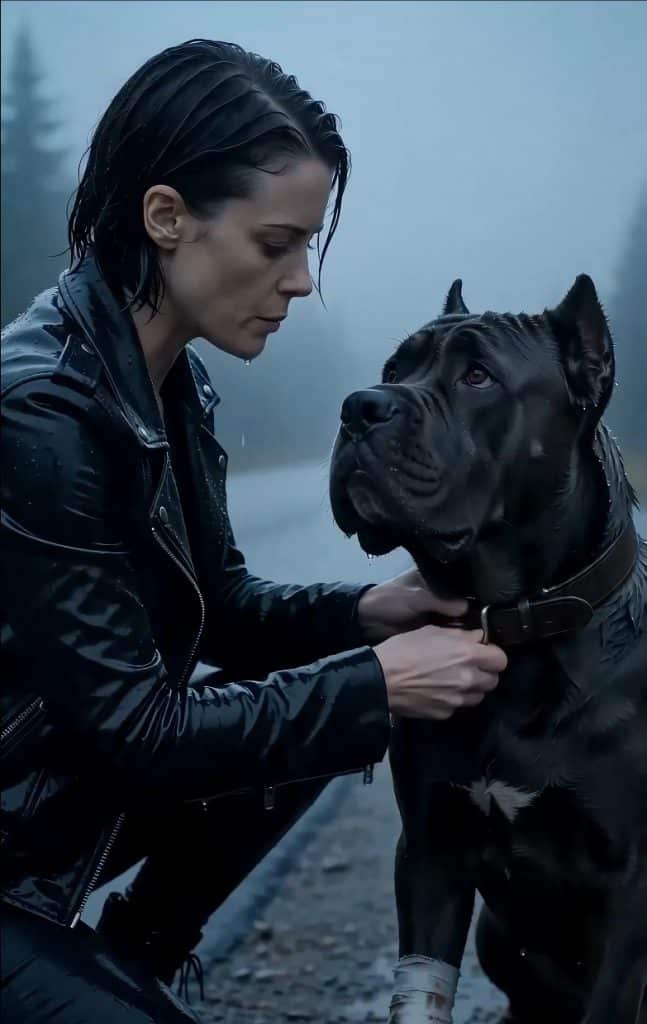
He sat on the gravel shoulder beneath the gray rain, huge and black against the fog, his broad head lowered just enough to look obedient. Water ran down his muzzle and gathered at the edge of his dark eyes. His front right paw, wrapped in a dirty white bandage, rested carefully above the puddled ground.
The dark gray SUV idled beside him with its driver’s door open.
Inside, warmth.
Outside, rain.
The woman knelt in front of him, her black leather jacket shining wet under the storm. Her short dark hair clung to her cheek, but she did not wipe it away. She did not look at the dog for more than a second at a time.
“Stop whimpering,” she said.
Her voice was flat. Almost bored.
The Cane Corso’s ears shifted at the sound of her voice. Even now, he listened. Even now, he tried to be good.
Her fingers worked quickly around the heavy black leather collar.
The buckle came loose.
The dog’s neck was suddenly bare.
For a moment, he leaned forward as if expecting her to scratch behind his ear the way his real owner used to. Instead, she stood, turned her wrist, and dropped the collar into a muddy puddle.
It landed with a wet slap.
“There,” she said. “Better.”
The dog looked down at the collar, then back at her.
His tail did not move.
The woman stepped into the SUV. Wet gravel crunched beneath her boots. She pulled the driver’s door shut with a heavy thud that sounded final before the engine even started.
The dog rose halfway, then stopped.
His injured paw trembled.
The SUV pulled away from the shoulder, tires spraying water across the road. Its red taillights glowed through the rain, smaller and smaller, until the fog swallowed them completely.
Still, the dog waited.
He sat exactly where she had left him, rain streaming over his face like tears, the collar sinking slowly beside him in the brown-gray water.
A truck passed. Then another.
No one stopped.
The dog gave one faint whimper, barely louder than the wind moving through the pines.
Then, far down the empty road, headlights slowed.
An old pickup pulled onto the shoulder, hazard lights blinking against the storm. A man stepped out wearing a faded canvas coat and rubber boots, one hand raised gently so the dog would not feel threatened.
The Cane Corso did not move.
The man saw the bandage first.
Then the puddle.
Then the collar.
He crouched and lifted it from the muddy water, wiping rain from the metal tag with his thumb.
The name appeared beneath the dirt.
ATLAS.
Below it, smaller letters.
VALE HAVEN SANCTUARY.
The man stopped breathing.
Because he knew that name.
And the woman who had thrown the collar away had not known what was hidden inside it.
Act II
Elias Porter had driven that road for twenty-seven years.
He knew every bend, every flooded ditch, every stretch where deer stepped out without warning at dusk. He knew the old pine grove where fog gathered first and the broken mile marker that had never been repaired after the winter storm of 2016.
He also knew Vale Haven.
Everyone in the county did.
Before it became a legal dispute, before developers circled it like vultures, before lawyers began calling it “the property,” Vale Haven had been a rescue sanctuary built on thirty acres of wet pasture and stubborn hope.
Michael Vale had opened it after leaving the fire department.
People thought he was crazy at first. A former firefighter spending his savings on injured dogs, abandoned horses, and old working animals no one wanted anymore. He patched fences himself, slept in the barn during storms, and kept a coffee pot running all day for volunteers.
Atlas had arrived as a puppy with paws too big for his body and eyes too serious for his age.
Michael used to say the dog was born old.
The Cane Corso grew into a quiet giant. He did not bark for attention. He did not jump on visitors. He simply watched, steady and patient, as if the world had entrusted him with making sure no one fragile was left alone.
That was why Lily loved him.
Michael’s daughter was nine when her mother died and ten when Atlas decided she belonged to him. He walked beside her through the fields, slept outside her bedroom door, and pressed his massive head into her lap whenever grief made her too quiet.
After Michael died in a crash on a rain-slick highway, Atlas became the only living thing Lily trusted completely.
Elias had been at the funeral.
He still remembered the little girl holding Atlas’s collar with both hands while the dog stood beside the casket, unmoving, like a soldier refusing to abandon his post.
Michael’s sister, Serena Vale, took over the estate after that.
On paper, it seemed temporary. She was supposed to protect the sanctuary until Lily turned eighteen. She was supposed to keep the animals cared for, keep the rescue accounts clean, and follow the conditions Michael had written into his will.
But Serena hated Vale Haven.
She hated the mud, the noise, the vet bills, the volunteers, the smell of hay in her car. She hated the way locals still spoke of Michael like he was the good one. Most of all, she hated the fact that the land could not be sold while Lily remained the primary beneficiary.
Atlas stood in the middle of all of it.
Michael had made sure of that.
The dog’s care was written directly into the trust. Not because Atlas was property, but because Michael knew his daughter would need him. Whoever served as Lily’s temporary guardian had to maintain Atlas’s care and the sanctuary’s operations.
If they failed, they could be removed.
Serena understood money.
She did not understand loyalty.
Three weeks before the rainy road, she began telling people Atlas had become difficult. Too large. Too dangerous. Too expensive. She said he frightened Lily. She said the sanctuary was unsafe. She said selling the land would be best for everyone.
Lily said nothing.
But whenever Serena entered a room, Atlas placed himself between the woman and the child.
Then the dog injured his paw.
Serena claimed he had tried to run through a fence. The vet suspected otherwise but could prove nothing. The bandage was fresh, the records incomplete, and Serena paid in cash.
That same afternoon, she loaded Atlas into the SUV.
She told Lily she was taking him for a follow-up appointment.
Instead, she drove forty miles into fog and rain.
Now Elias stood on the roadside with the truth dripping from his hand.
Atlas lifted his head at the sound of the sanctuary name.
The dog knew it.
Elias knelt slowly.
“Atlas,” he said softly. “I knew your dad.”
The Cane Corso stared at him through the rain.
Something in the dog’s face shifted.
Not trust.
Not yet.
Recognition of kindness, maybe.
Elias removed his coat and held it open, shielding the dog from the worst of the storm.
“Come on, boy,” he whispered. “You’re not staying here.”
Atlas tried to stand.
His injured paw buckled.
Elias caught him gently, one arm braced beneath the dog’s chest, rain running down both of them. Atlas was heavy, soaked, trembling, and still trying not to complain.
That broke something in Elias.
The dog had been left in the rain and was still trying to be good.
By the time Elias lifted him into the back seat of the pickup, the collar lay on the passenger seat beside him, muddy but intact.
And beneath the leather, something small blinked once.
A tracker.
Still alive.
Still recording.
And the woman who drove away was supposed to be his guardian.
Act III
The veterinary clinic smelled like antiseptic, wet fur, and old coffee.
Atlas lay on a padded mat in the emergency room while Dr. June Mercer cut away the soaked bandage with careful hands. She was in her sixties, gray-haired, sharp-eyed, and kind in the way people become kind after spending a lifetime seeing what cruelty can do.
She did not ask Elias whether he was sure.
One look at the dog told her enough.
“He was left out there?” she asked quietly.
Elias nodded.
“On Route 9. Collar in a puddle.”
June’s mouth tightened.
Atlas watched them both without lifting his head.
His paw was swollen but treatable. He was exhausted, chilled, and dehydrated, but alive. When June scanned his microchip, the screen confirmed what the collar already said.
Atlas Vale.
Registered owner: Michael Vale.
Emergency contact: Vale Haven Sanctuary.
Secondary legal contact: Hawthorne & Price Estate Counsel.
June stared at the final line.
“Estate counsel?” she said.
Elias picked up the collar from the counter.
“That’s not the strange part.”
He turned the leather over and showed her the seam.
The tracker inside had been sewn beneath the padding. Michael had done it years earlier after a rescued dog was stolen from the sanctuary. Most people never noticed it. It only activated if the collar was removed and stayed motionless too long.
Serena had thought she was erasing evidence by throwing the collar away.
Instead, she had triggered it.
By midnight, the tracker log showed everything.
The SUV leaving Vale Haven.
The stop at the rural veterinary clinic.
The long drive north.
The exact roadside location where Atlas had been abandoned.
The return route.
Elias sent the data to Margaret Hawthorne, Michael Vale’s attorney, who answered on the second ring despite the hour.
When he told her Atlas had been found alive, she went silent.
Then she said, “Where is Serena?”
“Back at the sanctuary, probably.”
“She called me at six,” Margaret said. “She claimed Atlas slipped his leash and ran into the woods.”
Elias looked through the clinic glass at the dog lying quietly under a blanket.
“She removed his collar.”
“I know,” Margaret said.
There was something in her voice that made Elias straighten.
“You know?”
“Michael expected this.”
The sentence dropped into the room like a key turning in a lock.
Margaret arrived at the clinic before dawn with a leather folder pressed to her chest and grief sharpened into purpose.
She had represented Michael for fifteen years. She had watched him build Vale Haven, watched Lily grow up under Atlas’s patient guard, watched Serena smile politely at family gatherings while calculating what the land might be worth.
“Michael didn’t trust her,” Margaret said.
June looked up from Atlas’s chart.
“Then why put her in charge?”
“He didn’t have time to change everything after the accident,” Margaret said. “But he did add conditions.”
She opened the folder.
Inside were copies of trust documents, guardianship terms, veterinary care requirements, and a handwritten letter from Michael to Lily.
Elias saw the old firefighter’s blocky handwriting and had to look away for a second.
Margaret’s voice softened.
“If Serena neglects, abandons, conceals, or attempts to dispose of Atlas, she is immediately removed from all authority over Lily’s trust and the sanctuary.”
June exhaled.
“She didn’t just abandon a dog.”
“No,” Margaret said. “She violated the trust.”
Elias looked at Atlas.
The dog blinked slowly, too tired to understand that his obedience had just saved the place his owner built.
But there was more.
Margaret reached into the folder and pulled out a photograph.
It showed Lily sitting in the grass beside Atlas, her arms around his neck, her face hidden in his fur. On the back, Michael had written one line.
If they ever try to take him from her, follow the collar.
Elias’s throat tightened.
That morning, Serena Vale arrived at the county probate office wearing black leather, clean boots, and an expression of practiced grief. She was there to request emergency permission to sell part of Vale Haven to a developer, claiming the sanctuary had become unmanageable after Atlas “ran away.”
She expected paperwork.
She expected sympathy.
She expected control.
Then the doors opened.
And Atlas walked in.
Act IV
He moved slowly, but he walked.
A soft medical wrap protected his paw. Elias held the leash loosely, not pulling, only guiding. June followed on one side, Margaret on the other.
Behind them came Lily.
The girl’s face was pale from crying, her hair tied back carelessly, her hands shaking at her sides. She saw Atlas and made a sound no child should have to make in a room full of adults.
Atlas heard it.
His head lifted.
For the first time since the roadside, his tail moved.
Lily dropped to her knees before anyone could stop her. Atlas leaned into her with all his weight, careful of his paw, pressing his head into her chest while she wrapped her arms around him and sobbed into his wet black fur.
“You said he ran away,” Lily whispered.
Serena stood frozen beside the conference table.
Her face emptied.
Only for a moment.
Then anger rushed in to fill it.
“This is inappropriate,” she snapped. “That dog is unstable.”
Atlas did not even look at her.
He stayed pressed against Lily, still and protective.
Margaret placed the tracker report on the table.
“No. He is evidence.”
The room went silent.
The probate officer, a serious woman with silver glasses, looked from the report to Serena.
“Ms. Vale, did you remove this dog from the sanctuary yesterday?”
Serena’s mouth tightened.
“I took him to a vet.”
“And after that?”
“He panicked.”
Elias laid the muddy collar on the table.
The leather had been cleaned enough for the nameplate to shine, but not enough to erase the stain of where it had been found.
“He panicked while sitting still on a roadside with no collar?” he asked.
Serena glared at him.
“You have no idea what I’ve had to deal with.”
Lily looked up from Atlas’s neck.
“He’s all I have left of Dad.”
The words did what documents could not.
They stripped the room down to the truth.
Serena had not abandoned an animal because she was overwhelmed. She had abandoned a bond because it stood between her and money. She had looked at a grieving child’s last comfort and seen an obstacle.
Margaret slid another document forward.
“Under the terms of Michael Vale’s trust, Serena Vale is to be removed immediately from all authority over the sanctuary and Lily’s inheritance if abandonment or neglect of Atlas is proven.”
Serena laughed once, sharp and desperate.
“You can’t prove intent.”
June opened the veterinary record.
“You paid cash under a false contact number.”
Elias pointed to the tracker log.
“You drove forty miles away from the clinic.”
Margaret touched the collar.
“You removed the device that could identify him.”
The probate officer looked at Serena.
“And then you reported that he ran into the woods near the sanctuary.”
Serena stopped speaking.
Outside the office windows, rain began again, soft against the glass.
Lily did not look at her aunt.
She only held Atlas tighter.
The officer closed the folder.
“The sale request is denied. Temporary authority over the trust and sanctuary is suspended pending review. Animal control and law enforcement will receive the full report.”
Serena’s eyes widened.
“You can’t do that.”
The officer’s voice stayed calm.
“I just did.”
For the first time, the woman who had left him in the rain had nowhere left to hide.
Act V
Atlas went home three days later.
Not to Serena.
To Lily.
Vale Haven looked tired when they returned. The fences needed repair. The barn roof leaked near the east corner. Half the volunteers had been pushed away by Serena’s cold emails and sharper temper. The donation boxes were nearly empty.
But when Atlas stepped out of Elias’s truck, the sanctuary seemed to remember itself.
A hound barked from the porch.
Two old horses lifted their heads from the pasture.
A volunteer who had worked with Michael for years covered her mouth and started crying before the dog even reached the gate.
Lily walked beside him slowly, matching his careful steps.
At the porch, she stopped.
Her father’s old jacket still hung by the door.
For months, she had not touched it. Grief had made it sacred and unbearable.
Atlas walked to it, sniffed the sleeve, then sat beneath it as if taking up his post again.
Lily sat beside him.
No one rushed her.
The sanctuary did not heal overnight.
Real life rarely does.
There were legal hearings, unpaid bills, inspections, and hard conversations. Serena’s lawyers tried to call the roadside incident a misunderstanding. They tried to say she had been stressed. They tried to say Atlas was too much responsibility for one household.
Then the tracker data was entered.
Then the vet records.
Then the false report.
Then Lily spoke.
She did not shout. She did not dramatize anything. She stood in a quiet hearing room with both hands folded and said, “My dad trusted her to protect what he loved. She tried to throw him away.”
After that, Serena stopped looking at her.
The court appointed Margaret and a local nonprofit as co-trustees until Lily came of age. Vale Haven could not be sold. Its rescue license was restored. Donations began arriving after the story spread through the county.
Not because people loved scandal.
Because people remembered Michael.
They remembered the firefighter who pulled strangers from wrecked cars. The man who took in animals no one else wanted. The father who had planned, even in death, for his daughter not to lose everything at once.
And they remembered Atlas.
The huge black Cane Corso left on a rain-soaked road, injured and loyal, who stayed where he was told until someone finally came back for him.
His paw healed slowly.
For weeks, Lily slept on a mattress beside him in the living room because she said he should not wake up alone. Sometimes he whimpered in his sleep. Sometimes she did too. When that happened, Atlas would lift his head, and Lily would reach for him in the dark.
They were both learning that being rescued does not erase the road.
But it does mean the road is over.
One month after his return, Vale Haven held a reopening.
Nothing fancy.
Coffee in paper cups. Folding tables. Mud near the gate because mud had always been part of the place. Volunteers came with bags of food, tools, blankets, and stories about Michael they had been waiting to tell Lily when she was ready.
Elias arrived last.
He carried the old collar in both hands.
It had been cleaned, repaired, and fitted with a new nameplate. The tracker remained inside, but Lily had added something beneath Atlas’s name.
HOME IS NOT A PLACE YOU THROW AWAY.
She knelt in front of Atlas.
“Is it okay?” she whispered.
Atlas lowered his head.
Lily fastened the collar around his neck.
The buckle clicked.
A small sound.
But everyone heard it.
Elias looked away quickly, pretending to study the fence line.
Margaret wiped her glasses.
June laughed softly through tears and said Michael would have complained that the ceremony was too dramatic, then cried harder than anyone.
Lily stood and slid her hand beneath Atlas’s jaw.
For the first time in a long time, she smiled without forcing it.
Serena never returned to Vale Haven.
Her name appeared in documents, reports, and eventually charges that moved slowly through the system. She lost the authority she had wanted, the sale she had planned, and the polished version of herself she had tried to present to the world.
But Lily did not spend much time thinking about her.
She had animals to feed.
She had schoolwork waiting on the kitchen table.
She had fences to paint with volunteers and memories of her father to gather before they faded at the edges.
And she had Atlas.
On rainy days, the dog still stood by the window.
He watched the driveway with solemn eyes, not because he expected Serena’s SUV to return, but because loyalty was woven too deeply into him to vanish quickly.
When thunder rolled over the fields, Lily sat beside him and rested one hand on his back.
“She’s not coming back,” she would tell him softly. “And if she does, she doesn’t get to take you.”
Atlas would lean against her then, heavy and warm and real.
Outside, rain washed the fields clean.
Inside, the old sanctuary breathed again.
The woman in the black leather jacket had thought abandonment was simple. Remove the collar. Close the door. Drive away. Let the rain erase what she had done.
But loyalty leaves evidence.
So does cruelty.
And sometimes, the thing thrown into the mud is exactly what brings the truth home.