Act I
The cane fell first.
It slipped from the old man’s hand and clattered across the sun-warmed country road, rolling once before stopping in the dust.
Henry Whitaker tried to reach for it.
His fingers moved, but his body did not obey.
For one long second, he stood beneath the bright summer sky with one hand pressed near his side, his gray beard lifting in the wind, his face empty with shock. The rolling green hills around him looked almost cruel in their beauty.
Then his knees gave way.
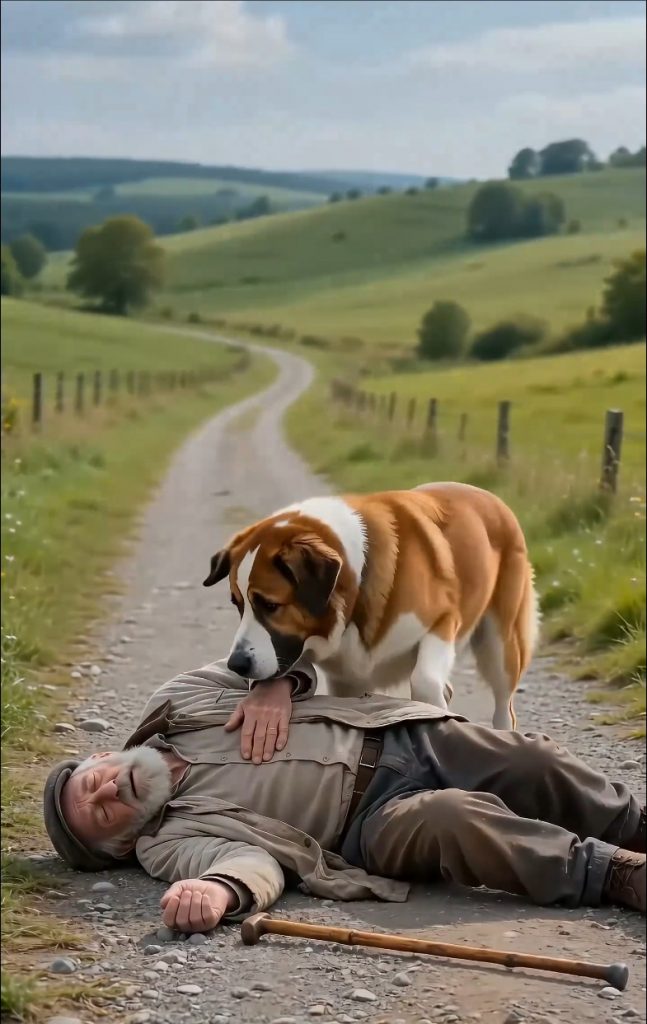
He fell sideways onto the quiet rural road, not violently, but heavily enough to make his St. Bernard stop dead in the grass.
“Bruno,” Henry whispered.
The dog turned.
Bruno was huge, brown and white, with dark patient eyes that had watched the old man through snow, rain, mud, and heat. For years, he had walked at Henry’s hip, never ahead, never behind, always matching the old man’s fading pace.
Now he rushed back, paws scraping gravel.
Henry lay still, his breath shallow, his face pale under the summer light. His wooden cane was out of reach. His hat had slipped from his head. One hand trembled against the road.
Bruno lowered his nose to Henry’s cheek.
The old man’s eyelids fluttered.
“Go,” Henry breathed.
The dog whined.
“Home,” Henry whispered. “Get… help.”
But Bruno did not move.
Not at first.
He stood over Henry, confused by the impossible command. His whole life had been built around staying. Staying beside Henry in winter. Staying close in rain. Staying when the old man stopped to catch his breath and pretended he was admiring the fields.
But Henry’s hand fell weakly to the road.
Bruno barked once.
Sharp.
Desperate.
No one answered.
The countryside remained wide and empty, insects humming in the grass, the road stretching pale and silent in both directions.
Then Bruno saw the black shopping bag lying near Henry’s feet.
He had carried it every market day.
Bread. Milk. Medicine. Letters.
This time, it held something else.
Bruno grabbed the bag gently in his mouth, looked once more at the man who had never left him behind, and ran.
And miles away, in a farmhouse at the end of that same road, a woman who had not spoken to her father in six years heard a dog barking like grief had found a voice.
Act II
People in Millbrook Valley knew Henry Whitaker by the sound of his cane.
Tap.
Step.
Tap.
Step.
In winter, it clicked against frozen ground beneath a sky the color of tin. In autumn, it splashed through puddles while rain drummed against his black umbrella. In spring, it tapped along the soft roadside grass where wildflowers lifted their small faces toward the sun.
By summer, the taps slowed.
Everyone noticed.
No one said much.
That was the custom in rural towns. People watched. People worried. People brought casseroles when someone died and looked away when someone was too proud to need them before that.
Henry had once been impossible to miss.
He had owned the feed store beside the church road. He could lift fifty-pound sacks without complaint and laugh loud enough for customers to hear from the parking lot. His wife, Margaret, ran the register and knew every child’s birthday in the county.
Their only daughter, Claire, grew up behind that counter, doing homework between hay bales and bags of seed.
For a while, they were the kind of family people envied.
Then Margaret got sick.
Henry became quieter after she passed. The feed store closed a year later. Claire left for nursing school, then came home, then left again after the argument no one in town ever fully understood.
All anyone knew was that Henry and Claire stopped speaking.
And then Bruno appeared.
He was a St. Bernard puppy then, too big for his own paws, with ears like folded velvet and a heart that seemed to belong to everyone. Margaret had chosen him before she died, saying Henry would need someone stubborn enough to drag him outside after she was gone.
She had been right.
Every morning, Bruno nosed Henry’s hand until the old man rose from his chair. Every afternoon, they walked.
At first, it was just to the mailbox.
Then to the old bridge.
Then farther.
All the way down the long road toward the southern ridge, where Claire lived with her husband and little boy in a farmhouse Henry had never entered.
He never knocked.
He never crossed the gate.
He simply walked close enough to see the roof, then turned back.
In winter, Bruno carried the black shopping bag in his mouth, packed with small things Henry told himself he had bought by mistake.
Children’s mittens.
A jar of peach jam.
A wooden toy truck wrapped in newspaper.
He left the bag by Claire’s mailbox and walked away before anyone saw him.
In rainy autumn, he brought cough syrup, canned soup, and a note he did not sign.
In spring, he left seed packets because Margaret had once promised Claire a garden full of marigolds.
Every time, Claire knew.
Every time, she found the bag.
Every time, she refused to call.
Because love can harden when it is wounded for too long.
And Henry, who could face snow, rain, and failing knees, could not face his daughter’s silence.
So he walked.
Season after season.
The road became his apology.
But apologies spoken only to gravel do not always arrive in time.
Act III
The fight between Henry and Claire had begun with money, but that was not what broke them.
It began after Margaret’s funeral, when grief turned the farmhouse cold and every room seemed to accuse the people left inside.
Claire wanted Henry to sell the feed store.
“You can’t run it alone,” she told him.
Henry heard something else.
You are weak.
You are finished.
He refused.
She offered to move back for a while.
He refused that too.
She said he was being proud.
He said she was being selfish.
Then came the worst sentence.
Claire, exhausted and crying, said, “Mom spent her last year worrying about you, and you still won’t let anyone help.”
Henry said, “Your mother understood loyalty. You ran the first chance you got.”
Claire stared at him as if he had slapped the child she used to be.
She left the next morning.
Henry expected her to come back angry.
She did not.
He expected her to call.
She did not.
He told himself she needed time. Then he told himself she had chosen her life. Then he told himself he was better off not begging for a place in it.
But the first Christmas without Margaret, Henry bought a wooden train for Claire’s son, Ben, a grandson he had seen only twice.
He sat with it at the kitchen table for three nights.
On the fourth, he put it in a black shopping bag and walked through fresh snow with Bruno beside him.
That became the pattern.
The town saw an old man walking.
They did not see the ritual.
They did not see Henry standing at the bend near Claire’s farmhouse, watching smoke rise from the chimney.
They did not see him whisper, “Tell her I’m sorry,” to a dog who could not carry words.
Bruno understood more than people gave him credit for.
He knew when Henry’s hand shook before they reached the mailbox. He knew when the old man’s breathing changed on the hill. He knew when Henry packed the black bag differently from groceries, with careful hands and a pain that smelled like rain even on clear days.
That summer morning, Henry packed the bag at dawn.
Inside were three things.
A bottle of heart medicine.
A wooden toy boat he had carved for Ben.
And an envelope addressed to Claire.
He had rewritten the letter eleven times.
The final version was short.
Claire,
I was cruel because I was afraid. Your mother knew that before I did. I should have let you help me. I should have come to your door. I have watched your boy grow from the road because I did not know how to ask forgiveness without deserving it first.
I am asking now.
Dad.
Henry folded it before he could lose courage.
Then he put on his summer shirt, took his cane, and whistled for Bruno.
The dog came at once.
The road was warm.
The hills were green.
Henry told himself that this time, he would not stop at the mailbox.
This time, he would knock.
But halfway there, his body made a decision his heart had postponed too long.
And Bruno ran toward the only person who could still answer the letter.
Act IV
Claire Whitaker heard the barking while hanging sheets behind the farmhouse.
At first, she thought it was thunder.
Then the sound came again.
Deep. Frantic. Wrong.
She turned and saw Bruno at the gate with the black shopping bag in his mouth.
Her hands went cold.
For six years, the bag had appeared by the mailbox like a ghost. Always full of things no stranger would know they needed. Always delivered without a knock.
Ben’s mittens when the first snow came early.
Soup when Claire caught the flu.
Marigold seeds after she mentioned at the market that her garden looked empty.
She had told herself not to care.
She had failed every time.
Now the dog stood alone.
No cane tapping behind him.
No old man at the bend.
Just Bruno, panting hard, eyes wide, the bag swinging from his mouth.
Claire dropped the sheet.
“Where is he?”
Bruno barked and spun toward the road.
Claire ran.
She did not stop for her coat. She did not close the gate. She barely heard Ben calling from the porch as she sprinted after the dog, her boots slipping in the dry dust of the lane.
Bruno kept looking back to make sure she followed.
At the bend, Claire saw the cane first.
It lay across the road like a broken line.
Then she saw her father.
“Dad!”
The word tore out of her before pride could stop it.
Henry was on his side near the edge of the road, one hand curled against the gravel, his face gray beneath his beard. Claire dropped beside him, nursing instincts rising through panic.
“Dad, can you hear me?”
His eyes opened a little.
For one breath, he seemed confused.
Then he saw her.
“Claire,” he whispered.
She pressed trembling fingers to his wrist.
His pulse was weak but there.
“Don’t talk,” she said, already reaching for her phone. “I’m calling an ambulance.”
He tried to move his hand.
Bruno whined beside him.
Claire saw the black bag lying in the grass where Bruno had dropped it. The envelope had slipped halfway out.
Her name was written across it in Henry’s uneven handwriting.
She looked at him.
Tears blurred the road.
“You were coming to me?”
Henry’s mouth trembled.
“I was late,” he breathed.
Claire broke then.
Not loudly.
Just a sound from somewhere so deep it seemed to carry every birthday missed, every Christmas bag found, every phone call never made.
“No,” she whispered, taking his hand. “You’re here.”
The ambulance arrived fifteen minutes later, though it felt longer.
Ben rode in Claire’s husband’s truck behind them, crying quietly with Bruno pressed against his side. The dog refused to leave until the paramedics lifted Henry safely inside.
Even then, Bruno tried to climb in after him.
One medic finally said, “Let him ride.”
So Bruno did.
He sat on the floor of the ambulance with his great head resting against Henry’s blanket, eyes fixed on the old man’s face as the siren carried them down the same road Henry had walked for years.
This time, he did not walk alone.
And this time, Claire did not let him disappear at the mailbox.
Act V
Henry woke in the hospital two days later.
The first thing he saw was not the white ceiling.
It was Bruno.
The St. Bernard lay beside the bed, technically not supposed to be there, wearing a red therapy-dog vest a nurse had borrowed from another ward because everyone had already decided rules could bend for a dog who had saved a man’s life.
Henry blinked slowly.
Bruno lifted his head.
His tail thumped once.
Then Henry saw Claire asleep in the chair by the window, one hand still holding the envelope he had written.
She had read it.
He knew by the way the paper had softened at the folds.
“Claire,” he whispered.
Her eyes opened immediately.
For a moment, they only stared at each other.
Six years of silence sat between them, heavy and useless.
Henry tried to speak first, but his voice failed.
Claire moved to the side of the bed.
“I got your letter,” she said.
He closed his eyes.
“I should have said it sooner.”
“Yes,” she said.
The honesty hurt.
Then she took his hand.
“But you said it.”
Henry swallowed hard.
“I watched from the road because I was ashamed.”
“I know.”
“I left the bags because I missed you.”
“I know.”
“I thought if I knocked, you’d send me away.”
Claire’s face crumpled.
“I thought if you wanted us, you would knock.”
That was the tragedy.
Not hatred.
Not absence of love.
Two people waiting on opposite sides of pride, mistaking silence for proof they were unwanted.
Henry cried then, quietly, his weathered face turned toward the window.
Claire bent over him and held him the way she had wanted to hold him at Margaret’s funeral, before both of them became too angry to be broken together.
“I’m sorry,” Henry whispered.
Claire pressed her forehead to his hand.
“Me too.”
Bruno sighed under the bed as if the matter had taken far too long.
Recovery did not make Henry young again.
It did not erase the years from his bones or return the strength to his legs. He moved slower after the hospital. His cane became a walker for a while. The road outside Claire’s farmhouse looked longer than ever.
But Henry no longer walked it as punishment.
He moved into the small guest room behind Claire’s kitchen at the end of summer.
He protested, of course.
He said he did not want to be a burden.
Claire told him burdens did not carve toy boats for grandsons or teach dogs how to carry groceries. Then she handed him a towel and told him to dry dishes if he wanted to be useful.
Ben adored him cautiously at first, then completely.
The boy asked about the old feed store, about Margaret, about why Bruno drooled so much, about whether Grandpa had really walked through snow just to leave mittens in the mailbox.
Henry answered every question.
Even the hard ones.
“Yes,” he told Ben one evening, sitting on the porch as fireflies rose from the grass. “I walked all that way because I was too stubborn to do the simple thing.”
“What was the simple thing?” Ben asked.
Henry looked at Claire, who was watering the marigolds near the fence.
“Knock on the door.”
Ben considered that.
Then he said, “Bruno knocked for you.”
Henry laughed until his eyes filled.
“Yes,” he said. “He did.”
Autumn came again.
This time, Henry did not walk the road alone under a black umbrella. Claire walked on one side, Ben on the other, and Bruno carried the black shopping bag proudly in his mouth. Inside were apples from the market, a newspaper, and a bag of dog treats Ben insisted Bruno had earned.
The rain fell softly.
The cane tapped.
The paws splashed.
But the sound no longer felt like loneliness moving through weather.
It sounded like a family learning a new rhythm.
Winter arrived months later with snow on the fences and white fields stretching quiet under a pale sky. Henry stood at the farmhouse window, watching flakes drift past the glass. For the first time in years, he did not feel the road calling him with unfinished things.
Claire came beside him with two mugs of tea.
“You thinking about walking?” she asked.
Henry smiled faintly.
“Not today.”
Bruno, hearing the word walking, lifted his head from the rug.
Ben laughed from the kitchen table.
Henry looked around the room.
At his daughter.
At his grandson.
At the dog Margaret had chosen because she had known him better than he knew himself.
The black shopping bag hung by the door, empty now.
No secret gifts inside.
No unsigned apologies.
No medicine carried too late.
Just a bag waiting for ordinary errands.
That was how Henry knew he had been forgiven enough to stay.
Months after his collapse, the town still talked about the St. Bernard who ran three miles with a shopping bag in his mouth and brought Claire Whitaker to the road in time. People called Bruno a hero whenever they saw him outside the market.
Bruno accepted praise with solemn dignity, especially if it involved biscuits.
But Claire knew the truth was bigger than rescue.
Bruno had not only saved Henry’s life.
He had carried a father’s apology the last distance pride could not cross.
And on quiet evenings, when the sun lowered over the summer hills and Henry’s cane rested beside the porch chair instead of lying abandoned in the road, Claire would look at Bruno sleeping at her father’s feet and think of all the seasons they had lost.
Snow.
Rain.
Grass.
Heat.
All those walks toward a home Henry believed he no longer deserved.
All those bags left at the edge of forgiveness.
And the dog who understood, before any of them did, that love does not always need the right words.
Sometimes it needs paws on gravel.
A black bag in its mouth.
And the courage to run back alone when the man who kept walking finally falls.