Act I
The hallway was so quiet that the mop sounded louder than footsteps.
Elena Morales dragged it across the polished gray floor in slow, wet strokes, her yellow gloves tight around the handle, her shoulders bent from a twelve-hour day that was not yet over. Fluorescent lights hummed above her. The blue mop bucket sat beside the cleaning cart, its wheels locked near a closed conference room door.
Against the wall, her son sat with his knees pulled close.
Mateo was seventeen, though exhaustion made him look younger. His curly dark hair fell over his forehead as he stared at a smartphone, trying to read exam notes on a screen with a crack running through the corner. His backpack rested beside him, half-open, stuffed with notebooks, pens, and a calculator he had borrowed from school.
He was trying to be invisible.
Elena had taught him that without ever meaning to.
Be quiet. Take up less space. Don’t make trouble. Don’t give anyone a reason to complain.
Then the sharp sound of dress shoes cut through the corridor.
Elena stopped mopping.
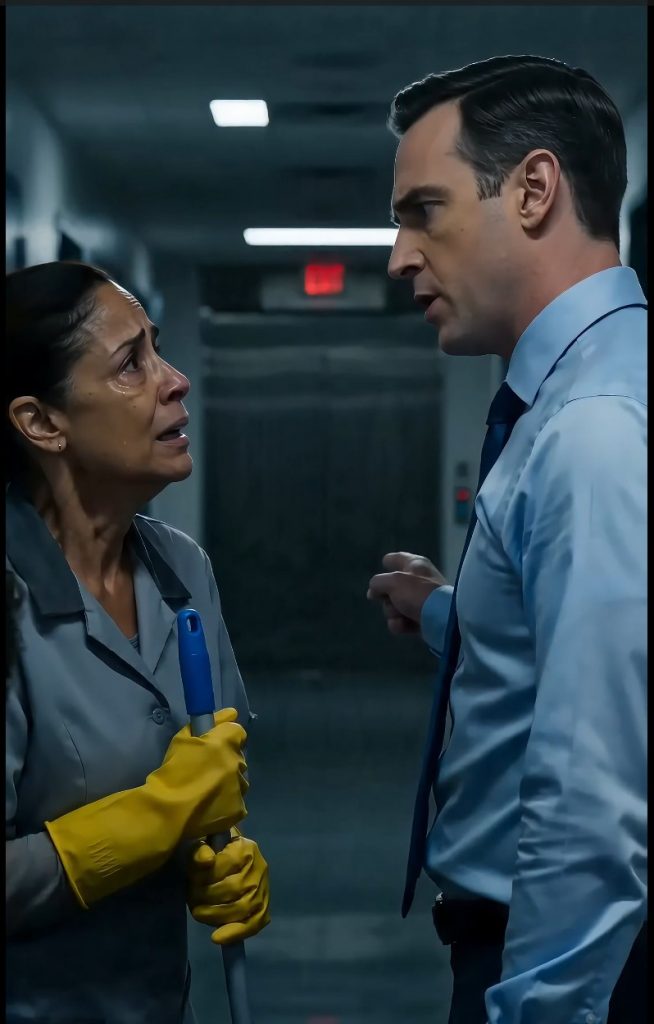
Martin Cole appeared at the end of the hall in a light blue dress shirt and dark tie, his face already twisted with irritation before he reached them. He was the night operations manager, a man who treated the building like his kingdom and everyone beneath him like an inconvenience.
His eyes moved from Elena to the boy on the floor.
“Why is your kid here after hours?”
Mateo lowered his phone.
Elena tightened both hands around the mop handle. “Sir, our internet got cut. He has an exam tomorrow.”
Her voice trembled, and she hated herself for it.
She hated that poverty always sounded like begging when spoken out loud.
Martin looked at Mateo’s backpack, then at the damp floor, then back at Elena.
“This is an office,” he said coldly, pointing toward the elevator. “Not a school.”
Mateo’s face changed.
Not much.
Just enough for Elena to see the small collapse behind his eyes.
He reached for his backpack and began sliding the phone inside.
“It’s okay, Mom,” he said softly. “I’ll fail quietly.”
Elena’s breath broke.
The mop slipped slightly in her gloves.
Martin gave a humorless laugh, the kind people use when they want cruelty to sound like discipline.
“That’s probably for the best. Maybe he’ll learn rules matter.”
Elena looked up.
For one second, anger rose in her so sharply she almost forgot fear. But then she saw the badge on Martin’s belt, the office keys in his hand, the power he had over her schedule, her paycheck, her job.
So she swallowed it.
She swallowed what she had swallowed for years.
Mateo zipped his backpack halfway.
Then the elevator dinged.
The sound moved through the hallway like a blade through silk.
The doors opened at the far end, spilling warm light onto the cold floor.
A man in a dark tailored suit stepped out.
He did not hurry. He did not raise his voice. He simply stood there, shoulders straight, eyes fixed on Martin Cole.
Martin’s pointing hand lowered.
The man’s voice was quiet.
“Say that again.”
And in that moment, Elena realized the most powerful person in the building had heard everything.
But Martin did not yet know why that mattered.
Act II
Elena had promised herself she would never bring Mateo to the office.
Not because she was ashamed of him.
Because she was ashamed of the way people looked at him when they realized he belonged to the woman holding the mop.
He had grown up in the spaces between her shifts. In laundromats. Bus stops. Hospital waiting rooms. Break rooms where employees pretended not to notice him sitting with a book while his mother cleaned the floors under their expensive shoes.
He never complained.
That was the worst part.
Other boys wanted sneakers, cars, weekends, new phones. Mateo asked for Wi-Fi and quiet.
Their internet had been cut off two nights earlier after Elena’s paycheck came up short again. Martin blamed a “timekeeping adjustment.” He said she had logged too many minutes between floors. He said the company could not pay for “wandering.”
Elena knew what that meant.
She had been mopping executive suites while someone else adjusted her hours behind a desk.
Mateo had seen the bill on the kitchen table. He had seen her counting cash with lips moving silently, choosing between the internet and groceries.
“Mom,” he had said, “I can study at the library.”
But the library closed at eight.
The exam was at seven in the morning.
It was not just any exam. It was the final qualifying test for the Mercer Future Scholars program, a full scholarship sponsored by the company whose floors Elena cleaned every night.
Mateo had applied without telling her.
He had written his essay on his phone during bus rides, after homework, after helping his mother carry laundry up three flights of stairs. He wrote about algorithms, public schools, and the strange loneliness of being poor in a city full of glass towers.
He also wrote about Elena.
My mother cleans the offices of people who build the future, he had written. I want to build one where women like her do not have to apologize for needing help.
When Elena finally found out, she cried into a dish towel so he would not see.
He was one of six finalists.
Tomorrow’s exam could change everything.
That was why she had brought him to the building after his shift at the diner ended. She told herself it was harmless. He would sit quietly against the wall for one hour, use the building’s guest Wi-Fi, review his math notes, and then they would take the last bus home.
No one would know.
No one would care.
But Martin Cole always cared when caring gave him someone to punish.
He had disliked Elena from the first week he became night operations manager. She did not flatter him. She did not laugh at his jokes. She corrected him once when he called her “the cleaning woman” instead of her name.
After that, her schedule got worse.
Her supply requests disappeared.
Her timecards changed.
And when she asked questions, Martin smiled like a man offering advice.
“People in your position should be careful,” he told her once. “Jobs like this are replaceable.”
Elena remembered every word.
Now, standing in the cold hallway with her son holding a half-zipped backpack, she understood that Martin had not seen a student preparing for an exam.
He had seen a cleaner’s child using light he had not paid for.
The man from the elevator began walking toward them.
His polished shoes crossed the damp reflection of the floor Elena had just mopped. His expression remained controlled, but something in his eyes made the hallway feel smaller.
Martin straightened too quickly.
“Mr. Mercer,” he said.
Mateo looked up.
Elena stopped breathing.
Everyone in the building knew that name.
Adrian Mercer.
Chief executive officer. Son of the company’s founder. The man whose signature appeared on letters Elena had only ever seen taped to elevator walls or framed in the lobby.
Martin tried to smile.
“Sir, I was just handling a minor after-hours policy issue.”
Adrian Mercer’s eyes moved to Mateo’s backpack.
Then to Elena’s gloves.
Then back to Martin.
“A policy issue,” he repeated.
Martin nodded, recovering some of his confidence. “Yes, sir. Unauthorized guest in a restricted workplace area.”
Adrian looked at Mateo.
“What’s your name?”
Mateo swallowed.
“Mateo Morales, sir.”
For the first time, Adrian Mercer’s expression changed.
Only slightly.
But Elena saw it.
Recognition.
And then the power in the hallway shifted again.
Because Adrian Mercer had not come downstairs by accident.
Act III
Adrian took one step closer.
“Mateo Morales,” he said. “Finalist number four.”
Mateo blinked.
Elena looked from her son to the executive, unable to understand how those words belonged in the same sentence.
Martin’s smile weakened.
“Sir?”
Adrian did not look at him.
“I read your essay this morning.”
Mateo’s face flushed. “You did?”
“I did.”
The hallway fell into a silence deeper than before.
Adrian reached into his coat pocket and pulled out a folded paper. He opened it with calm precision.
“‘My mother cleans the offices of people who build the future,’” he read. “‘I want to build one where women like her do not have to apologize for needing help.’”
Elena covered her mouth with one yellow-gloved hand.
Mateo stared at the floor, embarrassed and overwhelmed.
Adrian folded the paper again.
“My father started that scholarship because he was once a night janitor studying under a loading dock light,” he said. “He believed talent doesn’t always arrive through the front door.”
Martin said nothing.
His face had gone pale.
Adrian finally turned to him.
“So when you said this is an office, not a school, I need to know exactly what you meant.”
Martin adjusted his tie.
“Sir, I didn’t know he was connected to the scholarship.”
The sentence landed badly.
Adrian’s eyes hardened.
“So he deserved respect only if he was connected to something I cared about?”
Martin opened his mouth.
No answer came.
Elena lowered her hand. “Please, sir. I’m sorry. I knew I wasn’t supposed to bring him. I just needed him to study for one hour. We don’t have internet right now.”
Adrian’s gaze softened when he looked at her.
“Mrs. Morales, did your internet get cut because your paycheck was short?”
Elena froze.
Martin’s head snapped toward Adrian.
The executive continued, his voice still calm.
“Payroll flagged a complaint last week. Three cleaning staff members under Mr. Cole’s supervision reported missing hours. Yours was one of them.”
Martin spoke quickly.
“That was a clerical correction.”
Adrian looked at him.
“Then you won’t mind explaining it to the audit team.”
The color drained from Martin’s face.
Mateo slowly stood, backpack hanging from one shoulder.
“Mom,” he whispered.
Elena wished she could answer, but the world had tilted too quickly. A few minutes ago, she had been afraid of losing her job. Now the CEO of the company was standing in front of her, holding her son’s essay, talking about missing wages as if he had known all along.
Adrian turned toward Mateo.
“You have your exam tomorrow?”
“Yes, sir.”
“Have you eaten?”
Mateo hesitated.
That hesitation said enough.
Adrian’s jaw tightened.
Then he looked back at Martin.
“You ordered him to leave?”
Martin’s mouth moved, but no sound came.
Adrian stepped closer.
“And you told him it might be best if he failed?”
Elena saw Martin understand, finally, that the hallway itself had become a witness.
The mop.
The wet floor.
The backpack.
The boy with the quiet voice.
The mother who had begged for one hour of light.
Adrian’s voice dropped.
“Mr. Cole, your office. Now.”
Martin swallowed.
But before he could move, Mateo spoke.
“Sir?”
Adrian turned.
Mateo held the phone in both hands. “Please don’t fire my mom.”
Elena shut her eyes.
Of all the things her son could have asked for, he asked for her safety.
Adrian looked at him for a long moment.
Then he said, “Your mother is not the person whose job is in danger.”
And Martin Cole’s arrogance finally began to collapse.
Act IV
They did not go to Martin’s office.
Adrian stopped halfway down the corridor and looked at the damp floor.
“Mrs. Morales,” he said, “is this section still wet?”
Elena nodded automatically. “Yes, sir.”
“Then no one walks through it until you say it’s safe.”
It was a small sentence.
But it changed something.
For years, people had stepped over Elena’s work, around it, through it, across it, as if the labor only existed when it was missing.
Now the CEO waited for her permission.
Elena’s lips trembled.
“It’s safer by the wall,” she said.
Adrian nodded. “Thank you.”
Martin stared at the floor like it had betrayed him.
They walked around the wet section, past the cleaning cart and blue bucket, toward the glass conference room near the elevator. Adrian opened the door himself and gestured for Elena and Mateo to enter.
Martin followed last.
Inside, the room smelled like coffee, leather chairs, and money.
Mateo stood awkwardly near the table, afraid to touch anything.
Adrian noticed.
“Sit,” he said gently. “You have an exam to prepare for.”
Mateo sat.
Adrian tapped the wall screen, connected the conference room Wi-Fi, and placed the password on the table in front of him.
Then he picked up the phone.
“Security,” he said. “Please send HR and internal audit to Conference Room B. Also bring dinner for two from the executive kitchen. Something hot.”
Elena shook her head quickly. “Sir, that isn’t necessary.”
Adrian looked at her.
“It is.”
Martin tried again.
“Mr. Mercer, I think this has been blown out of proportion. I enforce rules. That’s my role.”
Adrian leaned back against the table.
“Rules without judgment are just weapons with paperwork.”
Martin flushed.
“I would never intentionally mistreat an employee.”
Adrian opened a tablet and turned it toward him.
The screen showed timecards.
Elena recognized her employee number.
Her shifts had been shortened by eleven minutes here, fourteen minutes there, twenty-three minutes on nights when she stayed late to clean boardrooms after meetings. Tiny cuts. Small enough to hide. Large enough to matter.
Adrian swiped to another page.
Two more names.
Two more cleaners.
Two more patterns.
Martin’s voice thinned. “I was managing overtime.”
“You were stealing wages.”
The words were quiet.
They were also final.
Martin looked at Elena then, not with remorse, but with accusation, as if her poverty had embarrassed him by becoming evidence.
Adrian saw that too.
“Don’t look at her,” he said. “Look at me.”
Martin obeyed.
The door opened.
A woman from HR entered with a folder. Behind her came a security supervisor and a man in rolled-up sleeves carrying a laptop. The atmosphere in the room shifted from confrontation to consequence.
Elena stood immediately.
“I should finish the hallway.”
Adrian shook his head.
“Your shift is over. Paid.”
“I can’t leave it wet.”
“Then we’ll wait until another cleaner is assigned and paid properly to finish it.”
Elena did not know what to do with that kind of sentence.
Paid properly.
It sounded almost impossible.
Mateo stared at his phone, but he was not reading anymore. Tears had filled his eyes, and he was trying hard not to let them fall in front of strangers.
Adrian sat across from him.
“I meant what I said about your essay,” he said. “It was the strongest one I read.”
Mateo wiped his cheek quickly with his sleeve.
“I wrote it on the bus.”
“I could tell,” Adrian said.
Mateo looked embarrassed.
Adrian smiled faintly. “That was a compliment.”
For the first time that night, Mateo almost smiled back.
Then Adrian turned to HR.
“Mrs. Morales receives full back pay for all adjusted hours by Friday. Review every employee under Mr. Cole for the last eighteen months. Until the investigation is complete, Mr. Cole is suspended from all supervisory duties.”
Martin’s mouth fell open.
“Suspended?”
Adrian looked at him the way he had looked in the hallway.
Cold.
Controlled.
Unforgiving.
“This is an office,” Adrian said. “Not a place to make people small.”
Martin had no answer left.
And for Elena, that silence sounded like justice beginning to breathe.
Act V
Mateo took the exam in the executive conference room.
He sat at the long table beneath lights brighter than the ones in their apartment, with a plate of untouched pasta beside him and his mother two chairs away, still in her gray uniform and yellow gloves folded neatly in her lap.
Elena tried not to cry.
She failed several times.
Whenever Mateo looked up, she wiped her face and pretended to be reading the emergency exit map on the wall.
Adrian gave them privacy. He stood outside the glass door with HR, audit, and security, speaking in low voices while the rest of the building slept above them.
At one point, Elena looked through the glass and saw Martin Cole being escorted toward the elevator.
He did not look at her.
She was grateful for that.
Not because she was afraid of him anymore.
Because she did not want to waste another piece of herself on his shame.
The exam lasted ninety minutes.
When Mateo finally hit submit, he sat very still.
Elena leaned forward. “Is it done?”
He nodded.
“How do you feel?”
Mateo let out a shaky breath.
“Like I didn’t fail quietly.”
Elena laughed through tears.
Then she hugged him, carefully at first, because he was seventeen and taller than her now, and then tightly because he folded into her like the little boy who used to fall asleep on bus rides against her shoulder.
Adrian stepped in only after they separated.
“Whatever happens with the scholarship,” he said, “you have a place to study here until graduation. Properly arranged. No hiding in corridors.”
Mateo looked stunned.
Elena shook her head. “We can’t accept—”
“You can,” Adrian said. “And you should.”
He glanced at the conference room, the glass walls, the city lights beyond the blinds.
“This building has rooms sitting empty every night while people who clean them go home to darkness. My father would have hated that.”
That was how the first after-hours study room began.
Not with a press release.
Not with a ribbon cutting.
With one boy, one borrowed phone, and one mother who had been brave enough to ask for mercy from the wrong man until the right one heard.
The investigation widened.
Martin’s wage adjustments were not mistakes. They were a pattern. He had shaved minutes from workers who were least likely to complain, denied supply requests, and threatened schedules whenever anyone questioned him.
By the end of the month, he was gone.
Elena received back pay large enough to turn their internet back on, repair the fridge, and buy Mateo a refurbished laptop that he touched like it might disappear.
Two weeks later, the scholarship results arrived.
Elena was making coffee when Mateo opened the email.
He stared at the screen for so long she thought the worst.
Then he covered his mouth.
“Mom.”
She crossed the kitchen in three steps.
He turned the laptop toward her.
Congratulations, Mateo Morales.
Elena read the first line.
Then she read it again because joy, like grief, sometimes takes time to become real.
Full scholarship.
Mentorship placement.
Summer internship.
Future Scholars Class of 2027.
Elena sat down before her knees gave out.
Mateo laughed and cried at the same time, and Elena pulled him into her arms so fiercely the chair scraped backward across the kitchen floor.
Their apartment was still small.
The paint still peeled near the window.
The bills did not magically vanish.
But something had opened.
A door.
A future.
A place where her son’s talent was no longer forced to survive on borrowed Wi-Fi and hallway light.
Months later, Elena returned to the same corridor on a Monday night.
The floors still shone gray under the fluorescent lights. The HVAC still hummed. Her cleaning cart still rattled slightly when the front wheel caught the tile seam near the elevator.
But the hallway did not feel the same.
Beside the conference rooms, a new sign had been installed.
After-Hours Learning Room
Open to all night-shift employees and their families by registration.
Inside, two children did homework at a table. A security guard’s daughter watched a science lecture with headphones. One of the cafeteria workers practiced English vocabulary on a company laptop.
Mateo was there too, not because he needed the Wi-Fi anymore, but because he had volunteered to tutor twice a week.
He looked up when Elena passed.
“You okay, Mom?”
She smiled.
“I’m working.”
He grinned. “I know. I just like asking.”
Elena laughed softly and kept moving the mop across the floor.
At the end of the hall, the elevator dinged.
For a moment, the old memory returned.
Martin’s voice.
Mateo’s defeated whisper.
The cruel point toward the exit.
This is an office, not a school.
Then the doors opened, and Adrian Mercer stepped out carrying a stack of folders. He paused when he saw Elena and nodded with the same respect he gave board members in tailored suits.
“Good evening, Mrs. Morales.”
“Good evening, Mr. Mercer.”
He looked toward the learning room, where Mateo was helping a little girl solve a math problem.
“Looks like the office became a school after all,” he said.
Elena looked through the glass.
Her son was leaning over the table, patient and gentle, showing another child how to find an answer without making her feel foolish for not knowing it yet.
Elena’s eyes warmed.
“Yes,” she said. “It did.”
Adrian smiled and walked on.
Elena dipped the mop into the blue bucket, wrung it carefully, and watched clean water spread across the floor in shining strokes.
Once, that hallway had been the place where her son prepared to give up quietly.
Now it carried the sound of pencils, whispered questions, soft laughter, and futures being built after dark.
The floor still needed cleaning.
The work still mattered.
But Elena no longer felt invisible doing it.
Because one night, under cold fluorescent lights, a cruel man tried to make her son small.
And the elevator opened before he finished.