Act I: The Brush on the Floor
The hallway at Atlantic Naval Command Academy was too bright for humiliation.
White overhead lights reflected off waxed tile and polished brass plaques, turning every uniform button into a little mirror. The corridor ran long and straight between dormitory wings and briefing rooms, with enough space for voices to echo and enough traffic for shame to travel quickly.
That afternoon, every eye in it was on me.
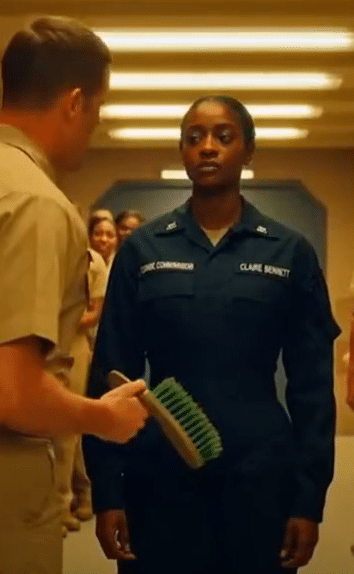
I had come straight from the lower maintenance decks in dark navy coveralls, the kind officers wore when inspections ran long and ceremonial appearances could wait. My name was stitched in black thread over the breast pocket: Claire Bennett.
That should have been enough.
It wasn’t.
Lieutenant Nolan Pike stood in front of me in khaki, broad-shouldered and smug, with the posture of a man who had been praised too often for things he had never truly earned. He had one hand on his belt and the other holding a long-handled scrub brush like it was an insult he hadn’t finished delivering yet.
Around him, seven or eight junior officers and cadets lined the corridor in loose formation. Some leaned against the wall. Some pretended not to be enjoying it. A few of them were already smiling before Nolan even opened his mouth.
“New girl,” he said, “grab that brush.”
His voice carried.
That was deliberate.
Everything Nolan Pike did in public was deliberate. He understood the power of a hallway audience. It was easier to turn cruelty into culture when enough people were watching and no one wanted to be next.
I looked at the brush but didn’t move.
He smiled when I stayed still.
Then he dropped it.
The wooden handle clattered loudly against the tile, bouncing once before spinning to a stop near my boots. The sound snapped through the corridor, and the cadets behind him laughed exactly on cue.
It wasn’t the laughter itself that bothered me.
It was how familiar it sounded.
I had heard versions of it twenty years earlier as a plebe at the same academy, when some men still believed a Black woman in uniform was either a mistake, a concession, or a problem waiting to prove their worldview correct. I had heard it after my first navigation exam, after my first command drill, after my first commendation, when praise made them meaner because competence was harder to dismiss than hope.
And now, after all the years between, here it was again.
Cheap.
Cowardly.
Confident.
Nolan tipped his head slightly, amused that I had not yet bent to pick up what he had thrown at my feet.
“What?” he said. “You deaf?”
Someone along the wall snorted. Another cadet lowered his eyes, uncomfortable but still silent. That was how places like this rot. Not just through the men who start it, but through the ones who decide not to interrupt.
I kept my hands at my sides.
I kept my face neutral.
I had learned long ago that some men mistake emotion for surrender. They want outrage because it gives them something to discipline. They want tears because they know how to stand over them. Calm is what unsettles them.
Nolan took a half step closer.
“Pick. It. Up.”
He said it slowly, like the problem here was my comprehension and not his character.
A female cadet near the far wall shifted her weight and looked at me with the kind of expression I recognized immediately. Not pity. Alarm. The look of someone who had already learned which humiliations the institution expected her to survive quietly.
I could have ended it then.
I could have told him my rank.
I could have told him I was the incoming commander of the entire corridor he was using as a stage.
I could have watched the color leave his face in real time.
But I didn’t.
Not yet.
Because what mattered in moments like that was not simply that one arrogant lieutenant had mistaken me for someone he could order around. What mattered was how many people around him thought the mistake made sense.
Nolan pointed toward the far end of the hall where a maintenance cart sat parked beneath an emergency light panel.
“You know what your problem is?” he asked. “People let you stand around too long pretending you belong here.”
That got him another ripple of laughter.
Then he leaned in and lowered his voice just enough to make the cruelty feel more intimate.
“You’re in the wrong hallway.”
I looked at the brush again.
Then up at him.
And said nothing.
That was when his smile sharpened.
He mistook silence for submission.
He always had.
He didn’t know that my orders had been signed two floors above his head six hours earlier. He didn’t know the command transfer had been moved up without announcement because the Secretary’s office wanted fresh eyes on academy discipline before the next training cycle. He didn’t know that I had chosen to arrive in coveralls on purpose, before the ceremony, because I wanted one honest look at the building before it learned my title.
And he definitely didn’t know that every second he kept performing in front of that hallway was becoming evidence.
Then the elevator at the far end of the corridor lit red and began to descend.
Act II: Why I Came Back in Coveralls
I had not planned to return to Atlantic Naval Command Academy.
Some places are too deeply fused to the bones to revisit without cost. The academy was one of mine. It taught me celestial navigation, operational command, and the exact flavor of loneliness that comes from being the first person in a room no one had imagined needing to make space for.
At nineteen, I learned to survive there.
At thirty-eight, I came back to decide whether it deserved to survive itself.
The orders arrived on a Tuesday night in Norfolk while I was still in engine-room coveralls from a training review aboard the Halsey. The Secretary wanted a new command structure installed before the autumn intake. Officially, it was a leadership transition.
Unofficially, it was an intervention.
Complaints had been building for months.
Racialized hazing hidden under “tradition.” Women in tactical tracks routed away from key assignments. Anonymous reports of humiliation rituals in hallways, maintenance bays, and late-night drills. Nothing spectacular enough to make headlines. That was the design. Institutions prefer their abuse procedural.
My name appeared because I had two things the academy board needed and feared.
A record they could not publicly discredit.
And a memory long enough to recognize their old tricks in new uniforms.
I knew Nolan Pike before I ever met him.
Not personally.
By type.
Golden boy. Third-generation naval family. Excellent evaluations from the sort of commanders who confuse confidence with leadership. Noted for presence, discipline, and “strong corridor control,” which is the kind of phrase people write when they are too lazy or complicit to name intimidation for what it is.
Three anonymous complaints mentioned him directly.
One called him “the man who turns hallways into little courts.”
Another said, “He humiliates people before he corrects them because the audience is the point.”
The third, written by someone who had probably deleted and retyped the sentence six times before submitting it, said simply: “He always chooses the person least likely to hit back.”
That last line stayed with me.
So when the academy arranged a formal command welcome with dress whites, photos, speeches, and a donor luncheon I did not want, I changed the terms. I told them I would arrive early, inspect quietly, and enter the building as I pleased.
Hence the coveralls.
Hence the hallway.
Hence Nolan Pike, standing above a scrub brush he had dropped for me in front of cadets who needed to learn exactly what this building had been rewarding while no one senior was looking.
The red light above the elevator was part of the old command protocol system. It only flashed for high-level arrival overrides or emergency access. Most cadets had never seen it used outside drills. That was why the corridor shifted before the doors even opened.
The laughter died first.
Then posture changed.
Cadets who had been leaning against the wall straightened instinctively. One young ensign took an involuntary step away from Nolan, as if he already sensed the geometry of the scene was about to turn against him. Nolan himself glanced toward the elevator with annoyance rather than concern.
He still thought he had time.
He didn’t.
I watched the doors part slowly beneath the red pulse and saw the command party reflected in the polished metal before I saw them directly. Dress whites. Medals. Caps. Authority carried not theatrically, but with the kind of quiet finality that empties a room before anyone speaks.
At the center was Admiral Thomas Reed.
White beard trimmed close. Face cut by weather, age, and the burden of having spent a career distinguishing between real sailors and decorated frauds. He had known me since I was twenty-three and half-convinced the service would rather wear me down than promote me.
He stepped out first.
Then two rear admirals behind him.
Then the academy’s civilian oversight chair, who looked like she had already been regretting the institution’s internal culture for years and had finally run out of patience for soft language.
Their eyes moved down the corridor.
Found Nolan.
Found the brush on the floor.
Found me standing still in dark coveralls while a hallway of cadets tried very hard not to look like witnesses.
And in that instant, I knew the moment no longer belonged to Lieutenant Pike.
It belonged to whatever Admiral Reed chose to say next.
Act III: The Name He Said Out Loud
Admiral Reed did not hurry.
That was the part that broke Nolan first.
Men like him prepare themselves for explosions. They know how to react to shouted orders, sudden fury, visible outrage. What they never prepare for is calm. Calm means the verdict has already been reached.
His shoes struck the tile in measured steps as he crossed the corridor. The two officers behind him spread slightly, creating the kind of formal angle that tells everyone present this is no longer ordinary hallway traffic. No one breathed loudly enough for me to hear it.
Nolan came to attention.
Too late.
He saluted so sharply it nearly looked painful.
“Sir—”
Reed didn’t even glance at him.
He came directly to me, stopped one pace away, and lowered his head the slightest fraction. The gesture was not theatrical. It was military. Precise enough to leave no ambiguity and restrained enough to make every witness fill in the rest for themselves.
“Commander Bennett,” he said. “Stand. This hallway answers to you.”
Something invisible snapped.
You could feel it in the air. In the way the cadets along the wall suddenly looked not at me, but at Nolan. In the way the brush on the floor no longer looked like a joke prop, but like evidence. In the way shame moved from one body to another without a single raised voice.
Nolan blinked.
Just once.
Then again, harder, as if his own eyes had become unreliable. He looked at me, at the name tape on my chest, at Admiral Reed, and then back to me as though maybe rank itself had become some sort of trick.
“What?” he said.
It came out exactly as frightened men always do when the hierarchy they trusted betrays them.
Not bold.
Not outraged.
Small.
The cadets heard it.
That mattered more than he knew.
Admiral Reed turned then, finally giving Nolan the full force of his attention. I had seen men collapse under enemy fire with more grace than Nolan Pike managed under that gaze.
“Lieutenant,” Reed said, “explain the brush.”
No one spoke.
Not Nolan.
Not the cadets.
Not the female ensign at the wall whose face had gone almost colorless.
The silence lengthened. Reed had always understood that silence is a weapon if you know how to hold it long enough. It gives the guilty room to reveal whether they possess shame or only fear.
Nolan swallowed.
“Sir, I believed she was—”
He stopped.
Reed’s expression did not change.
“You believed Commander Bennett was what?”
Nolan looked at me again. My coveralls. My skin. My sex. My stillness. All the assumptions he had stacked together fast enough to feel like certainty.
He could not finish the sentence because, for the first time, he heard it the way everyone else would.
I watched the realization spread through the hallway.
Not just that he had insulted the incoming commander.
But how.
Why.
What raw material in his mind had allowed him to look at a Black woman in naval coveralls with a name stitched across her chest and decide she was “new girl,” labor, target, audience meat.
The cadets were learning something too.
Not about me.
About him.
That may have frightened him most of all.
Admiral Reed looked down at the brush, then back at Nolan. “Pick it up.”
Nolan moved immediately.
He bent so fast his cap nearly slipped.
The room might have laughed if it hadn’t been so stunned.
But Reed wasn’t done.
“You dropped that brush to humiliate an officer before subordinates,” he said. “Whether you knew her rank or not is not the most damning fact here. The most damning fact is that you thought this was acceptable behavior toward anyone.”
The civilian oversight chair stepped forward then, speaking for the first time. Her voice was cool and clipped.
“Record every name in this corridor,” she said to the aide behind her. “Preserve camera footage. Freeze all pending evaluations tied to Lieutenant Pike’s supervisory authority.”
Now the fear moved beyond Nolan.
Cadets who had laughed were suddenly standing inside consequences they had not imagined could reach them. One looked physically sick. Another dropped his gaze to the floor and kept it there. The young female ensign at the wall closed her eyes briefly, and I wondered whether relief felt this much like dizziness.
Nolan straightened with the brush in his hand like a man holding the remains of his own judgment.
Then he looked at me.
For the first time, really looked.
And I let him.
Because now I wanted him to understand that I had stood there long enough to hear exactly what kind of institution he thought he served.
Act IV: What the Hallway Had Been Hiding
Admiral Reed asked if I wanted the corridor cleared.
I said no.
The answer surprised some of them. Not Reed. He knew me well enough to understand what I was looking at. Hallways like that are not just passageways. They are ecosystems. Ritual spaces. Places where cultures reveal themselves in miniature.
If I cleared the corridor too quickly, everyone would leave with private interpretations.
If I kept them there, they would have to watch.
“Lieutenant Pike,” I said, “who told you I was the new girl?”
His jaw tightened. He still held the brush.
“No one, ma’am.”
“Then why did you call me that?”
He didn’t answer.
Of course he didn’t. Because the truthful answer was not logistical. It was instinctive. He called me that because something in him saw woman, Black, coveralls, unfamiliar, and arranged those facts into permission.
I turned to the cadets lining the hall.
“Anyone else?”
No one spoke at first.
Then, from halfway down the wall, the female ensign lifted her chin. She couldn’t have been older than twenty-two. Her voice shook only once.
“He does it to everyone he thinks he can, ma’am.”
Nolan turned so sharply I thought he might forget himself completely.
“Ensign—”
“Stop,” I said.
He did.
That was the first time his obedience felt real.
The ensign swallowed and kept going. Once she started, the words seemed to arrive faster than her fear could block them. Late-night “corrective drills.” Public shaming. Men singled out for stutters, women singled out for tone, foreign-born cadets mocked under the cover of “toughening.” Nothing clean enough to report individually. Everything corrosive in accumulation.
One by one, others began speaking.
Not all.
That would have been too easy.
But enough.
A cadet from engineering admitted Pike made junior officers redo inspections in front of spectators just to prove he could. Another said hallway assignments were manipulated to isolate certain people. A third, red-faced with shame, admitted he laughed when Pike dropped the brush because “that’s what everyone does when he starts.”
Reed listened without interruption.
So did I.
This was the real inheritance of bad leadership—not one bully, but the little republic of silence that grows around him. The institution begins to call it resilience. Then standards. Then tradition. By the time someone senior decides to look properly, humiliation has already become grammar.
Nolan’s face had gone red under the fluorescent lights.
Not the theatrical red of embarrassment.
The raw, blotchy kind people get when they understand a room no longer belongs to them and might never again.
“I was maintaining discipline,” he said finally.
“No,” I told him. “You were renting yourself authority from other people’s fear.”
That line hit him harder than the admiral’s reprimand had.
Because punishment is something men like Nolan can narrate. They imagine themselves misunderstood, singled out, sacrificed for politics. But accurate description is harder to survive.
Reed asked for his sidearm, access card, and corridor authority tabs.
Nolan handed them over one at a time.
Each transfer sounded louder than it should have. Plastic against palm. Metal against metal. Little noises of ending.
Then Reed did something unexpected.
He looked at me.
“Commander Bennett,” he said, “this academy is yours as of 1800. What are your first standing orders?”
The hallway went still again.
This was the true pivot. Not Nolan’s humiliation. Mine. What I chose to do with the moment once power was formally placed in my hands.
I thought of myself at nineteen, standing in that same building after a senior midshipman told me women like me were public relations with pulse. I thought of all the reports softened before being filed, all the women who had learned to laugh first so no one could use their pain as a ranking exercise, all the men who had decided staying decent was more dangerous than staying included.
Then I looked at the brush in Nolan’s hand.
“First,” I said, “every unofficial corridor tradition is suspended pending review.”
I could feel relief move through some bodies like heat.
“Second, anonymous reporting becomes protected reporting. Names come to me, not through the chain that buried them.”
Now even the civilian oversight chair looked pleased.
“Third,” I said, “Lieutenant Pike will remain on administrative hold until I decide whether he belongs in uniform at all.”
Nolan shut his eyes.
Just briefly.
It was the closest thing to collapse I think he allowed himself.
Then I added the order I had known from the moment he dropped the brush.
“And before he leaves this corridor, he will apologize to every officer he taught to mistake humiliation for leadership.”
Act V: The Smile He Couldn’t Bear
He did it.
Not well.
Not gracefully.
But he did it.
Nolan Pike stood in the same fluorescent hallway where he had tried to make a lesson out of me and gave one halting apology after another to the people he had trained to laugh, freeze, or look away. He apologized to the female ensign first because Reed made him. He apologized to the engineering cadet next. He apologized to me last.
“I was wrong, Commander,” he said, staring somewhere near my collar and not quite at my face.
“Yes,” I said. “You were.”
I did not rescue him with language softer than truth. That would have been for my comfort, not his correction.
By 1800, his nameplate was off the corridor roster.
By 1900, the preserved footage was already in command review.
By morning, there were nine more statements on my desk.
That was the thing about fear once it loses its most convenient body. It does not vanish all at once, but it stops feeling immortal. People begin to imagine life after it. Then they start speaking.
I took formal command in dress whites the next day.
The academy assembled on the parade ground under a hard blue sky with gulls wheeling over the water beyond the eastern wall. Reed read the order. The colors moved. Cameras flashed for the official record. All of it was proper, clean, and late compared to what really mattered.
Because by then the true ceremony had already happened.
It happened in the hallway when the cadets saw a man like Nolan Pike stripped not of rank first, but of narrative. He was not exposed as a monster. That would have let too many others feel separate from him. He was exposed as something more ordinary and therefore more dangerous: a man the institution had rewarded until someone with enough authority finally insisted on naming him accurately.
Later that evening, when the building had quieted and the corridor lights had softened into night mode, I walked back through that same hall alone.
The brush was gone.
The walls were the same.
The floor still reflected light the same way it had when Nolan dropped it at my feet.
But the air was different.
Places hold memory. Good ones hold reform too, if you force them.
I stopped near the spot where I had first seen the brush spin to a stop and let myself feel, for one private second, the full weight of what almost happened and what did. If Reed’s elevator had opened two minutes later, if I had worn dress whites instead of coveralls, if I had announced myself first, Nolan would still have been Nolan. The culture would still have been there. Only hidden better.
That was why I did not regret the hallway.
Painful as it was, it told the truth quickly.
A knock sounded behind me.
It was the young ensign.
She looked embarrassed to interrupt, then set a small object on the ledge beneath the emergency light and stepped back.
It was a new floor brush.
Unused.
Clean.
I raised an eyebrow.
She gave the faintest smile. “Maintenance sent it up, ma’am. They said the old one finally ended up where it belonged.”
I laughed.
Not loudly.
Just enough.
She smiled back, relief loosening something in her face that had likely been clenched for months.
When she left, I looked at the brush a moment longer, then turned toward the dark window at the far end of the hall. My reflection looked older than I felt and steadier than I had been at nineteen.
Nolan’s last word in the corridor had been “What?”
People always think that’s the most important line in a reversal like this. The shock. The fear. The moment power realizes it has misjudged the room.
It isn’t.
The most important moment comes after.
When the person humiliated in public decides what expression to wear once the hierarchy breaks.
At the end of the footage, the one I reviewed alone just after midnight, you can see it clearly. Nolan’s face is flushed and stunned. Reed’s command party is visible near the elevator. The cadets are rigid at the wall.
And then the camera catches me in profile.
Calm.
Still.
The slightest smile at the corner of my mouth.
Not triumph.
Not cruelty returned.
Something better.
Recognition.
Because the hallway no longer belonged to the man who dropped the brush. It belonged, at last, to the woman who didn’t bend to pick it up.