Act I
The crusher was already halfway down when the men started laughing.
Metal groaned beneath the hydraulic press. The silver sedan buckled slowly, its roof folding under the enormous weight. Glass trembled in the window frames. Red plastic cracked at the rear taillight as the machine pushed the car lower into itself.
“Think fast, buddy!” the man in the brown leather jacket shouted.
His friend in the green jacket laughed and lit a cigarette.
Above them, inside the raised operator cabin, Mateo Rivas kept one hand near the controls and one eye on the pressure gauge. He had crushed thousands of cars in twenty-two years. He knew the difference between empty metal and metal that fought back.
This car sounded wrong.
Not just the frame.
Not just the suspension.
Something inside it made a muffled, desperate sound that disappeared under the grind of steel.
Mateo leaned forward.
Down below, the two men turned away from the sedan like they had just finished watching a joke. The man in green clicked his lighter shut and took a slow drag from his cigarette. The man in brown slapped the side of the crusher housing as if congratulating the machine.
Then the rear taillight moved.
Mateo froze.
A dull thump came from inside the crushed sedan.
Then another.
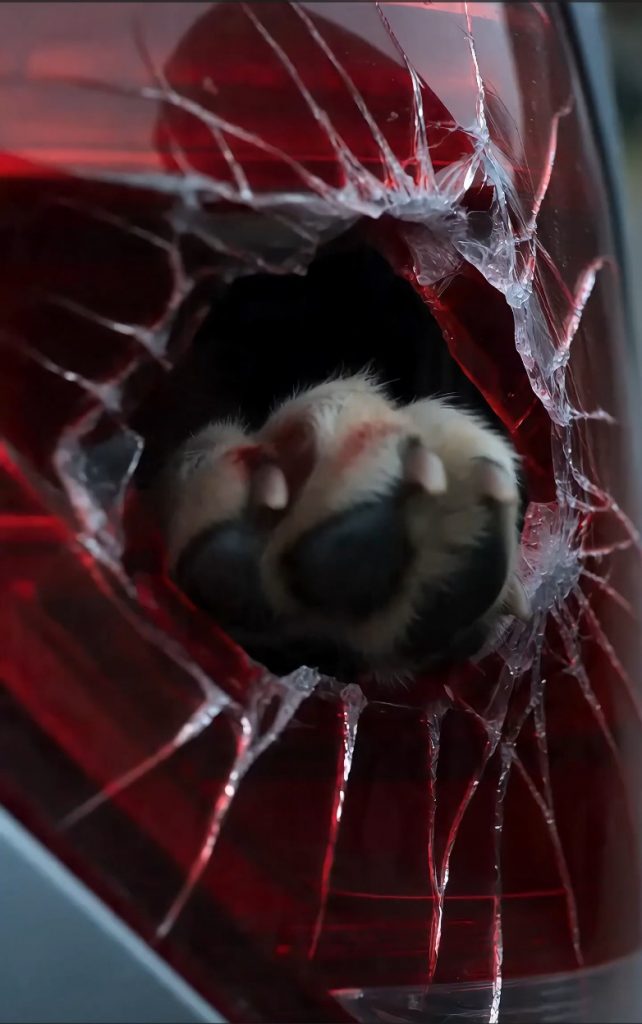
The red plastic bulged outward, cracked, and broke.
A furry front paw pushed through the opening.
Small claws scraped at the broken edge. The paw trembled, dirty and frantic, with a faint red smear near the fur where the plastic had scraped it.
Mateo’s heart slammed against his ribs.
“Jesus.”
He threw the stop lever down.
The crusher groaned, shuddered, and powered down with a heavy mechanical whine. The whole scrapyard seemed to hold its breath. Piles of twisted metal stood under the gray sky. Shipping containers loomed like walls. Somewhere inside the sedan, the dog whimpered again.
The two men kept walking.
They had not seen the paw.
Mateo shoved open the cabin door, grabbed the long metal pipe kept on the platform, and clattered down the steel steps so fast his boots nearly slipped.
The dog pawed weakly through the taillight.
Mateo’s grip tightened around the pipe.
“Hey!”
The men stopped.
The cigarette glowed between the green-jacketed man’s fingers.
Mateo crossed the oil-stained ground, orange work jumpsuit bright against the scrap heaps, fury rising in him like heat.
He stopped behind them.
“Turn around,” he said.
The man in brown slowly looked back.
His smile died before he finished turning.
Act II
Mateo had one rule in the yard.
Metal was never just metal until a man checked it himself.
He learned that from his father, who started Rivas Salvage with one tow truck, two borrowed tools, and a handshake reputation that lasted longer than most contracts. His father used to walk around every vehicle before crushing it, even the burnt ones, even the ones stripped down to nothing but frame and rust.
“Cars carry lives,” he would say. “You don’t flatten a life just because some paper says scrap.”
Mateo used to laugh at that.
Then life taught him not to.
Twenty-two years in a scrapyard meant seeing what people tried to erase. Wedding rings under seats. Children’s drawings in glove compartments. Prescription bottles, birthday cards, old photographs stuck behind sun visors. Once, a folded flag in a trunk that made every man in the yard stop talking until Mateo carried it to the office with both hands.
But nothing had ever been alive.
Not until that afternoon.
The two men had arrived just before closing with the silver sedan on a tow rig and paperwork that looked almost right if no one looked too long. The plates were gone. The VIN tag had been scratched badly enough to claim fire damage, though there had been no fire. The title was a salvage copy, rushed through a broker Mateo did not like.
He refused them at first.
“Come back tomorrow,” he said. “We verify before crush.”
The man in brown leaned on the counter.
His name, according to the form, was Bryce Lanning.
“Boss said same-day disposal.”
“What boss?”
Bryce smiled.
“The kind that pays cash.”
His friend, Wade Pike, tossed a roll of bills onto the desk and said nothing. He only looked around the yard like he was memorizing exits.
Mateo should have shut the whole thing down then.
But the owner had been pushing hard lately. Contracts were late. Bills stacked. The new regional scrap company across the county had been stealing customers by ignoring rules and charging less. Mateo had spent months fighting to keep the yard honest while everyone around him said honest was expensive.
So he compromised.
He checked the front seats. Checked the floorboards. Checked under the hood. The trunk was jammed from rear-end damage, and Bryce kept talking over him, asking how long it took, asking whether the crusher could handle “a stubborn one.”
Mateo heard no barking then.
No scratching.
No whimper.
Only rain starting in the distance and machinery waiting.
He signed the intake sheet with a bad feeling in his gut.
Now, standing on the scrapyard floor with a pipe in his hand and a dog’s paw sticking through the broken taillight, that bad feeling became something colder.
Bryce lifted both hands.
“Relax, man.”
Mateo stepped closer.
“There’s a dog in that car.”
Wade’s cigarette hung forgotten near his mouth.
Bryce glanced back at the sedan.
Not shocked.
Annoyed.
That was all Mateo needed to know.
“You knew,” he said.
Bryce’s eyes narrowed.
Mateo looked from one man to the other.
The crusher ticked behind him as it cooled.
Inside the crushed sedan, the dog whimpered again.
And this time, the sound carried across the whole yard.
Act III
Mateo did not hit them.
He wanted to.
The old anger in him wanted something simple and immediate, something that matched the sight of that trembling paw scraping for help.
But his father’s rule came back again.
Cars carry lives.
So Mateo used the pipe for the thing it was actually meant to do.
He turned and ran toward the sedan.
“Call 911!” he shouted toward the office.
The yard clerk, Nia, was already at the window with a phone pressed to her ear, her face pale.
Bryce took one step backward.
Mateo pointed the pipe at him without stopping.
“You move, she gives them your plate number, your faces, and the footage from every camera in this yard.”
Wade swore under his breath.
The dog pushed its paw farther through the taillight, then pulled back with a weak scratch.
“I’m coming,” Mateo said, voice breaking despite himself. “Hold on, buddy.”
He jammed the pipe carefully into the bent seam near the trunk and pulled. The metal resisted. He shifted, braced one boot against the bumper, and tried again. The sedan groaned, but the opening widened by an inch.
The dog whimpered.
Mateo stopped immediately.
“Okay. Okay. Slow.”
Nia ran from the office with a flashlight and a bolt cutter. Another worker, Sal, came from the far side of the yard carrying a hydraulic spreader used for wrecks that had to be opened before stripping.
Together, they worked around the crushed rear panel, not forcing too much, not moving faster than the trapped animal could survive. Rain began to fall in fine gray lines over the yard. The dog’s paw appeared again, then its nose, barely visible in the dark gap behind the broken taillight.
Mateo shined the flashlight inside.
A muddy brown dog stared back at him with wide terrified eyes.
Around its neck was a red collar.
The tag caught the light.
ROCKET.
Mateo stopped breathing.
Not because he knew every dog named Rocket.
Because he knew one.
His daughter’s dog was named Rocket.
Mateo’s hand shook around the flashlight.
“No,” he whispered.
He leaned closer, desperate for the tag to belong to some other life, some other family, some other father.
But beneath the name, scratched into the metal tag, was a phone number.
Lily’s number.
His daughter’s number.
For a moment, the entire scrapyard vanished.
All Mateo could see was Lily at seventeen, standing at his kitchen door with a mutt puppy tucked into her hoodie.
“He followed me home,” she had said.
“No, he didn’t.”
“He spiritually followed me home.”
Mateo had tried not to smile.
That was six years ago, before Lily moved out, before their fights became longer than their calls, before she started working for a local insurance investigator and asking dangerous questions about cars that vanished after accidents.
Mateo turned slowly toward Bryce and Wade.
The men saw his face.
This time, both stepped back.
Mateo’s voice came out low.
“Where is my daughter?”
Act IV
Bryce ran.
He made it three steps before Sal tackled him into a pile of broken plastic bumpers.
Wade dropped his cigarette and bolted toward the shipping containers, but Nia had already locked the gate from the office. He reached the chain-link fence, grabbed it, looked back at Mateo, and realized the cameras were pointed straight at him.
Police arrived in seven minutes.
Animal control arrived in nine.
The firefighters came in twelve, and by then Mateo was kneeling beside the sedan with both hands pressed to the wet metal, talking to Rocket through the gap.
“You’re doing good,” he whispered. “You hear me? You’re doing good.”
Rocket’s paw rested against his fingers.
That almost undid him.
The firefighters cut the rear panel carefully. No sparks near fuel lines. No rushed heroics. Just steady hands, quiet commands, and rain dripping off helmets while the crushed sedan slowly opened enough for Rocket to be lifted out.
The dog was shaking, scraped, and exhausted.
Alive.
When the animal control officer wrapped him in a blanket, Rocket twisted his head weakly toward Mateo and whined.
Mateo touched his collar.
“I know,” he said. “We’re finding her.”
The police searched the car before moving it.
Under the driver’s seat, they found Lily’s phone, cracked but powered off. In the glove compartment, behind a false panel, they found a small recorder. Tucked beneath the passenger-side carpet was a folder sealed in plastic.
Inside were photos of vehicles that had been marked as scrapped but were never properly processed.
Insurance fraud.
Stolen parts.
Fake salvage titles.
A chain of cars disappearing through yards that looked legitimate on paper.
Lily had been building a case.
One photo showed Bryce Lanning standing beside a tow rig.
Another showed Wade Pike removing plates from a car in the dark.
A third showed a man Mateo recognized from the broker’s office, shaking hands with the owner of the rival scrap company across the county.
Mateo looked at Bryce, now cuffed and sitting against a stack of tires.
“You brought her car here,” he said.
Bryce stared at the ground.
“Where is she?”
The officer asked it calmly.
Bryce did not answer.
Rocket did.
He began barking.
Weakly at first, then harder, fighting the blanket until the animal control officer nearly lost her grip. He pulled toward the back of the sedan, toward the crumpled rear seat, toward something the firefighters had not yet seen.
Mateo followed the dog’s gaze.
There, wedged between torn upholstery and bent metal, was Lily’s bracelet.
A leather cord with a small brass compass charm.
Mateo had given it to her when she started taking field assignments.
So you always find your way back, he had said.
The charm was bent, but inside the tiny casing was a folded scrap of paper.
Not a map.
A location.
Container 12. North rail spur.
Mateo looked up at the nearest officer.
“She left us a trail.”
Act V
Lily was found alive before midnight.
Locked in an abandoned site office near the rail spur, cold, frightened, and furious enough to refuse the stretcher until someone told her Rocket had survived.
Then she sat down.
Mateo reached the scene after the ambulance did.
For one awful second, father and daughter only stared at each other through flashing red and blue lights.
Lily’s hair was tangled. Her cheek was smudged with dirt. A blanket was wrapped around her shoulders. She looked older than the last time he had seen her, and younger at the same time.
Mateo tried to speak.
Nothing came.
Lily’s mouth trembled.
“Is Rocket okay?”
Mateo nodded hard.
“He’s okay.”
Only then did she cry.
He crossed the space between them, and she let him hold her.
Not the stiff, polite hug of two people who had forgotten how to be family.
The real one.
The kind that admits anger was never the opposite of love. Distance was never proof that love had died. Sometimes people stay away because every conversation hurts and neither knows how to stop bleeding on the other.
“I’m sorry,” Mateo whispered.
Lily gripped his orange jumpsuit with both hands.
“Me too.”
The case that followed tore open half the county’s salvage industry.
Bryce and Wade had not been masterminds. Men like that rarely were. They were hands for hire, used to scare witnesses, move vehicles, and destroy evidence before paperwork caught up.
The rival scrap company was laundering stolen vehicles through fake salvage titles.
The broker had been paid to move documents.
Several insurance adjusters were investigated.
And Lily, who had been warned twice to stop asking questions, had hidden proof in her own car because she trusted two things: her dog’s stubbornness and her father’s yard rules.
“I knew you checked cars,” she told Mateo later from a hospital bed, Rocket asleep beside her feet.
Mateo looked down.
“I almost didn’t check enough.”
“But you stopped.”
He closed his eyes.
Because that was the truth and the wound.
He had stopped.
Barely in time.
Rocket recovered slowly. His paw healed. His bark came back first, then his appetite, then his habit of stealing socks from Mateo’s laundry room like the world owed him tribute for surviving the crusher.
Mateo pretended to hate it.
Nobody believed him.
Rivas Salvage changed after that day.
Not with posters or empty promises. With rules that cost money and saved lives. No rush crushes. No cash exceptions. No vehicle processed until two workers checked it and cameras recorded the inspection. Every jammed trunk was opened before crushing. Every title verified. Every broker reviewed.
On the office wall, Mateo hung the damaged red taillight from Lily’s sedan.
Cleaned but unrepaired.
Beside it was a brass plaque.
LISTEN BEFORE THE MACHINE WINS.
Customers asked about it.
Mateo told them.
Not all of it. Not every time. But enough.
Enough to make people stop laughing in a place where metal screamed.
Bryce and Wade took plea deals after security footage from the yard showed them laughing while the crusher descended. Their faces on the video did more damage than any confession. Cruelty has a way of explaining itself when it thinks nobody important is watching.
At sentencing, Lily spoke.
She did not describe every fear. She did not perform pain for people who had already seen enough evidence to understand.
She only said, “You tried to turn my car into scrap, my dog into silence, and my work into nothing. You failed because one worker looked twice.”
Mateo sat in the back of the courtroom with Rocket’s leash wrapped around his hand.
He cried quietly where no one could see.
Except Lily.
She saw.
Afterward, she came over, sat beside him, and leaned her shoulder against his.
For a while, neither spoke.
Then she said, “You still hate my dog?”
Mateo looked down at Rocket, who was sleeping across both their shoes.
“He’s tolerable.”
Rocket snored.
Lily smiled.
It was small, but it was real.
Months later, on a gray afternoon much like the day of the crusher, Mateo climbed into the operator cabin and looked down over the yard. Cars waited in rows. Scrap piles rose beneath the sky. Machines sat still until hands told them what to do.
He thought about how close the world had come to swallowing the truth whole.
A few more seconds of pressure.
A little more noise.
One worker looking away.
That was all cruelty ever needed.
Then Rocket barked from below.
Mateo looked down and saw Lily standing near the office, hard hat crooked on her head, clipboard in one hand, Rocket’s leash in the other. She had joined the investigation firm full-time after the case, but she still came by the yard twice a week.
“Dad!” she called. “You coming down or are you supervising the clouds?”
Mateo smiled despite himself.
He shut off the cabin light and started down the metal steps.
The crusher loomed behind him, quiet now.
Still dangerous.
Still powerful.
But no longer trusted blindly.
That was the thing about machines, Mateo had learned. They only did what people allowed them to do. They could flatten evidence, or they could stop in time. They could bury a sound under grinding metal, or they could fall silent long enough for a dog’s paw to be seen.
And on the day two cruel men walked away laughing, certain the silver sedan would erase everything, the smallest sign of life broke through a shattered taillight and brought the whole machine to a halt.