Act I
The first thud sounded like grief knocking from the wrong side of heaven.
It rolled through the cathedral just as the priest lowered his eyes to the prayer book. A heavy, muffled sound from the front of the church.
Then came another.
Thud.
The mourners stiffened in their pews.
Candles trembled beside the white floral arrangements. Colored light from the stained-glass windows fell across the polished dark casket resting near the altar, turning its lid red, blue, and gold.
Ethan Vale stopped breathing.
He sat in the second row in a black suit and black shirt, his long brown hair tucked behind one ear, his hands folded too tightly in his lap. Beside him, his stepgrandmother, Beatrice Ashford, stared straight ahead in a black dress and pearl necklace.
Her face did not change.
Ethan leaned toward her.
“Wait,” he whispered. “Did you hear that?”
Beatrice barely turned her head.
“There was nothing.”
Her voice was cold enough to freeze the air between them.
The priest continued, though his eyes flicked once toward the casket. The congregation shifted uneasily, dark suits and black dresses rustling against the wooden pews. Everyone had heard it.
No one wanted to admit they had.
Because sounds were not supposed to come from a coffin.
Not during a funeral.
Not from the body of Henry Ashford, the man everyone had come to bury.
Another thud slammed from inside the casket.
This time, the lid trembled.
Ethan stood halfway.
“No,” he whispered, sharper now. “I heard something.”
Beatrice caught his sleeve with a grip that surprised him.
“Ethan,” she hissed, her pearls shifting at her throat. “Have you lost your mind?”
He looked at her hand.
Then at the casket.
Then at the rows of mourners staring at him as if he had already committed something unforgivable.
For years, Ethan had been told he was too emotional. Too suspicious. Too much like his father, who had died angry and disgraced after accusing the Ashford family of crimes no one wanted to discuss.
But the casket knocked again.
Weak.
Desperate.
Alive.
Ethan pulled free.
He moved down the aisle before fear could slow him. Behind him, Beatrice gasped, and the priest lifted his head from the lectern.
“Young man—”
Ethan did not stop.
The casket was polished so perfectly that he could see his own pale, terrified face in the wood. He planted both hands on the lid and pulled.
It resisted.
The cathedral seemed to hold its breath.
Ethan pulled harder, teeth clenched, shoulders shaking. The hinges groaned. A low, frantic sound rose from inside the box.
Breathing.
Muffled breathing.
The lid popped open with a wooden crack that echoed beneath the gothic arches.
A scream tore through the front pew.
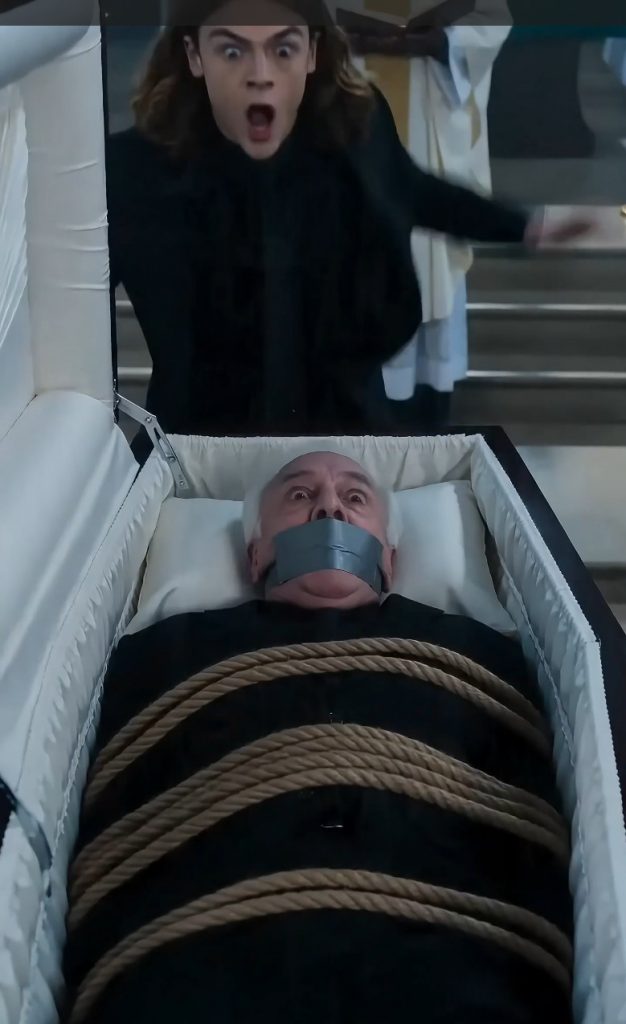
Inside the white satin lining lay an elderly man with short white hair, his wrists bound, his mouth covered, his eyes wide with terror and pleading.
Henry Ashford was alive.
For one second, nobody moved.
Then the cathedral exploded.
Mourners stumbled from their pews. Someone knocked over a kneeler. A woman screamed for help. The priest rushed forward, robes flashing white and gold as Ethan reached into the casket and began tearing at the restraints.
Beatrice stood frozen in the second row.
Her face was no longer stern.
It was emptied of color.
Ethan looked from Henry’s terrified eyes to Beatrice’s trembling mouth and understood with a cold shock that nearly stopped his heart.
This had not been a mistake.
And the woman who told him there was nothing had known exactly what was inside.
Act II
Henry Ashford had never wanted a grand funeral.
He had said so every Christmas after his second glass of wine, waving one hand at the chandeliers in the family dining room while everyone pretended to be annoyed by the speech.
“No cathedral,” he would say. “No choir. No speeches from people who only visited when they needed money. Burn me, bury me, toss me into the sea, but do not put me in a box while people lie about loving me.”
Ethan used to laugh.
His father never did.
Thomas Vale had loved Henry, but not quietly. Their arguments were family legend. Thomas married Henry’s daughter, Caroline, when they were both young and stubborn. After Caroline died, Thomas stayed close to the Ashfords for Ethan’s sake.
Then everything changed.
Thomas discovered irregularities in the Ashford Foundation accounts. Money moved through charities that existed only on paper. Properties transferred under shell companies. Old buildings sold at suspiciously low prices to investors connected to Beatrice.
Beatrice had married Henry late in life, arriving with perfume, perfect manners, and the strange talent of making people feel vulgar for asking direct questions. She smiled at donors. She charmed bishops. She placed one gloved hand on Henry’s arm in public and slowly took control of his calendar, his medicines, his household staff, and eventually his phone calls.
Thomas called her dangerous.
The family called him unstable.
One winter night, after a fight at the Ashford estate, Thomas drove off in the rain. His car was found wrapped around a tree outside the city limits. The police report called it an accident.
Ethan was seventeen.
At the funeral, Beatrice kissed his forehead and whispered, “Your father’s anger destroyed him. Don’t let it destroy you too.”
For years, Ethan believed part of that.
He believed grief had sharpened his memory into suspicion. He believed the adults who told him to let it go. He left for college, stopped answering invitations from the Ashford estate, and built a quiet life far from the family name.
Then Henry wrote to him.
The letter arrived three weeks before the funeral.
Not typed. Written by hand.
Ethan recognized his grandfather’s jagged script immediately.
I was wrong about your father.
That was the first sentence.
Ethan read it standing in the hallway of his apartment, rain tapping against the window.
Henry wrote that Thomas had been telling the truth. He wrote that Beatrice had isolated him, moved documents, changed attorneys, and pressured him to sign a new will. He wrote that if anything happened to him suddenly, Ethan should not trust the death certificate, the doctor, or the closed casket.
At the bottom, in a shakier hand, Henry had added:
Come home before the service. I have hidden proof where Caroline used to pray.
Ethan drove through the night.
But when he reached the estate, Beatrice met him at the door wearing black.
Henry, she said, had died peacefully in his sleep.
There would be a closed-casket funeral.
Ethan demanded to see him.
Beatrice placed one hand over her pearls and said the doctor had advised against it. She spoke gently, but there was steel beneath every word. The body, she said, had already been prepared. The funeral arrangements were complete.
“Don’t turn grief into a spectacle,” she told him.
But Ethan knew Henry’s letter was real.
He went to the cathedral early the morning of the funeral and found the side chapel where his mother used to pray as a child. Behind a loose stone near a statue of Saint Michael, he found a small envelope.
Inside was a key.
And a photograph.
The photo showed Henry sitting in his library beside a woman Ethan did not recognize. On the back, Henry had written only one name.
Margaret Doyle.
Ethan slipped the photo into his jacket pocket before the service began.
He did not yet know who Margaret Doyle was.
He only knew that Henry had been afraid.
Then the casket started knocking.
Act III
The priest was the first to reach Ethan.
Father Samuel Okoro did not hesitate. He climbed the altar steps, looked into the open casket, and his face shifted from horror to command.
“Call emergency services,” he ordered. “Now.”
Two men rushed forward from the front pew. One cut through the ropes with a small pocketknife while Ethan carefully peeled the tape from Henry’s mouth. Henry gasped, a rough, broken breath that filled the cathedral more powerfully than any hymn.
“Grandfather,” Ethan said, his voice cracking. “Who did this?”
Henry’s lips trembled.
His eyes moved past Ethan.
To Beatrice.
She stepped backward.
“Henry,” she whispered, but the name sounded wrong in her mouth now. Not grief. Not relief.
Fear.
Henry tried to speak, but only a rasp came out. Father Samuel brought water from the altar table and touched the cup to his lips.
Henry swallowed once.
Then he said, “She buried Margaret first.”
The words silenced even the screams.
Beatrice’s face hardened.
“That man is delirious,” she said loudly. “He has been drugged. He doesn’t know what he’s saying.”
Ethan turned slowly toward her.
“Margaret Doyle,” he said.
Beatrice’s eyes flicked to him.
It was fast.
Too fast.
“You know her,” Ethan said.
“I know many people.”
“Who is she?”
Beatrice lifted her chin. “This is not the time.”
Henry grabbed Ethan’s sleeve with surprising strength.
“Crypt,” he rasped. “Old crypt. Your mother’s chapel.”
The priest looked sharply toward the side aisle.
Beneath the cathedral was an old burial crypt, sealed decades ago except for maintenance access. Ethan knew it only from childhood stories. The Ashfords had funded repairs to the cathedral for generations. Their family vault sat beneath the east chapel.
The chapel where Henry had hidden the key.
The same key now burning in Ethan’s pocket.
Beatrice saw his hand move.
“No,” she said.
It was the first honest word she had spoken all morning.
Ethan stepped away from the casket.
Two paramedics entered through the side doors, followed by cathedral staff and security. The mourners crowded the back of the church, whispering, crying, recording, praying. The funeral had become a crime scene in real time.
Beatrice tried to leave through the side aisle.
Father Samuel blocked her path.
“You will remain here,” he said.
She stared at him as if no one had ever dared put a body between her and an exit.
Ethan moved toward the side chapel.
Beatrice’s voice rose behind him.
“Ethan, if you open that door, you will destroy this family.”
He looked back.
For a moment, he saw her exactly as his father must have seen her. Elegant. Controlled. Ruthless enough to call truth destruction when it threatened her comfort.
“No,” Ethan said. “You already did.”
The key fit the old iron lock beneath the chapel stairs.
It turned with a sound like a secret surrendering.
A security guard lifted the door open. Cold air rose from below, carrying dust, stone, and something older than grief.
Ethan descended first, phone light shaking in his hand.
The passage led beneath the cathedral floor to a narrow crypt lined with old plaques and sealed vaults. At the far end stood a newer wooden door, hidden behind a hanging cloth.
Fresh scratches marked the floor in front of it.
Ethan pulled it open.
Inside was a small room lit by a battery lantern.
There was a cot.
A medical bag.
Empty water bottles.
And on the wall, taped in neat rows, were photocopied documents.
Bank transfers.
Forged signatures.
Property deeds.
Birth records.
At the center was a newspaper clipping from twenty-eight years earlier.
LOCAL NURSE KILLED IN FIRE
The woman in the photograph was Margaret Doyle.
Ethan stared at her face.
Then at the birth record pinned beside it.
A child born to Margaret Doyle.
Father listed as Henry Ashford.
Child’s name: Beatrice Doyle.
Ethan’s stomach dropped.
Beatrice was not Henry’s wife by chance.
She was his secret daughter.
And she had not come into the Ashford family to love him.
She had come back to punish everyone.
Act IV
The truth had waited beneath the cathedral longer than most people’s grief.
Henry told the rest from a hospital bed that afternoon, his voice weak but steady, while police officers stood near the door and Ethan sat beside him.
He had known Margaret Doyle when he was young, long before he became the polished public man everyone admired. She was a nurse at a charity clinic his family funded. He loved her, he said, but not bravely enough.
When Margaret became pregnant, Henry’s father threatened to ruin her. Henry signed papers, made payments, and disappeared from her life because it was easier to obey cruelty than fight it.
Margaret raised Beatrice alone.
Then came the fire.
Henry was told both mother and child had died.
He believed it for decades.
But Beatrice survived.
She grew up under another name, passed through relatives, institutions, and foster homes that taught her the rich were never punished, only protected. She studied them. Copied them. Learned their manners, their charities, their language.
Then she returned as Beatrice Marlowe, a refined widow with no past anyone could verify.
Henry married her without knowing she was his daughter.
The room went cold when he said it.
Ethan looked away, sickened less by scandal than by the tragedy beneath it. A young woman abandoned by a powerful man. A child raised with bitterness where truth should have been. A lifetime twisted into revenge.
But pain explained Beatrice.
It did not excuse what she had done.
When Henry discovered her identity, he wanted to make amends. He drafted a new will, not to disinherit the family, but to divide his fortune between legitimate heirs, neglected charities, and a trust in Margaret Doyle’s name.
Beatrice saw it as another theft.
She wanted everything.
Not money alone.
Control.
She forged medical records claiming Henry had declined mentally. She replaced staff. She bribed a doctor to declare him dead after giving him medication that slowed his breathing enough to fool a careless examination. She arranged a rushed, closed-casket funeral in the cathedral her father’s family had used for generations.
Then she planned to bury him beneath praise.
Alive long enough to hear the lies.
Gone before anyone questioned the estate.
Ethan sat very still as Henry spoke.
His father had died trying to reveal the first layer of this. Thomas had found the accounts. He had suspected Beatrice’s fraud. He had not known the deeper wound driving it.
And perhaps that was why he had not survived.
Detectives found the final proof in Beatrice’s townhouse that evening.
A recording of Thomas Vale arguing with Beatrice on the night he died.
Her voice, calm and smooth:
If you keep digging, your son will lose more than a grandfather.
Thomas’s voice:
You don’t scare me.
Beatrice:
Then you are less intelligent than I thought.
The file ended there.
But police later matched damage on Thomas’s car to a vehicle once registered to a company Beatrice controlled.
The accident was reopened as a homicide investigation.
When detectives returned to the cathedral to arrest Beatrice, she was sitting alone in the front pew. The flowers had begun to wilt. Candle smoke curled beneath the arches. The casket remained open, empty now, its white satin interior exposed like a wound.
Beatrice did not run.
She looked almost peaceful.
Ethan stood at the back with Father Samuel.
For a moment, Beatrice’s eyes found his.
“You think he was innocent?” she asked.
Ethan knew she meant Henry.
He walked down the aisle slowly.
“No,” he said. “I think you became what hurt you.”
Her face tightened.
That was the only sentence that seemed to reach her.
Not the evidence. Not the police. Not even the discovery that Henry had survived.
But the idea that her revenge had turned her into the very cruelty she hated.
As the officers led her away, her pearl necklace broke.
Small white beads scattered across the cathedral floor, rolling beneath pews, into shadows, between the feet of mourners who had returned to give statements.
No one bent to pick them up.
And in the silence after she was gone, Ethan heard his father’s name spoken without shame for the first time in seven years.
Act V
Henry Ashford lived.
That alone felt impossible.
For days, doctors spoke cautiously. He had been weakened, frightened, and drugged, but not broken. His recovery would be slow, they said. He would need rest, protection, and time.
Henry laughed bitterly at that.
“Time,” he told Ethan. “I wasted enough of it.”
He began making statements as soon as he could hold a pen.
He cleared Thomas Vale’s name publicly. He restored the documents Beatrice had buried. He ordered the Ashford Foundation accounts opened to independent auditors and resigned from every board that had once applauded him without asking what his money concealed.
The newspapers loved the scandal.
Secret daughter. Staged funeral. Patriarch found alive in coffin.
But Ethan hated the headlines because they made everything sound dramatic instead of devastating.
This was not a gothic mystery.
It was a family ruined by cowardice, greed, silence, and the terrible human talent for turning old wounds into weapons.
Henry knew that too.
One week after leaving the hospital, he asked Ethan to drive him to the cemetery where Thomas was buried.
The old man moved slowly with a cane. His white hair lifted in the wind. Ethan walked beside him, unsure whether to help or let him struggle with dignity.
At Thomas’s grave, Henry stood for a long time.
Then he lowered his head.
“I failed him,” he said.
Ethan did not soften the truth.
“Yes.”
Henry closed his eyes.
“I failed you too.”
Ethan looked at the stone, at his father’s name, at the years stolen by lies. He wanted to forgive and could not. He wanted to hate and was too tired.
So he said the only honest thing he had.
“Start by telling everyone who he was.”
Henry did.
The memorial service for Thomas Vale took place in the same cathedral where Henry’s false funeral had collapsed.
This time, there was no casket.
No staged grief.
No Beatrice in black pearls guarding the family image.
Only people filling the pews, not out of obligation, but because truth has a strange power to call witnesses back.
Father Samuel led the service.
Ethan spoke.
He told them his father had been stubborn, imperfect, and brave. He told them Thomas had asked questions powerful people wanted buried. He told them suspicion was not madness when the world kept proving the suspicious right.
Henry spoke last.
He gripped the lectern with both hands.
“My son-in-law died carrying a truth I was too cowardly to face,” he said. “I let reputation become a god in my house. And gods like that always demand sacrifice.”
No one moved.
Henry looked at Ethan.
“I will spend whatever life I have left correcting the record.”
He did.
The Margaret Doyle Trust was established before the year ended, not as a public-relations gesture, but as a fund for abandoned families, whistleblowers, and victims of institutional cover-ups. Henry insisted Margaret’s name be carved above the foundation entrance.
Beatrice’s trial took nearly a year.
She never apologized.
Not to Henry. Not to Ethan. Not for Thomas.
But during sentencing, when Margaret’s photograph was entered into evidence, Beatrice stared at it for a long time. Her face did not collapse. She did not weep. Yet something in her expression went far away, back to the child who had once deserved rescue before revenge taught her another language.
Ethan saw it from the gallery.
For one brief moment, he pitied her.
Then he let the pity pass.
Some wounds explained the crime.
They did not erase the victims.
On the anniversary of the funeral, Ethan returned alone to the cathedral.
The casket was gone. The flowers were gone. The panic had long since faded from the stone walls. Sunlight moved through the stained glass, painting the aisle in colors too beautiful for what had happened there.
Father Samuel found him near the front.
“Do you still hear it?” the priest asked quietly.
Ethan knew what he meant.
The knocking.
The desperate thuds from inside the casket.
“Sometimes,” Ethan admitted.
Father Samuel nodded. “So do I.”
They stood together in silence.
Then Ethan walked to the side chapel where his mother used to pray. The loose stone had been repaired, but Henry had placed a small brass plaque beside it.
For those who hear the truth when everyone else calls it silence.
Ethan touched the edge of the plaque.
He thought of his father.
His mother.
Margaret Doyle.
Henry in the darkness.
Beatrice in her pearls, trying to bury the past and only proving that nothing buried alive stays quiet forever.
The cathedral bells began to ring.
Outside, the city moved on as if the world had not cracked open inside those walls.
But Ethan knew better.
He had learned that silence could be trained into a family, polished into manners, dressed in black, and seated in the front pew.
He had learned that grief could be used as a curtain.
And he had learned that sometimes the most important thing a person could do was stand up in a room full of people whispering there was nothing and walk toward the sound no one wanted to hear.