Act I
The first kick was annoying.
The tenth was unbearable.
By the twentieth, every passenger within three rows had stopped pretending not to notice.
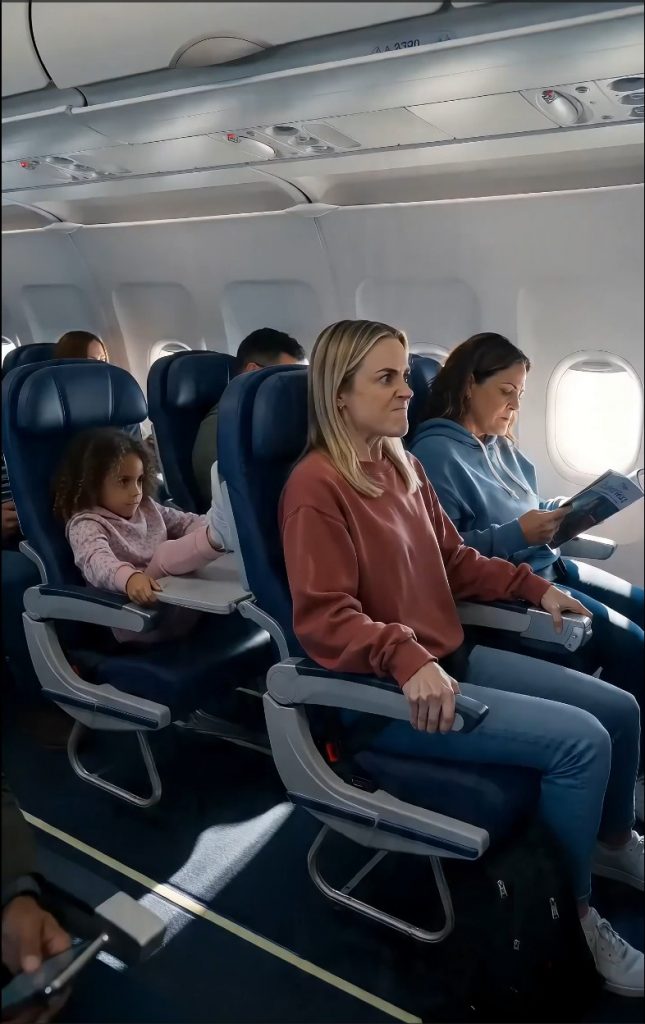
The dull thud came again from behind Meredith Lane’s seat, hard enough to rattle the tray table clipped into the backrest. Her coffee trembled in its cup. Her shoulders jerked forward. Somewhere across the aisle, an elderly man in a yellow sweater lowered his newspaper and stared.
Meredith closed her eyes.
She had been trying to breathe through it for fifteen minutes.
The airplane cabin hummed around her, steady and sealed. Rows of blue seats stretched ahead, overhead bins clicked softly with the vibrations of flight, and daylight poured through oval windows onto the blue carpet. It should have been an ordinary afternoon flight from Phoenix to Chicago.
Instead, every few seconds, the back of Meredith’s seat snapped forward.
Thump.
Thump.
Thump.
Behind her sat a curly-haired girl in a pink floral sweatshirt and white pants. Both of the child’s feet were planted on Meredith’s lowered tray table as if it were a footrest. Her right sneaker kept driving into the seatback with bored, careless rhythm.
Beside the girl, in the inner seat, her mother wore a blue hoodie and a hard scowl. She had seen everything.
She had done nothing.
Meredith gripped the armrest.
Her blonde hair had slipped loose from its clip. Her red sweatshirt was bunched at the shoulder from each jolt. The muscle in her jaw tightened as another kick slammed into her back.
The elderly man across the aisle finally leaned forward.
“Ma’am,” he whispered gently, “are you all right?”
Meredith forced a small nod.
Then came another kick.
This one was harder.
The tray table rattled like it might snap.
Meredith turned sharply in her seat.
“Stop,” she said, her voice cutting through the cabin hum. “Quit bothering me.”
The girl stared at her without lowering her feet.
The mother leaned forward, chin raised, eyes cold.
“She’s just a kid,” the woman said. “What’s the big deal?”
For a second, Meredith only stared at her.
The passengers nearby went quiet.
The mother’s mouth twisted as if she had won. The girl shifted her sneakers on the tray table, emboldened by the defense, and gave the seat one smaller kick, not hard, but deliberate.
Something in Meredith’s face changed.
She unbuckled her seat belt.
The click sounded louder than it should have.
Then she stood.
Her red sweatshirt rose above the seatbacks as she stepped into the aisle, straightened her shoulders, and turned toward the mother and child.
The mother smirked.
But Meredith was not standing because she wanted to argue.
She was standing because she had spent seven years waiting for a moment just like this.
Act II
Meredith Lane had not always been afraid of flying.
There was a time when she loved airports.
She loved the glow of departure boards, the smell of coffee before sunrise, the strange tenderness of strangers all going somewhere. Her husband, Daniel, used to tease her for arriving three hours early just so she could watch planes lift into the sky.
Daniel had been a flight attendant for nineteen years.
He knew how to calm nervous passengers. He knew how to kneel beside crying children and make them laugh with napkin puppets. He knew which travelers needed space, which needed water, and which needed someone to look them in the eye and say, “You’re safe.”
Then one flight changed everything.
It was not a crash. That was what made people misunderstand it.
There were no flames. No headlines that lasted longer than a day. No dramatic footage except one shaky phone video that Meredith had never been able to watch all the way through.
It was a passenger incident.
That was the phrase the airline used.
Passenger incident.
A man became aggressive during descent after refusing to follow safety instructions. His wife kept saying he was “just stressed.” His children laughed because they had learned his behavior was something everyone else had to survive. He shoved a crew member. He blocked the aisle. Daniel stepped in to protect a younger attendant.
The plane landed safely.
Daniel walked off it.
Three hours later, he collapsed at the airport clinic from complications nobody had caught in time.
The airline sent flowers.
The passenger paid a fine.
Meredith buried her husband in the blue tie he had worn on their first trip to Lisbon.
After that, she could not hear the phrase “What’s the big deal?” without feeling something cold open in her chest.
Because every dangerous moment started small to the people who caused it.
A foot on a tray table.
A blocked aisle.
A ignored seat belt sign.
A rude parent teaching a child that shared space belonged to whoever cared least about others.
Meredith had built a life out of not falling apart. She became a passenger rights advocate first, then a safety consultant, then an advisor for a nonprofit that trained airline crews to manage escalating cabin behavior before it became dangerous.
She had testified before committees.
She had sat across from executives who nodded solemnly and changed nothing until lawsuits forced them.
She had spoken to flight attendants who carried bruises, fear, and guilt like invisible luggage.
And she had learned one rule above all:
Disrespect in a sealed cabin was never just disrespect.
It was a test.
Will anyone stop me?
That afternoon, Meredith had not boarded the flight looking for trouble. She was going to Chicago to speak at a conference about crew safety and passenger accountability. Her notes were in the tote under her seat. Her speech began with Daniel’s name, though she had still not decided whether she would be brave enough to say it out loud.
Then the kicking started.
At first, she told herself it was nothing.
A child. A long flight. Tired legs.
Then she heard the mother’s dismissive sigh. Saw the girl’s feet planted on the tray table. Felt the seat slam again and again into her back.
And Meredith knew.
The child was not the problem.
The lesson was.
A child who had never been corrected would eventually become an adult who expected the world to absorb every impact.
Meredith stood in the aisle and looked at the mother in blue.
“Put her feet down,” she said evenly.
The mother gave a short laugh.
“Or what?”
A murmur moved through the passengers.
Meredith did not raise her voice.
“Or I’ll call the flight attendant, and you can explain why your child’s feet are on a tray table and why you refused to stop her from kicking another passenger’s seat.”
The mother’s eyes narrowed.
“You think you scare me?”
“No,” Meredith said. “I think you should be embarrassed.”
The cabin went silent.
The girl finally lowered one foot.
Not both.
The mother noticed, grabbed her daughter’s wrist lightly, and hissed, “Keep your feet where they are.”
And that was when Meredith understood this was not carelessness anymore.
It was performance.
Act III
The flight attendant arrived before the mother could say anything else.
Her name tag read Elise.
She was young, no more than twenty-six, with a practiced smile that had already begun to strain at the edges. She looked first at Meredith standing in the aisle, then at the girl’s feet still pressed against the tray table.
“Is everything okay here?” Elise asked.
“No,” Meredith said.
The mother leaned out from the window side. “This woman is harassing my child.”
A few passengers reacted immediately.
The elderly man in the yellow sweater said, “That is not what happened.”
A woman two rows back lifted her hand. “The child has been kicking her seat for a while.”
“She had both feet on the tray,” said another passenger.
The mother’s expression hardened.
“Mind your business.”
Elise took a controlled breath. “Ma’am, your daughter needs to remove her feet from the tray table.”
“She’s comfortable.”
“That tray is not a footrest.”
“She’s eight.”
“She still needs to follow cabin rules.”
The mother rolled her eyes. “You people are ridiculous.”
Meredith watched Elise’s hand tighten around the edge of the aisle seat. Not fear exactly. More like the familiar fatigue of someone expected to remain polite while being challenged by a person determined to make politeness feel weak.
The girl looked between the adults.
For the first time, uncertainty crossed her face.
“Mom,” she whispered, “I can put them down.”
“No,” the mother snapped.
The word hit the child like a slap without contact.
Meredith’s anger shifted.
Until then, she had been furious at the girl. Now she saw the truth more clearly. The girl was not powerful. She was being trained. Used as a tiny weapon in her mother’s war against anyone who told her no.
Elise lowered her voice. “Ma’am, I’m asking you to comply.”
“And I’m asking you to get out of my face.”
The passengers heard that.
So did the man seated directly behind the mother, who had been quiet until then. He leaned into the aisle, phone held low but recording.
“She told the kid to keep kicking,” he said.
The mother turned on him. “Delete that.”
He did not.
Meredith saw Elise glance toward the front galley.
A second flight attendant appeared at the curtain.
Then the mother made the mistake that changed the entire flight.
She reached forward and shoved Meredith’s seatback with her palm.
Not hard enough to injure.
Hard enough to prove she could.
“There,” she said. “Now blame me.”
The cabin erupted in murmurs.
Elise’s face went still.
Meredith looked down at the seatback, then back at the mother.
“Thank you,” Meredith said softly.
The mother blinked. “For what?”
“For making it clear.”
She reached into her tote and pulled out a slim folder.
The mother laughed. “What is that, your diary?”
Meredith opened it.
Inside was her conference badge.
AVIATION SAFETY ADVOCACY COUNCIL
Meredith Lane
Cabin Conduct & Passenger Accountability Panel
Elise recognized the name first.
Her eyes widened.
“You’re Meredith Lane?”
Meredith nodded once.
The mother’s smirk faltered.
The elderly man in yellow looked from Elise to Meredith. “Who is she?”
Elise’s voice was quieter now.
“She’s the reason our airline changed its assault reporting policy.”
The cabin shifted.
Meredith hated that sentence. Not because it was false, but because every policy change had come too late for Daniel.
The mother leaned back, suddenly less certain.
Meredith slipped a photograph from the folder. It showed Daniel in his flight attendant uniform, smiling in an airport terminal with one hand raised in a goofy wave.
“This was my husband,” Meredith said. “He spent nineteen years asking passengers to do simple things for everyone’s safety. Buckle your seat belt. Clear the aisle. Don’t interfere with other people’s seats. Don’t teach your children that rules are optional just because you feel inconvenienced.”
The mother’s face tightened.
“Don’t bring your dead husband into this.”
The words were so cruel that even the girl flinched.
Meredith went very still.
Then the girl slowly pulled both feet off the tray table and placed them on the floor.
Her mother stared at her.
The child whispered, “I’m sorry.”
It was the first honest thing said from that row.
And it broke the mother’s control more than any argument could have.
Act IV
The captain’s voice came over the intercom five minutes later.
It was calm.
Too calm.
“Ladies and gentlemen, please remain seated while the crew handles a passenger matter. We appreciate your cooperation.”
The mother had gone pale, but her anger had not disappeared. It had sharpened into something quieter and more dangerous.
Elise and the second flight attendant, Marcus, stood in the aisle now.
Meredith had returned to her seat at Elise’s request, but she did not lean back. Her body still carried the memory of every kick.
The girl sat with her hands folded in her lap, crying silently.
Her mother whispered, “Stop that. You’re making me look bad.”
Meredith turned her head.
The girl heard it too.
So did Elise.
That was when Meredith understood the real humiliation in that row was not the mother being challenged in public.
It was the child realizing everyone could see what her home life probably felt like.
Elise crouched slightly near the girl. “What’s your name, sweetheart?”
The girl looked at her mother first.
The mother hissed, “Don’t answer.”
Elise straightened.
“Ma’am, I need you to stop interfering.”
The mother laughed under her breath. “Interfering with my own kid?”
Marcus spoke then, firm but professional.
“We’ve been informed by the captain that law enforcement will meet the aircraft upon landing.”
The mother’s face changed completely.
“For a seat kicking?”
“No,” Marcus said. “For noncompliance with crew instructions and physical interference with another passenger’s seat.”
“I barely touched it.”
“We have witnesses.”
The man behind her lifted his phone slightly.
“So do I,” he said.
The mother looked trapped now, but not sorry. Her eyes moved quickly across the cabin, searching for sympathy and finding none.
Then the elderly man in yellow cleared his throat.
“I’d like to make a statement when we land,” he said.
Another passenger said, “Me too.”
“And me,” said the woman two rows back.
The mother’s voice dropped to a hiss. “You’re all insane.”
Meredith turned around again.
“No,” she said. “We’re tired.”
That sentence settled over the cabin.
Tired of absorbing other people’s bad behavior.
Tired of watching workers get insulted for doing their jobs.
Tired of children being used as excuses.
Tired of adults pretending every boundary was an attack.
The girl wiped her eyes with her sleeve.
Meredith looked at her, and her voice softened.
“You made a bad choice,” she said. “But you can make a better one now.”
The girl nodded quickly.
Her mother snapped, “Don’t talk to her.”
But the power in the row had already shifted.
The child looked at Meredith again.
“I’m sorry I kicked your seat,” she said, barely above a whisper.
Meredith felt the anger in her chest loosen just enough to become sadness.
“Thank you,” she said.
Elise handed the girl a tissue.
The mother stared out the window, jaw clenched, furious that the child’s apology had made her look smaller than all her defiance.
The rest of the flight moved in tense quiet.
No more kicks.
No more tray-table rattling.
No more laughter from behind Meredith’s head.
But every passenger nearby remained aware of the mother in blue, sitting rigidly beside her daughter, counting down the minutes until landing as if she could outrun what waited at the gate.
When the plane touched down in Chicago, nobody clapped.
The aircraft slowed. The seat belt sign stayed on. The captain asked everyone to remain seated.
At the front of the cabin, the door opened.
Two airport police officers stepped inside.
The mother saw them and whispered one word under her breath.
But the girl reached for her own seat belt, unbuckled only when instructed, and sat perfectly still.
For the first time that flight, she followed the rules.
Act V
The mother tried to turn the aisle into a courtroom before she even stood up.
“She threatened me,” she told the officers. “That woman in red. She scared my daughter.”
But this time, the first story was not the only story.
Elise gave her report.
Marcus gave his.
The elderly man in the yellow sweater explained each kick in careful detail, even demonstrating the tray-table rattle with his hands. The woman two rows back showed a video of the child’s feet planted on the tray table while the mother watched and did nothing.
Then the man behind them played the clip of the mother shoving Meredith’s seatback.
The officer’s expression did not change, but his notebook moved steadily.
The mother’s confidence drained with every witness.
“What’s going to happen?” she demanded.
“That depends,” one officer said, “on the airline’s complaint and the crew’s report.”
The girl began crying again.
Not loudly.
Quietly, like someone trying not to make things worse.
Meredith watched her from the aisle and felt the last of her anger fade into something heavier. The mother had embarrassed herself. The passengers had spoken. The crew had done their jobs.
But the child would carry the memory differently.
She would remember a plane full of adults staring. Her mother angry. A stranger in red standing up. The sudden discovery that “just a kid” did not mean “allowed to hurt people.”
Meredith stepped closer, keeping enough distance not to frighten her.
The mother snapped, “Stay away from my daughter.”
Meredith stopped.
She looked only at the girl.
“You apologized,” she said gently. “That matters. Remember how it felt to make it right.”
The girl nodded, tears on her cheeks.
Her mother scoffed, but the sound had no force left.
Airport police escorted the mother and child off after most passengers had deplaned. The mother walked stiffly, still insisting she had done nothing wrong. The girl looked back once.
Meredith gave her a small nod.
Not forgiveness exactly.
A door.
Some children needed to see one before they knew they were allowed to walk through it.
In the quiet cabin afterward, Elise found Meredith still standing near her row, one hand resting on the top of the blue seat.
“I’m sorry,” Elise said. “We should’ve gotten to it sooner.”
Meredith shook her head.
“You got to it.”
Elise swallowed. “I knew who you were from training. They show your husband’s case in the module.”
Meredith looked down.
Even after all these years, Daniel could still appear without warning and take the air from her lungs.
“He would’ve liked you,” she said.
Elise’s eyes filled.
“Was he brave?”
Meredith smiled sadly.
“He was kind. That was braver.”
They stood there for a moment in the emptying plane while cleaners waited near the front and daylight spilled across the seats.
Then Meredith reached into her folder and touched the edge of Daniel’s photograph.
At the conference the next morning, she changed her speech.
She had planned to talk about data. Incident reporting. Crew protection. The legal gray areas airlines loved to hide behind until public pressure forced clarity.
Instead, she began with the sound of a child kicking her seat.
The audience went still.
Meredith told them how small it seemed at first. How easy it would have been to endure it. How quickly the mother turned accountability into outrage. How the crew had to manage not only behavior, but ego, denial, and public pressure inside a metal tube thirty thousand feet above the ground.
Then she held up Daniel’s photograph.
“My husband did not die because one passenger had a bad day,” she said. “He died in a culture that kept calling bad behavior minor until it wasn’t. Safety is not only emergency exits and oxygen masks. Safety is whether we are willing to stop small cruelty before it becomes bigger.”
No one spoke for several seconds after she finished.
Then the room stood.
Meredith did not cry until she returned to her hotel room.
On the desk was an email forwarded by Elise.
It was from the airline’s customer care department. The mother had been placed under review for future travel restrictions. The crew’s report had been accepted. The passenger videos were preserved.
At the bottom was a note Elise had added herself.
The little girl asked me before leaving if flight attendants make the rules or help people follow them. I told her both. She said she wants to be better on her next flight.
Meredith read that line three times.
Then she sat by the window and looked out at the planes moving across the runway, silver bodies gliding under the morning light.
For years, she had thought justice would feel like punishment.
Sometimes it did.
But sometimes justice was smaller.
A child lowering her feet.
A crew member being believed.
A cabin full of strangers refusing to look away.
A woman in red finally standing up, not because she wanted a fight, but because she had learned what silence could cost.
And somewhere above all of it, in the sky Daniel had loved, one simple truth remained:
There is no such thing as a small act of disrespect in a place where everyone has to share the same air.