Act I
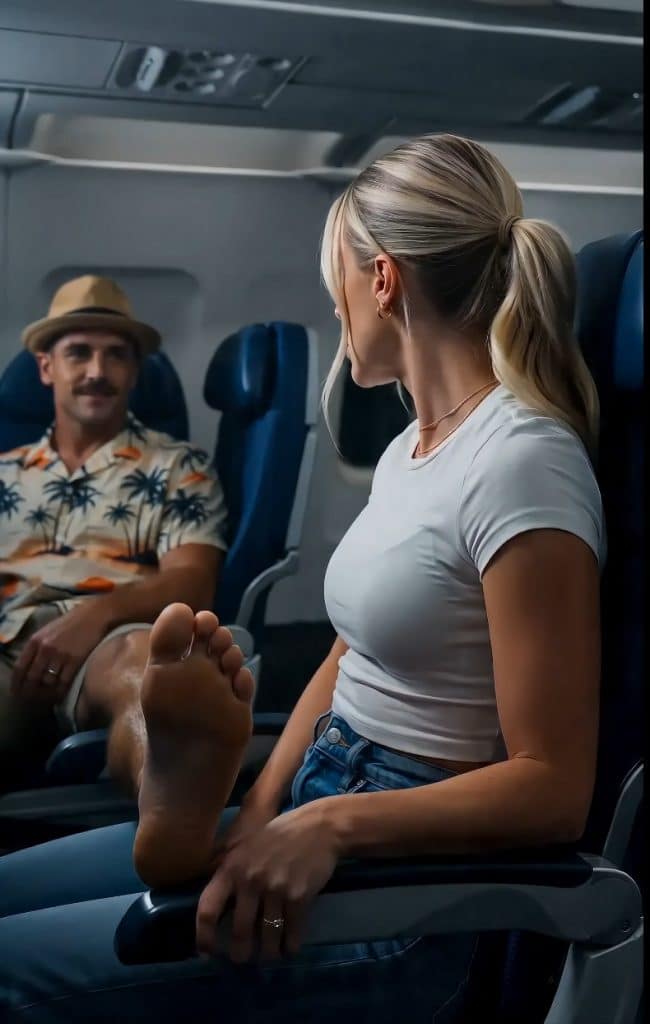
The foot appeared before the man’s face did.
It slid forward from the row behind and settled onto Claire Nolan’s left armrest like it belonged there.
Bare.
Damp-looking from the cabin heat.
Toes angled toward her elbow while the airplane hummed through the dark somewhere above the clouds.
Claire stared at it for one full second, waiting for the universe to correct itself.
It did not.
She turned slowly in her blue seat, her blonde hair brushing the shoulder of her fitted white T-shirt. The gold necklace at her throat caught a thin strip of aisle light. Behind her, a man in a tan fedora and a pale aqua tropical shirt sat with his mustached face arranged in smug comfort.
His shirt was printed with navy hibiscus flowers and muted orange leaves.
His manners had not received the same attention.
“Take your dirty foot off my armrest,” Claire said. “Right now.”
A few passengers looked over.
The man behind her leaned forward with a smirk.
“And what exactly are you going to do about it?”
His voice was casual, but loud enough to invite an audience.
Claire’s jaw tightened.
She looked at the foot again, then at his face.
“You’re invading my space.”
He shrugged.
“It’s a long flight.”
She reached down, pinched the side of his foot hard enough to make him jerk, then pushed it off the armrest.
His leg dropped back behind the seat.
A middle-aged man across the aisle lowered his newspaper.
A young woman with earbuds pulled one out.
For a brief moment, the armrest was clear.
Then the man behind Claire laughed.
Not embarrassed laughter.
Mocking laughter.
He lifted his leg again and placed the same bare foot back onto her left armrest, more deliberately this time, as if planting a flag.
The cabin went quiet in patches.
Claire faced forward.
Her shoulders became rigid.
Behind her, the man laughed louder, pleased with himself, certain that the little row of blue airplane seats had become his stage.
The man with the newspaper whispered, “Is he serious?”
Claire closed her eyes.
When she opened them again, the anger was gone from her face.
That was when the rude passenger should have become afraid.
Because Claire Nolan had stopped reacting like an annoyed traveler.
She had started documenting like a witness.
Act II
Claire had not always been good at staying calm.
Ten years earlier, she had been a flight attendant on red-eye routes, smiling through delays, spilled drinks, crying babies, bad turbulence, and men who believed buying a ticket gave them ownership of every woman in uniform.
She learned early that the cabin had two kinds of emergencies.
The ones everyone recognized.
Smoke. Medical calls. Sudden drops. Oxygen masks.
And the ones people dismissed until they became dangerous.
A hand on a crew member’s waist.
A passenger refusing to sit down.
A drunk man laughing while everyone else weighed whether speaking up would make it worse.
Claire had seen how quickly “rude” could become “unsafe” when trapped in a pressurized tube thirty thousand feet above the ground.
Her last flight as a crew member ended with a man blocking a junior attendant in the galley and calling it flirting. The airline apologized to him first because he had premium status. The girl transferred off international routes two weeks later. Claire resigned within the year.
But she did not leave aviation.
She went to law school at night.
She studied passenger misconduct, reporting gaps, crew authority, and the quiet way airlines trained people to apologize to the loudest person in the room. Eventually, she became the person carriers called when “customer conflict” became a legal risk.
That night, Claire was flying to Seattle to present a passenger-conduct reform proposal to NorthBridge Air.
Unofficially, she was a consultant.
Officially, after the board vote in two days, she was expected to become the company’s new Director of Cabin Safety Culture.
No press release had gone out yet.
No one on Flight 482 knew her name.
That suited her.
She wanted to see the cabin as ordinary passengers saw it. Tight seats. Tired crew. Delayed boarding. People testing boundaries because they assumed there would be no consequence.
Then Martin Bellamy put his foot on her armrest.
Claire did not know his name at first.
She only knew the type.
Mustache. Fedora. Loud shirt. Loud laugh. A man who treated discomfort as comedy as long as it belonged to someone else.
After he put his foot back, she looked at the call button above her seat.
She did not press it immediately.
She took a breath.
Then she looked across the aisle at the man with the newspaper.
“Sir,” she said quietly, “would you be willing to confirm that you saw him place his foot there twice?”
The man blinked.
“Yes.”
The young woman with one earbud out leaned forward.
“I saw it too.”
Behind Claire, Martin chuckled.
“Oh, come on. We’re doing witnesses now?”
Claire turned halfway toward him.
“No,” she said. “We’re doing accountability.”
That was the first time his smile weakened.
Act III
The flight attendant arrived with the practiced expression of someone already tired.
Her name tag read Marisol.
She looked at Claire, then at the bare foot still resting on the armrest, then at Martin behind her.
“Sir,” Marisol said, voice even, “you need to remove your foot from the passenger’s armrest and keep your feet in your own row.”
Martin sighed dramatically and dropped his leg.
“She pinched me,” he said.
Marisol looked at Claire.
Claire nodded.
“I removed his foot after asking him verbally. He put it back.”
Martin leaned into the aisle.
“She assaulted me over a foot. You people are unbelievable.”
The word people hung there.
Marisol heard it.
Claire heard it.
So did the woman with the earbuds.
Passengers nearby began to shift, the way crowds do when they realize the story is choosing sides.
Marisol kept her voice calm.
“Sir, this is your formal instruction. Keep your body within your seating area. Do not touch or intrude into another passenger’s space again.”
Martin laughed.
“Formal instruction. Very scary.”
Claire watched Marisol’s face.
A younger version of herself would have known that face instantly. Controlled. Professional. Exhausted by the knowledge that if she escalated too quickly, someone would accuse her of being dramatic. If she waited too long, someone else would get hurt or humiliated.
Claire lowered her voice.
“Marisol, may I have your purser, please?”
Martin snorted.
“Now she wants the manager.”
Claire did not look at him.
Marisol studied her for a beat.
There was something in Claire’s tone that changed the request from complaint to procedure.
“I’ll get him,” Marisol said.
The purser arrived three minutes later.
By then, Martin had put his shoes on, but not his shame. He had begun performing for the row, telling the story as if Claire were hysterical, as if personal space were a joke, as if everyone secretly agreed with him.
The man with the newspaper finally folded it completely.
“Actually,” he said, “you were disgusting.”
Martin turned.
“Excuse me?”
The man’s voice was mild but firm.
“She asked you to stop. You challenged her. She moved your foot. Then you put it back while laughing.”
The girl with the earbud added, “And you did it on purpose.”
Martin looked around, realizing the cabin was no longer laughing with him.
The purser, a broad-shouldered man named David Chen, stopped beside the row.
“What seems to be the issue?”
Claire reached into the seat pocket, pulled out her boarding pass, and wrote three lines on the back.
Time.
Seat number.
Passenger description.
Then she handed it to David.
“My name is Claire Nolan,” she said. “I’m traveling to Seattle for NorthBridge’s cabin safety review. This passenger was instructed to stop a personal-space violation and repeated it deliberately. Your crew handled the initial response correctly. Now I recommend you document it as passenger misconduct and notify the captain.”
The purser read the boarding pass.
His expression changed.
Martin saw it.
For the first time, he sat up straight.
Act IV
Martin Bellamy had lived too long on the assumption that embarrassment only worked downward.
He embarrassed servers.
Hotel clerks.
Gate agents.
Flight attendants.
People whose jobs required them to stay polite while he tested how far politeness could be bent.
He was not rich in the private-jet way, but he was rich enough to threaten surveys, status, and complaints. He owned a chain of beach bars in three cities and posted travel videos online where he rated airlines by how much they “let him relax.”
His followers liked the rudeness when it wore sunglasses and called itself honesty.
He had been reported before.
Twice for refusing crew instructions.
Once for using another passenger’s tray table as a footrest.
Once for shouting at a gate agent until security was called.
Each time, he was warned.
Each time, nothing serious happened.
That history reached the cockpit faster than Martin expected.
Twenty minutes after Claire identified herself, the captain’s voice came over the speaker.
“Ladies and gentlemen, we apologize for the disturbance in the cabin. For everyone’s safety and comfort, we remind passengers that crew instructions must be followed at all times.”
Martin rolled his eyes.
Then the captain continued.
“Mr. Bellamy in seat 18C, you have been issued a final warning. This aircraft will be met by airline security and law enforcement upon arrival.”
The cabin went completely silent.
Martin’s face changed color.
Claire stared straight ahead.
He leaned forward, voice low and sharp.
“You did this?”
Claire turned just enough to meet his eyes.
“You did.”
The young woman with the earbuds smiled faintly and put her earbud back in, as if the show had finally reached a satisfying scene.
Martin muttered under his breath for the rest of the flight, but he kept his feet where they belonged.
That was not bravery.
That was consequence.
When the plane landed in Seattle, two airport police officers and a NorthBridge ground supervisor waited at the jet bridge. Passengers remained seated while the purser approached Martin.
“Mr. Bellamy,” David said, “please collect your belongings and step forward.”
Martin stood too fast, knocking his knee against the seat.
“This is ridiculous,” he said, though his voice had lost its audience.
No one supported him.
The man with the newspaper simply watched.
The young woman with earbuds whispered, “Bye.”
Martin looked toward Claire one last time.
“You’re proud of yourself?”
Claire stood and pulled her carry-on from beneath the seat.
“No,” she said. “I’m tired of men like you mistaking patience for permission.”
He had no comeback.
Not one that worked with police waiting at the door.
Act V
The incident report was longer than the flight.
That surprised no one who understood aviation.
A small act in the cabin becomes a chain once written down properly. Seat numbers. Witness statements. Crew instructions. Passenger response. Captain notification. Prior record. Arrival action.
Martin Bellamy learned that consequences in airports do not need to shout.
They come with forms.
He was questioned at the gate, removed from his connecting flight, and issued a temporary travel restriction pending review. His premium status was suspended. His return ticket was canceled. The airline opened a conduct case using not only Claire’s statement, but David’s, Marisol’s, the newspaper man’s, and the young woman’s.
The newspaper man’s name was Arthur Bell, a retired school principal from Oregon who wrote in neat block letters:
The passenger was asked to stop. He repeated the behavior to humiliate her.
The young woman’s statement was shorter.
He thought it was funny because it was not happening to him.
Claire kept a copy of that line.
Two days later, she stood in a NorthBridge conference room in front of executives who had expected charts, risk categories, and careful language.
She brought those.
But first, she placed the printed incident report on the table.
“This,” she said, “is what culture looks like in miniature.”
The room quieted.
“It was one foot on one armrest. Easy to dismiss. Easy to call silly. Easy to tell the passenger to move once and hope the victim stops making the cabin uncomfortable.”
She looked at the CEO.
“But that is how escalation survives. It depends on everyone minimizing the first violation.”
Marisol and David were invited to speak by video. Claire insisted on it. Too often, cabin crew appeared in reports only as names attached to decisions made by people who had not been trapped in the aisle with an angry passenger.
Marisol spoke carefully at first.
Then more honestly.
“The hardest part is knowing we’ll be judged for either doing too little or too much,” she said. “Passengers like him count on that.”
The board voted unanimously to adopt the new policy.
Crew received clearer authority to document and escalate repeated personal-space violations, harassment, and refusal to comply. Passengers with prior misconduct records would be flagged earlier. Premium status would no longer delay conduct review. The phrase customer comfort issue was removed from categories where safety and dignity were at stake.
Claire did not think policy could fix human cruelty.
But it could stop rewarding it.
Weeks later, she received an email from the young woman with the earbuds. Her name was Lena Ortiz, and she was a college student flying home after visiting her father in the hospital.
I didn’t say more because I was scared he’d turn on me too, the email said. I keep thinking about how you asked for witnesses instead of asking people to save you. That made it easier to speak.
Claire read that line twice.
Then she answered.
Speaking is saving too.
Martin tried to make his own story online.
He posted a video from an airport hotel room, calling the airline humorless and accusing “some uptight woman” of ruining his trip over a foot. For twelve hours, his followers laughed.
Then another passenger uploaded the captain’s announcement.
Then Lena posted her statement.
Then Arthur Bell gave an interview to a local paper, not because he wanted attention, but because, as he put it, “Manners are what we do when we think no one can force us.”
Martin deleted his video.
It was too late.
By the end of the month, his travel sponsorships had quietly disappeared.
Claire did not celebrate that.
She had no interest in becoming the heroine of a viral footrest scandal. The whole thing was absurd. That was exactly why it mattered. People loved pretending dignity only counted during grand moments, but most disrespect arrived as something small enough to excuse.
A foot on an armrest.
A laugh after being told no.
A challenge delivered to someone expected to stay polite.
Months later, Claire boarded another night flight.
Different route.
Different airline.
Same dim cabin hum.
She slid into her seat, placed her bag under the seat in front of her, and rested her arm on the armrest. For a moment, she looked at the narrow space between rows and thought about how much trust strangers were asked to place in one another inside airplanes.
Trust not to shove.
Not to grab.
Not to invade.
Not to make another person’s trapped discomfort into entertainment.
Across the aisle, a child pressed her face to the window as runway lights blurred past. A flight attendant closed an overhead bin. Someone laughed softly at a movie screen. The aircraft began to taxi.
Claire fastened her seat belt.
She looked calm.
She was calm.
But calm was no longer the same as silence.
When the plane lifted into the night, she glanced at the armrest beside her and thought of Martin Bellamy’s smug question.
What exactly are you going to do about it?
Claire smiled faintly into the dark cabin.
Not because she had enjoyed the fight.
Because the answer had outlived him.
Document.
Witness.
Report.
Refuse to shrink.
And when someone mistakes a cramped airplane seat for permission to cross a line, make sure the whole cabin learns exactly where that line is.