Act I
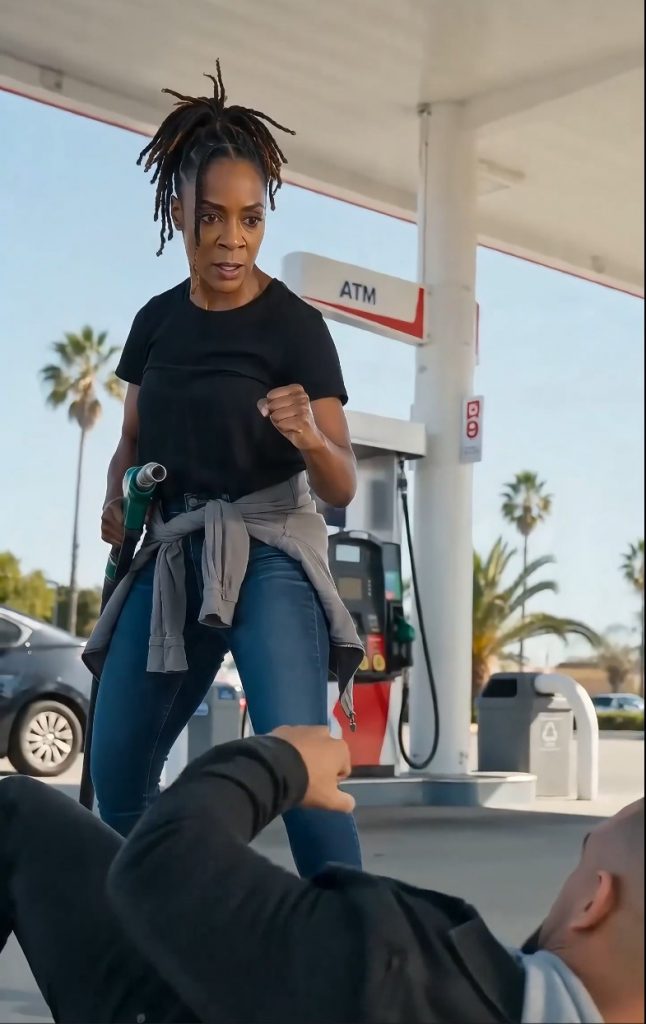
The punch came so fast that the gas nozzle swung from the pump like a loose threat.
For one frozen second, the entire station stopped breathing.
Cars idled beneath the white canopy. Palm trees shimmered beyond the lot in the bright afternoon heat. A child in the back seat of a parked SUV stared through the window with wide eyes while his mother reached for the door handle and then stopped, unsure whether moving would make things worse.
On the pavement beside Pump Four, Dana Brooks pushed herself up on one hand.
Her cheek burned from the hit. Her black T-shirt was dusty where she had landed. The gray jacket tied around her waist had twisted to one side.
The man who had struck her stood over her with his fists still half-raised.
“Should’ve just waited,” he muttered.
A few seconds earlier, Dana had been minding her own business.
She had pulled into the gas station, stepped out of her car, and wrapped her fingers around the black nozzle like any other person on any ordinary day. The pump hummed softly. Traffic whispered past the road. Nothing about the sunny lot suggested that violence was seconds away.
Then his car screeched in behind hers.
He shoved open the driver-side door and stormed toward her, a man with a goatee, a black jacket, and the kind of impatient anger that expected the world to rearrange itself.
He grabbed the nozzle right out of her hand.
“Let me pump first,” he snapped.
Dana looked at him, calm but firm.
“I was here first,” she said. “Please wait your turn.”
That should have been the end of it.
Instead, he ripped harder at the nozzle. Dana pulled it back. For one brief moment, they stood under the canopy with the hose between them, his entitlement pressing against her patience.
Then his face twisted.
His fist drove into the side of her face and sent her down.
Gasps broke out around the station.
Four bystanders rushed forward and stopped halfway when Dana began to move. Not slowly. Not helplessly.
Controlled.
She rolled onto one side, planted her palm on the pavement, and rose with the quiet precision of someone who had fallen before and knew exactly how to get back up.
The man stepped toward her again, still breathing hard, still convinced the punch had settled the matter.
Dana lifted her hands.
Her feet shifted.
Her eyes went cold.
He swung first.
Dana blocked the strike, pivoted, and drove one clean kick into his midsection. Before he could recover, she struck him hard enough to send him stumbling back and crashing onto the pavement.
The sound echoed under the canopy.
This time, nobody rushed forward.
They just stared.
The man groaned, rolled to one side, and forced himself up, his humiliation burning hotter than the sunlit concrete. His fists clenched again.
Dana stayed balanced, shoulders squared, breathing steady.
She did not smile.
She did not speak.
She simply watched him rise.
And that was when one of the bystanders whispered the name that changed everything.
“Isn’t that Marcus Vale?”
Act II
Dana had heard that name before.
Everyone in Riverside had.
Marcus Vale owned three towing companies, two auto shops, and enough local favors to make people lower their voices when his name came up. He sponsored little league teams. He shook hands with police captains. His face appeared on banners every election season beside slogans about “order” and “respect.”
But respect, Dana had learned, was a word men like Marcus used only when demanding it from others.
Her father had known that too.
Walter Brooks built Brooks Fuel & Market long before the bright white canopy and digital pumps. Back then, it was just two rusty pumps, a tiny register, and a handwritten sign taped to the window that read, “Cold soda, hot coffee, honest prices.”
Walter was the kind of man who remembered everybody’s name.
If a nurse came in after a night shift, he gave her coffee for free. If a teenager came up short on gas, he wrote the amount in a little notebook and said, “Pay me when you can.” He kept jumper cables behind the counter and dog treats under the register.
To the neighborhood, he was more than a gas station owner.
He was a steady place.
Then Riverside started changing.
Developers came first, measuring corners and talking about “revitalization” as if the people already living there were part of the clutter. Then came offers. Then pressure. Then city inspectors who suddenly found issues Walter had passed for years.
Marcus Vale was always nearby.
He never said the quiet part out loud. He didn’t have to. He would lean against a pump in his expensive sunglasses and tell Walter the block was going to change with or without him.
“You can sell now,” Marcus said once, “or you can lose it later.”
Walter refused.
A month later, one of Marcus’s tow trucks blocked the station entrance for an hour over a “breakdown” that somehow ended the moment police arrived. A week after that, a supplier canceled a delivery without explanation. Then a brick went through the market window after midnight.
Dana begged her father to file reports.
Walter did.
Nothing happened.
“People like that count on us getting tired,” Walter told her. “So we don’t.”
Dana had been living across the state then, teaching self-defense classes and working as a youth advocate. She had left Riverside because she needed to build a life not defined by fighting for every inch of dignity.
But when Walter got sick, she came home.
She helped him at the register. She balanced the books. She fixed the bathroom lock, repainted the curb, and installed cameras after someone cut the air pump hose twice in one month.
Her father noticed everything.
“You’re carrying too much anger,” he told her one evening.
Dana laughed without humor. “I wonder where I got it.”
Walter smiled sadly.
“No. I gave you stubbornness. Anger is what they throw at you and hope you pick up.”
That was Walter’s way.
He believed discipline mattered more than rage. He had boxed in the Army, but he never bragged about winning fights. He talked about walking away. About control. About protecting people without becoming what hurt them.
After he died, Dana found an envelope in his desk.
Inside was the station deed.
Her name was on it.
There was also a letter in Walter’s careful handwriting.
Don’t sell because you’re scared. Sell only if you’re done loving the place.
Dana cried over that sentence for a long time.
Then she reopened the station.
She knew Marcus would come eventually. Men like him always returned to places they believed should have been theirs.
She just did not expect him to arrive screaming over a gas pump in the middle of the day.
And she definitely did not expect him to make his mistake in front of twelve witnesses and six cameras.
Act III
Marcus did not recognize Dana at first.
That was his second mistake.
His first was thinking the pump belonged to whoever was angriest.
He staggered to his feet, one hand pressed to his ribs, rage boiling behind his eyes. Around him, bystanders stood scattered between cars and pumps, stunned into silence.
A man in a baseball cap held his phone at chest level, recording.
A woman near the ATM sign whispered, “He hit her first. I got it.”
Marcus heard her.
His eyes snapped toward the phone.
“Delete that,” he barked.
No one moved.
That unsettled him more than Dana’s counterattack. He was used to fear traveling ahead of him, clearing space before he had to ask. But the gas station was different now. People were looking at him not as a businessman, not as a donor, not as a man with connections.
They were looking at him as a man who had struck a woman over a turn at the pump.
Dana stepped between him and the bystanders.
“Walk away,” she said.
Her voice was calm, but it carried.
Marcus laughed once, breathless and ugly. “You don’t tell me what to do.”
“This is your chance,” Dana said.
His eyes narrowed. “You think because you know how to kick, you run this place?”
Dana held his stare.
“No,” she said. “I run this place because my father left it to me.”
The words hit him harder than the kick.
For the first time, Marcus really looked at her. The dreadlocks. The steady posture. The Brooks Fuel logo on the small key clipped to her belt.
Recognition crawled across his face.
“Walter’s girl,” he said.
Dana’s jaw tightened.
Around them, the bystanders shifted. They didn’t know the history, not all of it, but they felt the air change. This was no longer road rage. This was old business surfacing in public.
Marcus lowered his voice.
“You should’ve sold.”
Dana’s eyes did not leave his.
“You should’ve stopped asking.”
His expression hardened. The polished local businessman disappeared completely. What remained was the man her father had warned her about. The man who smiled in meetings and sent other people to break windows in the dark.
“You have no idea what you’re holding onto,” Marcus said. “That corner is worth more than your whole life.”
A bystander muttered, “Man, are you serious?”
Marcus ignored him.
Dana did not.
She turned slightly toward the small camera mounted under the canopy above Pump Four. Then toward the second camera over the market door. Then toward the black dome camera watching the ATM.
Marcus followed her gaze.
His face changed.
Dana had not just installed cameras after Walter died. She had upgraded everything. Audio near the pumps. Backup storage inside the market. Cloud copies sent automatically to an attorney in another city.
Her father had taught her to be kind.
Grief had taught her to be prepared.
“You’re on every angle,” Dana said.
Marcus swallowed.
The bystanders were still recording. The station cameras were recording. The car dashcams near the pump were probably recording too.
For a man who had built his power in shadows, the sunlight had become a trap.
Then the glass door of the market opened.
An older woman stepped out holding a phone to her ear. Mrs. Alvarez, the station’s morning cashier, had tears in her eyes and fury in her voice.
“Yes, officer,” she said. “He assaulted her. Yes, Marcus Vale. And tell them we still have the footage from the night Mr. Brooks’ window was smashed.”
Marcus went still.
Dana looked at Mrs. Alvarez.
The older woman nodded once.
“I saved it,” she said. “Your father asked me to.”
For a moment, Dana forgot the ache in her cheek.
Her father had known.
He had known Marcus would come back. He had known Dana would need more than courage. He had left her not just the deed, but the evidence.
Marcus took one step backward.
And for the first time since he arrived, he looked afraid.
Act IV
The police came with sirens that sounded almost too late.
By then, Marcus had tried to leave twice.
The first time, a pickup truck blocked his car from backing out. The driver, a mechanic named Leon who had known Walter for twenty years, stood beside his bumper with his arms folded.
“Pump’s busy,” Leon said.
The second time, Marcus reached for his phone and started shouting about lawyers.
Dana said nothing.
She stood by Pump Four, hands lowered now but still ready, while Mrs. Alvarez locked the market door and kept the footage safe behind the counter. The bystanders remained close enough to witness, far enough not to crowd the scene.
Nobody trusted Marcus not to explode again.
When the first officer stepped out, Marcus transformed.
His shoulders relaxed. His face rearranged itself into outrage. He pointed at Dana before the officer had even reached the pump.
“She attacked me,” he said. “I want her arrested.”
Dana almost laughed.
Not because any of this was funny, but because men like Marcus always believed the first story told in a confident voice would become the official one.
The officer looked at Dana, then at the bystanders, then at the cameras overhead.
“Is that what happened?” he asked.
Before Dana could answer, three voices spoke at once.
“No.”
“He hit her first.”
“He grabbed the nozzle from her.”
A young mother stepped forward, still holding her son’s hand. “My child saw it. He punched her after she told him to wait his turn.”
Marcus’s face flushed.
“They’re lying,” he snapped. “They don’t know who I am.”
The officer’s expression cooled.
“That’s not helping you.”
A second patrol car arrived. Then a third.
Dana gave her statement quietly. She described the nozzle, the demand, the punch, the second attempted attack, and her response. She did not embellish. She did not shake.
When asked if she needed medical attention, she said, “After the footage is secured.”
The officer glanced at her with something like respect.
Inside the market office, Mrs. Alvarez opened the camera system.
The screen showed everything.
Marcus’s car braking too close behind Dana’s. Marcus storming out. Marcus yanking the nozzle. Dana standing her ground. Marcus striking first.
Then the second angle showed what happened after.
Dana rising.
Marcus attacking again.
Dana defending herself with precision, not rage.
One officer watched the footage twice.
Then he turned to Marcus.
“Hands behind your back.”
Marcus stared at him. “You can’t be serious.”
“I am.”
“You know who I know?”
The officer stepped closer. “Sir, hands behind your back.”
The gas station fell silent as Marcus Vale was cuffed beside the same pump he had tried to take by force.
For years, he had made other people feel small on that corner. He had threatened workers, pressured owners, leaned on city offices, and acted as if public spaces belonged to whoever had the most money and the loudest voice.
Now he stood beneath the canopy, red-faced and furious, while people recorded the consequence.
But the final blow to his power did not come from the arrest.
It came from Walter Brooks.
Or rather, from what Walter had left behind.
Mrs. Alvarez handed Dana a small flash drive from the station safe. It was taped to an envelope with Dana’s name on it.
Inside was a note.
Baby girl, if he comes back, don’t just protect yourself. Protect the truth.
Dana’s hand trembled around the paper.
The flash drive held months of footage. Marcus’s men circling the station after closing. A tow truck blocking the driveway. A masked figure breaking the front window. A city inspector accepting an envelope from one of Marcus’s employees near the dumpsters.
Walter had collected it all.
Quietly.
Patiently.
Like a man who knew he might not live to finish the fight, but refused to leave his daughter unarmed.
Dana looked through the market window at Marcus being placed in the back of the patrol car.
He saw the flash drive in her hand.
And somehow, even through the glass, he understood.
This was no longer about a punch.
This was about everything.
Act V
The video spread before sunset.
At first, it was just a local clip shared with angry captions. Man assaults woman at gas station. Woman defends herself. Bystanders confirm he started it.
Then people recognized him.
Marcus Vale, donor. Marcus Vale, redevelopment partner. Marcus Vale, smiling in photos beside council members and police charity banners. Marcus Vale, who had spent years selling himself as a man who cared about Riverside’s future.
By morning, the future was asking questions.
Reporters gathered outside Brooks Fuel & Market. City officials stopped answering calls. Former employees of Marcus’s towing company began sending messages to Dana’s attorney. Other small business owners came forward with stories that sounded painfully familiar.
Blocked entrances.
Fake complaints.
Sudden inspections.
Threats disguised as offers.
Marcus had not targeted only Walter.
He had targeted anyone standing in the way of land he wanted.
The assault at Pump Four became the crack in the wall. Through it came years of rot.
Dana did not enjoy the attention.
She hated the cameras pointed at her face. She hated seeing the punch replayed online. She hated strangers turning her pain into entertainment.
But she also knew why visibility mattered.
Her father had spent years being ignored politely.
Nobody could politely ignore the truth now.
Two weeks later, the city suspended redevelopment negotiations connected to Marcus’s companies. An internal review opened into inspection fraud. His businesses lost contracts. His lawyers tried to frame the gas station incident as “a moment of stress,” but the footage would not cooperate.
Neither would the witnesses.
The young mother testified.
Leon testified.
Mrs. Alvarez testified with her chin lifted and Walter’s flash drive copied three times in her purse.
Dana testified last.
In court, Marcus would not look at her.
That almost made her smile.
When the prosecutor asked why she fought back, Dana did not give the answer people expected. She did not talk about pride. She did not talk about anger. She did not even talk about martial arts, though the defense had tried hard to make her skill seem suspicious.
Dana looked at the judge and said, “Because he hit me and came at me again. I protected myself. That is all.”
Simple.
True.
Enough.
Marcus was convicted for the assault at the station while the larger investigations continued. The court cases tied to his business dealings would take longer. Men like Marcus built their protection in layers, and layers had to be peeled back carefully.
But the neighborhood did not wait for a verdict to change.
People came to Brooks Fuel again.
Some bought gas. Some bought coffee. Some came just to tell Dana what Walter had done for them once. A retired teacher brought flowers. A delivery driver fixed the squeaky market door without charging. A teenager painted a small mural on the side wall with Dana’s permission.
It showed a hand holding a gas nozzle, not as a weapon, but as a symbol.
Under it were Walter’s words:
Honest prices. Steady place.
Dana stood in front of that mural the day it was finished, her eyes burning.
Mrs. Alvarez came outside and handed her a cup of coffee.
“Your father would hate all this attention,” she said.
Dana laughed softly. “He would pretend to hate it.”
“He’d be proud.”
Dana looked toward Pump Four.
For a long time, she had thought keeping the station meant preserving a building. Pumps, concrete, shelves, receipts. But standing there in the afternoon light, she understood that her father had left her something bigger.
A corner where people had been helped.
A place where neighbors still showed up.
A line in the pavement that said not everything could be bought by men who threatened loudly enough.
Weeks later, Dana replaced the damaged nozzle.
She did it herself.
The new one clicked into place under the canopy as traffic moved beyond the lot and palm leaves shifted in the breeze. Everything looked ordinary again from a distance.
But ordinary was different now.
People who came to the station looked up at the cameras and smiled. They held doors for one another. They told impatient drivers to wait their turn. Nobody said Marcus’s name unless they had to.
One afternoon, a little boy from the SUV returned with his mother. He stood near the counter, staring at Dana with shy seriousness.
“My mom said you were brave,” he told her.
Dana crouched so they were eye level.
“I was scared,” she said. “Brave just means you still do what’s right.”
He thought about that, then nodded as if filing it away for later.
After they left, Dana stepped outside.
The sun was low, turning the pavement gold. Pump Four hummed quietly. Cars came and went. Life moved forward in small, stubborn ways.
Dana rested one hand on the pump and looked at the spot where she had fallen.
She remembered the shock of the punch.
The heat of the pavement.
The moment she chose to rise.
Then she looked at the station her father had loved and the neighborhood that had finally seen the truth clearly.
Marcus Vale had arrived believing he could take whatever he wanted by force.
The pump.
The corner.
The silence.
But he had chosen the wrong woman, at the wrong station, in front of the wrong witnesses.
And by the time he understood that, the whole town was already watching.