Act I
The dog stood in the middle of the road like it had chosen death over silence.
Rain hammered the asphalt. Headlights cut through the night in bright white tunnels, and the wet blacktop reflected the flashing red and blue lights of Officer Nathan Cole’s patrol car. Any other animal would have bolted into the trees.
But this golden retriever did not move.
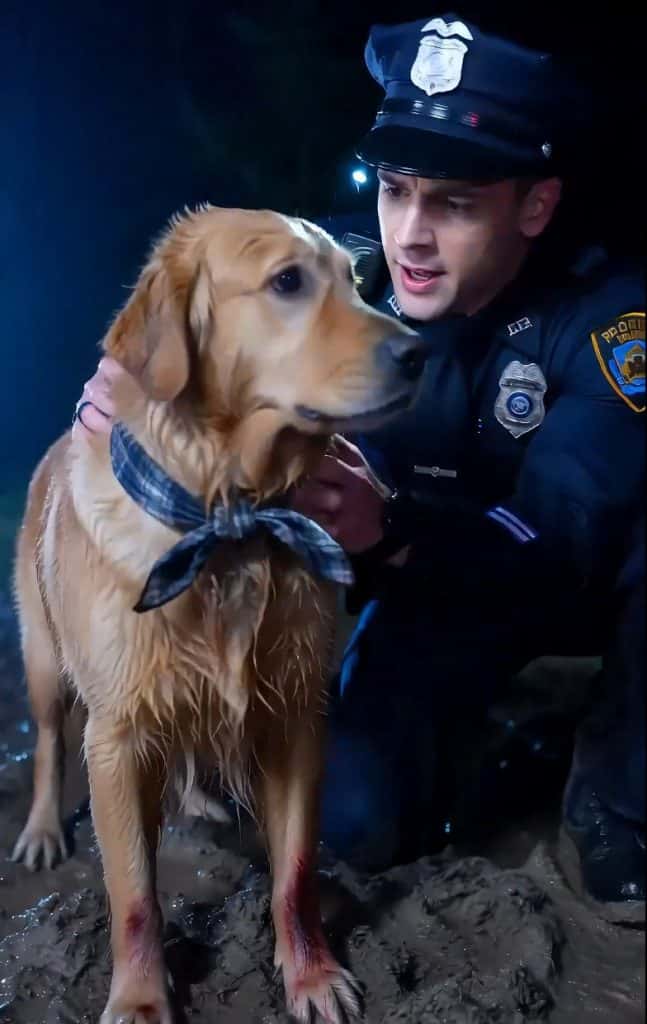
It stood there soaked to the bone, chest rising fast, muddy legs planted, eyes fixed on Nathan as if it had been waiting for exactly one person to stop.
Nathan eased his cruiser onto the shoulder and stepped out into the storm.
“Hey there, buddy,” he called softly.
The dog flinched at his voice, but it did not run. It only whimpered, a sound so small it nearly disappeared under the rain.
Nathan raised both hands where the dog could see them, then crouched low in the mud. He had handled enough frightened animals after accidents to know the look of panic. This was different.
This dog was not lost.
It was desperate.
As Nathan came closer, the retriever turned its head sharply toward the forest. Then back to him. Then to the forest again.
The message was clear before any words appeared.
Follow me.
Nathan reached for his radio, but the dog stepped toward him and lowered its head, pressing its wet collar against his hand.
That was when he saw it.
A strip of plaid cloth was tied around the collar, knotted tightly as if someone had done it with shaking fingers. Beneath the cloth, wedged against the leather, was a small orange pill bottle.
Nathan’s face changed.
He forgot the rain. Forgot the passing traffic. Forgot the routine report he had been preparing to make about an animal on the road.
“What is…” he whispered, working the knot loose. “What is this?”
The dog stood perfectly still, trembling all over.
The bottle clicked in Nathan’s hand. Empty, except for one rough scrap of cardboard rolled tightly inside. He twisted off the cap, shook it once, and caught the wet piece before it could fall into the mud.
The cardboard had been torn from a box.
The words were written in dark marker, uneven and rushed.
HE LOCKED ME.
Nathan stared at it for half a second too long.
The rain ran over the letters, but they did not disappear.
Behind him, his patrol radio cracked with static. Ahead of him, the forest waited in a wall of black trees.
Then the dog barked.
Not at Nathan.
At the woods.
The sound was sharp, furious, almost human in its urgency. Nathan snapped his head up and saw movement near the treeline—a shadow pulling back from the edge of his flashlight beam.
His hand dropped to his holster.
“Don’t move!” he shouted.
The dog lunged forward into the mud, barking again, then looked back at Nathan with wild, pleading eyes.
And that was when Nathan understood the worst part.
Whoever had written that note was still alive.
But the note was only the first thing the dog had carried out of those woods.
Act II
The dog’s name, Nathan would learn later, was Ranger.
But in that moment, Ranger was just a streak of soaked golden fur racing down a narrow trail that should not have existed. It split away from the road between two sagging fence posts, swallowed by rain, weeds, and the dense forest beyond.
Nathan followed, boots sinking into the mud.
Every few yards, Ranger stopped and looked back.
Not running away.
Guiding him.
Nathan kept one hand on his flashlight and the other near his radio. “Dispatch, this is Cole. I’m off Route 19, north shoulder, entering the woods on foot. Possible victim trapped. Send backup and medical.”
Static hissed back.
“Officer Cole, repeat location.”
Nathan repeated it, louder this time, pushing through wet branches.
Ranger barked once and ran harder.
The forest was colder away from the road. The police lights faded behind them until they became only red and blue flashes between the trunks, like distant warnings. Rain dripped from pine needles. Mud sucked at Nathan’s boots.
He kept seeing the cardboard note in his mind.
HE LOCKED ME.
Not “help.”
Not “trapped.”
He.
Someone had done this on purpose.
Nathan had been a police officer for only eighteen months, but he knew enough about fear to recognize the shape of it. People wrote differently when they were afraid. They did not waste space. They did not explain.
They left the one detail that mattered.
Whoever “he” was, the victim knew him.
Ranger stopped suddenly beside a rotted wooden post half buried in weeds. A rusted metal sign hung from it, swinging in the storm.
Nathan wiped rain from the surface.
WHITLOCK PROPERTY
NO TRESPASSING
His stomach tightened.
Everyone in Greyhaven knew the Whitlock land.
For decades, it had belonged to Eleanor Whitlock, the widow who lived in the white house on the hill before sickness and family disputes turned her name into a rumor. Some said she had gone into private care. Others said her nephew, Victor Harlan, had moved her out after gaining power of attorney.
Victor Harlan was not the kind of man people questioned.
He owned half the new construction in town. He sat beside the mayor at charity dinners. His face smiled from billboards promising “a safer Greyhaven.”
And two weeks earlier, Nathan had watched him shake the chief’s hand at a fundraiser for the police department.
Ranger barked again.
Nathan looked down and saw something caught in a thorn bush.
A woman’s scarf.
Blue silk, torn at one end, soaked and darkened by rain.
He lifted it carefully. A faint scent of lavender clung to it beneath the mud. There was something elegant about the fabric, something too delicate for a hunting trail.
Then Ranger pressed his nose into the ground and whined.
Nathan crouched.
There were drag marks in the mud.
Not fresh enough to be minutes old, but not old enough to have vanished in the storm. They led deeper between the trees, toward a slope where the land dipped behind the old Whitlock estate.
Nathan’s radio crackled again.
“Cole, backup is ten minutes out. Hold position if scene is unsafe.”
Nathan looked at Ranger.
The dog stared back, rain streaming from its muzzle, then let out a broken whimper that sounded almost like begging.
Ten minutes could be nothing.
Ten minutes could be the rest of someone’s life.
Nathan moved forward.
The trail narrowed until branches scraped both sides of his jacket. Ahead, a weak yellow light flickered through the trees. Not from the road. Not from any house.
A lantern.
Ranger lowered his body and growled.
Nathan killed his flashlight.
In the darkness, he heard it.
A voice.
Low. Male. Angry.
“You stupid old woman,” the voice said somewhere ahead. “You should’ve signed when I asked nicely.”
Nathan froze.
The dog had led him to a place everyone in town had forgotten.
And behind the trees, someone was still trying to finish what he had started.
Act III
The cabin stood at the bottom of the slope, half hidden behind dead vines and leaning trees.
It was not the kind of place people noticed from the road. Its roof sagged. Its windows were boarded from the outside. A rusted padlock hung from a storm-cellar door built into the earth beside it.
That was where Ranger ran.
He threw himself at the cellar door, barking and scratching, his front paws slipping in the mud. The stains Nathan had seen on the road were not from some accident on the asphalt.
They were from this door.
From hours of trying to dig, claw, and tear his way back inside.
Nathan’s throat went tight.
“Police!” he shouted. “Step out where I can see you!”
For one second, there was only rain.
Then the lantern inside the cabin went dark.
A back door slammed.
Nathan sprinted around the side just in time to see a man in a dark raincoat running toward the trees.
“Stop!”
The man did not stop.
Nathan chased him twenty feet before Ranger’s bark changed behind him. It was no longer warning.
It was panic.
Nathan turned back.
The victim came first.
He reached the cellar door and grabbed the padlock. New steel. Heavy. Fresh scratches marred the metal around it.
“Nathan Cole to dispatch,” he said into his radio, breathing hard. “I have a locked storm cellar on Whitlock property. Possible victim inside. Suspect fleeing north through the woods. I need backup now.”
A faint sound rose from beneath the door.
Not words.
A knock.
Weak. Slow.
Nathan dropped to his knees.
“Ma’am?” he shouted. “Can you hear me?”
Another knock.
Ranger pressed his whole body against the cellar door and whined.
Nathan searched the muddy ground, the doorframe, the rotting steps. No key. No release latch on the outside. Whoever had locked it had meant for it to stay locked.
He pulled the baton from his belt and struck the old hasp again and again until the wood around it splintered. The rain washed mud down the frame. Ranger barked beside him, frantic but focused, as if he understood every second mattered.
The lock finally gave.
Nathan shoved the door open.
Cold air rose from below.
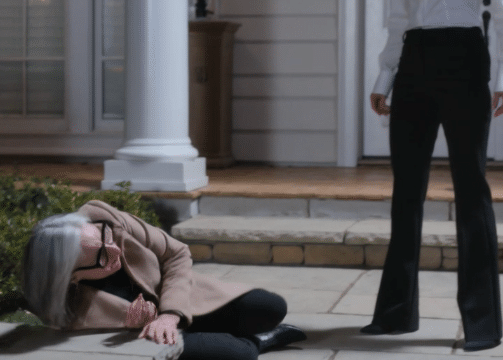
His flashlight beam swept down the wooden steps and landed on a woman curled near the far wall beneath a thin blanket.
She was elderly, soaked from leaks in the roof, her silver hair loose around her face. Her lips moved before sound came out.
“Ranger,” she whispered.
The dog bounded down the steps and pressed against her. She wrapped one trembling hand around his collar and began to cry without making a sound.
Nathan descended slowly.
“Ma’am, I’m Officer Cole. You’re safe now.”
The woman looked up at him.
For a moment, she seemed confused by the uniform, the light, the rain behind him. Then her eyes moved over his face, and something in her expression broke open.
Not relief.
Recognition.
She whispered a name Nathan had not heard since childhood.
“Lillian?”
Nathan went still.
“My mother’s name was Lillian,” he said carefully.
The woman’s hand tightened around Ranger’s collar.
“Oh God,” she breathed. “You’re her son.”
Nathan felt the cellar tilt beneath him.
His mother had died when he was two. That was the story. A storm, a car off the bridge, a body recovered days later, and a little boy sent into foster care because no family came forward.
No family.
That was what every file had said.
But the woman in the cellar was staring at him as if a ghost had walked down the stairs wearing a police badge.
“Who are you?” Nathan asked.
She swallowed hard.
“Eleanor Whitlock,” she said. “Your grandmother.”
The rain outside seemed to disappear.
Nathan could hear only Ranger panting and Eleanor’s breath catching in her chest.
Then she lifted a shaking hand and pointed toward a metal box in the corner.
“He locked me down here because I found it,” she whispered. “And because I was going to tell the truth about your mother.”
The rescue had become something much larger than a crime scene.
It had become the doorway to Nathan’s entire life.
Act IV
Backup arrived in waves of light and noise.
Officers came down the trail with flashlights. Paramedics wrapped Eleanor in blankets and lifted her carefully from the cellar. Ranger refused to leave her side, pressing his wet body against the stretcher until one medic finally smiled sadly and said, “Let him come.”
Nathan should have stepped back.
He should have let detectives take the scene, preserve the evidence, follow the chain of command.
But his hands would not let go of the metal box.
It was old, dented, and hidden beneath loose boards in the cellar floor. Eleanor had told him where to find it before they carried her out. Her voice had been faint, but her eyes had been clear.
“Victor thinks I’m confused,” she had said. “I let him think that. It was the only way to stay alive.”
Inside the box were papers wrapped in oilcloth.
A birth certificate.
Adoption records.
A will.
A photograph of a young woman with Nathan’s eyes, holding a baby wrapped in a blue blanket.
On the back, written in neat handwriting, were four words.
Lillian and baby Nathan.
His name.
Not the one given to him by the state. Not the one printed on foster documents after his mother’s death.
His real name.
Nathan Whitlock.
He stared at the photograph until the edges blurred.
Detective Mara Voss, the first investigator on scene, touched his shoulder gently. “Cole. You need to breathe.”
He did.
Barely.
The rest came fast.
Eleanor had never been placed in private care. Victor Harlan had kept her hidden on the old property, moving her between the estate and the cabin whenever questions got too close. He had filed documents claiming she suffered from severe memory loss, then used that claim to control her land, her accounts, and her silence.
But Eleanor had been waiting.
For years, she had collected copies. Bank transfers. Forged signatures. A private investigator’s report. A letter from Lillian written days before the crash, saying she was afraid of Victor and planned to take her son away.
There was more.
A sealed envelope addressed to the Greyhaven Police Department.
Nathan recognized the handwriting on the old report inside.
Chief Martin Vale.
His own chief.
Twenty-two years ago, Vale had been the responding officer at Lillian Whitlock’s crash. His report stated she had been alone. It stated the child had been located later through social services. It stated no next of kin could be verified.
But Eleanor’s records showed the opposite.
She had reported her grandson missing that same night. She had begged police to search Victor’s house. She had named him directly.
Her statement had vanished.
So had Nathan.
Victor had not just stolen land.
He had stolen a family.
By dawn, the search team found Victor Harlan three miles north, hiding in an equipment shed near the old quarry. His clothes were soaked. His shoes were caked in the same red clay as the cellar entrance. In his pocket was the key to the padlock.
He denied everything at first.
Then Detective Voss placed the orange pill bottle on the table in the interview room.
Victor’s face changed.
It was such a small thing. One cheap plastic bottle, scratched and dirty, wrapped in a strip of plaid cloth torn from Eleanor’s blanket.
But it had beaten him.
Ranger had beaten him.
An old woman he had dismissed as weak had beaten him.
And the young officer he had unknowingly erased from his own family’s history was the one who had followed the dog through the rain.
When Chief Vale arrived at the station demanding control of the case, Nathan was standing in the hallway with Eleanor’s file in his hands.
The chief saw the photograph first.
Then Nathan’s face.
For the first time in all the months Nathan had known him, Martin Vale looked afraid.
Nathan stepped forward.
He did not shout. He did not shake. He simply held up the missing report from twenty-two years ago.
“You signed this,” Nathan said.
The hallway fell silent.
Vale opened his mouth, but no words came out.
Detective Voss took the file from Nathan and turned to the officers behind her.
“Chief Martin Vale,” she said, “you’re relieved of duty pending investigation.”
Outside, rain still tapped against the station windows.
Inside, a family secret that had survived two decades finally met daylight.
But the person Nathan most needed to face was not the man in handcuffs.
It was the woman waiting in a hospital room, holding on for the grandson she thought she had lost forever.
Act V
Eleanor Whitlock looked smaller in the hospital bed than she had in the cellar.
Without the storm around her, without the cellar walls and the barking dog and the frantic rush of rescue, she seemed almost fragile. Her hands rested on the blanket. Ranger slept on the floor beside her, his head on one paw, waking every time she moved.
Nathan stood in the doorway for a long moment.
He had faced drunk drivers, break-ins, grieving parents, and men twice his size who thought a badge made him a target. But walking into that room frightened him more than any of them.
Because this was not a case anymore.
This was the life he had been denied.
Eleanor saw him and began to cry before he said anything.
“I looked for you,” she whispered.
Nathan crossed the room slowly.
“I know.”
“No one believed me. Victor said grief had broken my mind. The police told me the records were sealed. Then they stopped taking my calls.” Her voice shook. “I kept your room ready for ten years.”
Nathan looked away, but only for a second.
All his life, he had carried the quiet shame of being unwanted. Foster homes had taught him to pack quickly, expect little, and never ask why nobody came for him. He had built his whole life around being useful because being loved had felt like asking for too much.
Now an old woman was reaching for his hand as if she had been reaching for it through twenty-two years of darkness.
He took it.
Eleanor held him with surprising strength.
“Your mother loved you,” she said. “That is the first thing you need to know.”
Nathan closed his eyes.
For years, he had imagined his mother as a fading photograph, a story with missing pages. Now those pages were returning, one painful sentence at a time.
Lillian had tried to leave Greyhaven after discovering Victor had been stealing from the estate. She had planned to expose him, but she wanted Nathan safe first. Eleanor had been away caring for a sick friend when Lillian called and left one last message.
“I’m coming home, Mom,” she had said. “And I’m bringing Nathan.”
She never made it.
Victor had arranged the lie afterward with help from Vale, who buried the statements, redirected the child welfare records, and made sure the Whitlock name disappeared from Nathan’s file. In exchange, Victor helped finance Vale’s political rise inside the department.
It was not one act of cruelty.
It was a machine.
And for years, Eleanor had been trapped inside it.
The trials took months.
Victor Harlan’s lawyers tried to make Eleanor look confused. They suggested the evidence had been planted. They called Ranger “a trained animal acting on instinct,” as if instinct had not done what half the town had failed to do.
Then Detective Voss played the hospital recording of Eleanor explaining how she had tied the pill bottle to Ranger’s collar.
Victor had locked her in the cellar after she refused to sign the final transfer papers for the Whitlock land. He had taken her phone, her medication, and the documents he could find. But he had not noticed the old pill bottle in her pocket.
He had not noticed Ranger hiding under the stairs.
So Eleanor tore a strip from her blanket, wrote the message on cardboard, pushed the bottle through a gap near the cellar vent, and whispered one command to the dog she had raised from a puppy.
“Find help.”
Ranger had crawled through mud, forced his way under a loose board, and reached the road in the middle of the storm.
Then he stood in front of the headlights until someone finally stopped.
When the verdict came, Nathan sat beside Eleanor.
Guilty.
Victor did not look at her when the judge spoke.
Chief Vale took a plea before his trial began, trading names and records for a lesser sentence. More files reopened. More families received calls they had waited years to hear. Greyhaven learned that the most dangerous secrets were not buried in forests.
They were filed in cabinets by men who smiled in public.
Weeks later, the Whitlock house opened again.
Not as a mansion. Not as a monument to old money. Eleanor refused that.
She turned part of the property into a rescue center for displaced children and abandoned animals. The first photograph hung in the entrance showed Ranger wrapped in a towel, eyes bright, sitting proudly beside Eleanor’s hospital bed.
Below it, a brass plate read:
He found the road when no one else would listen.
Nathan visited every Sunday.
At first, he told himself it was to check on Eleanor’s safety. Then it was to help with repairs. Then it was to walk Ranger through the orchard, where the trees had started to bloom again after years of neglect.
Eventually, he stopped making excuses.
One evening, Eleanor gave him the blue blanket from the photograph. It had been folded in cedar for more than two decades, waiting for a child who never came home.
Nathan held it in both hands.
For a moment, he was not Officer Cole. He was not the foster kid who learned not to need anyone. He was not the young man standing over a storm-cellar door with a badge and a broken past.
He was someone’s grandson.
Someone’s son.
Someone who had been missed.
Ranger pressed his nose against Nathan’s knee, then looked toward the road beyond the trees.
The same road where he had stood in the rain.
The same road where everything had changed.
Nathan knelt and scratched behind the dog’s ears.
“You knew,” he said softly.
Ranger wagged his tail once, as if that had always been obvious.
Eleanor watched from the porch, wrapped in a shawl, her eyes wet but smiling.
For twenty-two years, the truth had been locked away in files, in lies, in a cellar beneath the trees.
But one stormy night, a dog stepped into the road with a bottle on his collar and a message no one could ignore.
And because one officer stopped, a woman was saved, a crime was exposed, and a lost family finally found its way home.