Act I
The bucket hit the lake with a sharp metallic splash.
For a moment, the sound cracked the morning open.
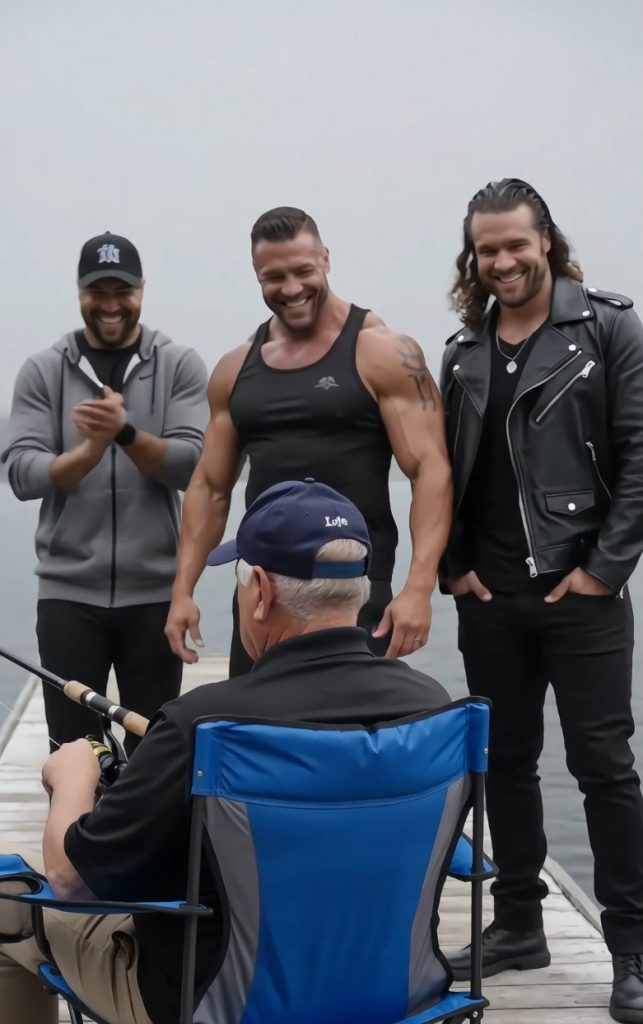
Ripples spread across the gray water, breaking the perfect reflection of the clouds, the white house across the shore, and the boats sitting quietly at their slips. The dock had been peaceful seconds earlier, just damp boards, soft wind, and an old man sitting in a folding chair with a fishing rod in his hand.
Then the laughter began.
Three young men stood over him, loud and careless against the mist.
The one in front wore a white ribbed tank top despite the cold. His shoulders were broad, his beard trimmed, his tattooed arm hanging loose at his side like he wanted everyone to notice it. He watched the bucket sink with a grin, then turned back to the old fisherman.
“Oops,” he said.
His friends laughed harder.
The old man did not move.
His name was Walter Briggs, though most people around the lake had once called him Walt. White hair showed beneath his navy cap. His face was lined from sun, wind, and years of refusing to say more than necessary. One hand held the rod. The other rested on the arm of his blue folding chair.
The fishing line trembled slightly in the water.
Not from fear.
From the current.
The bully stepped closer, boots heavy on the damp wood.
“Hey, old man,” he said. “This is our lake. If you want to fish here, you pay.”
Walter slowly lifted his eyes.
The boys behind the leader shifted with excitement. The one in the gray hoodie leaned forward as if waiting for a show. The long-haired one in the leather jacket smirked, already entertained by whatever humiliation came next.
Walter looked past them to the water.
The bucket was gone.
Inside it had been a small tackle box, two sandwiches wrapped in wax paper, and a faded thermos that had belonged to his wife. Nothing expensive. Nothing anyone else would mourn.
But Walter knew exactly where it had sunk.
He knew every board of this dock, every hidden nail, every knot in the wood. He knew where the water deepened, where the old pilings leaned, where children used to drop crumbs for bluegill in July.
He knew because he had built it.
The leader bent toward him. “You hear me?”
Walter’s voice was calm.
“Everything here is free,” he said. “I have the right to do whatever I want.”
The young man stared at him.
Then he laughed.
Not because it was funny. Because cruelty often laughs when it does not know what else to do with courage.
The other two joined in, their voices echoing across the water, ugly and bright in the quiet mist.
Walter stayed seated.
The tip of his rod moved once.
Across the lake, a boat engine started.
The boys did not hear it yet.
Walter did.
And for the first time that morning, his fingers tightened around the fishing rod.
Act II
Walter had not come to the dock for fish.
He came for Ellen.
Every Saturday morning for forty-two years, he and his wife had sat there together before the town woke up. Walter fished. Ellen pretended to read. Mostly, she watched the water and corrected him whenever he claimed the lake was too quiet.
“Water is never quiet,” she would say. “You just don’t listen properly.”
She was right about most things.
She had been right when she told him not to sell the shoreline to developers in the nineties, even when the offer would have paid off every debt they had. She had been right when she said the lake should belong to the people who loved it, not the people who fenced it. She had been right when she made him put the public access easement in writing, filed with the county, recorded in ink no bully could shout away.
“This dock stays open,” she told him. “Kids, old men, widows, anyone who needs a morning.”
Walter had grumbled that strangers would leave trash.
Ellen said he could pick it up.
So he did.
For decades, the dock became what Ellen wanted it to be.
A place where fathers taught daughters to cast lines. Where teenagers came after heartbreak and pretended they were only there for the view. Where retired men sat in silence beside one another and called it conversation. Where Walter and Ellen grew old without noticing it until one of them had to help the other stand.
Then Ellen got sick.
The first year, she still came to the dock.
The second year, Walter brought a blanket for her knees.
The third year, she sat in the blue folding chair and told him that if he ever stopped coming after she was gone, she would haunt him badly on purpose.
“You’d do that?” he asked.
“With enthusiasm.”
She died in early spring, when the lake was still cold enough to punish anyone foolish enough to fall in.
Walter came back the next Saturday.
And every Saturday after.
The town changed around him. The small bait shop closed. The marina got new owners. The houses along the shore became bigger, cleaner, and less likely to know their neighbors. People who had never watched a sunrise from that dock began talking about property values and private access.
Then the Keene family arrived.
The leader’s name was Troy Keene.
His father owned three rental cabins, two jet skis, and a talent for making public spaces feel inconvenient to anyone who could not afford him. Troy had inherited the confidence without the business sense. He and his friends spent mornings roaming the lakefront as if noise could be mistaken for ownership.
They harassed tourists.
Mocked old fishermen.
Charged teenagers “dock fees” that had no legal meaning.
Most people paid a few dollars just to avoid trouble.
Walter did not.
The first time Troy asked him for money, Walter said, “No.”
The second time, he said, “Still no.”
The third time, Troy brought friends.
That was the morning the bucket went into the lake.
What Troy did not know was that Walter had expected it.
Not the bucket, exactly. Cruelty likes improvisation. But the escalation. The demand. The performance.
Two weeks earlier, a thirteen-year-old boy named Milo had shown up at Walter’s porch with wet sneakers and red eyes. Troy and his friends had taken his fishing rod and told him he could have it back for twenty dollars.
Milo did not have twenty dollars.
Walter found the rod later behind a trash bin with the reel broken.
That night, Walter opened the old metal filing cabinet in his garage and pulled out the lake documents Ellen had insisted they keep. He called the county office. Then the sheriff. Then a woman named Denise Alvarez, who ran the local parks commission and had been trying for months to prove someone was illegally intimidating people at the dock.
“Walter,” Denise said, “do not confront them alone.”
“I won’t.”
“You’re planning something.”
“I’m going fishing.”
“Walter.”
He paused.
Then he said, “Ellen wanted that dock free.”
Denise went quiet.
Because everyone who had known Ellen understood that this was not about a bucket. It was not even about fishing.
It was about the moment a town decides whether kindness is public property or something stronger people can steal.
So when Troy stood over Walter and laughed, he thought he was mocking an old man alone on a dock.
He had no idea the entire lake was about to answer.
Act III
The engine grew louder.
The long-haired bully heard it first. His laughter faded, and he looked over his shoulder toward the mist.
A small patrol boat emerged from the gray water near the marina, moving steadily toward the dock. Behind it came another boat, then a third, their shapes appearing through the morning haze like the lake itself had grown witnesses.
Troy’s smile twitched.
“What is this?” the hooded one muttered.
Walter reeled in his line slowly.
No hurry.
No drama.
The first boat came alongside the dock, and Denise Alvarez stepped out before it had fully settled. She wore a dark jacket, rubber-soled boots, and the expression of a woman who had spent too many meetings listening to men explain why doing the right thing was complicated.
Behind her came Sheriff Nolan Price.
And behind him, carrying a waterproof camera bag, was Milo.
The thirteen-year-old kept his eyes on the dock boards, but his broken fishing rod was tucked under one arm.
Troy saw him and immediately understood something had shifted.
He pointed at Walter. “This old guy started it.”
The sheriff looked at the lake where the bucket had disappeared.
“Did he?”
Troy’s friends said nothing.
Denise stepped onto the dock and looked at Walter first.
“You all right?”
Walter nodded.
“Lost my thermos.”
Her jaw tightened. “Ellen’s?”
He nodded again.
For the first time, Troy looked uncertain.
Not sorry.
Just aware that he had kicked something into the water that belonged to a story bigger than him.
Denise turned to the three young men.
“This dock is public access under a recorded easement,” she said. “No one may charge fees, block access, intimidate users, or interfere with lawful fishing.”
The boy in the hoodie scoffed. “We weren’t charging anybody.”
Milo looked up.
His voice shook. “Yes, you were.”
Troy spun toward him. “Shut your mouth.”
The sheriff moved one step.
Only one.
Troy stopped.
Milo swallowed hard. His small hands tightened around the broken rod.
“You took my money last month,” he said. “And when I didn’t have enough, you broke my reel.”
Walter watched the boy speak and felt something in his chest pull tight.
It was not pride exactly.
It was pain.
Because no child should have to be brave just to tell adults what other adults should have noticed.
Denise opened her bag and pulled out printed pages sealed in plastic.
“We also have three written complaints,” she said. “Two phone videos. One statement from a marina employee. And as of this morning, an active observation request from the sheriff’s office.”
Troy’s face hardened. “You set us up?”
Walter stood.
Slowly.
His knees objected, but he ignored them. He folded his fishing chair with one hand and set it against the railing.
“No,” he said. “You walked onto a free dock and decided kindness looked weak.”
The mist moved behind him. The boats bumped softly against the dock. The water lapped against the posts as if Ellen had been right all along.
Water was never quiet.
You just had to listen.
Troy took a step toward Walter.
The sheriff’s voice cut in. “I wouldn’t.”
Troy stopped again.
But his anger needed somewhere to go.
So he pointed toward the lake.
“He can get his own bucket.”
Walter looked at him for a long moment.
Then he said, “You’re going to get it.”
Troy laughed once. “What?”
Denise smiled without warmth.
“Actually,” she said, “that would be a good start.”
Act IV
The lake was cold.
Troy discovered that ten minutes later.
He did not have to dive; the bucket had sunk near the shallower side, just off the dock, where the bottom dipped before the channel. But the sheriff made it clear that if Troy wanted the situation handled informally before charges and restitution were discussed, he would start by retrieving what he had thrown away.
So Troy stood at the edge of the dock in borrowed waders, jaw locked, while Milo watched from beside Walter.
The two friends stayed silent now.
The laughter had drained out of them the moment the first phone video played on Denise’s tablet. It showed Troy demanding cash from two younger kids. Another showed the hooded boy blocking a father and daughter from the dock. Another showed the long-haired one kicking over a tackle bag while the others laughed.
Public cruelty, Walter thought, always looked smaller when replayed without the crowd around it.
Troy stepped into the lake with a hissed curse.
Cold water climbed the waders. Mud shifted beneath his boots. He flailed once, and the long-haired boy almost laughed by habit, then thought better of it.
Walter said nothing.
Milo stood beside him, clutching the broken rod.
“You think he’ll really find it?” the boy asked.
“He’d better.”
“What was in it?”
“Lunch,” Walter said. Then, after a moment, “And my wife’s thermos.”
Milo glanced at him. “Was it special?”
Walter watched Troy bend awkwardly in the water, searching by feel.
“Yes.”
Milo nodded in the solemn way children do when they understand something matters even if they do not know all the reasons.
Troy finally found the bucket.
He dragged it up with both hands, water pouring from the rim. The tackle box clattered inside. The wax-paper sandwiches were ruined. The thermos was dented but still there.
Walter’s breath caught before he could stop it.
Troy sloshed back to the dock and shoved the bucket upward.
The sheriff did not take it.
Denise did not take it.
Walter did.
He reached inside and pulled out the thermos.
Blue enamel.
Scratched at the bottom.
Ellen’s initials still painted in tiny white letters near the lid.
For the first time that morning, his calm almost failed him.
Troy saw it.
Something flickered across the young man’s face. Not full understanding. Not yet. But the first uncomfortable recognition that his joke had landed on someone’s grief.
Walter unscrewed the lid, poured out lake water, and wiped the thermos with his sleeve.
“My wife brought coffee in this every Saturday,” he said.
Troy looked away.
Walter kept speaking.
“She believed this dock should stay open because there are people who need peace and don’t know where else to find it.”
The long-haired boy stared at the boards.
The hooded one swallowed.
Walter looked at all three of them.
“You thought you were taking money from strangers. You were taking the morning from people who came here because life was already hard enough.”
No one answered.
Then Milo stepped forward and held out the broken rod.
“You owe me a reel,” he said.
His voice was quiet.
But it did not shake this time.
Troy looked at the rod.
Then at the sheriff.
Then at Walter.
For once, there was no performance left.
“Yeah,” he muttered. “I do.”
Denise was not satisfied with mutters.
“Clearer.”
Troy’s face tightened.
“I owe you a reel,” he said.
Milo held his gaze. “And an apology.”
The dock went still.
Troy’s friends looked at him, waiting.
The old power between them was cracking. Everyone could hear it.
Troy wiped water from his sleeve, humiliated, angry, and trapped by the truth he had created. He could have sneered. He could have made it worse. For a moment, Walter thought he would.
Then Troy looked at Milo.
“I’m sorry,” he said.
Milo studied him.
“Okay.”
Not forgiveness.
Not friendship.
Just enough dignity to keep moving.
The sheriff took statements. Denise explained the restitution process. The marina employee pulled up in a skiff with more records of complaints. By the time the morning mist lifted, the dock no longer belonged to fear.
But Walter knew better than to mistake exposure for healing.
A dock could be reclaimed in a day.
A town took longer.
Act V
Two Saturdays later, the dock was full.
Not crowded in the loud way tourists crowd a place, but alive in the way Ellen would have loved.
Milo sat near the edge with a new reel attached to his repaired rod. His father sat beside him, pretending not to watch every cast. A young mother helped her daughter bait a hook. Two retired men argued quietly about whether the fish were smarter this year or whether they themselves had gotten worse.
Denise had arranged a new sign at the entrance.
PUBLIC LAKE ACCESS
NO FEES
NO HARASSMENT
REPORT VIOLATIONS
Below it, someone had taped a smaller handwritten note.
Be decent. Ellen would be watching.
Walter pretended not to see it.
He sat in his blue folding chair, the old thermos beside him. The dent remained, but it held coffee again. That was enough.
Across the dock, Troy Keene worked with a toolbox.
Part of his restitution involved community service at the lakefront. Denise, who understood justice better than punishment alone, had assigned him to repair loose boards, repaint railings, and help install a storage rack for loaner fishing rods.
He hated it at first.
That was obvious.
He showed up late the first day, resentful and silent. He avoided Walter’s eyes. He avoided Milo’s too. His friends did not come with him. Public shame, Walter knew, often reveals which friendships were only audiences.
But by the second week, Troy had learned how to replace a cracked plank.
By the third, he stopped slamming tools.
By the fourth, he brought his own gloves.
One morning, Walter found him kneeling beside the dock edge, pulling a tangle of fishing line from between the boards so birds would not get caught in it.
Walter said nothing.
Troy looked up anyway.
“What?”
“Nothing.”
“You’re staring.”
“Observing.”
Troy frowned. “That’s worse.”
Walter almost smiled.
They worked in silence for several minutes. Then Troy stood and wiped his hands on his jeans.
“My dad said this dock used to be private.”
“Your dad says a lot.”
“He said people like you just didn’t know how to make money off things.”
Walter looked across the lake.
The water was silver under the morning sun, no longer misty but clear enough to show the soft movement beneath the surface.
“Your father is wrong about what things are worth.”
Troy leaned against the railing.
For once, he did not argue immediately.
“What was your wife like?” he asked.
Walter glanced at him.
The question was awkward, uncomfortable, and almost certainly harder for Troy to ask than any apology he had been forced to give.
So Walter answered.
“Bossy.”
Troy blinked.
Walter took a sip from the dented thermos. “Kind. Funny. Terrible at cards because she talked when she lied. Believed every child should know how to fish and every fool deserved one chance to become less of one.”
Troy looked down.
“Only one?”
“Sometimes two. If she liked their mother.”
That got the smallest laugh out of him.
The sound surprised them both.
By summer, the dock became known again as Ellen’s Dock, though no official document called it that. The town raised money for a rack of free loaner rods. Milo helped teach younger kids how to cast. Denise organized Saturday cleanups that somehow turned into coffee, muffins, and long conversations nobody admitted they needed.
Troy kept showing up after his required hours ended.
Not every week.
Not perfectly.
But enough.
One morning, he arrived with a new metal bucket and set it beside Walter’s chair.
Walter looked at it.
“What’s that?”
“A bucket.”
“I can see that.”
Troy shifted. “For the one I kicked in.”
“You already retrieved it.”
“This one doesn’t leak.”
Walter studied the bucket, then the young man.
Troy’s face was still proud in places. Still rough around the edges. Change had not softened him into someone else overnight. Life rarely worked that cleanly.
But he was standing there with a bucket in his hand, trying.
Walter nodded toward the boards.
“Set it there.”
Troy did.
Then, after a pause, he said, “I didn’t know about your wife.”
Walter adjusted his cap. “You didn’t ask.”
Troy absorbed that.
“Yeah,” he said quietly. “I guess I didn’t.”
The lake lapped against the dock.
A gull passed overhead.
Milo shouted from the far end that he had a bite, and three people immediately gave him four different instructions. The young mother laughed. Denise waved from the shore. Somewhere behind Walter, the new sign creaked lightly in the breeze.
Everything here is free.
Walter had said it to provoke a bully, but now, watching the dock come back to life, he understood it differently.
The lake was free.
The dock was free.
But peace had a cost.
Someone had to protect it.
Someone had to speak when others were pressured into silence. Someone had to keep the paperwork, make the calls, retrieve the bucket, repair the boards, teach the child, correct the bully, and refuse to let public kindness be privatized by the loudest person standing on the dock.
Walter picked up his rod.
The line arced over the water and landed cleanly.
Troy watched.
“Think I could learn?” he asked.
Walter kept his eyes on the lake.
“You got patience?”
“No.”
“Then fishing might teach you some.”
Troy sat on the boards a few feet away, careful not to crowd him.
For a long while, neither of them spoke.
The lake was not quiet.
Ellen had been right.
It whispered against the pilings, rocked the boats, carried laughter from the far end of the dock, and held somewhere beneath its surface the echo of a bucket hitting water on a morning that had almost belonged to cruelty.
Almost.
Walter poured coffee from Ellen’s dented thermos and watched the ripples widen around his line.
This time, nobody laughed at him.
And if anyone ever tried again, the whole dock knew what to do.