Act I
The first thing that hit Leonard Voss was the cold.
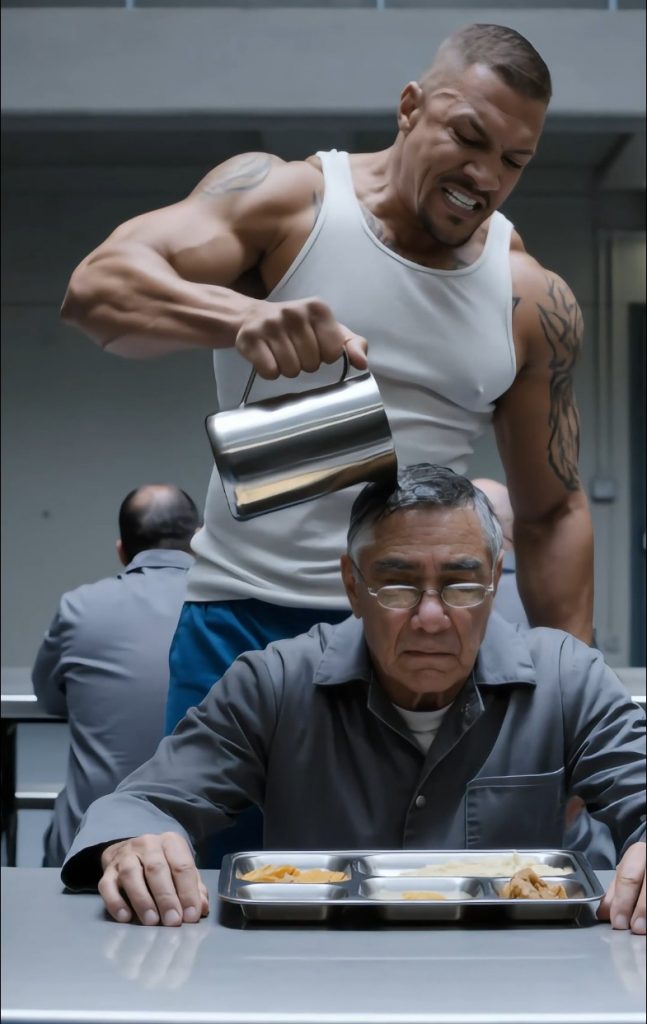
It crashed over his head from a metal pitcher, soaking his gray hair, running down his wire-rimmed glasses, slipping beneath the collar of his prison jumpsuit and spreading across his thin shoulders.
The cafeteria went quiet for half a breath.
Then the pitcher clanged against the table.
“Yah!” the tattooed man shouted, standing behind him like a wall of muscle and ink.
Water dripped from Leonard’s chin into his tray.
It pooled around the pale mashed potatoes, the overcooked carrots, the square of bread he had not yet touched. His hands trembled beside the tray, fingers curled slightly inward, as if his own body was asking permission to disappear.
The man behind him leaned closer.
His name was Victor Kane, though nobody in Block C called him Victor. They called him King, because he had made them, because men like him turned fear into a crown.
He wore a white ribbed tank top despite the cold cafeteria air. Black tattoos covered both arms and climbed his neck like vines. His slicked-back hair shone under the flat institutional lights.
“You will pay for everything,” King shouted.
Leonard did not answer.
A few metal trays scraped. Somewhere in the back, someone muttered under his breath. The guard by the far wall shifted his stance but did not step in.
Leonard kept his head down.
He could feel every eye on him.
The water kept dripping.
One drop from his nose.
One from his glasses.
One from the loose gray sleeve hanging over his wrist.
Across the cafeteria, an inmate in a blue button-down prison shirt stood among a cluster of men. His name was Terrence Boyd, and he had the cold certainty of someone who enjoyed watching punishment as long as his own hands stayed clean.
“He deserves this,” Terrence said.
That was all it took.
The room accepted the cruelty.
Leonard bowed his head lower.
He placed one wet hand over his face, not to wipe the water away, but to hide the fact that his eyes were filling. At seventy-one years old, in a room full of men who had already decided what he was, he had no strength left for pride.
King grabbed the back of Leonard’s chair and shook it once.
“You hear me, old man?”
Leonard’s tray rattled.
Still, he said nothing.
He only lifted his head, slowly, with water clinging to his lashes and his glasses sitting crooked on his face.
His eyes met the room.
They were not angry.
That unsettled some of them.
They were tired, wounded, and full of something worse than fear.
Recognition.
As if he had been expecting this moment for twenty-three years.
And as the final drop fell from his chin onto the metal tray, the cafeteria doors opened.
A young prison counselor stepped inside carrying a sealed file.
On the tab, printed in black ink, was a name that did not match the old man everyone thought they were punishing.
Act II
Leonard Voss had been in Graymoor Correctional Facility for six days.
That was long enough for rumors to grow teeth.
By the second morning, men were whispering that he had been rich once. By the third, someone said he had stolen money from widows. By the fourth, Terrence Boyd announced that Leonard had run a care home where men’s mothers and grandmothers were neglected while he pocketed the money.
By the fifth, the story had become fact.
That was how prison worked.
A rumor did not need evidence. It only needed hunger.
And Block C was always hungry.
Leonard never corrected anyone.
He did not explain that he had never owned a care home. He did not tell them he had spent most of his life repairing school boilers, church roofs, and old apartment pipes for people who paid late and apologized with casseroles. He did not tell them he had been married for forty-two years to a woman named Elise who kept birthday cards in shoeboxes and believed every window needed plants.
He did not tell them about the night she died.
That story belonged to him.
And to the girl he had protected.
Her name was Hannah.
His granddaughter.
At seventeen, Hannah had been fierce in a way that frightened adults because it looked too much like pain. She had her mother’s sharp eyes and Leonard’s stubborn mouth. After her parents disappeared into their own addictions and excuses, Leonard and Elise raised her in the small yellow house on Miller Street.
Elise softened Hannah.
Leonard steadied her.
For a while, that was enough.
Then Elise got sick.
Bills came in envelopes so thin they seemed harmless until opened. Treatments. Specialists. Insurance denials written in polite language. Leonard sold his truck first. Then the fishing boat. Then Elise’s wedding ring, though he lied and told her he had misplaced it.
Hannah knew.
She always knew more than he wanted her to.
After Elise died, something broke in the house.
Leonard moved through rooms like a ghost. Hannah stopped coming home before midnight. She fell in with people who spoke fast, drove stolen cars, and treated consequences like something that happened to other families.
One of them was Victor Kane’s younger brother.
Milo.
Milo was not evil. Leonard believed that even now. He was twenty, foolish, desperate to impress men who should have known better. He liked Hannah, or said he did. He brought her cheap flowers from a gas station once, and Elise, already weak by then, had smiled from her chair and said, “At least he knows yellow is your color.”
Milo blushed so hard Hannah laughed.
Six months later, he was dead.
The official report said robbery gone wrong.
Convenience store. Night shift. A frightened clerk. A gun nobody admitted bringing. A struggle. A shot. Panic.
Hannah came home shaking before dawn with blood on her sleeve that was not hers and terror in her eyes.
Leonard remembered every second.
The back door opening.
Her whisper: Grandpa.
The way she collapsed into him like she had become a child again.
He called the police.
Then he saw the gun in her backpack.
There are moments in life when the truth arrives too quickly for morality to prepare itself.
Leonard knew what he should do.
He knew.
But Hannah was seventeen. Hannah was all he had left. Hannah was sobbing that she did not pull the trigger, that Milo had, that everything went wrong, that the others ran, that she was only supposed to wait in the car.
Then the sirens came down Miller Street.
Leonard took the backpack from her hands.
“Listen to me,” he said.
She shook her head. “No.”
“You were never here.”
“Grandpa, no.”
“You were never here.”
He hid her in the basement behind the old furnace room, walked outside with the gun in his hands, and gave the police the first lie of his life that truly mattered.
He said he had done it.
No one believed him at first.
Then someone found his old work gloves in the car, because he had fixed the muffler two days earlier. Someone found his fingerprints on the backpack. Someone found that the store camera had failed. Someone found a grieving old man too tired to defend himself properly and a scared girl whose name never entered the report.
Leonard refused a trial.
He pleaded guilty.
And Hannah vanished before sentencing.
For twenty-three years, he heard nothing.
Until a letter arrived at Graymoor five days before the water poured over his head.
Grandpa, I am coming.
Act III
The counselor’s name was Maya Ellis.
She had started at Graymoor with the dangerous belief that paperwork could still save people. Most of the older staff found this amusing. They called her “college” behind her back and told her the facility would cure her of hope by winter.
But Maya had read Leonard Voss’s file, and something in it bothered her.
Not one thing.
Too many.
A seventy-one-year-old man transferred into a general population block after two decades in minimum security. A murder conviction with no trial transcript because of a plea. A missing witness file. A victim named Milo Kane, whose older brother happened to be housed in the same unit.
And now a sealed motion from the state review board marked urgent.
When Maya entered the cafeteria, she saw Leonard soaked at the table.
She saw King standing behind him.
She saw Terrence Boyd watching with satisfaction.
She saw the guard by the wall pretending to decide whether the humiliation had crossed the line.
Maya’s stomach tightened.
“Step away from him,” she said.
King turned his head slowly.
He almost smiled.
“This isn’t your business.”
Maya held up the sealed file.
“It is now.”
The guard finally moved.
Not quickly, not bravely, but enough.
“Kane,” he called. “Back up.”
King stared at Leonard one last time, then released the chair.
Leonard did not look at him.
He looked at the file in Maya’s hands.
His lips parted.
Maya walked to the table and lowered her voice.
“Mr. Voss,” she said, “we need to speak privately.”
Terrence laughed once from across the room.
“Private? For him?”
Maya turned.
“What do you think he did?”
Terrence’s expression hardened.
“We know what he did.”
“No,” Maya said. “You know what someone told you.”
A murmur moved through the cafeteria.
King’s eyes narrowed.
Maya opened the file.
She should not have done it there. She knew that. Privacy rules, procedure, chain of command—every policy in the building told her to close the folder and remove Leonard quietly.
But she also knew what prison silence did.
Silence had allowed King to pour water over an old man while a guard watched from the wall.
Silence had allowed rumors to become a sentence.
So Maya read the first line aloud.
“State of Illinois v. Leonard Voss. Conviction review recommendation: immediate evidentiary hearing based on sworn confession by Hannah Voss-Martin.”
Leonard closed his eyes.
King’s face changed.
“Hannah?” he said.
Maya looked at him.
“You know that name?”
King’s jaw tightened.
“That was Milo’s girl.”
Leonard flinched at the sound of Milo’s name.
Maya continued.
“Hannah Voss-Martin has submitted a sworn statement that Leonard Voss falsely confessed to protect her from prosecution in the death of Milo Kane. She further states that Milo Kane discharged the weapon during a struggle with the store clerk, and that Leonard Voss was not present at the scene.”
The cafeteria went silent.
Not quiet.
Silent.
King stepped back as if the floor had shifted under him.
Terrence’s eyes flicked from Maya to Leonard, searching for a way to keep the old story alive.
Maya turned a page.
“There is also new forensic review confirming Mr. Voss’s clothing contained no residue consistent with the original confession.”
Leonard’s wet hands trembled.
For twenty-three years, he had carried the lie like a punishment he had chosen.
He had imagined many endings.
Hannah safe. Hannah married. Hannah with children who never knew his name. Hannah forgetting him because forgetting might mean she survived.
He had not imagined her coming back.
He had not imagined the truth walking into a prison cafeteria while water dripped from his glasses and men who hated him watched his life rearrange itself in real time.
King’s voice came out low.
“You lied?”
Leonard looked up.
The entire cafeteria leaned toward the answer.
Leonard swallowed.
“Yes.”
King’s fists clenched.
“For her?”
Leonard nodded.
King’s face twisted.
“Milo died.”
“I know.”
“My brother died, and you let me spend twenty-three years thinking you killed him.”
Leonard’s eyes filled again, but this time he did not cover them.
“I let the world think it,” he said. “That was my sin.”
King lunged half a step forward before the guard grabbed his arm.
But Leonard did not flinch.
He only said, quietly, “I am sorry for Milo.”
The words did not fix anything.
But they were the first honest words King had ever heard from the man he thought he hated.
Act IV
The hearing happened three weeks later.
Not in a grand courtroom with polished wood and dramatic speeches.
In a gray institutional room with a video screen, two state attorneys, a judge who looked tired before anyone began, and Leonard Voss sitting in a chair that made him seem smaller than he was.
King was not supposed to know about it.
He found out anyway.
Prisons had their own underground weather. Information moved through vents, laundry carts, kitchen duty, whispers during count. By morning, every man in Block C knew the old man’s conviction was under review.
Some avoided Leonard.
Some stared.
A few muttered apologies too soft to carry.
Terrence Boyd said nothing at all.
That was how everyone knew he was afraid.
Because Terrence had built his influence by deciding who deserved cruelty. If Leonard was innocent of the thing they had punished him for, then Terrence had not been righteous.
He had been convenient.
King changed most visibly.
He still moved like a threat. Still spoke little. Still had the reputation of a man no one tested for fun. But he no longer sat with Terrence’s group. He no longer looked at Leonard like prey.
He looked at him like a locked room.
On the morning of the hearing, Leonard was led through the corridor in cuffs. King was mopping near the gate, assigned to work detail.
Their eyes met.
For a moment, neither spoke.
Then King said, “If she lied now to save you, I’ll know.”
Leonard nodded.
“She isn’t lying.”
“You sure?”
“No,” Leonard said. “I just hope she finally stopped.”
King looked down.
That answer stayed with him longer than a denial would have.
In the hearing room, Hannah appeared on the screen from a county courthouse two hundred miles away.
Leonard almost did not recognize her.
She was forty now. Hair tied back. Face thinner than the girl he had hidden behind the furnace. There were lines at her mouth that grief had carved carefully over time. But her eyes were the same.
Sharp.
Terrified.
Alive.
When she saw Leonard, she covered her mouth.
“Grandpa.”
He did not speak.
If he did, he would break.
The judge asked her to state her name.
She did.
The prosecutor asked whether she understood the legal consequences of her confession.
She said yes.
Then Hannah told the truth.
Every word.
The car. The boys. The store. Milo panicking. The sound that changed everything. Running home. The backpack. Leonard taking the blame before she could stop him. Her own cowardice afterward. The years of silence. The husband who finally told her that survival built on someone else’s cage was not survival at all.
“I let my grandfather disappear for what I did,” she said, sobbing now. “I told myself he chose it. I told myself he was old. I told myself a hundred things because the truth was that I was afraid.”
Leonard lowered his head.
Not from shame.
From mercy.
He did not want to watch her punish herself.
The judge asked one question.
“Why come forward now?”
Hannah wiped her face.
“My daughter turned seventeen,” she said. “The same age I was. And I realized I had let the best man I ever knew die slowly in prison so I could pretend I had been a child forever.”
No one spoke after that for a long time.
The hearing did not free Leonard immediately. Law moved slower than guilt. There were procedures, filings, responses, verifications.
But by the end of the day, the board recommended vacating the conviction.
Leonard was returned to Graymoor pending final release.
When he entered the cafeteria that evening, every tray seemed to pause midair.
He walked to the same table.
The same seat.
The one where King had poured water over his head.
For a moment, Leonard stood there, unsure whether his body could bear the memory.
Then King rose from a nearby table.
The room tightened.
King picked up his metal cup.
A guard straightened near the wall.
Leonard did not move.
King walked toward him.
Then he placed the cup on Leonard’s tray.
Untouched.
Filled with clean water.
“I can’t undo it,” King said.
Leonard looked at the cup.
“No,” he said.
King’s jaw worked.
“I hated you because it was easier than missing him.”
Leonard nodded slowly.
“I know something about that.”
King stepped back.
Not forgiven.
Not absolved.
But changed by the weight of knowing.
Leonard sat.
And this time, when the cafeteria watched him, no one laughed.
Act V
Leonard Voss left Graymoor on a Tuesday morning under a sky so bright it hurt his eyes.
He carried one cardboard box.
Inside were three books, two pairs of reading glasses, a stack of letters from Hannah written too late and read anyway, and a folded gray jumpsuit he had been told he did not need to keep.
He kept it.
Not as a souvenir.
As evidence.
Maya Ellis walked him to the gate. She had fought with supervisors, filed reports, answered disciplinary questions, and lost sleep over rules she had broken by reading his file aloud in the cafeteria.
She never apologized for it.
At the final door, Leonard stopped.
On the other side of the fence, Hannah waited.
Beside her stood a teenage girl with dark hair and the same sharp eyes.
Leonard’s great-granddaughter.
For twenty-three years, he had imagined Hannah as seventeen.
Now she was older than his son had been when he died. She was a mother. A woman. A stranger. His child and not his child at all.
The gate buzzed.
Maya opened it.
Leonard stepped through.
Hannah did not run to him.
Neither of them did.
Some reunions are too heavy for rushing.
They stood three feet apart, looking at the years between them.
Then Hannah said the only words she could.
“I’m sorry.”
Leonard’s face trembled.
“I know.”
“I should have come sooner.”
“Yes.”
She flinched, but he reached for her hand.
His fingers were thin. Hers were shaking.
“But you came,” he said.
That was when she folded into him.
Leonard held her with a strength no one in Graymoor would have believed he still possessed. His glasses slipped down his nose. Tears moved quietly down his face. The teenage girl stood nearby, crying without fully understanding the size of the history in front of her.
Maya watched from the gate.
Then, behind her, someone cleared his throat.
King stood inside the fence, hands at his sides, tattooed arms bare in the morning chill.
He was not allowed closer.
Maybe he did not deserve closer.
Leonard looked back.
King lifted one hand.
Not a wave.
Not quite.
An acknowledgment.
Leonard nodded.
For Milo.
For the water.
For all the years men spent blaming the wrong ghost because the truth had been too painful to hold.
Six months later, Leonard returned to Graymoor.
Not as an inmate.
As a visitor.
Maya had started a restorative justice program no one believed would work. The first meeting had four chairs, a bad coffee pot, and a guard outside the door who kept saying it was a waste of time.
King was the only inmate who showed up.
He entered slowly, saw Leonard sitting at the table, and almost turned around.
Leonard gestured to the chair.
King sat.
For a long time, they said nothing.
Finally, King placed something on the table.
A photograph of Milo.
He was young in it. Smiling. One arm around someone just outside the frame. The kind of boy who had not yet understood that one bad night could become the only story people told about him.
Leonard looked at the photo.
“I remember him bringing yellow flowers to my house,” he said.
King blinked.
“He did what?”
“For Hannah. Gas station flowers. They were half-wilted. She pretended not to like them.”
King looked down, and for the first time, his face softened into something younger than anger.
“He was always terrible at gifts.”
Leonard smiled faintly.
The room did not heal.
Not all at once.
But something moved.
A stone shifted from a place where both men had carried it too long.
Outside prison, Leonard’s name was cleared in the newspapers with far less noise than his conviction had once made. That was another kind of injustice. Lies traveled loudly. Corrections limped behind them.
Still, he kept the clipping.
Hannah framed the court order.
His great-granddaughter, Sophie, asked him once if he was angry about losing so many years.
They were sitting at the kitchen table in Hannah’s house, sunlight falling across a bowl of oranges, the kind of ordinary morning Leonard had once believed he would never see again.
He thought about Graymoor.
The tray.
The cold water.
The men watching.
The young counselor with the sealed file.
The granddaughter on the screen saying, I let the best man I ever knew disappear.
“Yes,” he said honestly. “I’m angry.”
Sophie looked worried.
Leonard reached across the table and squeezed her hand.
“But anger is not the only thing I brought home.”
“What else?”
He looked through the window at Hannah hanging laundry in the yard, older now, flawed, forgiven enough to keep living.
“The truth,” he said. “And you.”
A year after his release, Leonard spoke at a legal aid fundraiser in a small community hall.
He hated microphones.
He hated attention.
But Maya asked, and Leonard had learned that silence could be dangerous when it protected the wrong thing.
He stood at the podium in a brown suit Hannah had bought him, his glasses low on his nose, his hands resting on the pages he had written and rewritten for two weeks.
In the crowd sat lawyers, students, former inmates, families, and one large tattooed man in the back row on temporary release for the program, guarded but present.
Leonard looked at him once.
King nodded.
Leonard began.
“People ask me why I confessed,” he said. “They expect one answer. Love. Fear. Guilt. But the truth is, a lie can be made from all three.”
The room listened.
“I thought I was saving my granddaughter. But when truth is buried, it does not stay dead. It grows roots in everyone forced to live above it.”
His voice shook, but he continued.
“I cannot recover twenty-three years. I cannot give Milo Kane his life back. I cannot undo the pain my silence caused his brother or my family. But I can tell you this.”
He paused.
No one moved.
“No person should become only the worst story told about them.”
In the back row, King looked down.
Leonard folded his notes.
He did not need them anymore.
“I was humiliated in a prison cafeteria by men who believed they knew what I deserved,” he said. “But I had done the same thing to myself for years. I believed I deserved to vanish because I had lied for love.”
His eyes lifted.
“I was wrong.”
The applause came slowly.
Then stronger.
Leonard did not smile at first.
He simply stood there, an old man with a cleared name, a damaged life, and a voice that had taken more than two decades to return.
This time, when people stared, he did not lower his head.
The water had dried.
The truth had not.
And in the silence after the applause, Leonard Voss finally felt the one thing prison had tried hardest to take from him.
Not freedom.
Dignity.