Act I
From the outside, the farmhouse looked exactly how Emily Miller remembered it.
White porch rails. Weathered wooden steps. The same old maple tree leaning toward the roof as if it were guarding the place. The lawn had been cut recently, neat enough to make the house look cared for from the road.
Emily stepped out of the black sedan with a brown leather suitcase in one hand and a smile she had not planned.
For one brief second, she was ten years old again, running barefoot across that yard while her mother called from the porch that dinner was getting cold.
Then the car pulled away.
The silence that followed felt wrong.
Emily climbed the porch steps, adjusted the sleeve of her navy business suit, and turned the brass knob.
“Sarah?” she called as she entered. “I’m home early!”
No answer.
The living room was dim. Too dim. The curtains were drawn, though it was afternoon. The air smelled stale beneath a layer of cheap air freshener, sweet enough to make her stomach turn.
Emily’s smile faded.
“Sarah, where are you?”
Her mother’s bedroom was at the end of the hall.
As Emily walked toward it, the silence grew heavier. No television. No radio. No soft humming from her mother, who used to sing old hymns whenever she was nervous.
Emily reached the bedroom door.
The brass knob felt sticky beneath her fingers.
She pushed it open.
The suitcase slipped from her hand and hit the floor with a heavy thud.
For a moment, Emily could not breathe.
The room was ruined.
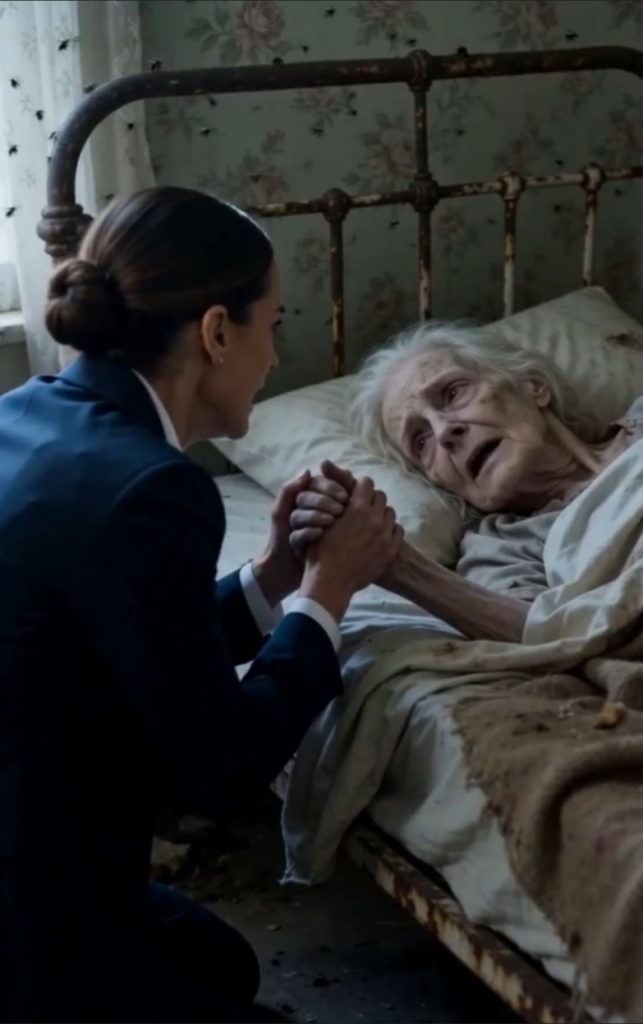
The floral wallpaper peeled from the walls in damp, curling strips. Rotting food sat on a tray on the floor, thick with flies. The curtains were yellowed and shut tight against the daylight. The rusted bed frame creaked faintly as something moved beneath a stained blanket that had once been white.
Then Emily saw her mother.
Mrs. Miller lay almost motionless, thin white hair spread across the pillow, her face pale and sunken, her lips cracked from thirst. She looked smaller than Emily remembered. Not elderly.
Abandoned.
Emily’s knees weakened.
“Mom?”
The old woman’s head turned with terrible effort.
Her eyes trembled toward the doorway.
“Em…” Her voice was barely air. “Emily… is that you?”
Emily rushed to the bed and fell to her knees in the dirt beside it. She took her mother’s fragile hand in both of hers, and the tears came so fast she could not stop them.
“I’m so sorry, Mom,” she sobbed. “God, I’m so sorry.”
Mrs. Miller’s fingers twitched weakly against her palm.
From the doorway came the sound of something dropping.
Emily turned.
Sarah stood there with a grocery bag at her feet, her stained apron hanging crookedly, her face draining of color as she saw Emily kneeling beside the bed.
For three seconds, no one spoke.
Then Emily rose slowly.
And the grief on her face became something far colder.
Act II
Emily had spent years convincing herself that money could solve distance.
That was the lie successful people told when their hearts could not keep up with their calendars.
She paid for the best caregiver agency in the county. She sent money every month, more than Sarah asked for. She arranged deliveries, medicine refills, house repairs, fresh bedding, weekly nurse visits, and private transportation to doctor appointments.
Every Sunday, she called.
Every Sunday, Sarah answered first.
“Your mother is sleeping.”
“Your mother had a good day.”
“She’s tired, honey. You know how she gets.”
And when Emily asked to speak to her, Sarah would put the phone near Mrs. Miller, and her mother’s weak voice would drift through.
“I’m fine, baby.”
Emily believed her because she needed to.
She was building a career two states away, running a company division where men called her brilliant in meetings and difficult in private emails. She worked until midnight. Flew across time zones. Signed contracts in glass towers. Told herself she was doing all of it for her mother, for the medical bills, for the house, for the security they had never had when Emily was a child.
Her mother had raised her alone after Emily’s father walked out.
No complaints. No bitterness. Just double shifts, packed lunches, homemade birthday cakes, and a kind of love so steady Emily did not understand its cost until she was old enough to repay it.
Or thought she was repaying it.
The last time Emily visited, six months earlier, the room had been clean.
Sarah had been cheerful. Mrs. Miller had been tired but smiling. There were fresh sheets on the bed and a vase of yellow flowers on the windowsill.
Emily remembered kissing her mother’s forehead before leaving.
“I’ll be back soon.”
Her mother held her hand longer than usual.
“How soon?”
Emily had laughed softly, already thinking about emails.
“Soon, Mom. I promise.”
But soon became quarterly reports.
Soon became a canceled flight.
Soon became a promotion.
Soon became the day Emily came home early because her conference ended before lunch and she wanted to surprise her mother.
Now she stood in a room crawling with neglect and understood something brutal.
Her mother had not been cared for.
She had been hidden.
Sarah lifted both hands.
“Emily, listen to me.”
Emily’s voice came out low.
“How long?”
Sarah swallowed.
“What?”
“How long has she been like this?”
Sarah looked toward the bed, then away.
“She’s old. She refuses food. She makes messes. You don’t understand how hard—”
Emily crossed the room so fast Sarah backed into the wall.
“Do not blame her.”
Sarah flinched.
In the bed, Mrs. Miller made a faint sound.
Emily turned instantly, anger breaking into fear. She ran back to her mother, checked her breathing, then pulled out her phone with shaking hands.
“911,” she said into the receiver. “I need an ambulance. Elder neglect. Severe. Please hurry.”
Sarah started crying.
Not for Mrs. Miller.
For herself.
And that told Emily this was worse than neglect.
Act III
The paramedics arrived in nine minutes.
Emily counted every one.
They moved quickly but gently, lifting Mrs. Miller from the bed, checking her vitals, asking questions Emily could barely answer. Sarah hovered near the doorway, saying useless things in a panicked voice.
“She was fine this morning.”
“She refused to eat.”
“I was just about to clean.”
Nobody believed her.
One paramedic looked at Emily with quiet anger in his eyes.
“Ma’am, you need to come with us.”
Emily nodded, then turned to Sarah.
“Stay here.”
Sarah’s face twisted. “Emily, please. We can talk.”
“No,” Emily said. “You can talk to the police.”
At the hospital, the truth unfolded in pieces.
Dehydration. Untreated sores. Missed medications. Weight loss no one had reported. Infection risk. Signs that her mother had been left alone for long stretches of time.
Each phrase landed like a stone.
Emily sat beside the hospital bed in her tailored suit, still smeared with dust from the bedroom floor, and held her mother’s hand as if holding tightly enough could undo the months she had missed.
When Mrs. Miller woke near midnight, her eyes found Emily’s face.
“You came,” she whispered.
Emily bent over her hand.
“I should have come sooner.”
Her mother’s lips moved.
“Letters.”
Emily lifted her head.
“What letters?”
Mrs. Miller swallowed with effort.
“I wrote you.”
Emily went cold.
She had received no letters.
Not one.
The next morning, Emily returned to the farmhouse with two officers and a protective services investigator. Sarah sat at the kitchen table, pale and silent, while they searched the house.
They found the letters in a locked drawer in Sarah’s room.
Dozens of them.
Some written in Mrs. Miller’s shaky handwriting. Some never finished. Some stained with tears.
Emily read the first one standing in the hallway.
My sweet girl,
I don’t want to worry you, but Sarah gets angry when I ask for help. She says you are too busy and that I should stop making you feel guilty. I know you work hard. I am trying to be brave.
Emily pressed the page to her mouth.
The second letter was worse.
She took my phone again. She says I confuse things. I don’t think I do. Please come when you can. I miss the sun.
Emily could not read the rest.
An officer found bank statements next.
Checks Emily had never written.
Withdrawals.
Care payments doubled.
Home repair invoices for work never done.
Then, in a folder beneath Sarah’s mattress, they found a document Emily did not recognize.
A petition for emergency conservatorship.
Not filed yet.
But ready.
The petitioner was not Sarah.
It was signed by Emily’s cousin, Daniel Pierce.
The same cousin who had recommended Sarah.
The same cousin who had been pressuring Emily for years to sell the farmhouse and the land behind it.
The land developers had started calling about last winter.
Emily stared at the signature until the ink blurred.
Sarah had not simply failed her mother.
She had been paid to make Mrs. Miller look beyond saving.
Act IV
Daniel arrived at the hospital wearing concern like an expensive coat.
He came with flowers, a soft voice, and a face arranged into sorrow.
“Emily,” he said, reaching for her shoulder. “I came as soon as I heard.”
She stepped back before he touched her.
His expression faltered.
Not much.
Enough.
Emily held up a copy of the conservatorship petition.
Daniel’s eyes dropped to it.
For one second, the cousin who had sent birthday cards and holiday texts vanished. In his place stood a man calculating how much she knew.
“What is this?” Emily asked.
He sighed as if she were being difficult.
“You were never here. Aunt Ruth needed stability. I was trying to help.”
Emily’s voice shook. “By paying Sarah to neglect her?”
His face hardened.
“Caregiving is complicated.”
“No. Starving an old woman in a dirty room is not complicated.”
A nurse at the station looked up.
Daniel lowered his voice.
“You’re emotional.”
Emily laughed once, a broken sound.
“There it is.”
“Emily—”
“You were going to take control of her estate, weren’t you? Then sell the land.”
Daniel’s mouth tightened.
“That property is wasted sitting empty.”
“My mother was in that house.”
“She barely knew where she was.”
From the hospital bed behind Emily, a weak voice spoke.
“I knew.”
Daniel froze.
Mrs. Miller’s eyes were open.
Pale. Tired. But clear.
Emily turned, tears filling her eyes.
Her mother looked at Daniel with the quiet dignity he had tried to steal from her.
“I knew every day,” she whispered. “I knew when Sarah didn’t bring food. I knew when she took my phone. I knew when she told me Emily forgot me.”
Daniel said nothing.
Mrs. Miller’s fingers curled around Emily’s.
“And I knew my daughter would come.”
That broke Emily.
The police interview lasted two hours.
Sarah confessed first.
People like Sarah often do when they realize richer cowards have left them holding the ugliest part of the plan. She admitted Daniel paid her extra cash to “document decline,” isolate Mrs. Miller, block calls, and make the house appear unlivable.
Daniel planned to petition the court, claim Emily was too absent to manage care, seize authority over Mrs. Miller’s property, and sell the estate to developers before Emily could intervene.
He had underestimated two things.
Mrs. Miller’s mind.
And Emily’s fury.
Daniel was arrested three days later.
He tried to blame Sarah.
Sarah tried to blame stress.
But the letters, bank records, text messages, and photos of the room told the story without needing either of them to become honest.
At the first hearing, Emily sat in the front row with her mother’s letters in a folder on her lap.
Daniel would not look at her.
That was fine.
Emily was no longer waiting for cowards to face what they had done.
Act V
Mrs. Miller did not return to the farmhouse right away.
She spent three weeks in the hospital, then two months in a rehabilitation center where nurses opened the curtains every morning and called her by her name instead of treating her like a burden.
Emily visited every day.
At first, she brought flowers and guilt.
Then she learned to bring better things.
Clean socks. Her mother’s favorite hand cream. Old family photographs. Soup from the diner Mrs. Miller loved. Silence when apologies became too heavy to keep repeating.
One afternoon, as Emily helped brush her mother’s thin white hair, Mrs. Miller touched her wrist.
“Stop punishing yourself.”
Emily froze.
“I left you there.”
“You trusted the wrong people,” her mother whispered. “That is not the same as leaving.”
Emily’s eyes filled.
“It feels the same.”
Mrs. Miller closed her eyes.
“I know.”
That was the mercy of her mother.
She did not erase the pain.
She simply refused to let guilt become the whole story.
The farmhouse was cleaned by professionals in white suits and masks. The rotten food was removed. The wallpaper stripped. The rusted bed hauled away. Every curtain was taken down and burned in a metal barrel behind the barn.
Emily watched the smoke rise.
She thought it would feel satisfying.
It didn’t.
Justice, she learned, rarely felt like triumph.
It felt like paperwork. Court dates. Medical charts. Bank disputes. Statements. Repairs. Long nights beside a hospital bed wondering how love could be so fierce and still arrive late.
Daniel pleaded guilty after the text messages surfaced.
Sarah did too.
The sentences were not enough in Emily’s heart, but they were real. More importantly, the estate was protected. Mrs. Miller’s care was placed under a legal structure Emily controlled directly, with independent oversight and no hidden middlemen.
Emily left her job three months later.
Not dramatically. Not because women must give up ambition to prove love. She left because the company had demanded every part of her for too long, and she finally understood that success was not success if it required her to ignore the trembling in her own chest.
She started consulting from the farmhouse.
The front parlor became her office. Her mother’s new room faced the morning sun. A proper caregiver named Joanne came during the day, though Emily checked references like a detective and installed cameras in shared spaces with Mrs. Miller’s full consent.
The first morning home, Mrs. Miller asked to sit on the porch.
Emily wrapped a blanket around her legs and wheeled her outside.
The maple tree moved softly in the breeze.
For a long while, her mother said nothing.
Then she whispered, “I thought I’d never see this again.”
Emily knelt beside the chair.
“You will see it every morning if you want.”
Mrs. Miller smiled faintly.
“Not every morning. Some mornings I want pancakes.”
Emily laughed through tears.
That laugh became the first clean sound the house had heard in a long time.
Spring came slowly.
The lawn grew wild at the edges because Emily forgot to call the landscaper and then decided she liked it that way. She planted lavender by the porch because flies hated it and her mother loved the smell. She repainted the bedroom a soft yellow, the color Mrs. Miller chose after rejecting eight samples with unexpected authority.
On the wall beside the bed, Emily framed one of the letters.
Not the worst one.
The last one.
The one her mother had written the night before Emily came home early.
My sweet girl,
If you ever read this, know that I tried to hold on. Not because I was brave every day. Some days I was not. But because I wanted to see your face again.
Love,
Mom
Emily read it whenever guilt tried to become memory’s only voice.
A year later, the farmhouse looked different from the road.
Still old.
Still weathered.
But alive.
The porch rail had been repaired. The windows opened again. Wind chimes hung where silence used to gather. On warm afternoons, Mrs. Miller sat outside in a clean cardigan with a quilt over her knees, correcting Emily’s flowerbeds from a distance.
One evening, Emily came out carrying two cups of tea.
Her mother looked toward the sunset.
“You know,” she said, “you used to run across this yard like the world couldn’t catch you.”
Emily handed her the cup.
“It caught me.”
Mrs. Miller smiled.
“Then run again.”
Emily looked at the house.
At the porch.
At the room where horror had waited behind a closed door.
Then at her mother, frail but alive, watching the sky with sunlight on her face.
The world had caught them both.
But it had not kept them down.
Emily sat beside her mother on the porch steps, her suit replaced by jeans, her phone silent inside the house, the evening full of birdsong and lavender.
For the first time in years, she did not feel far from home.
She was home.
And this time, no one would ever again stand between her mother and the light.