Act I
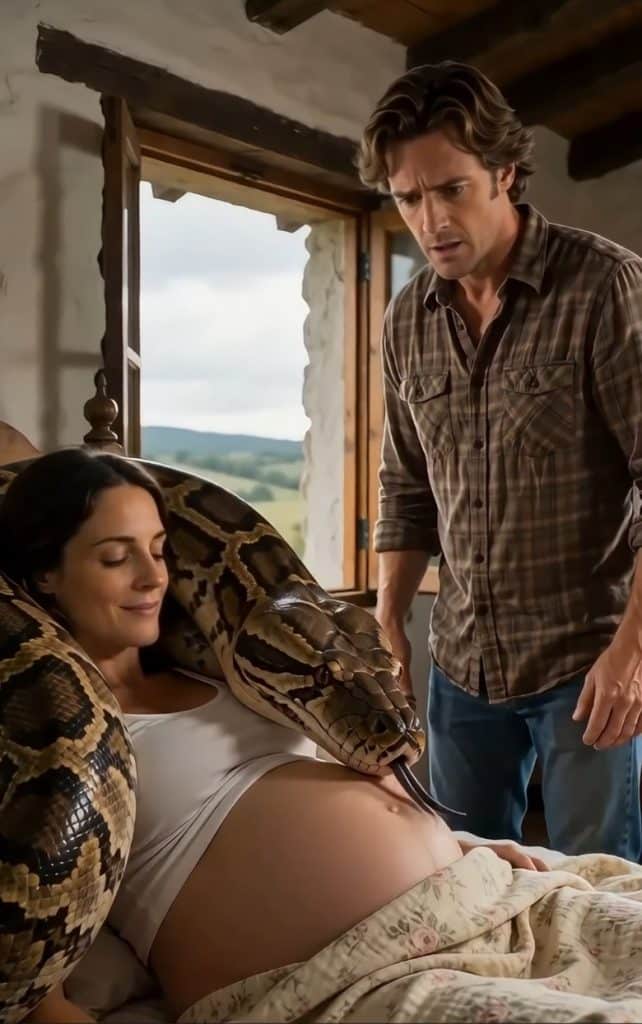
Luna’s head rested on the center of Emma’s bare pregnant belly.
The python was enormous, thick as a man’s thigh, its brown and black patterns shining softly in the morning light from the open window. Its body looped around Emma’s shoulders like a living scarf, heavy and silent, while its tongue flicked against her skin in quick, dark flashes.
Emma smiled.
“Luna is always near me,” she said.
Her voice was soft, almost dreamy.
Daniel did not smile back.
He stood beside the bed in a brown plaid shirt and jeans, arms crossed tightly over his chest, watching the snake with the fixed stare of a man trying not to panic. Outside the wooden window, green hills rolled beneath a gray sky. Inside, the bedroom smelled faintly of old pine, clean sheets, and rain.
It should have been peaceful.
It was not.
“Emma,” Daniel said carefully, “your snake is acting very strange.”
She kept stroking Luna’s patterned body with slow, affectionate movements.
“She loves the baby.”
Daniel’s jaw tightened.
That was what Emma had been saying for weeks.
Luna loves the baby.
Luna can sense her.
Luna knows she’s coming.
At first, Daniel tried to accept it. He knew Luna had been Emma’s long before he was. The python had been rescued from a neglected roadside reptile show when Emma was nineteen, back when she still trusted broken creatures more easily than people. Emma had fed her, healed her, talked to her through heartbreak, loneliness, and the death of her father.
To Emma, Luna was not a pet.
She was family.
But the pregnancy had changed something.
The python no longer stayed in her heated enclosure at night. She pressed against the bedroom door until Emma let her in. She curled near Emma’s feet while she slept. She refused food twice. Then she began resting her head on Emma’s stomach for hours at a time, tongue flicking, body still, eyes black and unreadable.
Daniel had searched online until fear made every sentence look like a warning.
Then came that morning.
Emma had woken with a dull pain in her back and insisted it was normal. Daniel wanted to call the midwife. Emma told him not to fuss. Then Luna slid onto the bed, wrapped herself around Emma’s shoulders, and lowered her head directly onto the baby bump.
Now the python’s tongue flicked faster.
Once.
Twice.
Again.
Daniel took one cautious step closer.
Luna lifted her head.
Not much.
Just enough.
Her eyes locked on him.
A cold pressure moved through the room.
“Emma,” Daniel whispered, “I need you to move her.”
Emma finally looked up, confused by the fear in his voice.
“She won’t hurt me.”
“I’m not sure that’s what she’s trying to do.”
The python shifted.
Its heavy body tightened slightly around Emma’s shoulders.
Emma inhaled sharply.
Daniel’s face drained.
Then Luna’s head snapped toward the old wooden floor beneath the bed.
And from below the floorboards came a sound neither of them had heard before.
A faint, hollow tapping.
Act II
Daniel froze.
Emma’s hand stopped on Luna’s scales.
The room held its breath.
The tapping came again.
Three soft knocks.
Then silence.
Daniel looked toward the floorboards beneath the bed, where the large floral blanket spilled over the mattress and almost touched the patterned rug below. The house was old, but old houses made old sounds. Groaning beams. Wind in window frames. Pipes shuddering in winter.
This was different.
This sounded deliberate.
“Did you hear that?” Emma asked.
Daniel nodded once.
Luna began moving.
Slowly, the python uncoiled from Emma’s shoulders and slid down across her belly, not in panic, not in aggression, but with a terrible certainty. Her head lowered toward the side of the bed. Her tongue flicked again and again at the gap between the floorboards and the edge of the rug.
Daniel reached for Emma’s hand.
“Get up.”
“I can’t,” she said.
Her voice had changed.
The calm was gone.
One hand pressed against the lower curve of her belly. Her face tightened with discomfort, then worry. For the first time all morning, she looked less like a woman defending her beloved animal and more like a mother realizing something was wrong.
Daniel stepped closer to help her.
Luna turned and hissed.
Not at Emma.
At him.
He stopped instantly.
“Luna,” Emma whispered. “No.”
But the python did not retreat. She placed her head between Daniel and Emma’s belly, then flicked her tongue toward the floor again.
Tap.
Tap.
Tap.
This time, the sound came from beneath the room.
Daniel’s mind moved quickly through all the possibilities he did not want to name. An animal under the house. A loose pipe. A structural problem. Something trapped.
Then he remembered the letter.
Two months earlier, after Emma’s mother died, a box had arrived from her estate. Most of it was ordinary: photographs, recipes, old baby clothes folded in tissue paper. But tucked at the bottom was a sealed envelope addressed to Emma.
Inside was a note in her mother’s careful handwriting.
Do not sleep in the back bedroom after the seventh month.
Emma had laughed when she read it, though not comfortably.
“My mother believed in omens,” she told Daniel. “She once threw away a perfectly good mirror because she said it was watching her.”
Daniel had asked what the note meant.
Emma said she didn’t know.
Then she put it in a drawer and never mentioned it again.
Now the back bedroom seemed smaller.
The white plastered walls, the wooden beams, the open window, the soft hills outside, all of it suddenly felt like scenery placed over something hidden.
Tap.
Daniel turned toward the hallway. “I’m getting the tools.”
“No,” Emma said quickly.
He looked back.
She was staring at Luna.
The python had lowered her body onto the rug now, pressing her weight against one corner near the bedpost. Her tongue moved over a seam in the floorboards that Daniel had never noticed before.
Emma’s eyes widened.
“My father built this room,” she whispered.
Daniel frowned. “What?”
“When my mother was pregnant with me. He added this part of the house himself.”
Her voice trembled.
“She always said he changed after that. He locked this room for months before I was born. She thought he was building a nursery.”
Luna pressed harder against the rug.
The corner lifted slightly.
Beneath it, a narrow iron ring glinted in the floor.
Daniel’s throat went dry.
Emma whispered, “That wasn’t there before.”
But it had been.
Waiting beneath the rug.
Waiting beneath the bed.
Waiting for the one creature in the house patient enough to listen through wood.
Act III
Daniel moved the rug with shaking hands.
Luna did not stop him this time.
She stayed close to Emma, head raised, body half coiled across the blanket as if guarding the boundary between the bed and the room. Emma watched from the pillows, one hand on her belly, breathing slowly through another wave of pain.
Under the rug was a trapdoor.
Small. Square. Almost perfectly fitted into the floorboards. The iron ring lay flat in a carved groove, darkened by age and dust.
Daniel pulled.
Nothing.
He pulled harder.
The door groaned upward, releasing a smell of damp wood, cold earth, and something older than either of them wanted to imagine.
Beneath the bedroom was not an empty crawlspace.
There was a narrow shaft.
A wooden ladder descended into darkness.
Emma covered her mouth.
Daniel leaned back, stunned. “Your parents never told you?”
She shook her head.
“My mother hated this room,” she whispered. “I thought it was because my father died here.”
Daniel looked at her.
Emma’s father, Silas Reed, had been found dead in the hills when Emma was three months old. A fall, people said. A storm, people said. A tragic accident, people said. Emma’s mother never spoke of it without going pale.
Daniel grabbed his phone and turned on the flashlight.
The beam dropped into the darkness below.
At the bottom, something reflected back.
Glass.
Metal.
A framed photograph.
Then Luna moved.
She slid down from the bed with frightening grace and positioned herself directly over the opening, not descending, not fleeing, simply blocking it with her body.
A warning.
Daniel crouched beside the trapdoor.
From below came another sound.
Not tapping now.
A faint mechanical click.
Then a soft hiss.
Emma gasped and clutched her stomach.
Daniel smelled it a second later.
Gas.
Not strong, not enough to fill the room yet, but unmistakable. Sharp. Chemical. Wrong.
He stood so fast he struck his shoulder on the bedframe.
“Emma, we need to get you out.”
This time, Luna did not object.
The python lifted her head toward Emma and nudged her belly once, gently, almost urgently.
Daniel helped Emma swing her legs over the side of the bed. She winced, gripping his forearm with surprising strength.
“Something’s wrong,” she said.
“With the baby?”
“I don’t know.”
Fear transformed Daniel. The trapdoor, the hidden shaft, the family secret, all of it became secondary to the woman trembling in his arms.
He guided Emma out of the bedroom, Luna sliding behind them across the floor with heavy, silent force.
At the doorway, Emma looked back.
The open trapdoor sat beside the bed like a dark mouth.
Inside it, Daniel’s phone flashlight still shone downward from where he had dropped it.
The light flickered across the framed photograph below.
Emma saw it.
A young woman.
Pregnant.
Lying in the same bed.
Wearing the same expression Emma had worn moments earlier.
And beside her stood Emma’s mother, much younger, one hand raised as if trying to stop whoever held the camera.
Written across the bottom of the photograph in black marker were four words.
THE CHILD MUST STAY.
Act IV
The ambulance arrived twenty minutes later.
The midwife came first, tires skidding in the muddy drive, her coat thrown over pajamas. Her name was Ruth Bell, and she had delivered half the valley, including Emma herself. She took one look at Emma’s face and stopped asking calm questions.
“Hospital,” Ruth said.
Emma shook her head weakly. “The room. There’s something under the room.”
Ruth’s expression changed.
Just enough.
Daniel saw it.
“You knew?” he demanded.
Ruth looked toward the open bedroom door.
Luna was coiled in the hallway, blocking it. Her head was raised toward the bedroom, tongue flicking at the air as though the house itself had become poisonous.
Ruth swallowed.
“I knew there were stories.”
“What stories?”
Emma gripped Daniel’s hand. “Tell me.”
Ruth hesitated only once.
Then the truth began to come out.
Before Silas Reed married Emma’s mother, he had belonged to a group in the valley that called itself the Covenant of the First Cradle. On paper, it was a religious charity for expectant mothers in isolated rural communities. In reality, it was a circle of families obsessed with bloodlines, inheritance, and control.
They believed certain children born in the valley had to remain on ancestral land.
No matter what the mother wanted.
Emma’s mother, Caroline, tried to leave when she was pregnant. Silas stopped her. The room was built not as a nursery, but as a monitoring chamber. Beneath it, he stored records, recordings, and equipment meant to track Caroline’s pregnancy and keep her dependent, frightened, and isolated.
“She escaped after you were born,” Ruth said quietly. “With help. Your father died trying to follow her during a storm.”
Emma stared at her.
“My mother let me come back here.”
“She thought the others were gone,” Ruth said. “Most left. Some died. Some became respectable.”
“Respectable,” Daniel repeated bitterly.
Ruth looked ashamed. “Your mother made me promise not to tell unless something started again.”
Daniel felt the air leave his lungs.
“Started?”
Ruth’s gaze moved to Emma’s belly.
“After you got pregnant, did strangers come by? Letters? Calls? Anyone asking about the house?”
Emma’s face went white.
Daniel knew the answer before she spoke.
The real estate agent.
The woman from the “historical preservation society.”
The old man at the market who touched Emma’s wrist and said her daughter would have “Reed eyes.”
The anonymous note pushed under their door last week.
Stay where the child belongs.
Daniel had dismissed it as village weirdness.
Emma had burned it in the kitchen sink and said nothing.
From the bedroom, a low alarm began to beep.
Daniel turned.
His phone, still lying near the trapdoor, had detected something and triggered an emergency alert. Gas concentration. Unsafe air.
Ruth grabbed Emma’s bag. “Now.”
But before they could move toward the door, headlights appeared outside.
Not ambulance lights.
Two black cars rolled up the gravel drive.
Luna reacted before anyone else.
The python surged across the hallway toward the front of the house, body powerful, head lifted, a silent golden-brown line of warning.
Daniel stepped to the window.
Three people got out.
A woman in a gray coat.
A tall man with white hair.
And a younger man carrying a leather case.
Emma made a sound that was almost a sob.
“The preservation woman,” she whispered.
The woman looked up at the bedroom window and smiled.
Not warmly.
Knowingly.
Then she knocked on the front door.
Act V
They did not get inside.
That was the first thing Daniel would remember later.
Not the fear. Not the gas. Not the trapdoor.
The door holding.
Ruth called emergency services again and spoke in a voice so sharp it sounded like command. Daniel moved furniture against the entrance while Emma sat near the open kitchen window, breathing through another wave of pain. Luna remained in the hall, head turned toward the front door, body tense but controlled.
The woman outside knocked again.
“Emma,” she called. “We only want to help.”
Emma laughed once, breathless and cold.
“No,” she whispered. “You want to be obeyed.”
The police arrived before the ambulance.
For once, the valley moved faster than its secrets.
The three strangers tried to become polite as soon as uniforms appeared. The woman in gray called herself a family historian. The man with white hair claimed to be a concerned neighbor. The younger one said the leather case contained medical records Emma had requested.
He was lying.
Inside the case were old birth certificates, forged guardianship forms for Emma’s unborn child, and a document granting emergency custody to a trust called First Cradle Holdings if Emma was deemed medically unstable.
The bedroom shaft gave up the rest.
Investigators found Silas Reed’s hidden chamber beneath the floor: photographs, journals, names, donation records, sealed files, and equipment connected to a gas line that had been recently tampered with. The leak was small enough to look like an accident later. Slow enough to confuse. Dangerous enough to make a pregnant woman seem faint, irrational, unreliable.
Emma sat in the ambulance when they brought the first boxes out.
Her face was pale. Her hair clung damply to her cheeks. Daniel stood beside her, one hand on her shoulder, the other resting near Luna’s transport crate. The python had finally allowed herself to be contained after Emma touched her head and whispered, “You did good, girl.”
A police officer looked uneasily at the crate.
“She saved them,” Daniel said.
The officer did not argue.
At the hospital, doctors confirmed what Ruth had suspected. Stress and exposure had triggered early contractions, but Emma and the baby were stable. The baby’s heartbeat filled the small exam room in rapid, steady beats.
Emma wept when she heard it.
Daniel did too.
Not loudly.
Just enough.
Two days later, Ruth brought Emma a box from the hidden chamber. It had been cleared by investigators because it contained only personal items from Caroline, Emma’s mother.
Inside was a journal.
Emma read it slowly, over several days, Daniel beside her, Luna’s crate positioned near the window where sunlight warmed the lid.
Caroline had written everything.
How Silas changed after she became pregnant. How the Covenant watched her. How Ruth helped her escape. How she returned years later only once, after Silas died, to hide evidence beneath the room so no one could deny what had happened if the group ever came back.
And why she never told Emma.
I wanted you to have a childhood that belonged to you, not to my fear.
The final entry had been written three months before Caroline’s death.
If Emma ever carries a child in that house, the old ones may come looking. I pray they are too weak by then. I pray the world has grown less hungry for control. But if not, trust what loves her without language. Animals know when a house remembers danger.
Emma closed the journal and looked at Luna.
The python rested behind glass, still as carved stone, eyes dark and watchful.
For years, Emma had believed Luna stayed near her because of affection.
That was true.
But affection had sharpened into vigilance.
The snake had sensed the faint gas beneath the floor. The vibration of the tampered pipe. The hidden chamber under the bed. Maybe even the fear Emma tried to pretend she did not feel.
Luna had not been hunting.
She had been guarding.
The case tore open the valley.
Names once whispered at church suppers appeared in legal filings. Old families denied membership until photographs proved otherwise. First Cradle Holdings was frozen. The woman in gray, once welcomed into homes as a preservationist, was charged with conspiracy and fraud. The forged custody documents became the kind of evidence no amount of politeness could soften.
Emma did not follow every headline.
She had a daughter to bring into the world.
Mara Caroline Reed was born three weeks early on a rainy afternoon, furious and healthy, with dark hair and a cry so loud Daniel laughed through tears.
Emma held her daughter against her chest and whispered, “You belong to yourself.”
That became the sentence she repeated often.
Not just to the baby.
To herself.
Months later, they returned to the countryside house.
Not to live there. Not at first.
Emma needed to stand in the bedroom again without fear deciding the shape of the room.
The trapdoor had been sealed with a glass panel set into the floor, not hidden anymore, but preserved. Beneath it, the chamber was empty. The bed was gone. The rug had been cleaned and moved to another room.
Sunlight poured through the open wooden window. The hills were green. The beams looked less heavy.
Daniel carried Mara in a sling against his chest.
Emma carried Luna’s secure travel enclosure with both hands, ignoring Daniel’s nervous glance.
“I’m not letting her roam,” she said.
“I didn’t say anything.”
“You breathed judgmentally.”
He almost smiled.
They stood together in the room where fear had once been built into the floor.
Emma looked down through the glass panel.
For a moment, she imagined her mother here, young and terrified, then older and brave enough to hide the truth for a daughter who might one day need it.
“Thank you,” Emma whispered.
The house creaked softly around them.
Mara stirred against Daniel’s chest.
Luna lifted her head inside the enclosure, tongue flicking once toward the baby, then toward the floor, then stilling.
Daniel watched her carefully.
This time, he did not step back.
Years later, people in the valley would tell the story differently.
Some said the snake knew evil was under the bed. Some said it heard ghosts. Some said it wrapped around Emma to keep death away.
Emma never corrected every version.
The truth was strange enough.
A python had listened when humans dismissed unease as nerves.
A mother’s warning had waited beneath wood.
A daughter had survived the house that once tried to own her.
And a baby entered the world free of a promise made by cruel people before she ever had a name.
On Mara’s first birthday, Emma sat by the open window with her daughter in her lap. Luna’s enclosure rested nearby in a patch of warm light. Daniel was downstairs making coffee badly and singing worse.
The hills rolled green beyond the glass.
Emma looked at her child, then at the old bedroom floor, then at the python watching quietly from the sun.
“You were right,” she told Luna.
The snake did not move.
She did not need to.
Some guardians bark. Some pray. Some stand at doors with weapons in their hands.
And some lie still across a mother’s belly, listening to the secrets beneath the floor before anyone else is ready to hear them.