Act I
The old woman did not touch the glass.
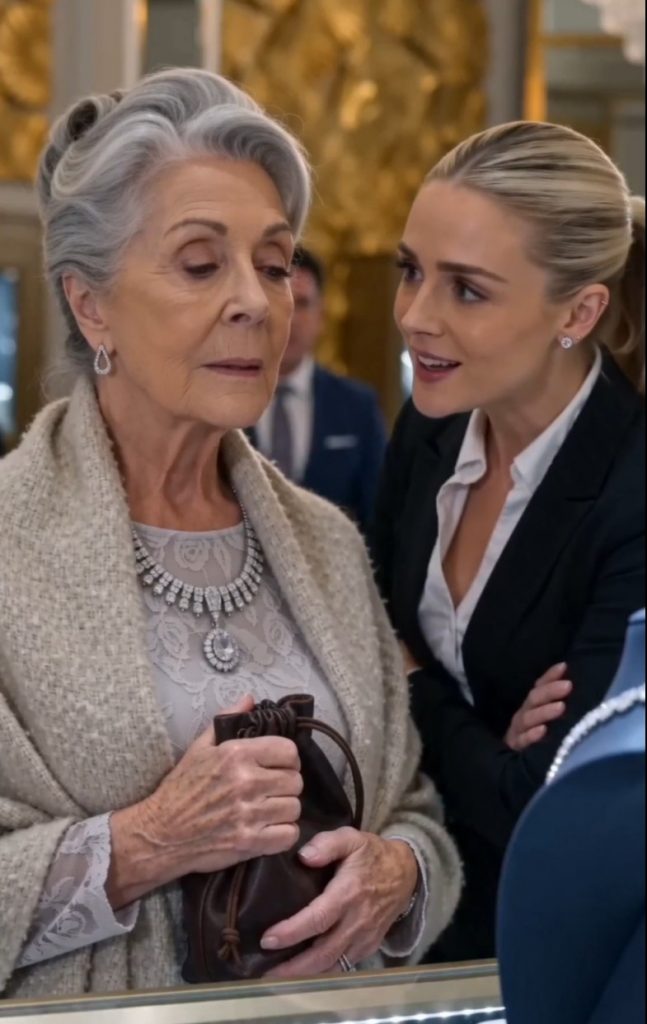
She only stood before the display case with both hands wrapped around a worn brown leather bag, staring at the diamond necklace inside as if it were not jewelry, but a memory.
Aurora Crown Jewelers was built to make ordinary people feel small.
Crystal chandeliers poured light over gold-leaf walls. Mirrors doubled every sparkle until the whole boutique seemed made of diamonds and silence. Security guards stood by the entrance in dark suits. Sales associates moved softly between glass cases, speaking in voices polished smooth by money.
The old woman did not belong there.
At least, that was what Vanessa Hart decided the moment she saw her.
Vanessa was twenty-six, blonde, sharp-faced, and dressed in a black suit cut so perfectly it looked like a uniform for cruelty. Diamond studs glittered at her ears. Her hair was pulled into a tight ponytail. She had spent two years learning how to flatter billionaires, heirs, executives, and women who said “just browsing” while wearing watches worth more than cars.
She had not learned how to recognize dignity.
The old woman wore a simple lace dress beneath a thick beige shawl. Her silver hair was twisted into a bun. The leather bag in her hands looked ancient, darkened by rain, age, and touch.
Vanessa crossed the room and stopped too close.
“Excuse me?” she said, her voice cold enough to cut. “That necklace costs more than your entire village.”
The old woman turned her head slowly.
For one second, their eyes met.
There was no anger in the old woman’s face. No embarrassment. Only a sadness so deep and steady that Vanessa almost looked away.
Almost.
Then the old woman lowered her gaze back to the bag.
“I understand,” she whispered.
A couple near the emerald case pretended not to hear.
Another sales associate froze behind the counter.
The necklace glittered under the lights, a river of white fire around a rare blue center stone. It was called the Aurora Tear, the crown piece of the boutique’s anniversary collection. Vanessa had been told it was priceless, not merely because of the stones, but because of the story attached to it.
She had never bothered to listen to that story.
The old woman stepped back from the case.
Her hands tightened around the leather drawstring bag.
Then footsteps thundered across the marble floor.
The manager burst from the private consultation room, breathless, pale, and horrified.
“Ma’am,” he said, rushing toward the old woman. “I sincerely apologize.”
Vanessa blinked.
The manager, Thomas Greer, was not a man who apologized easily. He was precise, controlled, and terrifying when standards slipped. He handled royalty, old money, new money, and the kind of clients whose names never appeared on receipts.
Now he stood before the old woman with his head slightly bowed.
The boutique went still.
Thomas turned toward his staff.
His face changed from panic to fury.
“Who spoke to her like that?” he shouted.
No one moved.
Vanessa felt the heat leave her body.
The old woman did not point. She did not accuse. She simply stood there, small beneath the chandelier, clutching that old leather bag like it contained something more valuable than every diamond in the room.
Thomas’s eyes found Vanessa.
She tried to speak, but her throat closed.
Her hands went to the front of her blazer.
“I did,” she whispered.
Thomas stared at her as if she had just set fire to the building.
And then the old woman opened the bag.
Act II
Her name was Elena Varga.
To Vanessa, that meant nothing.
To Thomas Greer, it meant everything.
Thirty-seven years earlier, before Aurora Crown had marble floors and international clients, it had been a narrow shop wedged between a watch repair stall and a bakery in Budapest. The sign had been hand-painted. The display window fogged in winter. The owner, Samuel Crown, repaired broken clasps and resized wedding rings for people who counted coins before buying flowers.
He was talented, but talent does not always become legacy.
Not until Elena walked in.
She had been twenty-nine, newly widowed, and carrying a leather bag full of stones wrapped in cloth. Not diamonds cut for showrooms. Rough stones. Uncertain stones. Stones most jewelers would have dismissed.
Samuel did not.
He saw what others missed.
But Elena saw something even he did not.
She had grown up in a mountain village where her father worked with raw minerals and her mother embroidered wedding veils so fine that brides saved them like scripture. Elena learned both languages: the patience of stone and the tenderness of thread.
When Samuel showed her his designs, she took a pencil and changed one line.
Then another.
By morning, the piece had become something alive.
A necklace shaped not like wealth, but like dawn breaking over a frozen valley.
Samuel called it the Aurora.
Elena told him it needed a tear.
“Beauty without sorrow is just decoration,” she said.
That was how the Aurora Tear was born.
Samuel built it.
Elena designed it.
Together, they sold it to a French collector who later wore it to a state dinner. Photographs traveled. Commissions followed. Aurora Crown became a name whispered in rooms where money spoke softly.
But the world only remembered Samuel.
Elena never minded at first.
She did not need applause. She had a son to raise, a workshop to keep alive, and a quiet partnership with a man who treated her mind as seriously as his own hands.
Samuel promised her that one day, when Aurora Crown had its own flagship boutique, the original design would hang in the center of the store with both their names beneath it.
He died before that promise was kept.
After Samuel’s death, his nephew Victor took over the business.
Victor had charm, ambition, and an instinct for removing people who complicated clean stories. He liked Elena’s designs, but not Elena. She was too modest for the brand he imagined. Too old-world. Too unwilling to smile for investors and pretend the company had sprung from pure genius and male inheritance.
He offered to buy her sketches.
She refused.
He offered her a retirement payment.
She refused again.
Then he did what men like Victor do when persuasion fails.
He buried her.
Not physically.
Professionally.
Her name vanished from catalogs. Contracts disappeared from storage. Employees were told she had been a minor assistant, a sentimental old woman exaggerating her role. When she tried to fight, lawyers asked for documents she no longer had.
A fire in the old workshop had destroyed most of her proof.
Or so Victor believed.
Elena left the city with her leather bag, her son, and one surviving folder of designs Samuel had signed with both their initials. She built a smaller life. A quiet life. She repaired heirlooms. She made wedding bands for couples who paid in installments. She never entered an Aurora Crown store again.
Until now.
Because Victor was dead.
Because Aurora Crown had spent three years trying to repair scandals left behind by his greed.
Because Thomas Greer, the new manager of the flagship boutique, had been hired not only to sell jewels, but to restore the soul of a house that had forgotten where its light came from.
And because that morning, Thomas had received a private call from the company’s board.
Elena Varga was coming.
Not as a customer.
As the woman whose name was about to be restored to every Aurora Crown archive in the world.
Vanessa did not know any of this.
She only saw an old woman in a lace dress.
She only saw a worn shawl.
She only saw a leather bag.
And because she did not see money, she assumed there was no power.
That was her first mistake.
Her second was speaking loudly enough for the room to remember.
Act III
The leather bag opened with a soft scrape of old cord.
Everyone watched.
Elena reached inside with careful fingers and removed a folded square of faded blue velvet. The fabric had been mended at the corners. She placed it gently on the glass display case, right beside the necklace Vanessa had mocked her for admiring.
Thomas looked as if he wanted to stop her from having to prove anything.
But Elena gave him the smallest shake of her head.
No.
Let them see.
She unfolded the velvet.
Inside lay a sketch.
The paper was yellowed, its edges softened by decades of being handled with care. Pencil lines swept across the page in delicate arcs. At the center was the same blue stone, drawn like a single drop of frozen sky.
Beneath the design were two signatures.
Samuel Crown.
Elena Varga.
The boutique became so quiet that the fountain in the lobby could be heard trickling beyond the glass doors.
Vanessa stared at the paper.
Her face had gone pale.
Thomas spoke, his voice controlled but shaking.
“This is the original Aurora Tear design.”
Elena looked at the necklace in the case.
“No,” she said softly. “That is the third copy.”
Thomas frowned.
The board had told him she had proof of authorship. They had not told him this.
Elena reached into the bag again.
This time, she removed a small black-and-white photograph.
A young woman stood beside Samuel Crown in a cramped workshop. Her dark hair was pinned loosely. Her sleeves were rolled up. Samuel held a necklace frame in one hand, while she leaned over the table with a pencil in hers.
Between them, unfinished but unmistakable, lay the Aurora Tear.
On the back of the photograph, Samuel had written:
Elena saw the light before I did.
Thomas closed his eyes briefly.
For years, Aurora Crown had sold romance, heritage, craftsmanship, and legacy.
Yet the woman who had shaped its most famous piece had been standing outside its story like a stranger.
Vanessa whispered, “I didn’t know.”
Elena looked at her then.
The words did not anger her.
They tired her.
“No,” she said. “You did not.”
Thomas turned toward Vanessa. “You insulted the co-creator of this house.”
Vanessa’s mouth trembled.
“I thought she was—”
“Careful,” Thomas said.
That one word stopped her.
Because everyone in the room knew what she had thought.
Poor.
Lost.
Unimportant.
Unworthy of courtesy unless a credit card proved otherwise.
Elena folded the photograph back into the velvet, but she did not return it to the bag.
Instead, she looked at the necklace.
“I came to see if it was true,” she said.
Thomas softened. “If what was true?”
“That you were putting my name back.”
“Yes,” he said. “The announcement is tonight. The board has approved the correction. The archives will be amended. The anniversary collection will be renamed.”
Elena’s lips moved, but no sound came.
For a moment, she was no longer the stoic woman beneath the chandelier.
She was twenty-nine again, standing in a workshop while Samuel promised the world would know.
Then her face changed.
Not with relief.
With sorrow.
“You are too late for Samuel,” she whispered.
Thomas lowered his head.
“I know.”
“You are too late for my son.”
The words landed differently.
Thomas looked up.
Elena’s hand tightened on the bag.
“My son died believing his mother had been erased because she was not strong enough to stop it.”
The boutique seemed to shrink around her.
“He was twelve when the lawyers came. He watched them call me confused. Bitter. Opportunistic. He watched men in good suits laugh at my drawings. After that, he never trusted beauty again.”
Her voice remained low, but everyone heard it.
“He became a mechanic. A good one. Honest. He used to say machines were kinder than people because at least when they broke, they admitted it.”
She looked at the necklace.
“He died three months ago.”
Thomas’s face crumpled with genuine pain.
Elena reached into the bag one last time.
This time, she pulled out a small envelope.
On the front was written in shaky handwriting:
For the Crown people, if they ever remember her.
Elena held it toward Thomas.
“My son wrote this before he died,” she said. “He asked me to bring it.”
Thomas took the envelope like it weighed more than gold.
Vanessa stared at the floor, tears bright in her eyes.
For the first time, she seemed to understand that her insult had not landed on a stranger’s clothing.
It had landed on a lifetime.
Act IV
Thomas did not open the envelope in the showroom.
He led Elena to the private consultation room, but she stopped at the doorway.
“No,” she said.
Thomas paused.
Elena turned back toward the glittering boutique, toward the staff, the customers, the chandeliers, the necklace in its case.
“You sell in public,” she said. “You corrected nothing in private for thirty years. Read it here.”
Thomas swallowed.
Then he nodded.
He stood beside the Aurora Tear display and opened the envelope.
The letter inside was only one page.
Thomas read it aloud.
“My name is Daniel Varga. My mother is Elena Varga. If this company is reading this, it means someone finally found the courage to admit what everyone in my childhood already knew: that Aurora Crown was built with my mother’s hands as much as Samuel Crown’s.”
Elena closed her eyes.
Thomas continued.
“I grew up watching rich people wear her ideas while she repaired broken clasps in a rented room. I watched her press dresses for court hearings where men with watches worth more than our apartment told her she had no proof. I watched her carry herself like a queen in places that treated her like a beggar.”
Vanessa covered her mouth.
The words were simple.
That made them merciless.
“My mother never hated diamonds. She hated what people used them to excuse. She taught me that a jewel has no value if the person holding it has no honor.”
Thomas’s voice broke slightly, but he kept reading.
“If Aurora Crown wants to restore her name, do not do it with a plaque and champagne. Do it by remembering that the first thing she ever designed for Samuel was not a necklace for a duchess. It was a wedding ring for a baker who paid in coins. She believed beauty should not kneel only to wealth.”
The old man near the watch case removed his glasses and wiped his eyes.
Elena stood perfectly still.
Only her hands shook.
The final paragraph changed the future of the room.
“I ask one thing. Create a fund in her name for apprentices who have talent but no access. The poor do not lack taste. They lack doors. My mother was one of the people who opened them. Be worthy of her.”
Thomas lowered the letter.
The silence afterward was not empty.
It was full of judgment.
Every staff member felt it.
Every customer felt it.
Vanessa felt it most of all.
Thomas turned to her.
“You will apologize,” he said.
Vanessa stepped forward unsteadily.
“I’m sorry,” she whispered.
Elena looked at her.
Vanessa tried again, tears slipping down her face.
“I am sorry for what I said. I saw your clothes and thought I knew your worth. That was cruel. And stupid. And ugly.”
Elena held her gaze for a long moment.
Then she said, “Yes.”
No comfort.
No easy forgiveness.
Only truth.
Vanessa flinched, but she accepted it.
Thomas removed his employee badge from his jacket pocket.
“Vanessa Hart, your employment ends today.”
She nodded as if she had expected it.
But Elena raised one hand.
Thomas stopped.
The old woman studied Vanessa carefully.
“Firing her is easy,” Elena said. “What will she learn from easy?”
Vanessa looked up, startled.
Thomas frowned. “Mrs. Varga, she humiliated you.”
“Yes,” Elena said. “And she did it well. That means she has practiced.”
The words cut deeper than anger.
Elena turned toward Vanessa.
“Who taught you to measure people this way?”
Vanessa’s lips parted.
No answer came.
But something in her face changed. A memory surfaced before she could bury it: her mother counting bills at a kitchen table, her father leaving when rent was due, classmates laughing at secondhand shoes. Years spent clawing toward rooms like this one, then pretending she had never known hunger because shame felt safer when aimed at someone else.
Elena saw it.
She did not soften.
But she saw it.
“You wanted wealth to make you untouchable,” Elena said. “Instead, you let it make you small.”
Vanessa began to cry in earnest then.
Thomas looked between them.
“What would you have me do?”
Elena glanced at Daniel’s letter in his hand.
“Create the apprenticeship fund,” she said. “Start with her.”
Vanessa froze.
Thomas blinked. “Her?”
“She should not sell diamonds,” Elena said. “Not now. Maybe not ever. But let her clean the workshop. Let her catalog old designs. Let her spend one year learning the hands behind the glass.”
Vanessa stared at Elena as if she had been struck.
“Why would you do that for me?”
Elena picked up her leather bag.
“I am not doing it for you,” she said. “I am doing it for the next old woman who walks through that door.”
Act V
The announcement that night did not go as Aurora Crown had planned.
There were still champagne flutes.
Still cameras.
Still women in silk and men in tailored suits beneath the chandeliers.
But the polished speech Thomas had prepared remained folded in his pocket.
Instead, Elena Varga stood beside the Aurora Tear in her lace dress and beige shawl, the same leather bag resting at her feet. Her name appeared behind her in gold letters for the first time in the company’s history.
Samuel Crown & Elena Varga
Co-creators of the Aurora Tear
She did not speak long.
“I was not gone,” she said quietly. “I was only unmentioned.”
No one moved.
“There is a difference. And tonight, that difference ends.”
The room applauded.
Elena did not smile for the cameras.
She looked upward, just once, as if speaking to Samuel, to Daniel, to the young woman she had been, and to every version of herself that had walked away from locked doors with her proof still in her bag.
The next morning, every Aurora Crown boutique in the world received new training materials.
Not about gemstones.
About conduct.
Thomas had the first page printed in heavy black type:
No client earns dignity by purchase. They arrive with it.
The Elena Varga Apprenticeship Fund launched within the month.
It did not look for perfect résumés. It looked for skill. Patience. Hunger. Hands that knew how to make broken things whole. Its first workshop was built behind the flagship boutique, where the public could see jewelers at work through a long glass wall.
Elena insisted on that.
“Let them see the labor,” she said. “Sparkle has a spine.”
Vanessa returned two weeks later without diamond studs, without her sales blazer, and without the hard mask she once wore like armor.
Her first job was polishing old tools.
For eight hours, she sat at a wooden bench beside apprentices who did not care that she had once worked the showroom floor. They cared only whether she labeled drawers correctly and kept her station clean.
At lunch, no one invited her to sit.
She deserved that.
So she sat alone.
On the third day, Elena placed a sandwich in front of her.
Vanessa looked up, ashamed.
“You don’t have to be kind to me,” she said.
Elena sat across from her.
“I know.”
For a while, they ate in silence.
Then Elena said, “My village was poor.”
Vanessa froze.
Elena looked at her evenly.
“But it was not small.”
Vanessa’s eyes filled.
“I’m sorry.”
“You said that already.”
“I mean it more now.”
“Good,” Elena said. “Meaning should grow.”
Months passed.
Vanessa learned how stones were graded, how settings were shaped, how metal behaved under heat, how a single careless motion could ruin a week of work. She learned the names of cutters, polishers, setters, engravers, and cleaners. She learned that luxury was not born in glass cases.
It began with bent backs, tired eyes, burned fingers, and people whose names rarely appeared on receipts.
Sometimes customers entered the boutique dressed modestly.
Vanessa noticed the staff notice.
And when someone’s gaze drifted too quickly toward shoes, coats, bags, she would step in.
“Welcome to Aurora Crown,” she would say. “Take your time.”
She never again decided who belonged.
A year later, Elena returned to the flagship boutique for the opening of the apprenticeship gallery.
This time, there was no panic when she entered.
Thomas met her at the door, not with fear, but with warmth. The staff stood straighter. The glass cases gleamed. The Aurora Tear rested beneath its lights, but it no longer seemed like the most important thing in the room.
On the wall behind it hung Elena’s original sketch.
Beneath it hung Daniel’s words:
The poor do not lack taste. They lack doors.
Elena stood before the display for a long time.
Her eyes shone, but she did not cry.
Then Vanessa approached.
She wore a simple black apron over a white shirt. No diamonds. No sharp suit. Her hands bore small marks from workshop tools.
“Mrs. Varga,” she said softly. “Would you like to see what we made?”
Elena followed her to the workshop gallery.
Inside a velvet tray lay twelve silver rings, each designed by a first-year apprentice. None were extravagant. None were meant for royalty. They were wedding bands, memorial rings, promise rings, small pieces for ordinary lives.
Elena picked up one with a tiny engraved sunrise inside the band.
“Who made this?”
Vanessa hesitated.
“I did.”
Elena examined the ring in silence.
Vanessa waited, nervous in a way no wealthy client had ever made her feel.
Finally, Elena nodded.
“You are learning to leave room for light.”
Vanessa lowered her head.
It was not forgiveness.
Not fully.
But it was something harder to earn.
Respect beginning at the edge.
Before Elena left, Thomas offered to have a car take her home.
She refused.
“I came by bus,” she said. “I can return by bus.”
He did not argue.
At the door, Vanessa held it open for her.
Elena stepped into the late afternoon sun with her leather bag against her side. People hurried along the city sidewalk, unaware that one of the most important women in jewelry history was walking among them in a beige shawl and sensible shoes.
That suited her.
She had never needed chandeliers to know her worth.
Behind her, inside Aurora Crown Jewelers, the necklace still burned under the lights.
But now, when customers stopped before it, staff told the whole story.
Not the polished version.
Not the convenient one.
The true one.
They spoke of Samuel Crown, who built the setting.
They spoke of Elena Varga, who saw the dawn inside the stone.
They spoke of a woman erased by greed, a son who carried her pain into one final letter, and a leather bag that held more truth than the entire showroom could buy.
And sometimes, when a customer asked why the piece was called the Aurora Tear, Thomas would look toward Elena’s sketch and answer carefully.
“Because beauty without sorrow is just decoration.”
Then he would pause.
“And because the woman who designed it knew that even after the longest night, light still has a way of returning.”