Act I
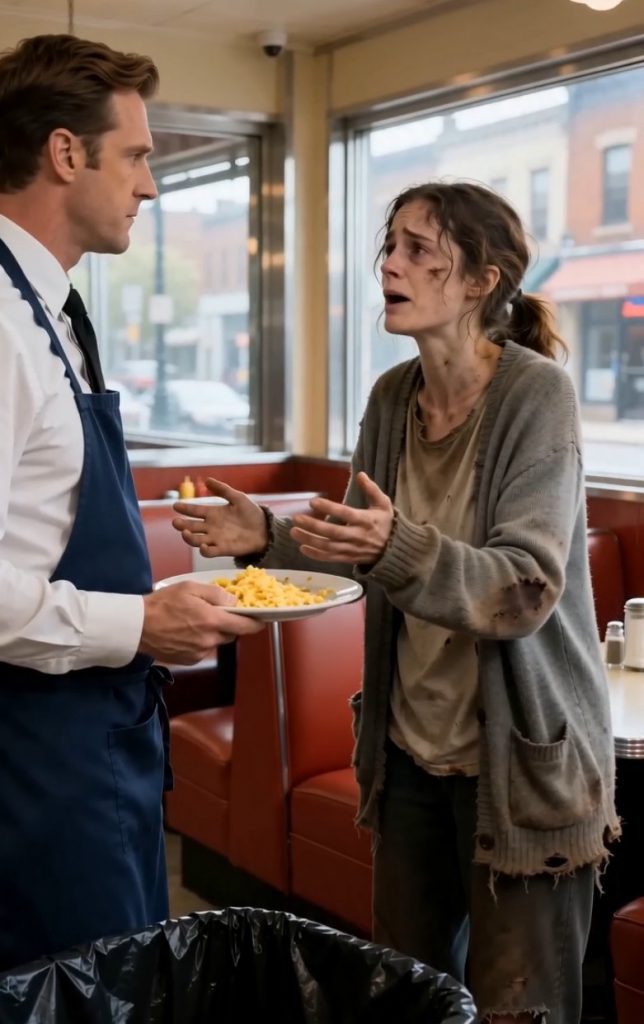
Anna reached for the plate before the waiter could turn away.
“Don’t throw it away, please,” she said, her voice shaking. “I was going to eat that.”
The diner went quiet in the strange way public places do when everyone hears cruelty but no one wants to inherit the responsibility of stopping it.
Forks paused halfway to mouths.
A coffee cup hovered near an old man’s lips.
At the counter, two teenagers in varsity jackets leaned back to watch.
Anna stood beside a table near the window, thin shoulders swallowed by an oversized gray cardigan. Her brown hair was tied in a loose, messy ponytail, and dirt smudged one side of her face like she had slept too close to the street. A hole gaped near the knee of her dark trousers.
The waiter held a plate of half-eaten scrambled eggs and toast.
His name tag read Colin.
He looked at Anna the way people look at a stain they want removed before customers notice.
“That’s trash,” he said.
Anna’s hands stayed out, not grabbing, only pleading.
“I know. I just haven’t eaten since yesterday.”
A woman in a booth looked down at her menu.
The man across from her cleared his throat and said nothing.
Colin gave a short laugh, not because anything was funny, but because he enjoyed having the room on his side even when the room was pretending not to be there.
“Not for you.”
Then he turned and dumped the food into the black trash bin beside the service station.
The sound was small.
A scrape of toast, a wet collapse of eggs, the plate striking the rim.
But Anna flinched as if something precious had been destroyed.
For a moment, she simply stood there, staring into the trash. Her lips parted, but no sound came out. Tears gathered in her eyes, and she blinked hard, trying to keep at least that much dignity.
Colin wiped his hands on his apron.
“You can’t bother customers,” he said. “This is a business.”
Anna nodded once.
Not because she agreed.
Because hunger had taught her that arguing with people who held the food only made the emptiness last longer.
She turned toward the door.
That was when the chef appeared in the kitchen doorway.
He had a rugged face, salt-and-pepper hair, and the tired eyes of a man who had seen too many people pretend rules were the same as morals. His white chef’s jacket was clean but worn soft at the sleeves. A black apron was tied at his waist.
He had heard everything.
He wiped his face with a towel, folded it once, and draped it over his shoulder.
Then he turned without a word and walked back into the kitchen.
Colin smirked, satisfied.
Anna took one step toward the exit.
Behind her, pans began to move.
Eggs cracked against steel. Butter hissed. Toast dropped into the grill. The kitchen, which had been only noise a moment before, suddenly sounded like purpose.
A minute later, the chef pushed through the swinging doors carrying a steaming plate.
Scrambled eggs, golden toast, bacon, and a small bowl of fruit sat arranged with the care usually reserved for paying customers.
He placed it gently on the table in front of Anna.
“It’s okay,” he said softly. “You can eat.”
Anna stared at the food.
Then at him.
Her whole body trembled, as if kindness was more shocking than insult.
Colin rushed back across the floor, face red.
“Hey,” he snapped, pointing at the chef. “What do you think you’re doing?”
The chef did not move away from Anna.
He kept one steady hand near her shoulder and looked at Colin with a calm that made the whole diner lean closer.
“What your father forgot this place was built to do,” he said.
And under the steam rising from that plate, the first secret of Miller’s Diner began to surface.
Act II
Miller’s Diner had once been famous for two things.
Blueberry pancakes the size of dinner plates, and a sign near the register that read:
If you’re hungry, tell Rose.
Rose Miller had painted the sign herself in red letters one winter night after a truck driver fainted in Booth Six because he had been too proud to admit he had not eaten in two days.
Rose was not soft. That was what people misunderstood.
She could throw a drunk out by the collar, argue with suppliers until they apologized, and make waitresses twice her size stand straighter with one look. But when someone was hungry, she fed them. No speech. No sermon. No public shame.
“Food first,” she used to say. “Questions after.”
The chef, Rafael Ortiz, had been sixteen when Rose gave him his first meal.
Back then, he had been angry, broke, and sleeping behind the laundromat two blocks over. He came in one rainy morning to steal a muffin from the counter. Rose caught him before his hand closed around it.
Instead of calling the police, she gave him eggs.
Then she gave him a mop.
Then an apron.
Twenty-six years later, Rafael still worked the same flat-top grill, still used Rose’s biscuit recipe, and still arrived before dawn because the diner felt more like home than his own apartment ever had.
But Rose was gone now.
Her son, Dale, had inherited the building and half the neighborhood’s loyalty. Unfortunately, Dale had inherited none of his mother’s heart.
Dale wanted the diner cleaner, sleeker, more profitable. He hired consultants who said words like repositioning and brand discipline. He replaced the cracked vinyl stools, raised prices, and removed Rose’s sign from the register.
Rafael found it in the dumpster that night.
He took it home and kept it behind his bedroom door.
Colin was Dale’s son.
He had grown up in the diner, but not in the way Rafael had. Colin had never washed dishes until his hands cracked. He had never stretched soup because a family came in short three dollars. He had never seen Rose Miller sit beside a crying stranger at midnight and slide pie across the counter like medicine.
To Colin, the diner was a stepping stone.
To Rafael, it was a debt.
Anna did not know any of that when she sat at the table with the fresh plate in front of her.
She knew only the smell of hot food.
Her hands hovered near the fork as if she was afraid someone would snatch it away. Her eyes kept darting to Colin, then to the customers watching from behind coffee cups and menus.
Rafael pulled out the chair across from her and sat.
That made Colin angrier.
Employees did not sit with people like Anna.
Not in his father’s diner.
“She can’t stay here,” Colin said. “She’s scaring customers.”
An old man at the counter finally turned around.
“She’s not scaring me,” he said.
Colin ignored him.
Rafael looked at Anna. “Eat.”
She picked up the fork slowly.
The first bite nearly broke her.
She closed her eyes, and a tear slipped down her face. Not dramatic. Not loud. Just one tear, honest and humiliating in its relief.
Rafael looked away to give her privacy.
Colin did not.
“Unbelievable,” he muttered. “We’re running a diner, not a shelter.”
Anna set the fork down.
“I can leave.”
“No,” Rafael said.
The word was quiet, but it stopped her.
Colin laughed. “You don’t get to decide that.”
Rafael stood.
For the first time, his calm looked dangerous.
“I decide what leaves my kitchen.”
“Your kitchen?” Colin scoffed. “My father owns this place.”
At that, Anna’s fingers tightened around the edge of the table.
A small movement.
Almost nothing.
But Rafael saw it.
“You know Dale?” he asked.
Anna lowered her gaze too quickly.
Colin noticed too and smirked.
“Oh, great. Another person with a story.”
Anna swallowed.
“I’m not here to cause trouble.”
“Then why are you here?” Colin demanded.
She looked toward the front counter, where the cash register sat beneath an empty patch of wall.
Something had once hung there.
Something rectangular.
Something missing.
Anna’s voice came out barely above a whisper.
“I came to see if the sign was still there.”
Rafael went still.
Colin frowned. “What sign?”
Anna looked at the empty space near the register.
Her eyes filled again.
“The one that said, ‘If you’re hungry, tell Rose.’”
The diner seemed to inhale.
Rafael slowly turned toward her.
“How do you know about that sign?”
Anna reached into the pocket of her cardigan and pulled out a folded napkin, so worn the edges had begun to tear. She unfolded it carefully, as if it were a legal document or a prayer.
Inside was an old photograph.
Rose Miller stood behind the counter, younger and broad-smiling, one arm wrapped around a little girl with messy brown hair and a gap between her front teeth.
On the back, in fading blue ink, was written:
For my Annie. Food first. Questions after.
Rafael’s face changed.
Not with recognition at first.
With disbelief.
Because the last time he had seen Anna Miller, she had been eight years old, wearing red sneakers, hiding under the pie shelf, and laughing while Rose pretended not to know where she was.
And everyone in that diner had been told she was dead.
Act III
Rafael took the photograph with both hands.
“Annie?” he whispered.
Anna’s face crumpled.
No one had called her that in twenty years.
Not with warmth.
Not like she belonged to a memory someone had protected.
“My name is Anna now,” she said.
Colin looked between them, irritated by the sudden shift in the room. “What is this?”
Rafael ignored him.
“Where have you been?”
Anna pressed her palms together on the table. The scratches on her fingers stood out under the diner lights.
“Everywhere.”
It was not an answer.
It was a whole life compressed into one exhausted word.
When Rose Miller died, Anna had been nine. Her mother, Rose’s daughter Elise, had already been gone for two years, lost to an illness that drained the house of laughter before it took her breath. Anna’s father was a man she barely remembered, a name that appeared on forms and nowhere else.
Rose was the whole world.
Then came Dale.
Rose’s son.
Anna’s uncle.
At the funeral, Dale held Anna’s hand while neighbors wept and said all the right things. He told everyone he would take care of his niece. He told the court the same thing. He moved into Rose’s house, took over the diner, and promised stability.
For three months, he was kind in public.
At home, he was impatient with grief.
He sold Rose’s car first.
Then her jewelry.
Then the house.
Anna remembered asking where they were going to live and Dale saying, “Somewhere appropriate.”
Appropriate meant a boarding facility two counties away.
Not school exactly.
Not home.
A place for children who had paperwork but no one looking closely at it.
Dale told people Anna needed care after the trauma of losing Rose.
He told Anna she was lucky.
Then he stopped visiting.
For years, she wrote letters to the diner.
Dear Uncle Dale.
Dear Mr. Rafael.
Dear anyone who remembers me.
No one answered.
At thirteen, she ran away from the facility after a staff member told her she had no family left to return to. At sixteen, she was working under the table in a motel laundry. At twenty, she had learned how quickly people turned suspicious when a woman had no address, no high school diploma, and a last name that meant nothing outside old diner photographs.
But she kept Rose’s picture.
She kept the napkin.
And she kept one more thing.
Anna reached into her cardigan again and pulled out a small brass key, dull with age.
Rafael stared at it.
Rose’s office key.
He would have known it anywhere because he had once used it every morning to unlock the back pantry.
“My grandmother told me never to lose it,” Anna said. “She said if anything happened, I should come back and open the blue cabinet in her office.”
Colin’s face drained slightly.
For the first time, he looked less angry than alert.
“There is no blue cabinet,” he said too quickly.
Rafael turned toward him.
“How would you know?”
Colin folded his arms. “Because I work here.”
“No,” Rafael said. “You stand here.”
The old man at the counter gave a cough that sounded suspiciously like agreement.
Anna looked down at her plate.
“I came last night,” she said. “After closing. I saw the old back door. I thought maybe the key would still work.”
Rafael’s jaw tightened. “That’s why your hands are cut.”
She nodded.
“The lock was changed. I tried the window near the alley. It broke. I’m sorry. I didn’t steal anything. I just wanted to know if the cabinet was real.”
Colin snapped, “So you admit you tried to break in?”
Anna flinched.
Rafael stepped between them.
But Colin was already pulling out his phone.
“My father needs to hear this.”
The bell over the diner door jingled.
Dale Miller walked in wearing a camel coat, polished shoes, and the annoyed expression of a man summoned away from comfort. He looked older than Rafael remembered him wanting to admit. His hair was dyed too dark. His smile arrived before his eyes did.
“What’s going on?” Dale asked.
Then he saw Anna.
The smile died.
For one moment, he looked at her not like a stranger, not like a trespasser, but like a mistake that had walked in hungry.
Anna stood slowly.
“Hello, Uncle Dale.”
The whole diner heard it.
Colin stared at his father. “Uncle?”
Dale recovered with astonishing speed.
He let out a soft, sorrowful laugh.
“My God,” he said. “Anna.”
He stepped toward her with his arms half open, performing shock for the room.
“Where have you been? We thought you were gone.”
Anna did not move into his embrace.
“You knew where I was.”
Dale’s face tightened.
Rafael watched him closely.
There it was.
The crack.
Anna lifted the brass key.
“Grandma told me about the blue cabinet.”
Dale’s eyes flicked to the key.
Only for a second.
But Rafael saw that too.
And suddenly, he understood why Dale had remodeled everything in the diner except one locked office no one was allowed to enter.
Act IV
Dale tried to move the conversation away from the customers.
That was his first mistake.
“Let’s discuss this privately,” he said, voice low and controlled.
Anna shook her head.
The woman who had pleaded for scraps only minutes earlier was still trembling, still hungry, still wearing torn clothes under fluorescent lights. But something had shifted. The plate Rafael cooked for her had done more than feed her.
It had reminded her she was allowed to sit down.
“No,” she said. “Every time this family did something privately, I disappeared.”
The diner went utterly silent.
Dale’s jaw hardened.
Colin looked at his father as if waiting for an explanation that would make everything simple again.
Rafael removed his apron.
Folded it.
Placed it on the counter.
Then he walked toward the narrow hallway beside the kitchen.
Dale stepped in front of him.
“Where are you going?”
“To Rose’s office.”
“That office is private property.”
Rafael looked at him.
“For twenty-six years, I opened this diner at five in the morning, cooked through blizzards, covered your shortages, trained your staff, and kept your mother’s recipes alive while you turned her kindness into a marketing problem. Don’t tell me which room is private.”
Dale’s face flushed.
“You’re fired.”
Rafael nodded once.
“Then I have nothing left to lose.”
The old man at the counter stood.
So did the waitress near Booth Four.
So did two regulars who had eaten breakfast there since Rose was alive.
Dale looked around and realized too late that ownership was not the same as loyalty.
Anna followed Rafael down the hall.
Her key did not fit the office door. Dale had changed that lock too.
But the waitress, Marcy, reached beneath the coffee station and pulled out a ring of keys.
“Rose gave me copies,” she said. “Told me not to tell Dale.”
For the first time all morning, Anna laughed.
It came out broken, but real.
The office smelled like dust, old paper, and lemon cleaner. Dale had replaced the desk and painted the walls beige, but in the corner behind a filing cabinet stood a narrow blue cupboard.
Paint chipped.
Handle rusted.
Still there.
Anna covered her mouth.
Rafael moved the cabinet blocking it.
Dale appeared in the doorway. “Stop.”
No one did.
Anna’s brass key slid into the cupboard lock.
For one terrible second, it stuck.
Then it turned.
Inside were folders wrapped in plastic, a metal cash box, a sealed envelope, and Rose Miller’s handwriting on everything.
Anna sank to her knees.
Rafael picked up the envelope first.
On the front, Rose had written:
For Anna, when she is old enough. Rafael will know what to do.
His hands shook.
Dale lunged for it.
Marcy blocked him with a coffee pot raised like a weapon.
“Try me,” she said.
Rafael opened the envelope.
Inside was a letter, a copy of Rose’s will, guardianship documents, and a ledger written in Rose’s careful hand.
The truth was not hidden in dramatic language.
It was written plainly, which somehow made it worse.
Rose had left the diner building and business in trust for Anna.
Dale was allowed to manage it only until Anna turned twenty-one.
He was required to maintain an account for Anna’s education and care.
Rafael Ortiz was named as secondary trustee if Dale failed in his duties.
Attached were bank statements from the months before Rose’s death and handwritten notes documenting Rose’s suspicion that Dale had been pressuring her to change the will.
Rafael read the final page aloud.
“If Dale tells you Anna is unwell, unstable, or gone, do not believe him without seeing her yourself. He has always mistaken mercy for weakness. Anna is my blood, my heart, and the rightful owner of everything I built.”
Colin stood in the hallway, white-faced.
“Dad,” he whispered.
Dale said nothing.
But silence was confession enough for every person listening.
Anna picked up the metal cash box.
Inside was a child’s red hair ribbon, a stack of birthday cards never mailed, and dozens of letters.
Her letters.
Every letter she had sent to the diner.
Returned, opened, and hidden.
Anna touched them like wounds.
“I thought no one answered because no one wanted me,” she whispered.
Rafael knelt beside her.
“I never saw them.”
She nodded, crying now.
“I know.”
Dale finally spoke, but his voice had lost its polish.
“You have no idea what it took to keep this place running.”
Anna looked up at him.
“I was a child.”
“You were expensive.”
The words left his mouth before he could soften them.
Even Colin recoiled.
Anna stood with one of the unopened birthday cards in her hand.
“How old was I when I became too expensive to feed?”
Dale looked away.
The question followed him anyway.
Through the hallway.
Through the dining room.
Past every customer who had watched him throw away Rose Miller’s granddaughter’s only meal.
Act V
The police came first.
Then the lawyer.
Then the health inspector, because Marcy had called everyone she could think of and one person she simply did not like.
By noon, Miller’s Diner was closed for the day.
A handwritten sign appeared on the front door.
Family emergency.
People gathered outside anyway.
News traveled fast in neighborhoods that pretended not to gossip. By evening, half the block knew Anna Miller had returned. By morning, everyone knew Dale had been removed from the office in handcuffs after trying to leave with financial records stuffed inside his coat.
Colin did not go with him.
He sat in Booth Two until the sun went down, staring at the table where Anna had eaten.
When Rafael came out of the kitchen, Colin stood.
“I didn’t know,” he said.
Rafael’s face was tired.
“You didn’t ask.”
Colin swallowed.
It was the same sentence Anna had said without saying it.
He looked younger without arrogance. Not innocent. Just exposed.
“My father told me she was troubled. That she ran away. That my grandmother wasted money trying to help people who only took advantage.”
Rafael wiped the counter slowly.
“And you believed him because it let you feel superior.”
Colin flinched.
“Yes,” he said.
That was the first honest thing Rafael had ever heard from him.
Anna spent that night in Marcy’s spare room.
She slept fourteen hours.
When she woke, there were clean clothes folded on a chair, a bowl of soup on the nightstand, and Rose’s photograph propped against the lamp.
For a long time, Anna only stared at it.
She had spent years imagining a return full of shouting, revenge, maybe some grand moment where the people who abandoned her dropped to their knees and begged forgiveness.
The real thing was quieter.
Her body hurt.
Her stomach had to relearn fullness.
Her heart had to relearn that closed doors did not always mean rejection.
The legal process took months.
Dale’s theft was not simple. It was tangled in business loans, forged reports, false care payments, hidden accounts, and the kind of paperwork that made cruelty look administrative. But Rose had prepared better than anyone expected.
The blue cupboard became the heart of the case.
The will stood.
The trust records held.
The letters proved Dale had known exactly where Anna was, then exactly how long she had been trying to come home.
Miller’s Diner belonged to Anna.
When the judge said it, she did not smile.
She cried.
Not because she wanted property.
Because the ruling meant Rose had not forgotten her.
That had always mattered more.
Anna reopened the diner six weeks later.
Not as a grand relaunch.
No ribbon cutting. No champagne. No newspaper pose in front of the grill.
Just the bell over the door ringing at six in the morning, Rafael back in his white jacket, Marcy pouring coffee like a queen, and Anna standing near the register in a clean blue sweater that still felt too new against her skin.
Above the counter, in the exact spot where Dale had removed it, hung Rose’s sign.
If you’re hungry, tell Rose.
Anna had added one small line beneath it in black paint.
Or Anna.
The first customer was the old man from the counter.
He ordered pancakes, eggs, and coffee.
Then he placed a twenty-dollar bill in the jar Anna had set beside the register.
“What’s this for?” he asked.
Anna looked at the jar.
On it, she had taped a handwritten label:
Food first.
“For anyone who needs breakfast,” she said.
The old man nodded.
Then he added another twenty.
By noon, the jar was full.
Colin came in near closing.
The diner changed when he entered. Not with fear. With memory.
He wore no apron, no tie, no polished expression. Just jeans, a plain jacket, and shame he did not try to hide.
Anna looked at him from behind the counter.
Rafael watched from the grill.
Colin held out an envelope.
“I found more letters in my father’s storage unit,” he said. “They’re yours.”
Anna did not take them right away.
“What do you want?”
He looked at the floor.
“To give back what I can.”
“That’s not an answer.”
He nodded.
“I want to apologize. But I know that doesn’t buy anything.”
“No,” Anna said. “It doesn’t.”
He accepted that.
Then he set the envelope on the counter and turned to leave.
Anna looked at the back of his expensive jacket, at the stiff way he carried himself now that he no longer knew his place in the room.
“Colin.”
He stopped.
She pointed to the jar.
“You can start there.”
He looked at the label.
Food first.
His throat moved.
He took out his wallet, placed every bill he had into the jar, and left without another word.
Rafael came up beside Anna.
“You didn’t have to do that.”
“I know.”
“You feeling generous?”
Anna watched Colin disappear through the glass door.
“No,” she said. “I’m feeling like Rose’s granddaughter.”
Spring came slowly that year.
The hole in Anna’s trousers disappeared, then the shadows under her eyes softened. She moved into the small apartment above the diner, the one Rose had lived in for forty years. At first, she slept with a chair against the door. Then only with the hallway light on. Then, one night, with neither.
Rafael taught her the books.
Marcy taught her which vendors lied.
The regulars taught her which booths had belonged to which ghosts.
And Anna taught the diner how to become itself again.
She started a standing breakfast tab for the shelter two blocks away. She put Rose’s old recipes back on the menu. She hired people who needed second chances and paid them before she paid herself.
Sometimes, someone would come in ashamed and hungry, hovering near the door the way Anna once had.
She never asked them to explain themselves in front of a room.
She simply pointed to an empty seat.
“It’s okay,” she would say. “You can eat.”
On the first anniversary of her return, Anna closed the diner early.
Only staff and old friends stayed. Rafael cooked pancakes for dinner because Rose used to say breakfast food tasted better after sunset. Marcy brought a cake shaped badly like the diner, and everyone pretended it looked wonderful.
After they ate, Rafael handed Anna a small frame.
Inside was the old napkin photograph of Rose and little Annie.
Anna touched the glass.
For years, that picture had been proof of what she lost.
Now it was proof of what had waited.
Rafael cleared his throat.
“I should have looked harder,” he said.
Anna shook her head. “You didn’t know.”
“I still should have.”
She looked at him then.
At the man who had fed her before he knew her name. At the chef who had stood between her and humiliation when everyone else watched. At the person Rose had trusted, correctly, across time.
“You looked when it mattered,” she said.
Rafael’s eyes reddened.
Outside, the streetlights flickered on. The windows reflected the diner back at itself: booths full, coffee warm, the sign above the register glowing under soft yellow light.
Anna stood behind the counter and listened.
To forks against plates.
To Marcy laughing too loudly.
To Rafael calling out an order even though the kitchen was closed.
To life returning not as a miracle, but as work.
Steady.
Daily.
Chosen.
Years from then, people would still tell the story of the hungry woman Colin Miller tried to throw out of the diner.
Some would focus on the plate of eggs.
Some on the hidden will.
Some on the uncle who stole a child’s inheritance and the chef who exposed him.
But Anna knew the real story began in the smallest moment.
A plate rescued from cruelty.
A chair offered without conditions.
A hungry woman told she could stay.
Because Rose Miller had been right all along.
Food first.
Questions after.