Act I
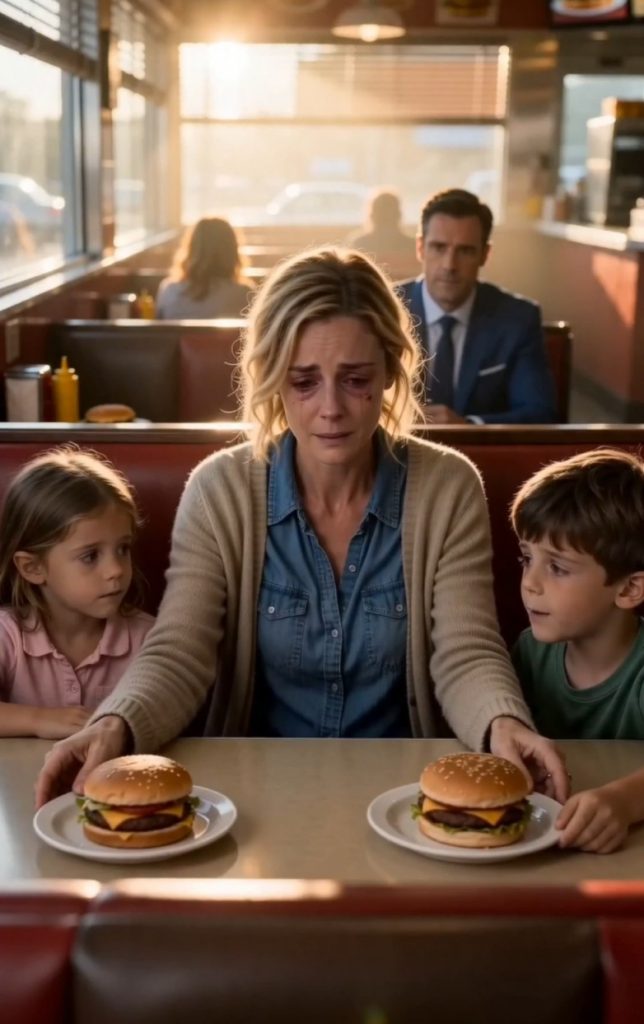
Rebecca Sloan pushed the two plates across the booth before her children could see her hands shaking.
One hamburger for Caleb.
One hamburger for Lily.
Nothing for herself.
The burger joint was old, sunlit, and tired in the way places become when everyone who enters is counting something. Counting dollars. Counting minutes before work. Counting how many bites are left before hunger returns.
Rebecca sat between her two children in a tan cardigan worn thin at the elbows, a denim shirt buttoned to the collar, and a smile she had practiced so many times it no longer reached her eyes.
“Mom,” Caleb said, staring at the burger in front of him, “I’m hungry.”
“I know, sweetheart.”
She slid the plate closer.
Lily, six years old and pink-shirted, looked at her brother first, waiting for permission from a world that had been too hard on them lately. Caleb picked up his burger with both hands, and Lily followed.
Rebecca watched them take their first bites.
Then she lifted a clear plastic cup of water and drank slowly, as if water could be a meal if a mother loved hard enough.
Caleb stopped chewing.
“Where’s yours?”
Rebecca’s throat tightened.
“I already ate,” she said. “I’m still full.”
The lie came out gently.
That made it worse.
In the booth behind them, a man in a blue suit paused with his coffee halfway to his mouth.
He had not meant to listen. He had come in only because his driver took the wrong exit and his next meeting had been delayed. He had expected bad coffee, maybe ten minutes of silence.
Instead, he saw a woman using the last of herself to make two children believe the world was still kind.
Caleb took another bite, then looked at his mother with a smile so bright it nearly broke her.
“Mom,” he said, crumbs at the corner of his mouth, “this is the best birthday I’ve ever had.”
Rebecca’s eyes filled instantly.
She turned toward the window so her children would not see.
Outside, traffic moved past the diner. People walked by with phones, coffees, shopping bags, ordinary lives. None of them knew that inside booth seven, a mother had spent her last eight dollars and seventy-six cents on two hamburgers and a birthday her son could remember without shame.
Rebecca pressed her napkin to her lips.
“Good,” she whispered. “That’s all I wanted.”
Behind her, the man in the blue suit lowered his coffee.
He looked at the children.
Then at Rebecca’s untouched side of the table.
Then at the folded resume sticking out of her worn leather bag.
The name at the top was visible.
Rebecca Sloan.
He remembered it.
Not from the diner.
From a file his board had buried three years earlier.
And when Rebecca walked into his corporate boardroom weeks later, he was the only man at the table who knew she had already survived the hardest interview of her life.
Act II
Before Rebecca Sloan became a woman who counted coins in a diner parking lot, she had been the person companies called when numbers stopped making sense.
She was not flashy.
She was not loud.
She did not enter rooms demanding attention.
But she could read a balance sheet the way some people read confessions. A missing shipment. A delayed invoice. A supplier paid twice under two names. A charity fund quietly drained through consulting fees.
Rebecca saw patterns people tried to hide.
For eight years, she worked in corporate logistics at Halden Foods, a national chain that owned restaurants, distribution centers, and frozen meal brands across the country. She rose fast because she did not panic under pressure. She became the woman senior executives brought into closed rooms when the official story looked clean but smelled rotten.
Then she found the one story no one wanted cleaned.
A charity program tied to Halden Foods claimed to provide meal grants to low-income families and school kitchens. The commercials were beautiful. The annual reports were polished. Executives applauded themselves at galas beneath banners about feeding America.
But Rebecca traced the money.
Millions had been redirected into private vendor contracts controlled by the CFO’s brother-in-law. The meal grants were delayed, reduced, or never sent. Schools blamed budget problems. Parents blamed themselves. Children went hungry while executives smiled beside oversized checks.
Rebecca brought the evidence to her supervisor.
He told her to wait.
She brought it to legal.
They told her to be careful.
She brought it to the CFO.
That was when her career began to die.
Within two months, Rebecca was accused of mishandling internal files. Her performance reviews changed overnight. Her access was revoked. People who once praised her suddenly avoided elevator rides with her.
Then her husband, Mark, got sick.
The kind of sick that turns time into paperwork. Insurance forms. Specialist visits. Prescriptions with prices that looked like threats.
Rebecca fought for him while fighting for her name.
She lost both battles.
Mark died in November, holding her hand and apologizing for leaving her with bills, as if death had been a choice he made poorly.
By spring, Rebecca was blacklisted quietly enough that no one could prove it. Recruiters stopped calling. Interviews vanished after reference checks. Her savings disappeared one payment at a time.
She sold her wedding ring to keep the apartment.
She told Caleb and Lily they were having “campout dinners” when the power was shut off for a night.
She learned which grocery stores marked down bread at closing.
Still, every morning, she got dressed like a woman who believed one door might open.
That morning at the diner was Caleb’s eighth birthday.
He had asked for one thing.
A burger.
Not a party. Not presents. Not cake.
Just a burger with his mother and sister in a real booth, like the kind of family he saw through restaurant windows.
So Rebecca gave him that.
She skipped breakfast. She skipped lunch. She told herself hunger was temporary, but childhood memory was permanent.
She did not know the man behind her was Nathan Whitmore, CEO of Whitmore Holdings, the company preparing to acquire Halden Foods.
She did not know Nathan had spent the last six months searching for the anonymous analyst who had once sent regulators a packet of evidence before disappearing from the industry.
She did not know her name was still attached to one confidential memo in his possession.
Rebecca Sloan: likely source. Highly credible. Terminated shortly after internal fraud discovery.
Nathan had read the memo the night before.
He had wondered what kind of person risked everything to expose stolen food money.
Now he knew.
She was the woman drinking water while her children ate.
And the worst part was that she still thought nobody had seen her.
Act III
Three weeks later, Rebecca stood outside the glass doors of Whitmore Tower wearing a navy suit she had bought secondhand and altered herself at midnight.
Her hair was pulled back neatly. Her shoes were polished. Her black leather portfolio looked better than she felt.
Inside the lobby, sunlight poured across white marble floors. People moved quickly around her, carrying laptops, coffees, access badges, confidence.
Rebecca stood still for one breath too long.
Then she stepped forward.
She had not applied for the executive strategy position because she believed she would get it. She applied because the listing had appeared at 2:14 in the morning while she sat at her kitchen table, surrounded by bills, unable to sleep.
Director of Operations Integrity.
Whitmore Holdings.
Experience in logistics, compliance, internal systems, and crisis response preferred.
Rebecca almost laughed when she read it.
Crisis response.
She had been living inside crisis so long she knew its wallpaper.
She submitted her resume with no expectations.
Two days later, someone called.
Now she walked into a boardroom high above the city, where floor-to-ceiling windows turned the skyline into a statement. A long glass table sat beneath cool recessed lights. A large screen displayed her name in bold white letters.
REBECCA SLOAN.
At the head of the table sat the man from the diner.
She did not recognize him at first.
In the booth, he had been a stranger with coffee.
Here, he was power in a blue suit.
Nathan Whitmore clicked a black pen once and looked toward the doorway.
“Next,” he said. “Rebecca Sloan.”
She entered with her portfolio held firmly at her side.
“Good morning.”
Three board members looked up from their notes. A woman from HR smiled politely. Another executive scanned Rebecca’s resume with the bored expression of a man already prepared to say no.
Nathan lifted his eyes.
Then froze.
Rebecca saw recognition hit him.
Not mild recognition.
Not the faint discomfort of someone placing a familiar face.
It was sudden, total, and almost painful.
“It’s you,” he whispered.
The boardroom went quiet.
Rebecca’s heart stopped.
For one terrible second, she thought he knew about Halden. The accusations. The rumors. The official reason no one hired her anymore.
She straightened her shoulders.
“Yes,” she said carefully. “I’m Rebecca Sloan.”
Nathan did not look away.
The executive beside him, Martin Vale, cleared his throat.
“Ms. Sloan, your resume shows an extended employment gap and an unresolved termination from Halden Foods. Before we waste time on technical questions, perhaps you can explain why your previous employer described you as a compliance risk.”
Rebecca’s fingers tightened around her portfolio.
There it was.
The wall she had hit in every interview.
Compliance risk.
A phrase clean enough to hide a knife.
She opened her mouth, but Nathan spoke first.
“No,” he said.
Martin blinked. “Excuse me?”
Nathan leaned back slowly, his eyes still on Rebecca.
“She doesn’t explain that first.”
He opened a folder in front of him and removed a document marked confidential.
“First, we explain why her previous employer had every reason to ruin her.”
Rebecca stopped breathing.
Nathan placed the memo on the table.
Three years of silence cracked open in front of everyone.
And for the first time since her life collapsed, Rebecca Sloan was not being asked to defend herself from a lie.
She was being handed the truth in a room powerful enough to hear it.
Act IV
Nathan slid the folder across the table.
“Ms. Sloan discovered an internal fraud scheme at Halden Foods three years ago,” he said. “The theft involved funds earmarked for school meal programs and emergency family food grants.”
The HR director’s face changed.
Martin Vale shifted in his chair.
Rebecca stood motionless near the end of the table, afraid that if she moved, the moment would vanish.
Nathan continued.
“After she reported it internally, she was terminated under questionable circumstances. Shortly afterward, regulators received documentation that triggered a sealed investigation. Whitmore Holdings acquired preliminary access to those findings during our merger review.”
Martin frowned.
“Are you saying she was the whistleblower?”
“I’m saying,” Nathan replied, “that while executives were stealing from programs meant to feed children, Rebecca Sloan risked her career trying to stop them.”
No one spoke.
Rebecca looked down.
Not because she was ashamed.
Because grief has strange timing, and sometimes dignity arrives so late it feels like another loss.
She thought of Mark, who had believed her when no one else did. Mark, who had kissed her forehead in a hospital bed and said, “One day someone will read the whole file.”
Someone finally had.
Nathan looked at her portfolio.
“Did you bring work samples?”
Rebecca nodded, forcing herself back into the room.
“I did.”
“Then show us.”
Her hands no longer trembled when she opened the folder.
She walked them through broken systems with calm precision. Vendor fraud. Inventory leakage. Distribution delays. False reporting incentives. She described how companies hide hunger behind efficiency metrics, and how executives convince themselves that a missing meal is only a spreadsheet issue if they never meet the child waiting for it.
Nathan listened without interrupting.
So did everyone else.
By the time she finished, the bored executive had stopped looking bored.
The HR director had tears in her eyes.
Martin Vale looked irritated, which told Rebecca more than his words could have.
Then Nathan asked one final question.
“Why do you want this job?”
Rebecca had prepared an answer.
Something polished about integrity frameworks and operational accountability.
But the truth rose instead.
“Because I know what it feels like when a system decides a family is invisible,” she said. “I know what it costs when people at the top treat hunger like a branding problem. And I know there are mothers right now doing math in parking lots, trying to turn seven dollars into dinner and dignity.”
Her voice softened.
“I can’t fix everything. But I can make sure this company never profits from pretending not to see them.”
The room was silent.
Nathan closed his folder.
Martin exhaled sharply. “This is moving, but we have other candidates with cleaner histories.”
Nathan turned to him.
“Cleaner histories?”
Martin stiffened.
Nathan’s gaze hardened.
“Her history is clean. The people who punished her are not.”
Then he pressed a button on the conference phone.
“Please send in legal.”
Rebecca looked up.
The glass door opened, and two attorneys entered with a second set of folders.
Nathan faced the board.
“Before Ms. Sloan arrived, I asked legal to complete one more review. Martin, your consulting firm received payments from Halden Foods during the period Ms. Sloan was blacklisted. You also advised against her candidacy this week before interviewing her.”
Martin’s face drained.
“That is a mischaracterization.”
Nathan did not blink.
“It is an invoice trail.”
The room shifted.
Rebecca stared at Martin.
Now she understood the coldness. The quick dismissal. The phrase compliance risk ready in his mouth like it had been loaded there years before.
Martin had not merely judged her past.
He had helped bury it.
Nathan stood.
“Effective immediately, Mr. Vale is removed from this hiring committee pending investigation.”
Martin pushed back his chair.
“You’re making a mistake.”
“No,” Nathan said. “I made one when I let men like you define credibility without asking who paid you to doubt it.”
Security appeared at the door.
Martin left without another word.
The city skyline shone behind him, vast and indifferent.
Rebecca stood in the boardroom, stunned by the speed of justice when power finally chose to move.
Nathan turned back to her.
“Ms. Sloan,” he said, quieter now, “I owe you an apology.”
She swallowed.
“For what?”
“For recognizing you from the diner and almost saying nothing.”
Rebecca’s face went pale.
He had seen.
The booth. The water. The burgers. Caleb’s birthday.
Her practiced strength nearly failed.
Nathan’s voice softened.
“I watched you feed your children while pretending not to be hungry. And then I read your file. I realized the woman who tried to feed other people’s children had been left unable to feed herself.”
Rebecca pressed her lips together.
“I didn’t want them to know.”
“I know,” he said. “That is why I didn’t approach you there.”
He paused.
“But I promised myself that if your name ever crossed my desk again, no one would erase it quietly.”
Rebecca looked at the screen where her name still glowed.
For years, that name had been whispered as a warning.
Now it stood in white letters above the city.
And no one in that room could pretend not to see it.
Act V
Rebecca did not accept the job immediately.
That surprised everyone except Nathan.
She asked for the offer in writing. She asked for authority, not decoration. She asked for independent reporting access to the board, protection for internal whistleblowers, and a budget for community food programs that could not be redirected into public relations.
Nathan agreed to every term.
Then Rebecca asked for one more thing.
“No press release about me.”
The HR director looked confused.
Nathan did not.
Rebecca lifted her chin.
“My children have had enough of being part of someone else’s story.”
Two weeks later, Rebecca started as Director of Operations Integrity at Whitmore Holdings.
Her first day began before sunrise in a small apartment where Caleb could not find his left shoe and Lily spilled cereal on her school shirt. Nothing about success made breakfast less chaotic. Nothing about a new salary erased the old habit of checking prices twice.
But when Caleb opened the refrigerator and saw it full, he went quiet.
Rebecca noticed from the sink.
“You okay?”
He nodded, a little too fast.
Then he hugged her around the waist.
Not dramatically.
Just a boy holding onto proof that the ground beneath them had stopped moving.
That evening, Rebecca took Caleb and Lily back to the same burger joint.
Caleb hesitated at the door.
“Are we allowed?”
Rebecca smiled.
“Yes, baby. We’re allowed.”
They sat in booth seven.
This time, Rebecca ordered three burgers.
Then fries.
Then milkshakes.
Lily’s eyes widened as if her mother had just purchased the moon.
Rebecca laughed for the first time in what felt like years.
When the food came, Caleb watched her carefully.
“You’re eating too, right?”
Rebecca picked up her burger and took a bite.
His whole face relaxed.
That was when she understood the cost of her old lie.
Children know more than mothers hope they do.
Caleb had known she was hungry.
He had loved her enough to pretend he believed her.
Across the diner, a man in a blue suit entered quietly.
Nathan did not approach until Rebecca saw him and nodded.
He walked over with a small paper bag in one hand.
“I didn’t want to interrupt,” he said.
Caleb looked at him suspiciously, as children often do when adults arrive with importance attached to them.
Rebecca smiled.
“Kids, this is Mr. Whitmore.”
Lily asked, “Is he your boss?”
Rebecca glanced at Nathan.
“Technically.”
Nathan placed the paper bag on the table.
“Not tonight. Tonight I’m just someone who owed your mom dessert.”
Inside were three slices of chocolate cake from the bakery next door.
Caleb’s eyes widened.
Rebecca looked at Nathan, and something unspoken passed between them.
Not pity.
Respect.
Months later, Whitmore Holdings announced the Sloan Initiative, a permanent fund for school meal access, emergency grocery cards, and legal support for employees who reported fraud. Rebecca fought the name, but Nathan insisted only after Caleb said it sounded “official and cool.”
The fund’s first audit uncovered more than stolen money.
It uncovered habits.
Departments that treated low-income customers as statistics. Managers who punished workers for giving away unsold food. Executives who believed generosity required approval from branding.
Rebecca changed policies with the same quiet force she had once used to push two plates toward her children.
No family assistance funds without independent oversight.
No retaliation hidden in performance reviews.
No food waste while shelters within ten miles needed meals.
No employee punished for feeding a hungry child.
The rule became known inside the company as Evelyn’s Rule at first, after an old lunchroom manager who helped draft it. But Nathan corrected people gently.
“It’s Rebecca’s Rule,” he said. “She lived the reason.”
A year after the diner, Rebecca stood in the same boardroom where Nathan had once whispered, “It’s you.”
Only now she was not a candidate.
She was presenting results.
School meal grants restored in forty-two districts. Emergency family support expanded across five states. Internal fraud reporting up, retaliation cases down. Millions recovered from shell vendors tied to the old Halden network.
At the end of the presentation, the board applauded.
Rebecca accepted it with a nod.
She had learned not to shrink from respect.
Afterward, Nathan found her by the windows, looking out over the city.
“You still thinking about the diner?” he asked.
“Every day,” she said.
He stood beside her.
“Does it hurt?”
Rebecca watched the sunlight move over the buildings.
“Yes,” she said. “But not the way it used to.”
For a long time, she had believed that day in the booth was evidence of failure. Proof that she had fallen too far. Proof that all her intelligence, honesty, and effort had not been enough to protect her children from hunger.
Now she saw it differently.
It was the day she had given her son a birthday when she had nothing.
It was the day a stranger saw her sacrifice and chose not to insult it with pity.
It was the day her name began finding its way back to the rooms that tried to lock it out.
That night, when she came home, Caleb had left a drawing on the kitchen table.
It showed three people in a diner booth.
A boy.
A girl.
A mother.
In front of each of them was a hamburger.
Above the picture, in uneven letters, he had written:
Mom eats too now.
Rebecca sat down and cried.
Not because she was sad.
Because sometimes healing arrives in the smallest sentence.
Years later, people would tell the story differently.
They would say a CEO discovered a struggling mother in a diner and changed her life. They would say kindness saved her. They would say luck found her at the right time.
Rebecca knew better.
She had already been saving herself.
Every day she got up. Every resume she sent. Every bill she negotiated. Every smile she gave her children when fear was chewing through her stomach.
Nathan did not create her strength.
He witnessed it.
And when the world finally opened a boardroom door, Rebecca Sloan walked through it carrying every version of herself.
The analyst who told the truth.
The widow who buried her grief.
The mother who drank water and said she was full.
The woman who learned that dignity is not proven by never falling.
It is proven by what you still give when you have almost nothing left.
And on the wall of her office, framed beside her first executive badge, Rebecca kept the receipt from the diner.
Two hamburgers.
Two children fed.
One mother unseen.
Until she wasn’t.