Act I
Lily tugged on her father’s sleeve for the third time before he finally looked down.
The garden around them was full of music, champagne, and sunlight. Women in silk gowns laughed beneath white canopies. Men in tuxedos stood near the fountain, speaking in low voices about donations, board seats, and names carved into hospital wings.
Everything at Ashbourne House had been polished for the gala.
The hedges were trimmed into perfect walls of green. The stone paths had been swept clean. Even the fountain seemed to sparkle more than water should, spilling silver streams into a marble basin where the sunlight broke apart.
But Lily was not looking at the fountain.
She was looking at the boy sitting beside it.
“Daddy, please stop,” she whispered, both hands wrapped around her father’s arm. “He shouldn’t be alone, Daddy.”
Adrian Whitmore paused only because his daughter’s voice had changed.
Usually, Lily asked for things with the quick brightness of a child who expected the world to answer kindly. Another lemon tart. Five more minutes near the horses. A pink ribbon from the gift table.
This was different.
This was pleading.
Adrian followed her gaze.
At first, he saw only what everyone else at the gala had decided not to see.
A dirty child.
A boy of seven or eight, sitting on the stone edge of the fountain with his shoulders curled inward. His brown shirt was torn near the collar. His pants had holes at the knees. His chin-length hair fell in tangled waves around a face smudged with dirt.
He clutched a crumpled paper bag against his chest as if it were the only thing he owned.
Guests drifted around him in a careful circle.
No one asked why he was there.
No one asked who had let him through the gates.
They simply looked away because looking away was easier when the violins were playing and the wine was cold.
Adrian’s first instinct was irritation.
Not at the boy, exactly.
At the interruption.
He had spent months planning this gala. The children’s foundation depended on the donors gathered in that garden. A single unpleasant scene could become gossip by evening, a headline by morning, and a problem by Monday.
“Lily,” he said quietly, “security will handle it.”
His daughter looked up at him as if he had said something terrible.
“He’s not an it.”
The words struck him.
Before he could answer, Lily turned back toward the fountain. She watched the boy lift one hand and wipe his nose with the back of his wrist. His fingers were thin. Too thin.
Then she whispered something so softly Adrian almost missed it.
“He looks like me.”
Adrian’s body went still.
Slowly, he turned his head and looked at the boy again.
This time, he did not see torn clothes first.
He saw the shape of the child’s mouth.
The curve of his cheek.
The same warm brown eyes Lily had inherited from her mother.
And then the boy looked up.
Adrian forgot how to breathe.
For a second, the garden vanished. The music blurred. The guests became shadows moving behind glass. All he could see was that small, wary face by the fountain, a face he had seen once before in a hospital nursery eight years earlier.
A face he had mourned.
Lily slipped from his side before he could stop her.
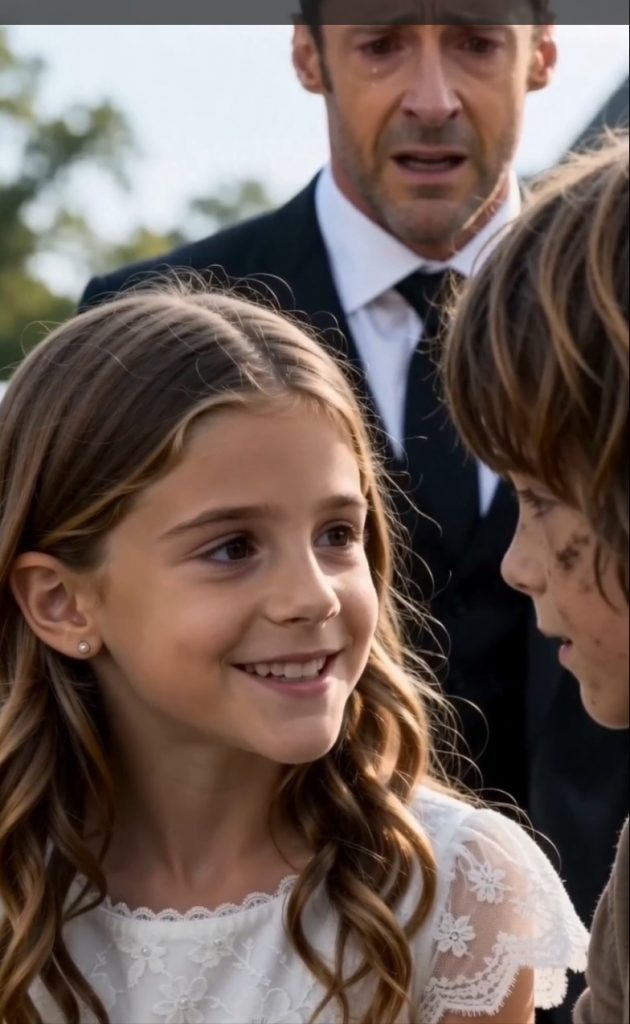
She crossed the grass in her white lace dress and sat down beside the boy as if the space had been waiting for her.
The boy stiffened but did not run.
Lily smiled gently.
“I’m Lily.”
He stared at her for a long moment, uncertain whether kindness was a trap.
Then he whispered, “Ethan.”
Lily leaned closer, studying him with the fearless honesty of childhood.
“You have my nose,” she said.
Behind them, Adrian Whitmore stood frozen in the sun, staring at a child who should not exist.
And inside the boy’s crumpled paper bag was the proof that someone had buried the wrong truth.
Act II
Eight years earlier, Adrian Whitmore had been a different man.
Not softer, exactly.
But less afraid of feeling.
His wife, Clara, used to tease him that he wore his black suits like armor even at breakfast. She would walk barefoot through the old halls of Ashbourne House, laughing at the portraits of dead relatives, opening curtains servants had closed, filling rooms with flowers and music and the sound of her voice.
She made the estate feel less like a monument and more like a home.
Clara came from no dynasty. No old money. No family trust written in careful legal language. She had been a schoolteacher from Vermont with ink stains on her fingers and the stubborn belief that children should never be treated as decoration.
Adrian’s mother, Margot Whitmore, hated her for that.
Margot did not raise her voice. She did not need to. She had the quiet cruelty of a woman who could destroy a person with a pause.
“She is charming,” Margot said after Adrian introduced Clara. “In the way temporary things often are.”
Adrian married Clara anyway.
For three years, Ashbourne House changed.
The ballroom hosted school fundraisers instead of political dinners. The unused west wing became a music room for local children. Clara started a small scholarship program for foster youth, and Adrian, who had inherited money without ever asking what it cost the world, began to understand that wealth was either a door or a wall.
Then Clara became pregnant.
Twins, the doctors said.
A girl and a boy.
Clara cried when she heard it. Adrian pretended he had dust in his eye. For months, they chose names in whispers beneath the old oak tree by the fountain. Lily came easily because Clara loved lilies. Ethan took longer.
“It means strong,” Clara told him one night, one hand resting on her stomach. “And if he has to grow up in this family, he’ll need strength.”
Adrian laughed then.
He did not later.
The birth came too early, during a storm that turned the estate roads into rivers. Clara was rushed to St. Aurelia’s, the private hospital whose board carried three Whitmore names. Adrian remembered white hallways, thunder against glass, nurses moving quickly, Margot’s hand cold on his shoulder.
He heard one baby cry.
A girl.
Lily.
Then doors closed.
Hours passed.
When Dr. Selwyn finally came out, his face was arranged in professional sorrow.
Clara was gone.
The boy had not survived.
Adrian did not remember falling, but he remembered waking in a chair with his mother beside him and a nurse placing Lily in his arms. His daughter was impossibly small, furious, alive.
Everything else was a blur of papers, condolences, and decisions made by people who said they were helping.
Margot arranged the funeral.
Margot handled the hospital records.
Margot told Adrian he must focus on the child who had survived.
And Adrian, broken by grief, obeyed because obedience required less strength than suspicion.
No one let him see his son.
“The damage would be too painful,” Margot said.
No one let him hold Clara one last time.
“Remember her as she was,” Margot said.
No one spoke the boy’s name.
Not once.
After the funeral, Ashbourne House became quiet again. The music stopped. Clara’s scholarship files were boxed and stored. The west wing was locked.
Adrian raised Lily with all the love he still knew how to give, but grief made him careful. Too careful. He hired the best tutors, the best doctors, the best security. He taught his daughter manners before he taught her mischief. He held her tightly and called it protection.
But Lily had Clara’s heart.
That terrified him.
She saw people others stepped around. The kitchen assistant with swollen eyes. The driver who missed his son’s school play. The gardener whose wife had been ill for months. Lily noticed all of them.
And every time she did, Adrian felt Clara moving through the house again.
The gala that afternoon was supposed to mark a new beginning.
The Whitmore Children’s Foundation was being relaunched in Clara’s name. Adrian had finally agreed to reopen the west wing as an education center. Reporters were there. Donors were there. Margot was there in pale blue silk, watching every conversation with the calm of a queen inspecting her court.
Then Ethan appeared by the fountain.
At first, staff assumed he had slipped in with a vendor.
A security guard tried to approach him, but Lily had already seen him.
And once Lily saw someone, the world had to answer for them.
Adrian stood behind his daughter as she sat beside the boy. His pulse beat hard in his throat.
“Ethan,” he repeated carefully.
The boy’s eyes flicked toward him.
Not trusting.
Not impressed.
Only alert.
“That’s what she called me,” the boy said.
“Who?” Lily asked.
Ethan looked down at the paper bag.
“The woman from the shelter.”
Adrian crouched slowly, trying not to frighten him. Up close, the resemblance was worse. Not exact. Not simple. But unmistakable.
This child looked like Lily with hunger carved into him.
“What are you doing here?” Adrian asked.
Ethan tightened his grip on the bag. “I came for the lady in the picture.”
“What picture?”
The boy hesitated.
Then he reached into the crumpled paper bag and pulled out a folded photograph.
It was old, bent at the corners, softened from being touched too many times.
Adrian took it.
The garden tilted.
It was Clara.
Younger, laughing beneath the oak tree near the fountain, her hair blown across her face, one hand resting on her pregnant stomach.
On the back, in Clara’s handwriting, were five words.
For Ethan, when he asks.
Adrian stared at the sentence until it blurred.
Lily looked from the photograph to her father.
“Daddy,” she whispered, “why does Mommy know him?”
Before Adrian could answer, a shadow fell across the grass.
Margot Whitmore stood behind them, her face perfectly still.
And for the first time in Lily’s life, her grandmother looked afraid.
Act III
Margot recovered quickly.
Women like her always did.
She gave a small, cold smile and extended one hand toward the boy as if he were a misplaced napkin.
“Adrian, darling, this is not appropriate. The child is confused. Security will find where he belongs.”
Ethan pulled back.
Lily moved closer to him.
That small gesture told Adrian more about the room than any adult confession could have.
“He belongs here until I know why he has my wife’s photograph,” Adrian said.
Margot’s eyes sharpened. “Do not create a spectacle.”
Adrian stood.
The guests nearest the fountain had begun to watch. Conversations faded in small circles. A waiter stopped with a tray of champagne halfway between two tables.
For years, Adrian had been trained by his mother to fear public embarrassment.
But grief had taught him something worse.
There were things silence could cost that scandal never could.
He looked at Ethan.
“Where did you get this?”
The boy’s voice was barely audible. “It was in my blanket.”
“What blanket?”
“The one they found me in.”
“Who found you?”
Ethan glanced at Margot, then at Lily, then back at Adrian.
“I was left at St. Agnes Shelter when I was a baby. Sister Beatrice said I had the picture and a silver rattle. She said there was a note, but the note got taken.”
“Taken by whom?” Adrian asked.
Ethan lowered his eyes.
“A man in a black car.”
Margot stepped forward. “Enough.”
Adrian turned on her.
It was not loud.
That made it worse.
“Mother.”
She stopped.
“Did you know about this child?”
For the first time, no answer came smoothly.
Margot looked toward the guests, then toward the white canopies, then finally at her son.
“You are grieving again,” she said softly. “This is exactly why I wanted him removed quietly.”
The world narrowed to one word.
Again.
Adrian felt something inside him begin to split.
“What did you say?”
Margot’s expression hardened.
“You have a daughter. A legacy. A foundation opening in your late wife’s name. Do not throw your life into chaos because some street child has been coached.”
Lily stood now, furious in her lace dress.
“He’s not some street child.”
Margot looked at her. “Lily, be silent.”
Adrian moved before he thought, stepping between his mother and his daughter.
“Do not speak to her like that.”
A murmur passed through the crowd.
Ethan flinched at the sound, clutching the bag tighter.
From the edge of the garden, an elderly nun in a plain gray habit began pushing through the guests. She was small, wrinkled, and walking with a cane, but people moved for her because her face carried the kind of purpose no invitation list could deny.
“Mr. Whitmore,” she called.
Ethan’s face changed. “Sister Bea.”
The nun reached the fountain, breathless but steady.
“I tried to stop him from coming alone,” she said, resting a hand on Ethan’s shoulder. “But he heard your family name on the radio. He said he had to see the house from the picture.”
Adrian held up the photograph.
“Tell me what you know.”
Margot spoke sharply. “This is a private event.”
Sister Beatrice looked at her.
“No,” she said. “It stopped being private when a newborn was left at our door with a hospital band cut from his wrist.”
The crowd went silent.
Adrian’s heart pounded so hard he could hear it.
“A hospital band?” he said.
Sister Beatrice reached into her worn leather satchel and removed a small envelope. Her hands trembled with age, not fear.
“I kept what I could,” she said. “I was younger then. I should have gone to the police again, but the first officer told me powerful families handle private adoptions in unusual ways. Then a lawyer came with documents. He said the child was not to be connected to any family.”
She looked at Ethan.
“I did not believe him.”
Inside the envelope was a thin strip of plastic, yellowed with time.
A newborn hospital band.
Most of the printed ink had faded, but one line remained clear.
Baby Boy Whitmore.
Adrian stopped breathing.
Lily stared at the band, then at Ethan.
“My brother?” she whispered.
Ethan looked frightened by the word, as if it were too large to trust.
Margot’s voice cut through the moment like glass.
“That proves nothing.”
Sister Beatrice turned to her.
“No,” she said. “But the blood test will.”
Adrian looked at his mother.
The woman who had arranged his wife’s funeral.
The woman who had controlled the hospital room.
The woman who had told him his son was gone before he was strong enough to ask for proof.
“Why?” he asked.
Margot’s mask cracked.
Only slightly.
But enough.
“Because Clara was going to ruin everything.”
Act IV
The confession did not come all at once.
People like Margot Whitmore never hand over truth freely. They release it in pieces, each one dressed as justification.
Clara had been changing the trust.
That was the first piece.
Two weeks before the twins were born, she had convinced Adrian to sign preliminary documents expanding the foundation beyond scholarships. She wanted a portion of Whitmore land sold to fund shelters, legal clinics, and housing for mothers fleeing abuse.
Margot called it emotional charity.
Clara called it responsibility.
The second piece was worse.
Clara had discovered that Margot and the family attorney had been using the foundation for years as a social shield, moving money between donors, political allies, and private investments while attaching children’s names to the public reports.
Clara had gathered copies.
She planned to go to Adrian after the birth.
She never got the chance.
The third piece came from Dr. Selwyn himself.
He arrived at Ashbourne House that afternoon because Margot called him in a panic. She thought his presence would control the situation. Instead, the sight of Ethan broke whatever loyalty money had purchased.
He was older now, thin and gray, with a face that seemed permanently haunted.
When Adrian confronted him in the library, away from the guests but not away from Lily, Ethan, Sister Beatrice, and two foundation board members who refused to leave, the doctor began to cry before he spoke.
“The boy was alive,” he said.
Adrian gripped the back of a chair.
Lily held Ethan’s hand.
Dr. Selwyn’s voice shook. “He was small, but alive. Weak, but breathing. Your mother told me Clara had signed papers authorizing private placement if one child survived impaired. She said you knew. I knew it was wrong. I knew.”
“Then why did you do it?” Adrian asked.
The doctor looked at Margot.
“Because she owned the hospital board. Because she threatened my career. Because I told myself the child would be cared for.”
Ethan’s fingers tightened around Lily’s.
“I wasn’t,” he said.
No one moved.
Two words from a child did what an entire room of adults had failed to do.
They stripped the excuses bare.
Margot turned toward him, furious now. “You were placed where you could not harm this family.”
“Harm?” Adrian said.
“He was a complication.”
“He was my son.”
“He was Clara’s weapon!” Margot snapped.
The room went silent again.
There it was.
Not grief.
Not protection.
Fear.
Margot’s breathing quickened, but she kept going because control, once broken, often turns reckless.
“Clara was filling your head with guilt. She wanted to scatter the estate into shelters and clinics. She wanted to drag our name through investigations because she could not understand that families like ours survive by keeping certain things contained.”
Adrian stared at her as if seeing a stranger wearing his mother’s face.
“So you took my child.”
“I preserved what generations built.”
“You took my child.”
Margot flinched this time.
Not from guilt.
From his certainty.
Sister Beatrice pulled another paper from her satchel.
“This was the note found with Ethan,” she said. “The original was taken. I made a copy before the lawyer arrived.”
She unfolded it carefully.
The handwriting was rushed, uneven, but unmistakably Clara’s.
If this reaches anyone kind, his name is Ethan. Tell Adrian I did not leave him. Tell him both babies lived. Tell him Margot knows.
Adrian sat down.
Not slowly.
Like his body had forgotten its own strength.
For eight years, he had believed his wife had died before knowing their son was gone. Now he understood that Clara had known. She had fought. She had used her last strength to name the truth.
And everyone around him had buried her with it.
Lily began to cry silently.
Ethan did not.
He only stared at Adrian with wary, guarded eyes, as if waiting to find out whether this man would want him now that wanting him came with wreckage.
Adrian looked at his son.
The word almost broke him.
Son.
He crossed the room and knelt in front of Ethan, careful to leave space between them.
“I didn’t know,” he said, voice raw. “That does not make it better. But I swear to you, I didn’t know.”
Ethan searched his face.
“Are you going to send me back?”
Lily made a small wounded sound.
Adrian shook his head.
“No.”
“You don’t know me.”
“No,” Adrian whispered. “But I should have.”
Ethan’s mouth trembled.
He looked down at his paper bag.
Inside were all the things he had carried into the estate: the photograph, the hospital band, a cracked silver rattle, and a small toy horse with one missing leg.
Everything he owned.
Everything that proved he had once belonged somewhere before the world denied it.
Adrian lowered his head.
“I can’t ask you to trust me today,” he said. “But I can make sure no one ever hides you again.”
Behind him, Margot Whitmore turned toward the door.
Two security guards blocked it.
For the first time in her life, the house she had ruled would not let her leave.
Act V
The garden party ended without music.
Guests were escorted out through the side gate. Reporters stayed outside the iron fence until nightfall. By evening, the fountain still ran beneath the golden light, but the champagne glasses sat abandoned on white-covered tables, and Clara’s portrait had been moved from the dedication stage into the main hall.
No one wanted to speak beneath her eyes.
Margot Whitmore was not arrested that day.
Power rarely collapses that quickly.
But her passport was surrendered by morning. The family attorney’s office was raided within the week. St. Aurelia’s Hospital opened an internal investigation only after the state forced it to. Dr. Selwyn surrendered his license before the hearing because shame had finally become heavier than fear.
The blood test came back three days later.
Ethan was Adrian’s son.
Lily’s twin brother.
Adrian read the report alone first, then with Lily, then with Ethan. He did not expect joy. Joy would have been too simple for something born from so much theft.
Ethan sat on the edge of a chair in the library, ready to run from a house too large to trust.
Lily sat beside him, their shoulders touching.
When Adrian handed him the paper, Ethan did not look at it.
“I don’t know how to be rich,” he said.
Adrian’s throat tightened.
“Good,” he said. “Most rich people are terrible at it.”
Lily giggled through tears.
Ethan almost smiled.
It was small, but Adrian saw it.
For the first few weeks, Ethan stayed at Ashbourne House only during the day. Sister Beatrice insisted, and Adrian agreed. Trust would not be forced because the law had found a match. Ethan returned to the shelter each night until he decided otherwise.
Every morning, Lily waited at the front steps.
Every morning, Ethan arrived clutching the paper bag.
At first, he would not eat unless food was left where he could take it without being watched. He hid bread in his pockets. He slept sitting upright in chairs. He flinched when doors closed too loudly.
Lily adjusted faster than any adult.
She did not ask him why he was strange.
She simply made room for his strangeness.
When he hid rolls from dinner, she hid one too and declared it a twin tradition. When he refused new clothes, she wore her oldest cardigan with missing buttons to breakfast. When he panicked in the west wing because the hallway was too quiet, she took him outside and showed him where frogs lived near the pond.
“You don’t have to like the house yet,” she told him. “I didn’t like broccoli for years.”
Ethan stared at her.
Then he laughed.
The sound startled everyone who heard it.
Adrian stood at the window and cried where the children could not see.
The foundation changed next.
Not in name only.
Adrian opened every financial record Clara had collected. Donors fled. Board members resigned. Old family friends called him reckless, unstable, manipulated by grief.
He had heard those words before.
This time, they did not work.
The Whitmore Children’s Foundation was rebuilt under independent oversight. The first grant went to St. Agnes Shelter. The second funded legal advocates for children in private placements. The third reopened cases connected to St. Aurelia’s and the Whitmore family attorney.
Clara’s west wing became what she had wanted all along.
Not a memorial.
A place where children could walk in hungry, frightened, angry, silent, or ashamed and be met by people trained to ask the right questions before deciding they already knew the answers.
Months passed before Ethan slept at Ashbourne House for the first time.
It happened during a storm.
Thunder rolled over the roof, and the old windows shook. Adrian found him sitting on the stairs after midnight, paper bag hugged to his chest, eyes wide in the dark.
“I can take you back to Sister Beatrice,” Adrian said gently.
Ethan shook his head.
“I don’t want to go.”
“Do you want me to sit with you?”
A long pause.
Then Ethan nodded.
So Adrian sat on the stairs beside his son while rain lashed against the windows.
For a while, neither spoke.
Then Ethan reached into the paper bag and pulled out the cracked silver rattle.
“Was it mine?” he asked.
Adrian took it carefully.
He remembered buying it in London because Clara had said it was absurdly expensive and therefore perfect for a baby who would mostly throw it on the floor.
“Yes,” he whispered. “It was yours.”
Ethan looked at the rattle.
“Did you want me?”
The question was so quiet Adrian almost missed it.
When he answered, his voice broke.
“Before you had a name. Before I saw your face. Before I knew whether you were a boy or girl. Yes. I wanted you.”
Ethan’s eyes filled, but he did not look away.
Adrian did not reach for him.
He waited.
At last, Ethan leaned sideways, just enough for his shoulder to touch Adrian’s arm.
It was not a hug.
It was everything.
A year later, the fountain at Ashbourne House was surrounded by children again.
Not donors.
Not politicians.
Children.
Some came from shelters. Some from hospitals. Some from homes where adults were trying and failing and learning to try better. They ran through the garden in sneakers and party shoes, laughing beneath the same sun that had once shone on Ethan sitting alone with all his belongings in a paper bag.
Lily stood beside him at the fountain, older now, her white lace dress replaced by muddy boots and a blue ribbon in her hair.
Ethan wore clean clothes but kept his hair a little messy on purpose.
“You still have my nose,” Lily said.
He rolled his eyes. “You have mine.”
Adrian watched them from beneath the oak tree.
Beside him stood Sister Beatrice, leaning on her cane.
“She saved him first, you know,” the nun said.
Adrian looked at Lily.
“I know.”
“No,” Sister Beatrice said softly. “Not from hunger. Not from the shelter. From being unseen.”
Adrian swallowed.
Across the lawn, Lily grabbed Ethan’s hand and pulled him toward a group of children near the fountain. He hesitated only once before following.
That was healing, Adrian had learned.
Not forgetting.
Not making the past beautiful.
Just hesitating once instead of ten times.
Walking forward anyway.
Margot’s trial began that autumn. She never admitted guilt in words that mattered. She called her choices protection, legacy, necessity. But the documents spoke more clearly than she did, and Clara’s note was read aloud in court.
Ethan did not attend.
Lily did not either.
Adrian went for all of them.
When he returned home, he found the twins asleep in the library, Lily curled into one corner of the sofa and Ethan on the rug below her, one hand resting near the paper bag he no longer carried everywhere.
Adrian stood in the doorway for a long time.
On the wall above them hung Clara’s portrait.
For years, he had looked at that portrait and seen only loss.
Now, beneath her painted gaze, her children slept under the same roof.
Not untouched by pain.
Not magically repaired.
But together.
The next morning, Ethan came down to breakfast without the paper bag.
No one mentioned it.
Lily only slid a plate of toast toward him and stole one of his strawberries.
He protested.
She grinned.
Adrian sat at the head of the table and listened to them argue about nothing, the most ordinary miracle in the world.
Outside, the fountain kept running.
The same fountain where a neglected boy had once sat alone while wealthy people pretended not to see him.
The same fountain where a little girl in a white dress had looked at him and recognized what every adult had missed.
Family.
Not the kind protected by money.
Not the kind preserved by lies.
The real kind.
The kind that begins when someone stops, looks closer, and says, “He shouldn’t be alone.”