Act I
The slap echoed against the glass tower like a crack in the morning.
For half a second, the sidewalk froze.
People in tailored coats turned their heads, then quickly turned away again. A black sedan rolled past the crosswalk. The revolving door of the luxury building spun slowly behind them, reflecting sunlight across the clean concrete.
The street cleaner stood with his face turned to the side.
His name was Gabriel Torres, though no one on that block had ever asked.
He wore an orange safety vest over a gray shirt, dark work pants, and old boots scuffed white at the toes. His hands were wrapped around a straw broom, knuckles rough from years of cold mornings and city dust.
In front of him stood a young businessman in a slim black suit.
Evan Caldwell was twenty-six, handsome in the expensive way that made people forgive cruelty before it spoke. His tie was perfect. His shoes looked untouched by weather. His face twisted with disgust as if Gabriel’s existence had interrupted the architecture.
“Clean somewhere else,” Evan had snapped.
Gabriel had only lifted his eyes.
“I’m just working.”
That calm answer seemed to offend Evan more than defiance would have.
He leaned in close, his voice dropping into something venomous.
“You smell like trash.”
Then he hit him.
Gabriel’s head snapped to the side. His cheek burned. His broom shook in his grip, but he did not raise a hand back.
He simply stood there.
That made Evan smile.
Around them, pedestrians flowed past, pretending the scene was none of their business. One woman slowed, then kept walking. A man in sunglasses glanced over, decided he had meetings more important than dignity, and entered the building.
Evan adjusted his cuff.
“Know your place,” he said.
Gabriel looked at him then.
Not with fear.
With a sadness so steady it made Evan’s smile falter.
Before either man could speak again, the revolving door spun behind them.
An elderly executive stepped out.
He was silver-haired, elegant, and unmistakably powerful, dressed in a black suit that had probably cost more than Gabriel made in a month. Two assistants trailed him, one holding a tablet, the other already speaking into a phone.
“Harrison,” someone called from inside the lobby.
Harrison Caldwell, founder of Caldwell International, took one step onto the sidewalk.
Then he stopped.
His hand went to his chest.
His face changed.
The assistants froze.
Harrison swayed once, eyes wide with shock, then collapsed backward onto the pavement.
The scream came immediately.
“He’s not breathing!”
People poured out of the building, expensive shoes scattering around him in a panicked circle. Someone shouted for an ambulance. Someone else cried into a phone. Evan stood at the edge of the crowd, pale now, his confidence gone.
Gabriel dropped his broom.
“Move back!” he shouted.
No one moved.
So he pushed through them.
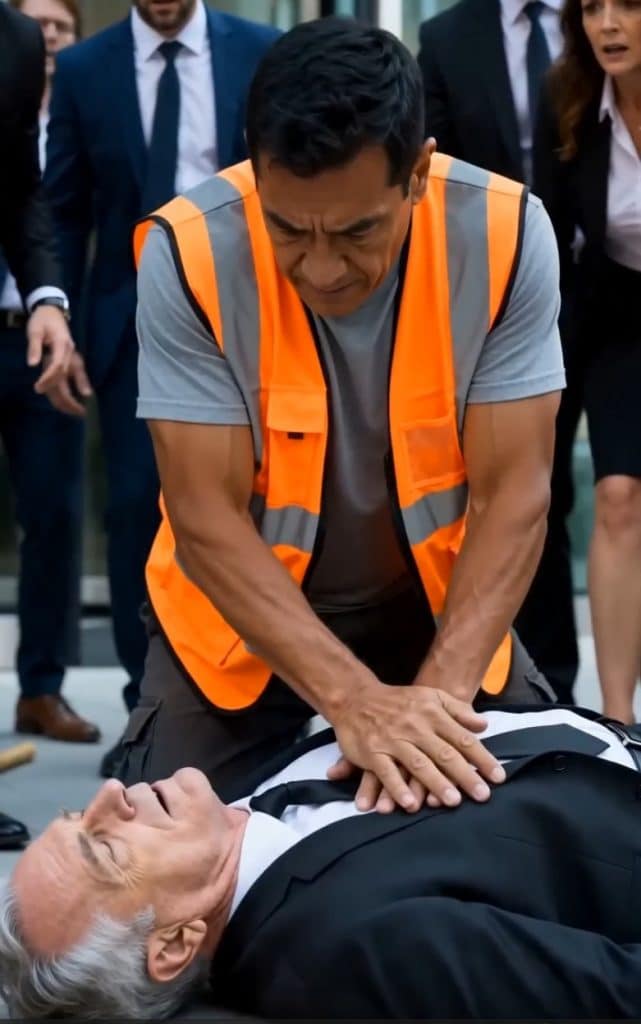
He knelt beside Harrison Caldwell, checked him with fast, practiced hands, and began chest compressions with a focus so sharp that the entire crowd seemed to bend around him.
“Call 911. Tell them possible cardiac arrest. Get the AED from the lobby. Now.”
The words were not a request.
They were command.
The same people who had ignored him thirty seconds earlier obeyed without thinking.
Evan stared.
The street cleaner’s hands moved with brutal precision. His face was calm, his jaw set, his cheek still red where Evan had struck him. The orange vest rose and fell as he counted under his breath.
Then Harrison Caldwell gasped.
A sharp, ragged breath tore through him.
His eyes fluttered open.
The crowd erupted.
Gabriel eased back, one hand still steady on the old man’s shoulder.
Harrison blinked up at him, disoriented and terrified.
Then recognition flickered in his eyes.
“You saved me,” he whispered.
Gabriel did not smile.
Slowly, he reached into the pocket of his orange vest and pulled out a small piece of paper.
It was folded, torn, and burned black along one edge.
He held it where Harrison could see it.
“I know you,” Gabriel said.
And Harrison Caldwell’s face went whiter than the pavement beneath him.
Act II
Fifteen years earlier, Gabriel Torres had worn a different uniform.
Not orange.
Navy blue.
Back then, people stepped aside when he ran, not because they looked down on him, but because he was going toward the danger everyone else was fleeing.
He had been a paramedic with the city’s rescue unit, the kind of man other first responders trusted without needing to ask why. He could hear panic and cut straight through it. He could look at a scene and know which life had seconds left and which one could wait.
His wife, Marisol, used to say he carried storms in his chest and peace in his hands.
They lived in a small apartment above a bakery in Queens. Their daughter, Ana, was nine years old and loved drawing buildings with impossible windows. She said one day she would become an architect and make homes where nobody felt small.
Gabriel kept one of her drawings folded inside his wallet.
A tower.
A sun.
Three stick figures holding hands in front of a door.
On the back, in crooked pencil, she had written:
Papa saves people. One day I will build places worth saving.
Then came the Meridian fire.
The Meridian Hotel was not the biggest building Harrison Caldwell owned, but it was one of the oldest. A historic luxury property downtown, all marble floors, brass elevators, and chandeliers polished for wealthy guests.
The fire started in a service corridor just after midnight.
By the time Gabriel’s unit arrived, smoke had filled the lower floors. Guests were trapped. Staff were screaming. The sprinkler system had failed in two wings, and emergency exits on the east side would not open because renovation equipment had been stored against the doors.
Gabriel remembered the heat.
He remembered carrying a young kitchen worker down four flights of stairs.
He remembered going back in for a maid who had called 911 from a supply closet.
He remembered hearing a man coughing behind a locked conference room door.
That man was Harrison Caldwell.
Gabriel broke the door open with an axe.
Harrison was on the floor, barely conscious, one hand clenched around a leather portfolio. He was younger then, still silver at the temples, still powerful, still dressed like disaster was something that happened to other people.
Gabriel dragged him out.
Halfway down the corridor, Harrison grabbed his sleeve.
“My papers,” he rasped.
Gabriel thought he was delirious.
But Harrison would not let go.
“Please,” he choked. “My papers.”
Gabriel almost left them.
He should have left them.
Instead, because he was trained to preserve whatever mattered to the person he was saving, he reached back through smoke and grabbed the leather portfolio from the floor.
Inside were contracts, renovation permits, inspection notices, and one memo burned along the edge where sparks had eaten through the leather.
Gabriel did not read it then.
He had other screams to answer.
That night, seventeen people were injured.
Three died.
One of them was Marisol.
She had not been a guest.
She had been working an extra cleaning shift at the hotel because Ana’s school fees were due the next week. Gabriel did not know she was inside until he saw her name on a hospital list at dawn.
For two days, he sat beside her bed and begged her to wake up.
She never did.
Grief should have been enough.
But men like Harrison Caldwell rarely stopped at being rescued.
Within a month, Caldwell International launched its own version of the story. Faulty wiring. Contractor negligence. Chaos. Confusion. A tragic but unavoidable accident.
Then the whispers began.
Gabriel had reentered the east wing against protocol.
Gabriel had delayed evacuation.
Gabriel had removed documents instead of focusing on victims.
The company did not accuse him directly.
That would have required proof.
They simply allowed the blame to drift toward the man too broken to fight back.
The department investigated. The press circled. Gabriel’s name appeared in headlines beside words like questions and judgment and fatal delay.
He tried to tell them the exits had been blocked.
He tried to tell them the sprinklers had failed.
He tried to tell them Harrison Caldwell had known about both.
But the inspection records vanished.
The security footage was corrupted.
The maintenance supervisor suddenly retired.
And Harrison Caldwell, the man Gabriel had carried through smoke, gave one careful public statement.
“In moments of tragedy, memory can become unreliable.”
He never said Gabriel lied.
He did not have to.
Gabriel lost his badge six months later.
Not officially for the fire.
For emotional instability after the death of his wife.
That was the clean language they used when they wanted a grieving man to disappear.
Ana changed after that.
She stopped drawing towers.
She stopped asking why people on the news said her father had made mistakes.
At sixteen, she left for college on a scholarship Gabriel barely understood how she had won. At nineteen, she stopped coming home for holidays. Not because she hated him. Because every room they shared had Marisol in it, and neither knew how to breathe around the other’s pain.
Gabriel took city work.
Street cleaning at first was supposed to be temporary.
Then years passed.
He learned the rhythm of the downtown blocks. Learned which doormen nodded and which looked through him. Learned that in wealthy neighborhoods, invisibility was not silence. It was a role assigned to you by people who preferred their world clean but did not want to see the hands doing the cleaning.
Every morning, he swept in front of Caldwell Tower.
Not by accident.
By request.
Because some wounds do not heal.
They keep watch.
And in his vest pocket, every day, Gabriel carried the one thing the fire had failed to destroy.
The burned memo from Harrison Caldwell’s portfolio.
Act III
The ambulance arrived with sirens screaming against the glass buildings.
Paramedics took over, but not before one of them looked at Gabriel’s hands and paused.
“You’ve done this before,” she said.
Gabriel stepped back.
“A long time ago.”
Harrison Caldwell was lifted onto a stretcher, oxygen mask over his face, eyes still locked on the torn paper in Gabriel’s hand. The old man tried to speak, but the paramedic told him to save his strength.
Evan hovered nearby, shaken and useless.
Only minutes earlier, he had struck the man who had just saved his grandfather’s life.
The crowd knew it.
Their silence had changed flavor.
Before, they had ignored Gabriel because he was beneath them.
Now they looked at Evan because shame had nowhere else to go.
Evan swallowed and stepped toward Gabriel.
“I didn’t know you were—”
Gabriel turned to him.
“A person?”
The word landed harder than any slap.
Evan looked down.
For the first time that morning, his expensive shoes seemed ridiculous.
As the stretcher rolled toward the ambulance, Harrison reached out with trembling fingers. Gabriel hesitated, then stepped closer.
Harrison’s voice came faint through the oxygen mask.
“Where did you get that?”
Gabriel unfolded the burned memo.
The paper was fragile, blackened at one corner, the ink faded but still readable.
Harrison’s eyes filled with recognition.
Not of Gabriel.
Of guilt.
The memo was dated three weeks before the Meridian fire. It was addressed to Harrison Caldwell from an internal safety consultant. The language was corporate, cautious, designed to warn without sounding emotional.
East stairwell remains obstructed.
Sprinkler pressure deficiencies unresolved.
Temporary occupancy should be suspended until corrective action is complete.
At the bottom, in blue ink, was Harrison Caldwell’s signature.
Approved for delayed remediation.
Three people died because fixing the hotel before a holiday investor event would have cost too much money.
Gabriel had found the memo in the leather portfolio that night.
He did not understand its importance until after Marisol’s funeral.
By then, every official copy had disappeared.
So he kept the burned one hidden.
Not because it could bring his wife back.
Because it proved he had not lost his mind.
Harrison stared at it.
“I thought that was destroyed,” he whispered.
Gabriel’s voice remained low.
“So did your lawyers.”
Evan looked between them, horror dawning slowly. “Grandfather?”
Harrison closed his eyes.
The ambulance doors opened behind him, but he gripped Gabriel’s wrist with surprising strength.
“I did not mean for anyone to die.”
Gabriel leaned closer.
“But you meant to save money.”
The old man flinched.
That was answer enough.
Reporters had begun gathering at the edge of the sidewalk. A bystander had filmed everything from the slap to the rescue to the burned memo held in the light. Phones were raised now. The glass tower reflected a dozen versions of the same scene.
For fifteen years, Caldwell International had controlled the story.
For fifteen years, Gabriel Torres had carried the truth in a pocket.
And now, on the clean sidewalk outside the company’s own building, the truth had finally been seen.
But the burned memo was not the only thing Gabriel had kept.
Act IV
At the hospital, Harrison Caldwell asked for Gabriel before he asked for his lawyers.
That alone frightened the Caldwell family.
By afternoon, an entire floor had been tightened with private security. Assistants moved quickly through corridors. Legal counsel arrived in dark coats. Evan sat alone in the waiting room, his tie loosened, his hand pressed to his forehead.
Gabriel came because the hospital called him.
Not because Harrison deserved him.
He arrived still wearing the orange vest. He had washed his hands, but dust remained in the creases. The red mark on his cheek had begun to darken.
When Evan saw it, he stood.
“I’m sorry,” he said.
Gabriel kept walking.
Evan followed, desperate now. “I was wrong.”
Gabriel stopped.
“Wrong is missing a turn,” he said. “You humiliated someone because you thought no one would stop you. Learn the difference.”
Evan had no answer.
Inside the private room, Harrison looked smaller than any photograph had ever allowed him to look. Tubes ran from his arm. Monitors blinked beside the bed. Without the tower, the assistants, the boardrooms, he was only an old man who had run out of distance from his past.
Gabriel stood at the foot of the bed.
Harrison’s first words were not an apology.
They were worse.
“Why didn’t you use it?”
Gabriel knew what he meant.
The memo.
The proof.
The thing that could have cracked open the whole lie.
“I tried,” Gabriel said. “No newspaper would touch it. No lawyer would take me without money. The fire department called it incomplete evidence. Your people said it was stolen property.”
Harrison looked away.
Gabriel reached into his vest again.
This time, he pulled out a second piece of paper.
Not burned.
Folded carefully.
Evan had entered the room silently and stood near the door. When Gabriel opened the paper, the young man saw a child’s drawing of a tower, a sun, and three figures holding hands.
Gabriel’s voice changed.
“This was in my wallet the night I carried you out.”
Harrison stared at it.
“My daughter drew it,” Gabriel said. “She was nine.”
No one spoke.
“She believed buildings could protect people. She believed men who owned buildings cared what happened inside them.”
Harrison’s eyes watered.
Gabriel folded the drawing again.
“After the fire, she watched the world call her father reckless. She watched my badge disappear. She watched me become a man people stepped around.”
Evan looked at the floor.
Gabriel turned to him.
“And this morning, she would have watched you slap me for doing honest work.”
Evan’s face crumpled.
For the first time, he looked like a young man instead of a polished weapon.
Harrison whispered, “Where is she now?”
Gabriel’s mouth tightened.
“Chicago. Architect.”
Something flickered across Harrison’s face. Surprise, then recognition.
“Her name?”
“Ana Torres.”
Evan looked up sharply.
Harrison closed his eyes.
Gabriel saw it.
“What?”
Harrison was silent too long.
Gabriel stepped closer. “What?”
Evan answered before his grandfather could stop him.
“Ana Torres is presenting to our board next week,” he said. “She designed the housing project for the East River redevelopment.”
The room shifted.
Gabriel’s daughter, who had stopped drawing towers because of what one had taken from her, had become an architect anyway.
And she was about to walk into Caldwell Tower without knowing her father’s disgrace had been manufactured by the man whose company wanted to profit from her work.
Gabriel laughed once, but there was no humor in it.
“Of course.”
Harrison’s monitor ticked faster.
“I didn’t know.”
Gabriel’s eyes hardened. “You never know when not knowing is useful.”
That sentence broke through something in Harrison that the heart attack had only cracked.
He turned to Evan.
“Call the board.”
Evan stared at him. “Grandfather, you should rest.”
“Call them.”
The old authority returned, but this time it was aimed somewhere different.
By evening, Harrison Caldwell recorded a statement from his hospital bed.
His lawyers begged him not to.
His family begged him to wait.
He did neither.
In a shaking voice, he admitted the Meridian Hotel safety warnings had been ignored. He admitted the company had allowed public blame to fall on Gabriel Torres despite knowing the blocked exits and failed systems were under corporate control. He admitted the burned memo was real.
He did not dress it up as tragedy.
He called it what it was.
A cover-up.
The statement hit the news before midnight.
By morning, Caldwell International’s stock had dropped, the city had opened a criminal inquiry, and Gabriel Torres’s name was being spoken on television without the old stain attached to it.
But none of that mattered as much as the call he received at 7:12 a.m.
He was sitting at his kitchen table, still in yesterday’s clothes, when his phone rang.
The number was from Chicago.
He answered, but said nothing.
For a moment, there was only breathing.
Then a woman’s voice, older now but still carrying the echo of the little girl who once drew suns on skyscrapers, whispered, “Dad?”
Gabriel closed his eyes.
And the years between them finally began to collapse.
Act V
Ana Torres arrived two days later.
She came straight from the airport to the municipal hearing, rolling suitcase in one hand, portfolio tube in the other. She wore a camel coat, black boots, and the guarded expression of someone who had learned not to expect too much from apologies.
Gabriel stood when she entered.
For a second, neither moved.
Then Ana saw his cheek.
The mark from Evan’s slap had faded into a yellow bruise.
Her face changed.
“Who did that?”
Gabriel almost smiled.
Of all the things she could have asked first, she chose the wound she could see.
“It’s handled,” he said.
Ana looked past him to Evan Caldwell, seated behind his grandfather’s legal team.
Evan lowered his eyes.
The hearing room filled quickly. City officials, journalists, former Meridian workers, families of the injured, and relatives of those who had died sat shoulder to shoulder beneath harsh lights. For once, Caldwell money could not soften the room.
Harrison entered in a wheelchair.
People turned.
Some with hatred.
Some with satisfaction.
Some with grief too old to be neat.
Gabriel did not look at him.
He looked at Ana.
When he testified, he did not perform pain for cameras. He spoke plainly. He described the fire, the blocked doors, the memo, the investigation that bent away from the powerful and crushed the man easiest to blame.
Then he unfolded Ana’s childhood drawing.
His voice finally broke.
“My daughter drew this before she knew buildings could lie.”
Ana pressed her hand to her mouth.
Gabriel looked at her then, not at the officials.
“I should have fought harder to make sure you knew the truth. But I was ashamed. Not because I caused it. Because I couldn’t stop them from taking my name.”
Ana’s eyes filled.
“They didn’t take it,” she said, voice trembling across the room. “I did.”
Gabriel shook his head.
“No, mija. You survived how you could.”
Harrison testified after him.
The room did not soften for him, and it should not have.
He named the lawyers who buried records. He named the executives who approved delayed safety repairs. He named himself as the man who signed the memo and later allowed Gabriel to be destroyed.
When he finished, he looked toward Gabriel.
“I owe you my life twice,” Harrison said. “And I repaid the first debt with cowardice.”
Gabriel did not forgive him.
Not there.
Not because cameras waited.
Not because an old man cried.
Forgiveness, he had learned, was not a public relations event.
But justice began moving.
The city reopened the Meridian case. Gabriel’s record was corrected. His pension was reinstated. The families of the victims filed suit with evidence no one could bury anymore. Caldwell International lost contracts, board members, and the polished myth that had protected it for decades.
Evan resigned from his executive training program.
At first, people assumed it was disgrace.
It was partly that.
But three weeks later, he appeared at a city sanitation office wearing plain clothes and asked to be placed on community work detail.
The supervisor laughed in his face.
Gabriel did not.
When Evan found him sweeping outside a courthouse one cold morning, he stood several feet away and said, “I don’t expect you to respect this.”
Gabriel kept sweeping.
“Good.”
“I just didn’t want the apology to be the last thing I did.”
Gabriel stopped and looked at him.
Evan was thinner. Tired. Still rich, still privileged, still carrying a lifetime of insulation no orange vest could erase. But there was something unfamiliar in his posture.
Humility, maybe.
Or the beginning of it.
Gabriel pointed with his broom toward the curb.
“You missed a line of leaves.”
Evan looked at the gutter.
Then he bent down and picked them up by hand.
Gabriel went back to sweeping.
That was the only approval he gave.
Months later, Ana’s East River housing project was approved under a new public trust, stripped from Caldwell control and rebuilt with independent oversight. At the groundbreaking, she invited her father to stand beside her.
Gabriel almost refused.
He owned one good jacket, and it still smelled faintly of storage. Ana took it from him, brushed the shoulders, and adjusted the collar the way Marisol used to.
“You’re coming,” she said.
So he did.
The building would not be luxury glass.
It would be affordable apartments with wide stairwells, clear exits, working sprinklers, ground-floor clinics, childcare space, and windows large enough to let morning light touch every hallway.
Ana stood at the podium, looking out at the crowd.
“My mother cleaned buildings she could never afford to enter through the front door,” she said. “My father saved people inside buildings owned by men who forgot people were the point. This project is for everyone who has ever been treated as invisible by the places they kept alive.”
Gabriel lowered his head.
Not to hide shame this time.
To hold back tears.
After the ceremony, Ana placed the old childhood drawing inside a frame and gave it to him.
The burned memo went somewhere else.
Into evidence.
Where it belonged.
Harrison Caldwell died the following year, not as the untouchable titan he had spent his life pretending to be, but as a witness whose confession helped unravel the empire he had built on silence. His final letter to Gabriel arrived through an attorney.
Gabriel read only the first line.
You deserved better than my regret.
Then he folded it and put it away.
Some apologies did not need to become treasures.
On clear mornings after that, people still saw Gabriel sweeping outside the glass towers downtown. Some recognized him now. Some nodded with too much respect, as if respect given late could balance years of contempt.
Gabriel accepted none of it too deeply.
He had been a man before the headlines.
He was still a man after them.
One morning, Evan arrived in work gloves, pushing a cart of city-issued tools. He was no longer dressed in black designer suits. He had not become noble overnight. Life was not that simple.
But when a delivery worker dropped a crate near the crosswalk and apples rolled across the pavement, Evan was the first to kneel and gather them.
Gabriel watched him.
Then he looked up at Caldwell Tower, its glass shining in the sun, reflecting the city back to itself.
For years, that building had represented everything that crushed him.
Power.
Money.
Silence.
Now, taped inside a frame on his kitchen wall, Ana’s drawing showed a different kind of tower. A childish one. Crooked. Bright. Impossible.
Three figures holding hands in front of a door.
Papa saves people.
One day I will build places worth saving.
Gabriel picked up his broom and returned to work.
Not because he knew his place.
Because at last, everyone else knew his.