Act I
Julian saw his mother before the guests did.
That was the worst part.
He had time to stop it.
He had time to step away from the white floral archway, cross the gravel drive, take Eleanor Whitcomb’s hand, and walk her inside like the woman who had given him everything.
Instead, he stepped in front of her.
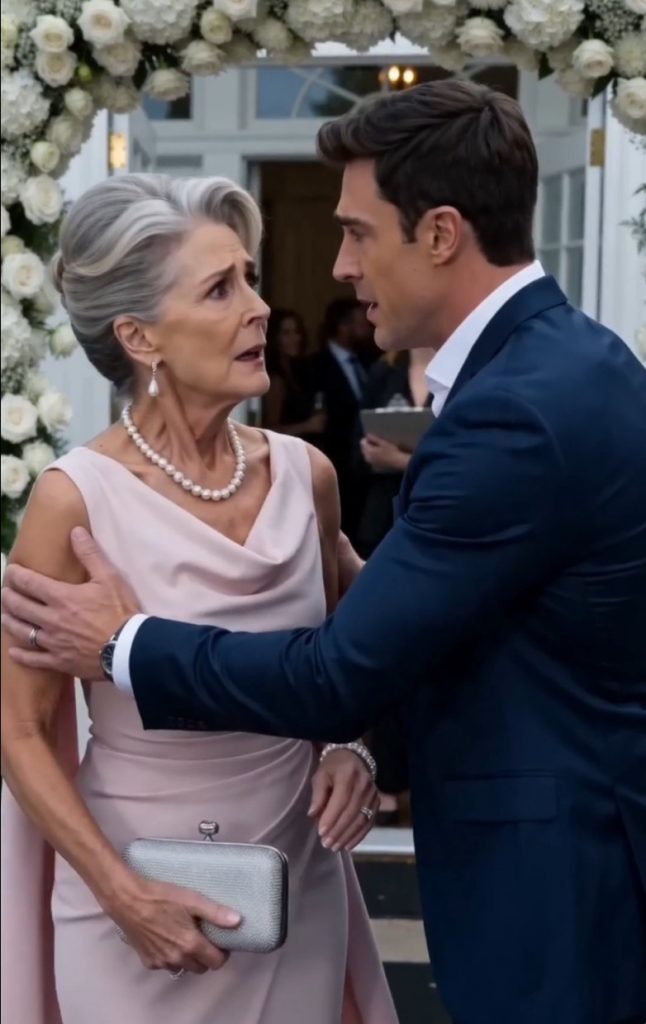
The evening gala glittered behind him. White doors stood open beneath a grand arch of roses and orchids. Waiters moved with champagne trays. Guests in black tuxedos and silk gowns drifted through the entrance of the estate as if they were entering a world built for people who had never been told no.
Eleanor stood at the threshold in a soft pink gown, pearls at her throat, silver clutch in one hand.
She looked elegant.
She looked proud.
And for one fragile second, she looked happy to see her son.
Then Julian placed a gentle hand on her arm.
“Mom…” he said, his voice low. “Your name isn’t on the list.”
The words did not land all at once.
Eleanor blinked, still searching his face for the mistake, the joke, the quick embarrassed correction. Her grey hair had been swept neatly back. Her lipstick was perfect. But the color drained from her face so fast that even Julian’s young assistant, standing behind him with a clipboard, looked away.
“What do you mean?” Eleanor whispered.
Julian lowered his eyes.
“It must have been a mistake.”
But he did not move aside.
That was how she knew.
Not from the words. Not from the list. Not even from the assistant’s silence.
She knew because her son would not look at her.
Behind him, laughter rose from the lawn. A string quartet played near the fountain. Cameras flashed around the sponsor wall where Julian Whitcomb’s name was printed in gold beside the words Legacy Renewal Gala.
Legacy.
Eleanor almost smiled at the cruelty of it.
She had raised Julian in that legacy. She had sold jewelry to pay his tuition when his father’s debts swallowed the family accounts. She had sat beside hospital beds, signed loan papers, carried grief quietly, and protected him from truths ugly enough to twist a boy into stone.
And now he was telling her she did not belong.
In front of strangers.
In front of staff.
In front of the house that had once belonged to her mother.
Julian finally looked up, his face tight with guilt.
“I’ll fix it later,” he murmured.
Eleanor studied him.
There were moments in life when a heart does not break loudly. It simply folds. Softly. Permanently.
She reached out and patted his shoulder.
“It’s okay, son,” she said.
Then she turned away from the white flowers, the open doors, the music, and the guests waiting to applaud a legacy they did not understand.
Julian watched his mother walk down the drive alone.
He did not know that by the time the first toast was made, she would be in her private study unlocking a drawer she had not opened in twelve years.
He did not know the file inside carried his future.
And he did not know that the house he had just kept her out of had never belonged to him.
Act II
Everyone in town called it Grandmother’s House.
Even people who had never met Eleanor’s mother called it that.
The estate had been built in 1912 by Margaret Whitcomb, a widow with a steel will and a habit of buying land men told her she could not manage. Over the years, it became less a mansion than a symbol. Weddings were held under its oaks. Governors dined beneath its chandeliers. Children from the local shelter came every Christmas to receive coats and books from Margaret herself.
When Margaret died, she left the house to Eleanor.
Not to the family corporation.
Not to a trust controlled by men in suits.
To Eleanor.
The will was plain about it.
My daughter understands that a house is not valuable because it impresses the powerful. It is valuable because it shelters the vulnerable.
Eleanor honored that line like scripture.
She opened the gardens for charity events. She hosted scholarship dinners. She kept the old study exactly as Margaret had left it, dark wood panels, antique brass lamp, a desk heavy enough to survive generations of secrets.
Then Eleanor’s husband died with debts no one knew about.
Julian was nineteen.
He never saw the worst of it. Eleanor made sure of that. She met creditors alone. She sold her father’s watch collection. She quietly mortgaged a smaller property. She took in boarders for one winter and called them “visiting academics” so Julian would not feel ashamed bringing friends home.
He went to business school believing his family had endured a difficult season with dignity.
He did not know dignity had cost his mother sleep, money, health, and nearly the roof over her head.
By the time Julian became successful, he had learned to speak the language of donors and investors. He became polished. Strategic. Admired.
And slowly, he became embarrassed by the parts of his mother that did not fit the new version of his life.
Eleanor remembered birthdays. Julian remembered schedules.
Eleanor wrote thank-you notes by hand. Julian’s assistant sent branded emails.
Eleanor still called the estate Grandmother’s House. Julian called it the Whitcomb Renewal Property.
That name alone should have warned her.
Three months before the gala, Julian came to her study with rolled architectural plans and a smile too careful to be casual. He told her he wanted to host a major fundraising event at the estate. The proceeds, he said, would support affordable elder housing and community medical care.
Eleanor agreed before he finished speaking.
She believed in the cause.
She believed in him.
She did not know the gala was also an investor showcase.
She did not know Julian had promised private donors a future luxury wellness development on the grounds.
And she did not know his advisory board had decided Eleanor herself was a problem.
Too sentimental.
Too old-fashioned.
Too likely to object if she heard certain phrases.
Asset conversion.
Heritage monetization.
Residential exclusivity.
Julian told himself he was protecting her from complicated business conversations. He told himself she would not enjoy the crowd. He told himself one awkward evening was better than a public disagreement.
But deep down, beneath every excuse, he knew the truth.
He was choosing the room over the woman who built the floor beneath him.
And Eleanor, walking away in her pink gown, understood something he had not meant to reveal.
Her son had not forgotten her name.
He had removed it.
And there is a difference.
Act III
Eleanor did not cry until she reached the car.
Even then, it was only once.
One sharp breath. One hand pressed to her mouth. One tear that slipped before she caught herself and straightened her shoulders.
The driver asked if she was all right.
“Yes,” she said.
It was not true.
But Eleanor had lived long enough to know that being wounded and being helpless were not the same thing.
At home, the study was quiet.
No violins. No champagne. No guests speaking too loudly over one another beneath rented lights.
Only the low tick of the mantel clock and the fading gold of evening through the garden window.
Eleanor placed her silver clutch on the desk.
Then she took a small key from the hidden pocket of her gown.
The drawer opened with a soft wooden scrape.
Inside lay a beige file folder tied with a blue ribbon.
For twelve years, she had kept it locked away because she believed she would never need it. Because a mother does not raise a child while imagining the day she may have to defend herself from him. Because love, when it is healthy, does not keep receipts.
But Margaret Whitcomb had been less sentimental.
She had trusted love.
She had also trusted documents.
Eleanor untied the ribbon.
The first paper was the deed.
The second was the family trust amendment.
The third was a private letter Margaret had written the year Julian was born.
Eleanor unfolded it slowly.
My dear Eleanor,
One day, Julian may grow into a man loved by the world. Be careful. The world is often generous to men who forget the women who carried them there.
If he honors the house, let him use it.
If he mistakes it for his inheritance, remind him.
If he shuts you out, shut the gate.
Eleanor’s hand stilled on the page.
For a moment, she could almost hear her mother’s voice: dry, calm, merciless when necessary.
She reached for her phone.
Her attorney answered on the second ring.
“Mrs. Whitcomb?”
Eleanor looked at the floral invitation lying open beside the file. Legacy Renewal Gala. Hosted by Julian Whitcomb.
Her son’s name.
Her mother’s house.
Her absence.
“Please prepare the letter,” she said.
There was a pause.
“The one in the sealed instructions?”
“Yes.”
“Are you certain?”
Eleanor looked toward the window, where the garden had gone dark.
She thought of Julian at five years old, asleep against her shoulder after a fever.
She thought of Julian at nineteen, weeping at his father’s funeral.
She thought of Julian that evening, unable to meet her eyes while telling her she was not on the list.
“Yes,” she said. “I am certain.”
Then she sat behind the desk and placed both hands flat on either side of the file.
She did not look angry.
That would have been easier.
She looked final.
At the estate, Julian was standing under the lights accepting congratulations from people who believed he was the master of Grandmother’s House.
By midnight, every one of them would know who had given him permission to stand there.
And who had taken it back.
Act IV
The first sign that something had changed came during Julian’s speech.
He stood on the terrace without his jacket, white shirt sleeves crisp, tie loosened just enough to seem human. Behind him, the estate glowed under lanterns and floral arches. Cameras waited. Donors lifted their glasses.
Julian smiled the smile he used when he wanted people to trust him quickly.
“Tonight is about legacy,” he began. “Not the kind trapped in portraits or locked rooms, but the kind we renew for the future.”
Polite applause rose.
Near the back, his assistant stepped through the crowd with her clipboard pressed to her chest. Her face had gone pale.
Julian noticed but kept speaking.
“My grandmother believed in service. My mother—”
He stopped.
For the first time that evening, the word caught in his throat.
My mother.
The crowd waited.
He forced himself to continue.
“My mother carried that belief forward. And now it is our responsibility to transform this estate into something greater than memory.”
That was when the attorney arrived.
Not dramatically.
Not with police.
Just a quiet older man in a dark suit moving through the edge of the party with a white envelope in his hand.
He gave it to the assistant.
The assistant hesitated, then walked to Julian.
The interruption was small, but high-society guests can smell disruption faster than smoke. Conversations faltered. A photographer lowered his camera. Someone near the fountain whispered, “What is happening?”
Julian took the envelope.
On the front, in neat blue handwriting, were four words.
From Grandmother’s House.
His face changed before he opened it.
A boy’s face appeared beneath the businessman’s.
For one second, he was not a polished founder or a host or a man standing before donors. He was a son who suddenly remembered his mother’s hand on his shoulder.
It’s okay, son.
He tore open the envelope.
The letter was short.
Julian,
Tonight, you told me my name was not on the list.
You were right.
My name does not belong on your guest list.
It belongs on the deed.
Effective immediately, all permissions granted to you, your foundation, your investors, and any associated entities to use Grandmother’s House are revoked.
No development presentation may proceed.
No sale, lease, transfer, conversion, or partnership involving this property is authorized.
By morning, the gates will close.
By noon, your board will receive copies of the trust documents proving what you should have already known: this house was never yours to sell.
I gave you access because I trusted you.
I am taking it back because you taught me not to.
Your mother,
Eleanor
Julian’s hands began to shake.
Someone asked if he was all right.
He could not answer.
The attorney stepped forward and addressed the crowd with professional calm.
“Ladies and gentlemen, on behalf of Mrs. Eleanor Whitcomb, this evening’s charitable dinner may conclude as scheduled. However, all investment materials concerning the estate are withdrawn. Any representation that Mr. Julian Whitcomb or his foundation controls this property is inaccurate.”
The guests erupted into whispers.
A donor near the front said, “Julian, is this true?”
Julian looked toward the floral entrance.
The place where his mother had stood.
Only an hour earlier, he had worried she might embarrass him.
Now her absence was humiliating him more completely than her presence ever could have.
His assistant quietly handed him the second page.
It was not part of the legal notice.
It was a copy of Margaret Whitcomb’s old letter.
If he shuts you out, shut the gate.
Julian read that line twice.
Then the room blurred.
Not because he was losing money.
Not because the donors were watching.
Because he finally understood that his mother had not walked away weak.
She had walked away giving him one last chance to follow.
And he had stayed at the party.
Act V
Julian went to his mother’s house just after dawn.
Not Grandmother’s House.
Not the estate.
The smaller brick home where Eleanor had lived after moving out of the mansion years earlier, saying the old place was too large for one woman and too full of echoes.
He arrived without his assistant, without his board, without a speech prepared.
His jacket was gone. His tie was folded in his pocket. His eyes were red from a night spent watching guests leave through gates he no longer controlled.
Eleanor was in the study.
She had not slept either.
The beige folder lay closed on the desk. Beside it sat two cups of tea, one untouched and one waiting across from her as if she had known he would come.
Julian stood in the doorway.
“Mom?”
She looked up.
The word sounded different in the quiet room.
At the gala, it had been a problem to manage.
Here, it was almost a confession.
Eleanor gestured to the chair.
He sat down slowly.
For a long moment, neither spoke.
Then Julian said, “I didn’t think it would happen like that.”
Eleanor’s expression did not change.
“What did you think would happen?”
He looked down.
“I thought you’d be upset. I thought I’d apologize later. I thought…”
His voice broke.
“I thought you would forgive me before I had to understand what I did.”
That was the first honest thing he had said.
Eleanor softened, but only slightly.
“I have forgiven many things, Julian. Your missed calls. Your canceled dinners. The way your staff sends me holiday gifts with your signature printed on a card.”
He flinched.
“But yesterday,” she continued, “you did not forget me. You stood in front of me and chose not to know me.”
Tears filled his eyes.
“I was under pressure.”
“Yes.”
“The board said the investors might walk if the property looked emotionally complicated.”
Eleanor almost smiled.
“People are emotionally complicated. Properties are not. That is why men like your investors prefer properties.”
He covered his face with one hand.
“I’m sorry.”
“I believe you.”
He looked up, hopeful.
But Eleanor lifted a hand gently.
“Believing your apology does not require me to restore your access.”
The hope faded.
She opened the beige folder and removed a document.
“I am transferring Grandmother’s House into a protected charitable trust. Not your foundation. Not your board’s. A new one.”
Julian swallowed.
“For what?”
“For the work you used in your speech before you tried to sell the ground beneath it. Elder housing. Medical care. Scholarships. Gardens open to children who need somewhere beautiful to feel safe.”
His face crumpled.
“That was real to me.”
“I know,” Eleanor said. “That is why this hurts.”
He bowed his head.
Outside the study window, morning light touched the garden. Eleanor looked at her son and saw all his ages at once: the boy with scraped knees, the teenager hiding grief, the man who had mistaken applause for respect.
“I raised you to enter rooms with confidence,” she said quietly. “Perhaps I forgot to teach you that confidence without gratitude becomes entitlement.”
Julian wiped his face.
“Can I help fix it?”
Eleanor studied him for a long time.
“Not as chairman. Not as founder. Not as the man with his name on the invitation.”
He nodded.
“As what?”
“As my son,” she said. “If you can remember how.”
That broke him.
He reached across the desk, but stopped before touching her hand, as if he no longer trusted himself to assume permission.
Eleanor saw the restraint.
Then, slowly, she placed her hand over his.
It was not absolution.
Not yet.
It was a beginning.
Months later, Grandmother’s House reopened without a sponsor wall.
No gold lettering announced Julian’s legacy. No investor brochures waited in white folders. The floral archway was gone, replaced by a simple wooden sign near the gate.
Margaret House.
A home for women recovering from financial abuse. A legal aid office in the east wing. A clinic in the old carriage house. Garden lunches for seniors every Wednesday.
Eleanor chaired the trust.
Julian volunteered on Saturdays.
At first, people watched him with curiosity. Some with judgment. He carried boxes. He set up chairs. He learned the names of nurses, caseworkers, drivers, cooks. He listened more than he spoke.
One afternoon, he found Eleanor in the old rose garden, sitting beneath the pergola where Margaret had once taken tea.
“I added Mom’s name to the donor plaque,” he said.
Eleanor looked up.
“Whose idea was that?”
“Mine.”
She waited.
He corrected himself.
“No. That’s not true. It should have been there from the beginning.”
Eleanor nodded.
Progress, she had learned, often sounded like a man revising his own sentence.
That evening, when the first families moved into the restored north wing, Julian stood near the gate and watched his mother greet them.
She wore pearls again.
Not as armor.
As inheritance.
A little girl carrying a stuffed rabbit looked up at the mansion and asked, “Do we really get to stay here?”
Eleanor bent down with a smile.
“Yes, sweetheart,” she said. “Your name is on the list.”
Julian turned away before anyone saw his face.
The words struck him gently, but deeply.
He thought of the white floral archway. His mother’s silver clutch. The way she had patted his shoulder after he wounded her, still protecting him from the full weight of his own cruelty.
He had thought power meant deciding who could enter.
His mother had taught him that legacy meant opening the door.
And Grandmother’s House, which he had once tried to claim, now belonged to the people Margaret Whitcomb had always intended it to shelter.
Not because Julian gave it away.
Because Eleanor took it back.
And when she did, she did more than punish her son.
She saved the house from becoming another monument to pride.
She made it a home again.