Act I
“Those are my child’s clean clothes…”
The words came out as a trembling whisper, almost swallowed by the humming washing machines.
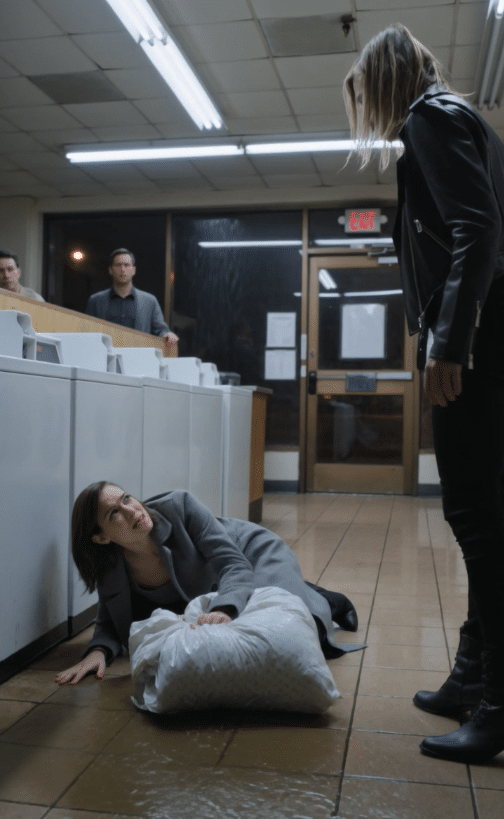
A man in a black leather jacket stood over a woman on the wet tile floor, watching as her little bag of freshly washed clothes slid through a puddle of spilled coffee. A tiny blue shirt landed face down in the brown liquid. A pair of white socks disappeared beneath the edge of a plastic chair.
The woman lunged for the bag.
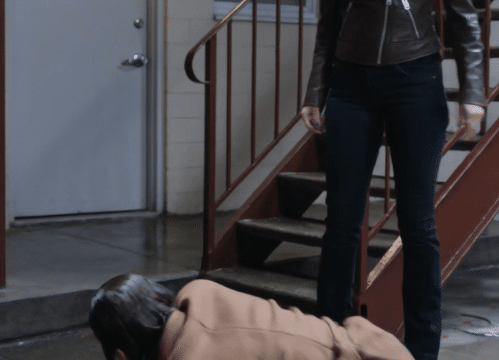
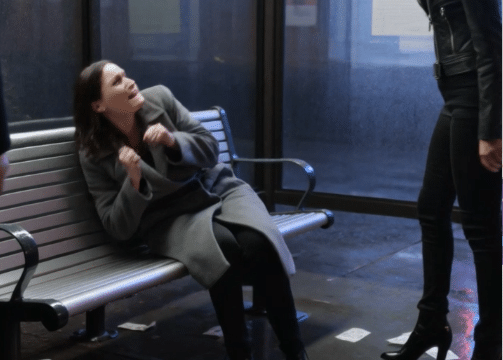
Before she could retrieve it, the man kicked her hard in the back.
She crashed against the side of a vibrating washing machine, her hands striking the cold metal as she fell. Her elbow hit the machine’s base, leaving a thin red mark against her skin. The impact sent the remaining clothes spilling across the floor.
For one terrible second, she could only lie there, gasping.
Her name was Rachel Bennett. She was thirty-seven years old, wore a faded gray sweater beneath a thin coat, and had spent the entire evening trying to keep one small promise to her eight-year-old son.
He would have clean clothes for school in the morning.
Rachel worked wherever she could find work. She cleaned offices before sunrise, took occasional shifts at a roadside diner, and accepted laundry jobs from people who paid her to wash, fold, and return their clothes. Her hours changed every week, and her earnings rarely stretched far enough to cover rent, groceries, and the bills that arrived regardless of whether she had worked.
That night, she had washed her son’s last clean outfit at an old self-service laundromat near their apartment.
She had brought the clothes home in a plastic bag, keeping it tucked close to her chest while rain tapped against the windows. She had been counting the minutes until she could get back to her son, who was waiting with his homework spread across the kitchen table.
Then a man had accused her of blocking his path.
He had demanded that she move faster, mocked the dirty floor, and complained that people like her made places like this unbearable.
Rachel had apologized and stepped aside.
It had not been enough.
Now she was on the floor, staring at the clothes that had taken her last few dollars to wash.
“Please,” she said, trying to push herself upright. “Those are my child’s clean clothes.”
The man, forty-year-old Brandon Hale, looked at the coffee spreading across the tile.
“Trash. Wash them again.”
Rachel’s face tightened.
“I don’t have time. He needs them tomorrow.”
Brandon gave a short, contemptuous laugh.
“Then you should’ve kept them out of the way.”
He stepped closer and kicked her twice more as she reached for the bag. Rachel curled around the clothes, trying to shield them with her arms. The machines continued humming, indifferent to the violence unfolding between them.
A woman waiting beside a dryer covered her mouth.
A young man near the vending machine took a step backward. Another customer stared at the floor, pretending to search through his pockets.
Nobody intervened.
Brandon looked down at Rachel with open disgust.
“Poor people always make a mess.”
Rachel pressed her forehead against the cold tile. Her breathing came in uneven bursts, and tears gathered at the corners of her eyes.
She was not crying because the clothes were expensive.
She was crying because she had worked so hard to make one ordinary morning possible for her son, and a stranger had destroyed it simply because he could.
Then a door opened at the back of the laundromat.
A middle-aged man in a white shirt and navy jacket stepped out, followed by the store manager. He took in the coffee puddle, the scattered clothes, and Rachel struggling to rise.
His expression went still.
He crossed the room and positioned himself between Brandon and the injured mother.
Then he looked toward the manager.
“Lock the front door.”
Brandon’s face changed.
He stared at the man, then at the manager moving toward the entrance.
“Lock me in?”
For the first time that night, Brandon seemed to understand that he had made a serious mistake.
He had no idea who owned the laundromat.
And he had absolutely no idea what the owner had just seen on the security cameras.
Act II
Rachel Bennett had learned to measure life in small victories.
A full refrigerator was a victory. A paid electricity bill was a victory. Getting her son, Noah, to school with breakfast in his stomach and his homework in his backpack was a victory.
She had once imagined a different life.
Before Noah was born, Rachel had studied bookkeeping at a community college and worked as an assistant in a small insurance office. She liked neat columns of numbers, organized files, and the satisfaction of solving a problem that had seemed impossible at first.
Then her marriage ended.
Her husband left when Noah was four, promising that he would continue helping with expenses. The payments came irregularly, then stopped. Rachel spent months trying to make the arrangement work before accepting that she could not build her son’s future around promises that never became dependable.
She took a cleaning job because it paid quickly.
When the hours were cut, she found another.
Eventually, she began doing laundry for a handful of elderly residents in her neighborhood. She collected their bags, washed and folded everything carefully, and returned the clothes for a small fee. It was not glamorous work, but it allowed her to arrange her schedule around Noah’s school day.
It also meant that she spent a great deal of time in laundromats.
The one on Mercer Street was old, but its machines usually worked. The fluorescent lights flickered occasionally, and the floor always seemed to hold a faint smell of detergent and damp concrete. A narrow back office sat behind the dryers, its door normally kept closed.
Rachel had never met the owner.
She knew the manager, Denise, who sometimes let her use a rolling cart when she had several laundry bags to carry. Denise had a practical kindness about her. She never asked Rachel why she came in so late or why she counted every coin before feeding the machines.
On difficult nights, that small absence of judgment mattered.
Rachel’s biggest worry was Noah.
He was a gentle child who loved drawing cars and building elaborate cities out of cardboard boxes. He had a habit of asking questions just when Rachel was trying hardest not to cry.
When she came home exhausted, he would sometimes place a glass of water beside her and announce that he was making dinner, even if dinner consisted of toast and scrambled eggs.
“I’m going to get a job when I’m older,” he told her one night.
Rachel smiled. “You can get a job when you’re older. Right now, your job is to be a kid.”
“What if I want to help you?”
She pulled him into a hug.
“You already do.”
That was why the clothes mattered so much.
Noah had outgrown most of his wardrobe. His school required a plain shirt and dark trousers, and Rachel had been saving to buy him another set. Until she could afford it, she washed his only suitable outfit carefully and made sure it was ready for Monday morning.
She had done the same thing for weeks.
That evening, she had even checked the weather before leaving the laundromat. The rain was getting heavier, so she tucked the folded clothes into a plastic bag and wrapped her thin coat around them.
She had almost reached the door when Brandon Hale walked in.
He was the kind of man who expected every room to rearrange itself around him. His leather jacket was expensive, his shoes were spotless, and his expression suggested that the world had personally disappointed him by failing to provide better surroundings.
He had come to wash a few shirts before a business trip.
When he saw Rachel’s laundry cart near the aisle, he complained that she was taking up too much space.
“It’s just for a second,” she said, moving it aside.
Brandon muttered something about the place being filthy.
Rachel ignored him.
Then he saw the clean clothes bag on the floor near her feet.
He kicked it.
Coffee spilled from a cup he had placed on a nearby machine, and the bag slid straight through the puddle.
Rachel bent to retrieve it.
That was when he attacked her.
The back office door opened seconds later, but the man who emerged was not merely a property owner checking on a disturbance.
His name was Edward Lawson.
At fifty-eight, he was a successful entrepreneur who had spent the better part of three decades building a chain of neighborhood laundromats and investing in small commercial properties. He dressed simply, rarely appeared in company advertisements, and preferred to know how his businesses actually operated rather than relying on polished reports from managers.
He had purchased the Mercer Street laundromat years earlier, when the previous owner was close to shutting it down. He kept the prices affordable, repaired machines instead of replacing them unnecessarily, and quietly helped customers who had fallen on hard times.
He did not believe kindness needed a camera.
But Edward also believed that a business revealed its character in the way it treated people who had no power over it.
That night, he had been reviewing the monthly accounts in the back office when he heard a crash.
Then came a gasp.
Then another impact.
He had looked at the security monitor and seen Brandon standing over Rachel.
Edward had watched long enough to understand that this was not an argument.
It was an assault.
And before he opened the door, he had already instructed Denise to contact the police.
What Brandon did not realize was that the owner had seen every kick.
Nor did he know that the back office contained more than a security monitor.
It contained the records that could explain why Brandon had been so determined to bully a woman who had done nothing to him.
Act III
“Don’t go near her again,” Edward said.
Brandon turned, his anger sharpening.
“Who are you?”
“The owner.”
Brandon glanced at the manager, then at the machines, as though he expected the room itself to confirm that this man had no right to challenge him.
“Your customer attacked me,” he said.
Denise stared at him.
“She did no such thing.”
“Then she fell. Whatever happened, it’s none of your business.”
Edward crouched beside Rachel, careful not to move her abruptly.
“Can you hear me? Don’t try to get up too quickly.”
Rachel looked at him through tears.
“My son’s clothes,” she whispered.
Edward followed her gaze to the bag.
“I see them.”
“They’re his last clean ones.”
“I understand.”
“No,” Rachel said, her voice breaking. “You don’t. He has school in the morning.”
Edward’s face softened.
He did not tell her that clothes could be replaced or that everything would be fine. He could see that she was frightened, in pain, and thinking about a child who was not even in the room.
Instead, he took off his navy jacket and placed it within reach so she could cover her shoulders.
Then he turned to Denise.
“Get clean towels. Call for medical assistance if they haven’t already confirmed it. And keep everyone away from this area.”
Denise hurried to comply.
Brandon let out a disbelieving laugh.
“You’re acting like she was murdered. It was a little accident.”
Edward stood.
“You kicked her.”
“You weren’t here.”
“I watched you do it.”
The words struck Brandon harder than a shout might have.
Edward gestured toward the back office.
“The cameras recorded the entire incident. Every time you kicked her. Every word you said.”
Brandon’s eyes flickered toward the office door.
“You can’t just record people without telling them.”
“Security cameras are posted throughout the business. The footage will be preserved and provided to the police.”
Brandon tried to recover his swagger.
“You think some video makes you important?”
“No,” Edward replied. “It makes your story less convincing.”
For the first time, Brandon had nothing immediate to say.
Edward returned his attention to Rachel. Denise brought clean towels and helped cover the coffee-soaked clothes without forcing Rachel to move. The other customers remained silent, watching the man who had dominated the room suddenly find himself without an audience willing to laugh along.
When the police arrived, Edward handed them the relevant information and offered to preserve the security footage. The officers separated the people involved and began taking statements.
Brandon continued insisting that he had been provoked.
But no one could explain how a woman bending down to retrieve her child’s clothes had provoked three deliberate kicks.
As one officer spoke to Denise, Edward asked the manager to bring him the customer incident log.
Brandon frowned.
“What does that have to do with anything?”
Edward did not answer immediately.
The incident log contained more than the occasional complaint about broken machines or lost socks. During the past several months, Denise had recorded a series of troubling encounters involving Brandon.
He had shouted at another customer for using a machine he wanted. He had threatened to report a young employee who refused to give him a refund outside company policy. He had left a long complaint demanding that the laundromat stop allowing what he called “undesirable people” to use the premises.
At the time, Edward had treated the remarks as the entitled behavior of one difficult customer.
Now he looked at the pattern differently.
“Have you been here before?” Edward asked.
Brandon lifted his chin.
“I come where I want.”
“That’s not what I asked.”
Brandon’s jaw tightened.
Edward opened the log to a page marked with the date of an earlier incident. Beside the entry was a description of a man in a leather jacket who had threatened a cleaner after she asked him not to leave dirty cups on the folding tables.
Brandon scoffed.
“That’s ridiculous.”
“Then the footage should settle it.”
Edward turned to the police officer.
“I’d like to make sure the earlier records are preserved, too.”
Brandon’s expression changed.
He had expected the owner to throw him out, perhaps demand payment for the ruined clothes, and let the matter end there. He had not expected someone to connect his behavior to a documented history of complaints.
Still, he believed he had one advantage left.
He was a client of a property investment firm that did business with several commercial landlords. He knew people who could make calls, lean on suppliers, and cause headaches for small business owners.
He looked at Edward with a thin smile.
“You should be careful. You don’t know who you’re upsetting.”
Edward closed the log.
“I know exactly what I saw.”
Then he leaned closer, lowering his voice just enough that Brandon had to stop talking to hear him.
“And I know something you don’t.”
Brandon stared at him.
Edward glanced toward the back office, where a second folder sat on the desk beside the security monitor.
It contained documents from a business negotiation that Brandon had assumed was already settled.
Documents bearing the name of his own company.
And suddenly, the order to lock the front door seemed far less mysterious.
Act IV
Brandon tried to leave.
One of the officers asked him to remain while they completed the initial investigation. When he protested, the officer explained that he was not free to interfere with the collection of statements or the preservation of evidence.
Brandon looked at Edward as though the owner had personally arranged the humiliation.
“You think you’ve won something?”
Edward remained calm.
“This isn’t a competition.”
“Then open the door.”
“The police are handling the situation. You can discuss your departure with them.”
Brandon’s face reddened.
He turned toward the other customers, hoping someone would laugh at the absurdity of being kept inside a laundromat because of a dispute over a bag of clothes.
No one laughed.
A middle-aged woman stood beside a dryer, holding her phone in both hands. A college student watched from the folding counter. Denise remained near Rachel, making sure she was warm and comfortable while the officers took her statement.
The room had changed.
A few minutes earlier, Brandon had been the person everyone feared might turn on them next. Now the people who had witnessed his cruelty were speaking to the police, one after another.
Edward went into the back office and returned with the folder he had mentioned.
Brandon recognized the logo on its cover.
It belonged to a commercial property company called Hale Urban Partners, a firm managed by his older brother, Michael Hale. Brandon occasionally helped the company negotiate vendor contracts and had spent years boasting that his family had influence over commercial properties across the city.
“What are you doing with that?” Brandon demanded.
Edward placed the folder on the counter.
“Your company has been negotiating to lease two properties I own. One is a small retail building downtown. The other is a warehouse near the interstate.”
Brandon’s expression hardened.
“That has nothing to do with this.”
“Normally, I’d agree.”
Edward opened the folder.
“But your company submitted a proposal containing several representations about its management standards, vendor relationships, and compliance practices. Those representations are now being reviewed.”
Brandon gave a dismissive laugh.
“You can’t cancel a business deal because you don’t like me.”
“I haven’t said I’m canceling anything.”
Edward spoke without anger, which made the words more unsettling.
“I said the proposal is being reviewed. After what I witnessed tonight, I intend to examine every representation made in the application and every relevant record before deciding whether to proceed.”
Brandon stared at him.
Edward had no intention of using a property contract as a weapon to punish someone for a personal insult. But he was responsible for the businesses and properties he owned, and he was not going to ignore new information about a prospective partner’s conduct simply because the contract was valuable.
He had already instructed his attorney to review the relevant documents before the incident. The negotiations had raised questions about how certain contractors were treated and whether the company had accurately disclosed several disputes.
Brandon had assumed those questions would be settled quietly.
Now Edward intended to make sure they were answered properly.
“You’re threatening my business over a woman who can’t even afford to buy new clothes?” Brandon asked.
Edward’s expression grew cold.
“No. I’m telling you that your choices have consequences. The police will investigate what happened here. My attorney will review the business records. Those are separate matters, and neither will be decided by your threats.”
Brandon looked toward the front door.
“Lock me in?” he repeated, his voice rising. “You can’t do that.”
“The door was secured while the officers responded,” Edward said. “No one is keeping you here unlawfully. When the officers are finished, you can leave as they direct.”
Brandon’s confidence had begun to unravel.
He had built his identity around the belief that he could make other people uncomfortable and then walk away before they had time to respond. He had never expected the laundromat owner to preserve the footage, collect the records, and refuse to be intimidated.
But Edward was not interested in humiliating him in return.
He was interested in making sure the truth could not be brushed aside.
The officers finished their initial interviews and explained the next steps in the investigation. They documented Rachel’s account and the witnesses’ statements, and they obtained information about the available security footage. The exact legal consequences would depend on the evidence and the authorities’ review.
Before Brandon was allowed to leave, Edward addressed him one final time.
“You owe this woman an apology.”
Brandon laughed sharply.
“I’m not apologizing to her.”
“Then don’t.”
Edward stepped aside.
“But don’t expect me to pretend I didn’t see what you did.”
Brandon walked toward the entrance, his shoulders rigid. The manager unlocked the door when the officers indicated that it was appropriate, and the cold night air swept across the tile floor.
He paused on the threshold, perhaps waiting for Edward to call him back or soften his position.
Nothing happened.
He left without another word.
The door closed behind him.
Only then did Rachel begin to cry in earnest.
She had held herself together through the pain, the police questions, and the humiliation of explaining why a bag of children’s clothes mattered so much. Now that the man who had hurt her was gone, the fear she had been suppressing finally caught up with her.
Edward pulled a chair beside her.
“You’re safe here,” he said.
Rachel wiped her face with a towel.
“I don’t know what I’m supposed to do now.”
“First, we’re going to make sure you’re all right. Then we’ll figure out the clothes.”
She looked at the coffee-stained bag.
“I can’t afford to wash them again.”
Edward nodded.
“Then we won’t ask you to pay.”
It was such a simple answer that Rachel stared at him, unable to respond.
But Edward knew that clean clothes were only the immediate problem.
He had seen the way she had tried to protect the bag even after being kicked. He had heard her speak about her son. And he had recognized the expression of someone who had been carrying too much responsibility for far too long.
He wanted to help her without turning her hardship into a spectacle.
So he made a decision that would change more than one evening.
Act V
The next morning, Rachel woke to the sound of Noah moving around their small kitchen.
She had returned home late after being checked by medical professionals. She was sore, exhausted, and still shaken by what had happened, but she had managed to get a few hours of sleep.
Noah was standing beside the table in his pajamas, staring at the clean clothes she had brought home in a new bag.
“Mom,” he said, “where did these come from?”
Rachel sat down carefully.
“The people at the laundromat helped me.”
“Did you have to pay?”
She smiled faintly.
“No, sweetheart.”
Noah studied her face.
“Why are you walking funny?”
Rachel had rehearsed several answers on the way home. She had wanted to tell him that she had slipped, that she had bumped into a machine, or that she had simply worked too hard.
But she remembered what Edward had said about preserving the truth.
So she told Noah that a man had hurt her, that other people had stepped in, and that she was getting help. She did not burden him with every detail, but she did not make him believe that cruelty was something he had to accept without question.
Noah listened in silence.
Then he wrapped his arms around her.
“I wish I was bigger,” he whispered.
Rachel held him tightly.
“You don’t have to be bigger to be brave.”
She kissed the top of his head.
“Sometimes being brave means telling the truth. Sometimes it means asking for help. And sometimes it means knowing that something wrong is not your fault.”
Later that day, Denise called to check on her.
Edward had arranged for the laundromat to rewash the clothes that could be salvaged and replace the damaged items. He had also offered to cover the cost of Rachel’s immediate medical expenses related to the incident, subject to the appropriate documentation.
Rachel hesitated when Denise explained.
“I can’t accept all that.”
“You don’t have to decide anything right now,” Denise replied. “Mr. Lawson said the offer stands. He doesn’t want you worrying about a bill while you’re recovering.”
Rachel sat quietly for a moment.
She had spent years learning to refuse help before anyone could use it to make her feel small. She had seen people offer assistance only to bring it up later, as though kindness were a debt that could be collected whenever they wanted.
But Denise did not pressure her.
She simply told Rachel that the offer was there if she needed it.
For the first time, Rachel allowed herself to consider accepting help without imagining the humiliation that might follow.
A few days later, Edward visited her apartment.
He arrived without a photographer, a company representative, or anyone carrying a giant check. He brought a paper bag containing fresh bread and fruit from a neighborhood market, along with a small folder of information about a local family-support program.
Rachel invited him inside.
Noah peeked around the kitchen doorway, curious about the man his mother had described as the owner who came out of the back office.
Edward shook his hand seriously.
“So you’re Noah.”
“Yes, sir.”
“I hear you needed a clean outfit for school.”
Noah nodded.
Edward glanced toward Rachel.
“Your mother did a good job making sure you had one.”
Noah looked at her with pride.
“She always does.”
Rachel had to turn away for a moment.
Edward did not offer to solve every problem in their lives. He did not promise that they would never struggle again. Instead, he explained that the laundromat was starting a quiet assistance program for customers facing temporary hardship.
The program would help with essential laundry costs, work clothes, and children’s school clothing. Customers would not need to stand in line for a public handout or explain their circumstances to strangers. The manager would handle requests discreetly, and the support would be available to anyone who qualified.
“I don’t want anyone to feel that they have to earn basic dignity,” Edward said. “And I don’t want someone who needs help to be afraid of coming through our door.”
Rachel listened, surprised by how deeply those words affected her.
She had thought the night at the laundromat would become another painful memory she would have to carry alone. Instead, it had led to something that might prevent another person from experiencing the same humiliation.
When she thanked Edward, he shook his head.
“You don’t owe me gratitude for doing what should have been done.”
She smiled.
“Maybe not. But I’m still grateful.”
The investigation into Brandon continued. The security footage and witness statements gave the authorities a clearer account of the assault, and the incident remained documented rather than disappearing into a private dispute. Edward’s attorney also completed a review of the commercial negotiations involving Brandon’s family business. Any decision about those agreements would be made on the relevant facts and contractual terms, not simply on anger over one man’s behavior.
Brandon, meanwhile, discovered that his actions had followed him further than he expected.
The witnesses did not retract their statements. The laundromat’s records were preserved. And the people who had once watched him bully others without speaking began to recognize that silence had allowed him to believe he could do whatever he wanted.
He had thought locking the door was an act of intimidation.
Instead, it had been the moment he realized he was no longer the only person with something to lose.
A month later, Rachel returned to the laundromat.
She wore her gray sweater beneath a warmer coat, and Noah’s clothes were folded neatly in a reusable bag. Denise greeted her at the entrance and showed her the new assistance-program information posted near the counter.
The sign was simple. No photographs. No grand announcement. Just a clear explanation of how customers could request help with essential laundry expenses.
Rachel stood in front of it for a long time.
Then she noticed a young mother near the dryers, trying to shake water from a child’s jacket. The woman looked exhausted, and her little boy stood beside her in shoes that were much too large.
Rachel recognized the expression on the mother’s face.
It was the same look she had worn on the floor that rainy night: the desperate calculation of someone trying to decide which problem could wait and which one could not.
Rachel walked over.
“Would you like me to show you something?” she asked gently.
The woman looked up, wary.
Rachel pointed toward the information by the counter.
“They helped me when I needed it. You don’t have to explain anything to me, but I thought you should know.”
The woman’s eyes moved toward the sign.
“Really?”
“Really.”
Rachel did not offer money she could not spare or make promises she could not keep. She simply showed the woman where to ask for help and stayed beside her long enough to make sure she understood the process.
Sometimes that was enough to help someone take the first step.
As Rachel gathered her own clothes, she looked toward the back office door.
She remembered the machines humming, the coffee spreading across the tile, and Brandon’s voice as he stood above her.
Poor people always make a mess.
At the time, the words had made her feel ashamed of everything she could not afford.
Now she understood something she wished she had known long before that night.
Poverty was not a character flaw. Needing help was not a moral failure. And a person’s dignity did not disappear because they were tired, frightened, or carrying their child’s last clean outfit in a plastic bag.
Brandon had looked at Rachel and seen someone he believed could not fight back.
Edward had looked at her and seen a mother who deserved protection.
The difference between those two men had nothing to do with the price of their clothes or the size of their bank accounts. It had everything to do with what they believed another human being was worth.
As Rachel left the laundromat, Noah’s clean shirt rested safely in her bag.
The rain had stopped.
Behind her, the washing machines continued their steady hum, turning through another cycle, rinsing away the dirt and coffee that had stained the floor.
And for the first time since that terrible night, Rachel did not feel as though she were simply trying to survive until morning.
She felt that she and her son might actually be able to build something better.
Brandon had kicked a bag of clothes into a puddle because he thought poverty made its owner disposable.
Instead, he exposed the cruelty he had mistaken for strength—and gave one quiet business owner a reason to turn a single act of protection into a promise that no struggling parent should have to face that kind of humiliation alone.