Act I
The rice was washing into the gutter when the old man realized he had lost everything he needed for dinner.
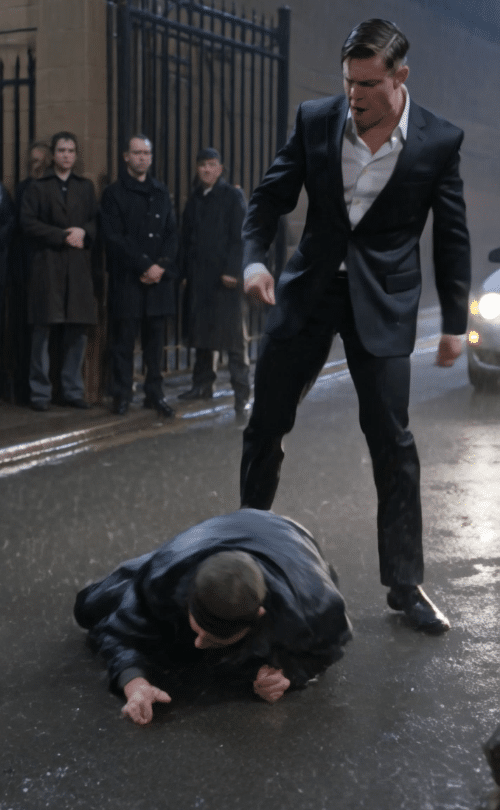
He lay on the rain-soaked road beside his overturned scrap cart, one hand pressed against his back, the other reaching desperately toward a small torn bag. White grains spilled into the rushing water, disappearing beneath the wheels of a parked truck.
A few feet away, a man in an expensive black suit stood beneath the headlights of a luxury sedan, looking down at him with open disgust.
“You blocked my car,” the man snapped.
The old man tried to lift his head. His knit cap had slipped sideways, and rain ran down his deeply lined face. His thin coat clung to his shoulders as he struggled to breathe through the pain.
He was seventy-three years old. His name was Walter Hayes, and he had spent most of his life working wherever someone was willing to pay him honestly.
These days, he collected discarded cans, broken metal, and recyclable scraps from warehouses around the industrial district. He pushed everything in a creaking cart, then sold what he gathered to a recycling yard at the end of the week.
It was exhausting work. His hands were stiff, his knees hurt when the weather changed, and every winter seemed to leave him a little slower than the one before.
But he had learned to survive without asking anyone for anything.
That small bag of rice was supposed to be his dinner.
Now it was dissolving into the gutter.
Walter pushed himself onto one elbow, grimacing as pain tightened across his face. His sleeve scraped the wet road, leaving a faint trace of blood where his elbow had struck the pavement.
“Please,” he whispered. “That rice is for tonight…”
The driver gave a short, contemptuous laugh.
“Trash. Your cart blocked my car.”
Moments earlier, he had leaned on his horn behind Walter, furious that the old man’s cart could not move quickly enough through the narrow industrial road. Walter had tried to pull aside, but the cart was heavy, its wheels caught in a rut, and the rain made the pavement treacherous.
The delay had lasted only seconds.
For the driver, those seconds were an insult.
He had jumped out of his car, stormed toward Walter, and kicked him hard in the back. Walter’s chest slammed against the edge of the cart before the entire load tipped sideways. Cans scattered across the road, metal clanging against the concrete as the rice bag tore open.
Then, while Walter struggled on the ground, the man kicked him again.
And again.
Nearby workers stared in disbelief. One covered his mouth. Another stepped backward beneath the awning of a warehouse. Nobody approached the injured man.
The driver looked at the scattered cans and rice as though Walter had deliberately created a mess to inconvenience him.
“Pick your garbage faster.”
Walter curled onto his side, his face contorted with pain. He tried to shield the remaining rice from the rain, but there was nothing left to save.
He had spent the day pushing his cart through the industrial district, collecting enough scraps to earn a few dollars. He had been looking forward to going home, boiling the rice, and eating it with the last of the vegetables in his refrigerator.
Now he could not even stand.
The driver straightened his jacket and turned toward his car.
That was when a black SUV appeared at the far end of the road.
It braked hard near the industrial gate, its headlights cutting through the rain. The rear door opened, and a sixty-year-old man in a long navy coat stepped out. Several security officers followed him.
The newcomer looked first at Walter.
Then at the rice washing into the gutter.
His expression hardened.
He signaled to his security team, crossed the road, and positioned himself between the injured old man and the driver.
Without raising his voice, he gave a command.
“Close this road behind him.”
The security officers moved immediately, blocking the luxury sedan’s exit.
The driver turned, irritation flashing across his face.
Then he looked at the black SUV, the security team, and the man in the navy coat.
“Behind me?”
For the first time that evening, the rain was no longer the thing making him uncomfortable.
He had just attacked an old man over a few seconds of traffic.
And he had done it on a road owned by someone who would not simply drive away.
Act II
Walter Hayes had once worked twelve-hour shifts in a steel mill, where the noise was so constant that he sometimes heard machinery humming in his sleep.
He had started at nineteen, shortly after his father died. His mother needed help paying the mortgage, and his younger sister still had years of school ahead of her. Walter had taken the first steady job he could find and kept it for more than three decades.
He was never a wealthy man, but he was reliable. He arrived early, stayed late when the line needed help, and rarely complained even when supervisors demanded more than they should.
He believed that if he worked hard enough, life would eventually offer him a little peace.
For a while, it did.
He married his high-school sweetheart, Eleanor, and they bought a modest house on the edge of town. They planted tomatoes in the backyard, repaired their own appliances, and spent Sunday evenings watching old movies on a television that occasionally needed a firm tap on the side.
They had no children, but their house was rarely empty. Neighbors came by for coffee. Walter helped people repair fences and replace tires. Eleanor made soup whenever someone in the neighborhood fell ill.
They did not have much.
They had enough.
Then Eleanor became sick.
The illness took years to understand and months to become impossible to ignore. Walter used his savings to cover appointments, medication, and the bills that accumulated faster than he could pay them. He sold his truck, then some of his tools, then the little fishing boat he had owned since he was twenty-five.
When Eleanor died, he kept the house for another year.
He could not bear to leave it immediately. Every room carried a memory: her favorite chair by the window, the chipped bowl she used to hold tomatoes, the pencil marks on the kitchen door where they had measured the height of their nieces and nephews.
But the bills continued. The roof needed repairs, and his pension could not cover everything. Eventually, he sold the house and moved into a small rented room closer to the industrial district.
He told everyone he was fine.
The truth was that he had become afraid of spending money.
A few dollars for food seemed manageable. A surprise bill could ruin an entire month. When his old refrigerator stopped working, he bought a used one from a neighbor. When his coat tore at the pocket, he sewed it himself.
He collected scrap because it gave him control over the small things.
A bag of cans could become groceries. A discarded length of copper could pay the electric bill. A few extra hours on the road could mean enough money to buy something warm for dinner.
He was not ashamed of his work.
He was ashamed of how quickly the world sometimes decided that a man doing it must be worthless.
The industrial district had changed over the years. Old factories had closed, new warehouses had appeared, and the roads had become busier with delivery trucks and expensive cars driven by people who rarely looked beyond their windshields.
Walter had learned which yards paid fairly and which supervisors allowed him to collect cans from designated areas. He kept a small notebook in his coat pocket, recording what he earned and what he needed to buy.
That afternoon, the rice had been his only planned purchase.
He had counted the coins twice before handing them to the shopkeeper. He had even put a few cents back when he realized the price had risen.
He could have bought something cheaper.
But he had eaten bread for lunch, and he wanted a proper meal.
He wanted one ordinary evening in which he did not have to calculate every bite.
The driver who attacked him knew nothing about any of this.
His name was Grant Mercer, a thirty-eight-year-old investor who had built a reputation for closing deals quickly and expecting everyone else to keep up. He wore tailored suits, drove a luxury sedan, and spoke about efficiency as though it were a measure of a person’s moral worth.
Grant had arrived in the industrial district to meet a potential business partner. He was already late, though not by enough to jeopardize the meeting. The traffic had been moving slowly because of the rain, and the narrow access road had forced several vehicles to wait behind Walter’s cart.
Grant saw the delay as a personal affront.
He did not ask whether Walter could move. He did not consider that the cart was heavy or that the road was slick. He saw an old man in worn clothing occupying space that Grant believed should belong to him.
When Walter could not move quickly enough, Grant decided to make the old man pay for it.
He had expected a frightened apology, perhaps a few muttered words and a hurried retreat. He had certainly not expected anyone important to witness what he did.
But the man stepping out of the black SUV was not just another wealthy driver.
His name was Charles Whitmore.
And unlike Grant, Charles had spent years building something that did not depend on making other people feel small.
Act III
Charles Whitmore owned the industrial park.
At sixty, he had built his business from a single warehouse inherited from his father into a network of industrial properties employing hundreds of people. He knew the names of the maintenance crews, the loading supervisors, and the small contractors who kept the facilities running.
He had not become successful by being universally loved. Business required difficult decisions, and he had made his share of them. But he believed that ownership carried responsibilities beyond collecting rent and signing contracts.
A road through his property was not merely a strip of asphalt between buildings.
It was where workers walked home after late shifts. It was where delivery drivers waited in bad weather. It was where people like Walter collected discarded materials that companies no longer needed.
Charles had established clear rules for the industrial park: safe access, designated collection areas, and respectful treatment of everyone who worked there. He expected tenants and visitors to follow those rules regardless of their wealth or position.
That evening, he had been returning from a meeting when his driver slowed near the industrial gate.
The security team had noticed a commotion farther down the road. Charles saw the overturned cart first, then the cans rolling through the rainwater. A moment later, he saw Walter on the pavement.
He did not know the old man’s name yet.
He did not need to know it to understand that something terrible had happened.
Charles hurried toward him, motioning for his security officers to keep Grant away. He crouched beside Walter, careful not to move him unnecessarily.
“Can you hear me?” he asked.
Walter nodded faintly.
“Don’t try to stand. Medical help is coming.”
Walter’s eyes moved toward the gutter.
“My rice,” he whispered.
Charles followed his gaze.
The bag had split completely. Most of the rice had washed away, leaving a pale trail in the dirty water.
For a moment, Charles said nothing.
He had seen accidents on industrial roads. He had dealt with machinery failures, workplace injuries, and the awful phone calls that came when someone did not make it home after a shift.
But there was something especially cruel about the way Walter kept looking at that ruined bag.
The old man was injured, frightened, and lying in the rain, yet he was still worrying about the one small purchase he had made for himself that day.
Charles took off his navy coat and laid it over Walter’s shoulders, keeping him sheltered as much as possible.
Then he looked at his security chief.
“Get medical assistance here now. And make sure nobody touches that cart until we’ve documented what happened.”
The security chief nodded and moved away to make the necessary calls.
Only then did Charles stand.
Grant had been watching with growing irritation. He seemed offended that the newcomer had ignored him in favor of the man lying in the road.
“You can’t block my car,” Grant said. “I have somewhere to be.”
Charles turned toward him.
“You assaulted a man who was trying to move his cart.”
Grant scoffed.
“He was blocking the road.”
“For a few seconds.”
“I was late.”
Charles glanced at the overturned cart.
“So you kicked him?”
Grant spread his hands as though the question itself were absurd.
“He needs to learn to keep out of people’s way.”
A worker beneath a warehouse awning lowered his eyes. Another stared at Grant with open disbelief. None had spoken before, but the certainty in Grant’s voice was beginning to work against him.
Charles did not shout.
“What is your name?”
“Grant Mercer.”
Charles studied him for a moment.
“Mercer. Are you connected to Mercer Industrial Logistics?”
Grant’s expression changed slightly.
The company was not his own, but he had been negotiating to acquire a major stake in it. The deal would depend on access agreements, warehouse leases, and a long-term operating contract with several property owners.
Charles Whitmore was one of the most important people involved.
Grant had spent weeks trying to secure a meeting with him.
He had been told that Charles valued discretion and expected potential partners to demonstrate sound judgment. Grant had assumed this meant polished presentations, financial projections, and an impressive list of references.
He had not considered that the man he needed to impress might see him behaving in the one way that made him impossible to trust.
Grant straightened his jacket.
“I have a meeting with people in this district,” he said. “This is a misunderstanding.”
Charles looked at the security officers standing beside the luxury sedan.
“Close this road behind him.”
The order had not been a threat. It was a practical instruction: secure the area, keep traffic away from the injured man, and prevent the driver from leaving before the incident had been properly addressed.
But Grant heard something else.
He heard that the road was not his to command. He heard that the security team answered to Charles. And he began to understand that the stranger he had dismissed as an inconvenience had authority over the place where he was standing.
Grant’s anger turned defensive.
“You’re making a mistake,” he said. “You don’t know who you’re dealing with.”
Charles looked toward Walter, who was still lying beneath the coat.
“I know exactly what I saw.”
Grant glanced at the industrial gate. A security officer had closed the access barrier behind the luxury sedan. Another was speaking with a dispatcher, giving the location and requesting that the road remain clear for emergency responders.
The workers who had watched the attack were no longer looking away.
Charles turned back to Grant.
“You’re going to wait here. The authorities can take your statement, and the witnesses can give theirs.”
Grant stared at him.
For the first time, his expensive suit looked less like armor and more like a costume that could not protect him.
Yet he still believed he could talk his way out of it.
He had no idea how much of his future depended on what happened next.
Act IV
The emergency vehicle arrived within minutes, its lights flashing against the warehouse walls.
Paramedics knelt beside Walter and assessed his condition. He was in pain and badly shaken, but he remained conscious. They stabilized him before moving him onto a stretcher, explaining each step as they worked.
Charles stayed close enough for Walter to hear him.
“Your cart will be looked after,” he promised. “You don’t need to worry about it right now.”
Walter swallowed.
“I don’t have money for all this.”
“We’ll discuss that later. Right now, let the paramedics take care of you.”
Walter looked toward the gutter again.
Charles followed his gaze, then quietly asked a security officer to arrange for the scattered belongings to be collected once the scene had been documented.
The rice could not be saved. Neither could the time Walter had spent gathering scrap that day. But the old man did not need to watch the remains of his dinner disappear while everyone discussed what had happened to him.
As the paramedics prepared to leave, Walter reached for Charles’s sleeve.
“Why are you helping me?”
Charles paused.
Because the question carried more weight than Walter realized.
For years, Charles had watched people with money and influence treat access as a privilege they were entitled to defend at any cost. He had seen wealthy visitors demand that workers move faster, speak less, and tolerate behavior they would never accept from a business partner.
He had also seen the consequences when nobody challenged them.
“Because you needed help,” Charles answered. “That’s enough.”
Walter’s eyes glistened.
He had spent so long trying not to become a burden that the simple answer seemed almost impossible to accept.
The paramedics took him away.
Charles remained by the road as a police officer arrived and began speaking with the witnesses. The security team provided the relevant information and identified cameras that might have recorded the incident. No one was asked to embellish what they had seen. Their accounts would be collected and assessed through the proper process.
Grant stood beside his car, his jaw clenched.
“This is ridiculous,” he muttered. “The old man was obstructing traffic.”
The officer looked at him.
“Did you strike him?”
Grant hesitated.
“He wouldn’t move.”
“That wasn’t my question.”
Grant’s face reddened.
Charles watched without intervening. He had given the officer the facts he knew, and he had no intention of turning the encounter into a private negotiation.
Grant was used to settling uncomfortable situations with money. He was accustomed to calling an assistant, arranging a conversation, or finding someone who could make a problem disappear before it reached the wrong ears.
He tried the same approach now.
“I can compensate him for the damage,” he said. “Give him some money. Replace the cart. Whatever he wants.”
Charles’s expression remained cold.
“You don’t get to decide that money makes this disappear.”
Grant looked at him sharply.
“Everyone has a price.”
“Then you have learned very little about people.”
A gust of wind drove rain beneath the warehouse awning. Several workers moved farther back, watching as the exchange continued.
Grant lowered his voice.
“You have no idea how much business you could lose by making an enemy of me.”
Charles almost smiled, though there was no warmth in it.
“You’re standing on property I own, threatening me because I won’t ignore an assault. Do you truly believe that helps your position?”
Grant’s eyes flicked toward the gate.
Charles’s security chief approached with a tablet. The industrial park’s access records showed when Grant’s car had entered the property. Nearby cameras could potentially provide additional evidence, including the moment the vehicle stopped behind Walter’s cart.
The security chief had also identified the business meeting Grant had mentioned. It was connected to the proposed logistics agreement Charles’s company was reviewing.
Charles glanced at the information, then returned the tablet.
“Notify our legal department that the proposed agreement is on hold pending a review of this incident and any relevant business concerns. Keep the decision documented. No one is to destroy or alter records.”
Grant stared at him.
“You can’t cancel a deal over something like this.”
“I can decide whether I want to enter a business relationship with someone whose conduct raises serious questions about judgment and safety.”
“This has nothing to do with business!”
“You made it my business when you assaulted someone on my property.”
The officer continued taking statements. One of the workers confirmed that Grant had struck Walter more than once. Another described the overturned cart and the rice spilling into the gutter. A third pointed out where the cans had rolled, helping establish the sequence of events.
Grant looked from one witness to another.
He had assumed their silence meant they were afraid of him.
He was beginning to understand that they had simply been waiting for someone to make it safe to speak.
Charles turned toward the industrial gate.
“Keep the road closed until the officers finish. Then reopen it when it’s safe.”
The security chief acknowledged the order.
Grant watched the team move with practiced efficiency. His car remained where it was, the engine idling beneath the rain. He could not leave just because he had decided the conversation was over.
His anger gave way to something less comfortable.
Uncertainty.
He had come to the industrial district expecting a quick meeting and a profitable deal. Instead, he was facing questions from police, witnesses who were willing to speak, and a property owner who had no interest in protecting him from the consequences of his own behavior.
Then Charles said something that made Grant’s stomach tighten.
“We’ll also be reviewing whether you have treated other workers or contractors this way while conducting business here.”
Grant’s face went still.
He had not expected anyone to look beyond this one incident.
But Charles knew that one public act of cruelty could reveal a pattern worth examining. If Grant had intimidated contractors, endangered workers, or pressured people to tolerate unsafe behavior, those concerns deserved to be investigated rather than dismissed as personality conflicts.
Charles made no accusation he could not support.
He simply refused to stop asking questions.
And for Grant Mercer, that was worse than a shouted threat.
It meant that the truth might finally have room to speak.
Act V
Walter woke the following morning in a hospital room with a dull ache in his back and a paper cup of water beside his bed.
For several seconds, he did not remember how he had arrived there. Then he saw the wet knit cap folded on a chair and remembered the overturned cart, the rain, and the rice disappearing into the gutter.
He turned his face toward the window.
A nurse entered and checked on him, explaining that the medical team was monitoring his injuries and that he would need time to recover. Walter listened carefully, then asked the question he had been holding inside since the previous evening.
“How much is this going to cost me?”
The nurse told him that the hospital’s financial assistance team would speak with him about his options.
Walter nodded, but his worry remained.
He had spent decades making sure he could pay his own way. The idea of a bill he could not cover frightened him almost as much as the assault.
Later that morning, Charles Whitmore arrived.
He was no longer wearing the navy coat that had sheltered Walter on the road. Instead, he carried a small paper bag and a folder containing the contact information for the industrial park’s support team.
Walter tried to sit up.
“You don’t have to keep coming here.”
“I know,” Charles said, pulling a chair beside the bed. “I came because I wanted to.”
He placed the paper bag on the bedside table. Inside was a simple meal, including rice, vegetables, and a small container of soup.
Walter stared at it.
For a moment, he could not speak.
Charles did not mention the lost bag from the night before. He did not turn the meal into a grand gesture or ask Walter to express gratitude.
He simply sat down.
After a while, Walter picked up the fork.
The first few bites were slow. Then, as the warmth settled into him, his shoulders began to relax.
It was only food.
But it was the first meal since the attack that he could eat without calculating what it would cost him.
Over the next several days, Charles arranged for the industrial park’s maintenance team to repair Walter’s cart. The damaged frame was straightened, the wheels were replaced, and the load was secured so that it would be safer to push in bad weather.
The team also reviewed the designated collection areas and access procedures to ensure that people gathering recyclable materials could work without being placed in unnecessary danger.
Walter was offered temporary assistance while he recovered, with no requirement that he accept a job or repay the cost of his immediate needs. Charles made it clear that the help was voluntary and that Walter could decide what worked best for him.
At first, Walter resisted.
“I’ve worked my whole life,” he said. “I don’t want people thinking I’m asking for handouts.”
Charles listened.
“Then don’t think of it that way. Think of it as help while you recover from something that should never have happened.”
Walter looked down at his hands.
They were rough and weathered, the nails worn from years of work. He had spent his entire life measuring his worth by what he could do for others and what he could pay for himself.
It took him time to understand that accepting help did not erase any of that.
Meanwhile, the investigation into Grant’s actions continued. Witness statements were collected, available security footage was reviewed, and the incident was handled through the appropriate legal channels. Charles’s company conducted its own review of the proposed business agreement, keeping that process separate from the authorities’ work.
The potential deal was ultimately suspended while the company assessed the risks and determined whether a future relationship was appropriate.
Grant had believed his money and status would insulate him from consequences. Instead, his conduct had damaged the trust he needed to secure the agreement.
He could not simply demand that the matter be forgotten.
Nor could he force the witnesses to change what they had seen.
For Walter, the consequences were less dramatic but far more meaningful.
When he was ready to return to the industrial district, the rain had stopped. The road was still narrow, and trucks still rumbled between the warehouses, but the security team had marked a safer route for carts and pedestrians.
Walter pushed his repaired cart slowly along the pavement.
He was still seventy-three. His back still hurt, and he was still living on a modest income. Nothing about his life had suddenly become effortless.
But he was no longer pushing a broken cart with the feeling that the entire world had decided he did not matter.
At the entrance to the recycling yard, a worker recognized him and came outside.
“Good to see you back, Walter.”
Walter smiled faintly.
“Good to be back.”
He unloaded the cans he had collected and counted the payment carefully. It was not much, but it was honest money. On his way home, he stopped at the small grocery store and bought rice, vegetables, and a loaf of bread.
He placed the rice in his bag and held it securely against his chest as he walked.
That evening, he cooked dinner in his small room. Steam rose from the pot, fogging the window. He set a place at the table out of habit, then paused when he realized he had done it again.
For years, he had set two places before remembering that Eleanor was gone.
This time, he left the second place where it was.
He ate slowly, listening to the rain begin again against the roof. It no longer sounded like a warning. It was simply rain.
A few days later, Charles stopped by to check on him. Walter thanked him for the cart, the meal, and the help with his recovery.
Charles waved away the list.
“You don’t have to keep thanking me.”
“I know,” Walter replied. “But I want to.”
He reached into a cupboard and took out a small jar of homemade jam a neighbor had given him. It was not expensive, and the label had been written by hand.
“I don’t have much to offer you.”
Charles accepted the jar with both hands.
“You don’t have to offer me anything.”
Walter smiled.
“Then we’re even.”
Charles laughed, and for the first time since the industrial road, the two men spoke without the weight of an emergency between them.
Outside, the rain moved across the pavement in silver lines. Trucks passed through the industrial gate, their headlights sweeping over the repaired cart beside Walter’s door.
Grant Mercer had believed a few seconds of inconvenience gave him the right to humiliate another human being. He had mistaken wealth for permission and an old man’s silence for weakness.
But the road had not belonged to him.
The people watching had not belonged to him.
And Walter Hayes, despite his worn coat and creaking cart, had never belonged beneath his boot.
The man who owned the industrial park had understood something Grant had not: power was not proved by how easily you could make someone afraid.
It was proved by what you did when you saw someone who could not defend himself.
That night, Walter finished his dinner and rinsed his bowl. He folded the empty rice bag and placed it beside the door, ready to be reused.
Tomorrow, he would push his cart again.
He would collect cans, sell scrap, and count his earnings. His life would continue in the same modest rhythm it had before.
But he would no longer remember that rainy road only as the place where a stranger kicked him into the gutter.
He would remember the black SUV braking at the gate. The navy coat placed around his shoulders. The quiet command that stopped the road and forced everyone to pay attention.
And he would remember that, when the world treated him as if he were invisible, one man had looked directly at him and decided he mattered.
The rice had been lost.
His dignity had not.