Act I
“That is my rent money…”
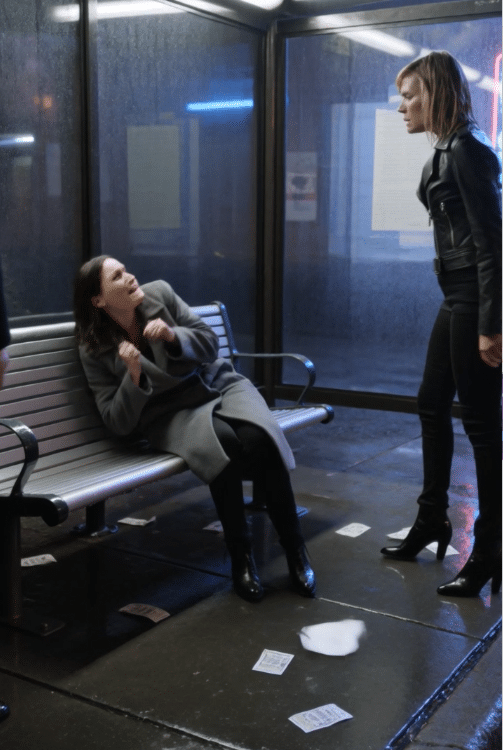
The woman’s voice broke beneath the neon lights as she reached under the wet bus bench.
Her name was Sarah Mitchell, and at forty-one, she had learned to recognize the sound of a bad night before it even began. The rain was coming down hard, turning the pavement into a mirror of red and blue neon. Her old gray coat clung to her shoulders, and the small crossbody bag hanging against her hip contained everything she needed to get through another exhausting week.
Everything important was inside the envelope now lying beneath the bench.
Her rent money.
She had spent the entire week selling lottery tickets outside convenience stores, working extra hours whenever someone agreed to let her stand beneath an awning. She had skipped lunch twice, walked home instead of paying for the bus, and counted every dollar at the kitchen table after her eight-year-old daughter, Lily, had fallen asleep.
The envelope contained exactly what her landlord had demanded.
Not a dollar more.
Sarah had promised Lily they wouldn’t have to leave their apartment. She had promised that the pink blanket on her daughter’s bed would still be there next week, that her schoolbooks would remain on the same shelf, and that they wouldn’t have to pack their lives into plastic bags again.
She had promised because Lily had already experienced one move too many.
Now a stranger had knocked that promise onto the pavement.
“Move!” the man snapped.
He was around forty, dressed in an expensive leather jacket that looked untouched by the rain. He had approached the bus stop with the impatient swagger of someone accustomed to making other people step aside.
Sarah had been standing near the bench, holding her envelope against her chest while she waited for the next bus.
He decided she was in his way.
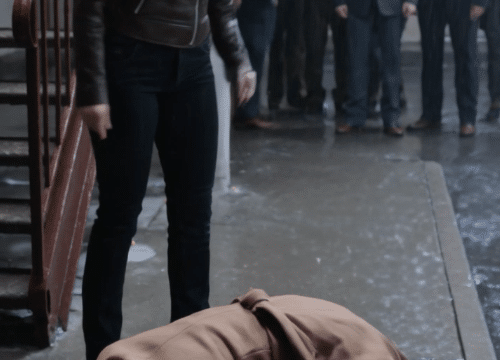
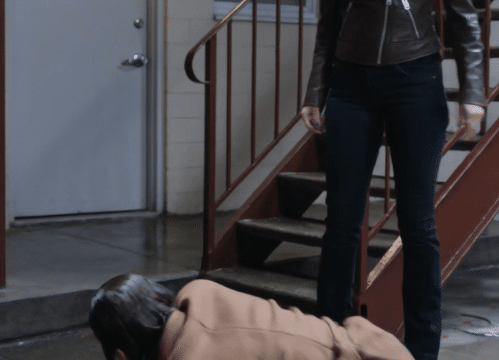
Before she could move, he rushed forward and drove a hard kick into her chest.
Sarah fell backward onto the wet bench. Her shoulder struck the metal frame, and her elbow hit the bench leg as she tried to catch herself. A thin trace of blood appeared on her skin.
Her lottery tickets flew across the pavement.
The envelope slipped from her fingers and disappeared beneath the bench.
For a second, she could only gasp.
Then she saw where the envelope had gone.
“No, no, no…”
She forced herself forward, grimacing as pain tightened across her chest. Rain soaked her hair while she stretched one trembling hand beneath the bench.
The man stood over her.
“Trash,” he said. “Rent somewhere cheaper.”
Sarah stared at him in disbelief.
“Please. I just need my money.”
She reached farther beneath the bench, her fingers brushing the edge of the envelope.
Then the man stepped closer and kicked her twice more in the back and side.
Sarah cried out and curled around herself, struggling to breathe through the pain. Her hand slipped away from the envelope.
The people waiting nearby recoiled.
A young woman covered her mouth. An older commuter turned toward the street, looking as though he wanted to intervene but couldn’t make himself move. Another passenger stepped backward beneath the shelter’s flickering light.
Nobody touched Sarah.
Nobody reached for the envelope.
The bully glanced down at her and shook his head.
“Your eviction is not my problem.”
Sarah’s eyes filled with tears.
She wasn’t crying because the man had insulted her. She was crying because she could already imagine the letter her landlord would send, the conversation she would have to have with Lily, and the sight of her daughter’s belongings stacked beside a locked apartment door.
She had spent months trying to keep their lives together.
And now a stranger had nearly destroyed everything in seconds.
Then headlights swept across the bus shelter.
A black luxury sedan braked sharply beside the curb.
The rear door opened, and a tall man in a long black coat stepped into the rain. He was sixty-three, silver-haired, and carried himself with the composed confidence of someone who rarely needed to repeat himself.
An assistant emerged from the other side, carrying a tablet.
The older man took one look at Sarah on the pavement.
His expression hardened.
He crossed the short distance to the bench, removed his coat, and draped it around her shoulders. Then he positioned himself between Sarah and the bully.
Only after she was protected did he turn toward his assistant.
“Find me his information.”
The assistant immediately opened the tablet and began typing.
The bully let out a sharp laugh.
“My information?”
He tried to sound amused, but something had changed in his face.
The older man had not shouted. He had not threatened anyone. He hadn’t even asked the bully to explain himself.
He had simply looked at him as if the next few minutes mattered far more than the man could understand.
And the bully was about to discover why.
Because the stranger who had stepped out of the luxury sedan wasn’t merely a wealthy businessman.
He owned the building where Sarah and her daughter lived.
And he had just witnessed something that would force him to reconsider everything he thought he knew about the man standing in front of him.
Act II
Sarah Mitchell had never expected anyone to rescue her.
She had spent most of her adult life believing that if she worked hard enough, stayed careful enough, and made the right sacrifices, she could protect her daughter from the worst things the world had to offer.
For years, that belief had been enough.
Sarah had met her husband, Michael, when she was twenty-four. They married young, rented a small apartment, and spent weekends searching flea markets for furniture they could afford. When Lily was born, they painted the nursery pale pink and promised each other that their daughter would grow up in a home filled with laughter rather than fear.
Then Michael died in a highway accident.
Sarah was thirty-three.
The insurance settlement barely covered the funeral and the debts left behind. She returned to work three weeks later because the rent did not stop arriving simply because her world had collapsed.
She took whatever work she could find.
Cleaning offices before sunrise. Stocking shelves at a grocery store. Selling lottery tickets during the afternoon rush. Sometimes she worked two jobs in a single day, then came home to help Lily with her homework before falling asleep at the kitchen table.
She learned to hide her exhaustion.
When Lily asked why her mother was always tired, Sarah smiled and said she was simply working hard because she loved her job.
When the electricity bill arrived, she found ways to reduce the heating.
When groceries became expensive, she made inexpensive meals and told Lily she wasn’t hungry.
And when their landlord announced that the rent would increase, Sarah quietly began calculating how many extra shifts she would need.
She couldn’t afford to move.
The apartment wasn’t luxurious. The paint was peeling near the kitchen window, and the bathroom faucet dripped whenever someone turned it off too quickly. But Lily had friends at school, a familiar walk to the bus stop, and a bedroom where she had marked her height against the doorframe every birthday.
It was the first place that had felt like home since Michael died.
Sarah had no intention of losing it.
The man who had attacked her, however, knew nothing about any of this.
His name was Richard Cole.
Richard was not a landlord, a police officer, or anyone with a legitimate reason to decide where Sarah could stand. He was simply an impatient man who had come to the bus stop in a bad mood and decided that the woman near the bench was an obstacle.
He had spent years believing that inconvenience was something other people should absorb.
He expected shop employees to move faster, drivers to get out of his way, and strangers to apologize whenever they failed to meet his expectations. When someone resisted, he treated it as a personal insult.
Sarah’s presence had annoyed him.
Her worn coat had irritated him.
And the fact that she hadn’t immediately disappeared when he told her to move had made him angry enough to attack her.
He had not considered the consequences because, until that moment, consequences had rarely interrupted his life.
Now, standing beneath the bus shelter, he looked at the older man in the black coat and tried to recover his composure.
“Look, she was blocking the bench,” Richard said. “This is being blown out of proportion.”
The older man ignored him.
He crouched beside Sarah and asked whether she could breathe comfortably. He instructed his assistant to call for medical help and retrieve the rent envelope without disturbing anything else.
Sarah shook her head weakly.
“Please,” she whispered. “I can’t lose that money.”
“You won’t be left alone to deal with this,” he told her.
She looked up at him, confused.
He spoke with an unusual gentleness, but there was no uncertainty in his voice.
“What’s your name?”
“Sarah.”
“Sarah, I’m Edward Whitmore. We’re going to make sure you receive medical attention first. Then we’ll work out what needs to happen next.”
Sarah stared at him.
The name sounded familiar, though she couldn’t immediately place it.
Edward Whitmore was one of the city’s most prominent property owners. His company held commercial buildings, apartment complexes, and several large developments across the metropolitan area. His name appeared on construction permits, charitable foundation announcements, and the occasional newspaper profile about the city’s changing housing market.
He was wealthy enough that most people recognized his name even if they had never met him.
But Sarah knew none of that when he knelt beside her.
All she knew was that a stranger had offered her his coat while everyone else had watched.
Edward’s assistant returned with the envelope.
It was damp around the edges, but the money remained inside.
Sarah took it with both hands.
A long, shaky breath escaped her.
“Thank you.”
Edward nodded.
Then he looked toward Richard.
“Stay where you are.”
Richard scoffed.
“You can’t order me around.”
“No,” Edward replied. “But the witnesses and the authorities will have questions for you.”
He turned to his assistant.
“Record the names of everyone willing to provide a statement. Preserve any available security footage. Make sure the emergency responders have what they need.”
His assistant nodded and began speaking with the waiting commuters.
The crowd had changed. People who had been too frightened to approach Sarah were now offering to describe what they had seen. One woman admitted that she had recorded part of the incident on her phone. Another pointed toward a nearby storefront with a security camera facing the bus shelter.
Richard’s face tightened.
“You’re acting like I’m some kind of criminal.”
Edward looked at him.
“I haven’t decided what you are. I’m making sure the facts are preserved.”
That answer seemed to unsettle Richard more than an insult would have.
Edward did not appear interested in winning an argument.
He appeared interested in discovering the truth.
And when the assistant finally returned with the first details she had been able to confirm, Edward’s expression changed in a way Richard couldn’t interpret.
“Sir,” she said quietly, “I found the property records.”
Edward glanced at the tablet.
Then he looked at Sarah.
The apartment building she had been struggling to keep was one of his company’s properties.
And the name associated with the building’s management had recently appeared in a complaint Edward had never personally seen.
A complaint involving rent demands, disputed fees, and tenants who claimed they had been threatened with eviction even after making their payments.
Edward’s jaw tightened.
The attack at the bus stop was one problem.
What the records might reveal about Sarah’s housing situation was another.
And suddenly, the envelope beneath the bench seemed to represent something far larger than one month’s rent.
Act III
The ambulance arrived within minutes.
Sarah was examined by the medical team, who checked her injuries and helped her move carefully away from the wet bench. She remained frightened, repeatedly asking whether the rent envelope was safe.
Edward’s assistant placed it inside Sarah’s crossbody bag and handed it back to her.
“It’s right here,” she assured her.
Sarah pressed the bag against her body.
Only then did she begin to calm down.
Edward stayed nearby while the responders assessed her condition. He did not crowd them or interfere with their work. He simply made sure the witnesses knew how to contact the authorities and that the available footage would be preserved.
Richard continued complaining.
“This is insane. You people are making a scene over nothing.”
Nobody answered.
His irritation grew as the crowd’s attention shifted away from him. The commuters who had once looked afraid now watched him with open disapproval.
He had expected to leave the bus stop with a funny video.
Instead, he was surrounded by witnesses, and a wealthy stranger was quietly collecting information about him.
Then Edward’s assistant approached with the tablet.
“There’s a problem with the management records,” she said.
Edward turned slightly away from Richard.
“What kind of problem?”
“The building’s management company has received several complaints over the past six months. Most concern disputed late fees and notices sent to tenants whose payments were allegedly made on time.”
“Allegedly?”
“We haven’t verified every complaint yet. But Sarah’s name appears in the records.”
Edward looked at her.
“What does her file say?”
His assistant reviewed the details.
Sarah had paid most of her rent consistently, but the latest payment had been delayed after an administrative dispute over a fee she said she did not owe. She had contacted the management office several times to resolve the matter.
Her account contained notes indicating that she had been warned about possible eviction.
The assistant frowned.
“There’s also a payment entry that doesn’t appear to have been reconciled correctly.”
Edward’s expression darkened.
“Meaning?”
“Meaning we need to review the original ledger before we can say whether her balance is accurate.”
Richard had been listening.
He suddenly stopped talking.
Edward noticed.
“Do you know something about this building?” he asked.
Richard shifted his weight.
“No.”
“Then you won’t mind explaining why you’re so interested in leaving before the authorities arrive.”
Richard’s face flushed.
“This has nothing to do with me.”
“Then let the investigation establish that.”
Edward turned back to his assistant.
“Contact our compliance director. Freeze any pending eviction action connected to Sarah’s account until the ledger has been independently reviewed. Preserve the original records and all communications.”
His assistant nodded.
“And the other complaints?”
“Review them as well. We do this properly, or we don’t do it at all.”
Sarah heard the exchange from beside the ambulance.
She looked at Edward in disbelief.
“You can really do that?”
“I can require our company to review its own records,” he said. “If mistakes have been made, they need to be corrected. If anyone has acted improperly, we need to establish what happened.”
Sarah swallowed.
“I didn’t want any trouble. I just wanted to pay my rent.”
Edward looked at her for a moment.
“Paying your rent should not require you to endure this.”
The words were simple.
But they seemed to loosen something inside her.
For months, Sarah had blamed herself for every setback. She had wondered whether she should have worked more hours, spent less on groceries, or found a second job sooner. She had treated the possibility of eviction as a personal failure, even though she had done everything she could to avoid it.
Now someone was telling her that she was entitled to ask questions.
That she was allowed to expect accurate records.
That being poor did not mean she had to accept every accusation made against her.
Richard, meanwhile, had begun to understand that Edward was not simply offering Sarah a temporary kindness.
He was examining the circumstances that had brought her to that bus stop with an envelope full of money she could barely afford to lose.
And if the records were wrong, someone would have to explain why.
Richard tried one last time to regain control.
“Look, I don’t know what she told you, but people like her always have a story.”
Edward turned slowly.
“People like her?”
Richard hesitated.
“You know what I mean.”
“No,” Edward said. “I don’t think I do.”
The crowd fell silent.
Richard looked around, suddenly aware that every person within earshot had heard him.
Edward continued.
“You saw a woman who was struggling. You decided she was beneath you. Then you attacked her because you didn’t like where she was standing.”
Richard opened his mouth.
Edward raised one hand, stopping him.
“You can explain your actions to the authorities. You don’t need to explain them to me.”
For once, Richard had nothing to say.
The police arrived shortly afterward and began interviewing the witnesses. The footage from the bystander’s phone was preserved, and the nearby storefront agreed to retain its security recordings for investigators.
Edward provided his contact information and instructed his assistant to cooperate with any lawful requests for company records.
He did not demand that Richard be punished in a particular way.
He did not threaten to use his wealth to destroy him.
He simply made sure that the facts would not disappear.
Then he returned to Sarah.
“Do you have somewhere safe to go tonight?”
Sarah hesitated.
“My daughter is at home with our neighbor. I was supposed to bring the rent payment to the office before it closed.”
Edward nodded.
“Let’s make sure you’re taken care of first. Then we’ll contact your neighbor and make arrangements for you to get home safely.”
Sarah’s eyes filled again.
“What if they still evict us?”
Edward looked toward his assistant.
“That’s what we’re going to investigate.”
He paused before adding, “And if the records show that you’ve paid what you owe, no one should be threatening you over an error.”
Sarah held the envelope close.
For the first time that evening, she allowed herself to imagine that the worst might not happen.
But the review of her account was about to uncover something that would make Edward far angrier than a misplaced payment.
Because the problem wasn’t just a questionable fee.
Someone had been changing the records.
And the name attached to those changes was one Edward knew very well.
Act IV
Edward Whitmore did not build his property company by ignoring problems.
He had inherited a small portfolio of buildings from his father and spent decades expanding it into a business that employed hundreds of people. He knew that a company could not operate on trust alone. It needed accurate records, responsible managers, and a system that allowed tenants to challenge mistakes without fearing retaliation.
He also knew that wealth could create distance.
The larger his company became, the more decisions passed through layers of administrators, contractors, and regional managers. A report could be summarized before it reached his desk. A complaint could be categorized as routine. A tenant’s account could be reduced to a line on a spreadsheet.
Edward had tried to build safeguards against that distance.
But safeguards were only useful if someone actually followed them.
The next morning, his compliance director began reviewing Sarah’s account alongside the complaints submitted by other tenants in the building.
The first discrepancy appeared in the payment ledger.
Sarah had made a payment that was recorded in the company’s banking records, but the property management system showed a different balance. A late fee had been added, then carried forward into the following month.
When Sarah disputed the charge, the account notes described her as uncooperative.
The records did not show that anyone had adequately explained the discrepancy to her.
A second tenant had reported a similar problem.
Then a third.
The compliance director expanded the review.
Over the next several days, investigators compared payment confirmations, account adjustments, tenant correspondence, and eviction notices. They discovered that several disputed fees had been carried forward even after tenants supplied evidence of payment.
In some cases, the errors appeared to result from poor administrative practices.
In others, the explanations were less straightforward.
Several adjustments had been entered under the credentials of the same regional property manager: a man named Victor Hale, who had overseen the building for nearly four years.
Victor had previously been praised for reducing outstanding balances and improving collection rates.
His reports showed a steady decline in overdue accounts.
Those numbers had impressed senior management.
They had also concealed the fact that some tenants were being charged fees they disputed, while others were facing eviction notices before their account histories had been properly reconciled.
The company did not yet know whether the pattern resulted from deliberate manipulation, reckless management, or a mixture of both.
But it was serious enough to warrant an independent investigation.
Edward requested the original records, not just the summaries that had been presented to him. He also asked for an audit of the management company’s procedures for handling payment disputes and eviction warnings.
When Victor was asked to explain the discrepancies, he blamed software errors and staff turnover.
He insisted that the complaints were isolated incidents.
The documents suggested otherwise.
Several emails showed that employees had raised concerns about inconsistent balances months earlier. One message asked whether the team should pause eviction warnings while disputed payments were checked.
The response instructed staff to continue processing the notices unless a supervisor approved an exception.
That supervisor was Victor.
Edward read the email in silence.
Then he placed it on the table.
“How many people were threatened with losing their homes because no one wanted to stop and verify a number?”
Nobody answered immediately.
The compliance director explained that the review was ongoing and that the full extent of the problem remained uncertain.
Edward nodded.
“Then we find out. Every account. Every complaint. Every notice.”
He authorized an independent audit and instructed the company to suspend disputed eviction actions at the affected property while the review proceeded. Tenants would be contacted directly, offered a clear explanation of their account status, and given a way to challenge errors without dealing with the same managers whose decisions were under review.
Where the records showed that tenants had been incorrectly charged, the company would correct the balances and refund improper payments.
Where conduct suggested intentional wrongdoing, the findings would be referred to the appropriate authorities.
It was not enough to apologize to Sarah and move on.
The company had to establish whether other families were facing the same danger.
Meanwhile, Richard’s assault case continued through the legal process. The police reviewed the witness statements and recordings, and Richard was required to respond to the evidence against him.
Edward made no attempt to influence the criminal investigation.
He had no need to.
The footage, the witnesses, and the medical assessment would speak for themselves.
But Richard soon discovered that the man he had dismissed at the bus stop was also the owner of the building where Sarah lived.
When that fact became known, Richard began sending messages through intermediaries, asking whether Edward would consider settling the matter privately.
Edward refused to discuss the criminal case outside the proper process.
He did, however, agree to meet Richard’s lawyer regarding a separate question: whether Richard had any connection to the property management company or its employees.
He did not.
The inquiry established that Richard had no business relationship with Edward’s company and no authority over Sarah’s housing. He had attacked her simply because she had been standing where he wanted to pass.
That fact made the incident no less serious.
It made it more revealing.
Richard had acted as though Sarah’s circumstances gave him permission to treat her however he pleased. He had assumed that a woman in an old coat, holding an envelope of cash, would have no one willing to challenge him.
He had been wrong.
But the most important discovery was not about Richard.
It was about Sarah’s rent.
The independent review confirmed that a payment she had made had not been properly credited to her account. Additional charges had then been calculated from the incorrect balance, making it appear that she owed more than she actually did.
The company corrected the ledger.
The disputed fees were removed, and Sarah received written confirmation of her accurate account balance. The eviction action was suspended while the review took place and was withdrawn once the records established the error.
She would not lose her apartment because of a debt that did not exist.
When Edward received the final confirmation, he sat alone in his office for several minutes.
He thought about Sarah reaching beneath the bench, terrified that the money she had worked so hard to earn would disappear.
He thought about the months she had spent worrying that her daughter would lose her home.
And he thought about how easily the problem might have continued if nobody had looked beyond the first explanation.
The assault had brought him to Sarah’s side.
The records had shown him what else needed to be fixed.
When he called her, he told her the review was complete.
Sarah listened without speaking.
Then she asked the question that mattered most to her.
“Does that mean Lily and I can stay?”
“Yes,” Edward said. “Your account has been corrected, and the eviction action has been withdrawn.”
Sarah covered her mouth.
For several seconds, she could not find the words to answer.
Then she began to cry.
Not because someone had handed her a fortune.
Not because her problems had magically disappeared.
But because she could finally tell her daughter that they were not losing their home.
And this time, the promise would hold.
Act V
When Sarah returned to her apartment that evening, Lily was sitting at the kitchen table with a coloring book spread in front of her.
The little girl looked up as the door opened.
“Mom! Did you pay the rent?”
Sarah set her bag down and knelt beside her.
“Yes, sweetheart.”
Lily’s face brightened.
“So we’re staying?”
Sarah wrapped her arms around her daughter.
“We’re staying.”
Lily hugged her tightly, then pulled back to study her mother’s face.
“Why are you crying?”
Sarah laughed softly through her tears.
“Because I’m happy.”
She did not tell Lily every detail of the attack that night. She explained that a man had hurt her at the bus stop, that she had received medical attention, and that the police were handling what had happened.
She also told her that the rent account had been reviewed and corrected.
Lily listened carefully.
Then she brought her mother a drawing.
It showed two people standing in front of a small apartment building, holding hands beneath a bright yellow sun. Above them, in uneven letters, Lily had written: OUR HOME.
Sarah pressed the paper against her chest.
She had spent so long trying to protect that little girl from uncertainty that she had forgotten how much Lily understood already.
Children noticed when the pantry grew emptier.
They noticed when their parents stopped buying small treats.
They noticed when conversations became quiet after the bills arrived.
Lily had known her mother was frightened, even when Sarah tried to hide it.
Now, for the first time in months, the apartment felt peaceful.
The following week, Edward visited the building with a member of his compliance team.
He did not arrive with a photographer or a public relations representative. He came to speak with the residents whose accounts had been affected by the management problems.
Some were angry.
Others were exhausted.
One elderly tenant had spent weeks trying to understand why her balance kept increasing despite making regular payments. A single father had received repeated notices that left him afraid to open his mailbox. Another family had borrowed money from relatives to cover fees that were later found to be incorrect.
Edward listened.
He did not ask them to be grateful that the company was reviewing its records. He did not suggest that the problems were unimportant because they had not all resulted in completed evictions.
He acknowledged that the management system had failed to give residents clear, reliable answers.
The company retained an independent auditor, changed its procedures for reviewing disputed balances, and established a direct escalation process for tenants who believed their accounts were incorrect. The regional manager was removed from handling the affected accounts while the investigation into his decisions continued.
The audit findings were reviewed before any further action was taken.
Some issues were attributed to administrative failures. Others required additional scrutiny. The company corrected verified errors and cooperated with the appropriate authorities wherever the evidence warranted it.
The changes did not transform the city’s housing problems overnight.
Rents remained high. Families still struggled with unexpected expenses. Some residents still needed assistance beyond what a single property owner could provide.
But at that building, tenants had a clearer way to challenge mistakes.
And Sarah no longer had to spend every evening wondering whether an unexplained fee would cost her daughter her home.
As for Richard, the assault case proceeded independently of the housing investigation. The evidence gathered at the bus stop was assessed through the legal process, and he faced the consequences determined by that process.
His attempts to dismiss the incident as an argument over space could not erase the recordings or the witnesses who had seen him attack Sarah.
The public attention also damaged the image he had carefully cultivated.
People who had once watched his online performances began questioning the way he treated strangers. Several people came forward with accounts of his aggressive behavior in public, though each allegation had to be evaluated on its own evidence.
Richard eventually issued a public apology.
He admitted that he had been angry, that he had acted violently, and that he had treated Sarah as though her circumstances made her less deserving of respect.
The apology did not undo what happened.
Sarah was not required to accept it.
When someone asked her whether she wanted revenge, she shook her head.
“I wanted my rent money,” she said. “I wanted to go home to my daughter. That’s what mattered to me.”
She paused.
“I don’t need to spend my life thinking about him.”
And she didn’t.
Sarah returned to selling lottery tickets while looking for more stable work. Edward’s company offered her information about available positions through its employment assistance program, but she chose which opportunities to pursue and continued making decisions for herself.
She wasn’t transformed into a wealthy woman overnight.
She still watched her spending. She still planned meals carefully. She still worked hard.
But she no longer carried the constant fear that one accounting error could take away the home she had fought so hard to keep.
A few months later, Edward stopped by the bus shelter where they had first met.
The rain had returned, falling in silver streaks beneath the neon lights. The wet bench gleamed, and commuters waited beneath the shelter, looking at their phones and watching the road.
Sarah was there, holding a small paper bag.
She had brought coffee for herself and an extra cup for the older man she expected to see that evening, a regular commuter who often waited for the same bus.
When Edward approached, she smiled in recognition.
“I wanted to thank you properly,” she said.
“You don’t owe me thanks.”
“I know,” Sarah replied. “But I still want to say it.”
She told him about Lily’s drawing, about the corrected rent account, and about how peaceful it felt to walk through her apartment door without expecting another notice.
Edward listened.
Then Sarah looked at the bench.
“I keep thinking about that night. I thought the envelope was the most important thing I had.”
“What do you think now?” he asked.
She considered the question.
“The envelope mattered. My daughter needed a home. But I think what frightened me most was the feeling that nobody would care if I lost it.”
Edward nodded slowly.
“That’s a difficult feeling to carry.”
“It is.”
Sarah took a breath.
“But someone did care.”
A bus approached, its headlights reflecting across the pavement.
Before Sarah stepped aboard, Edward asked how Lily was doing.
“She wants to be a veterinarian,” Sarah said, smiling. “Yesterday she told me she’s going to have a house with enough room for every stray animal in the city.”
Edward laughed.
“Sounds ambitious.”
“She gets that from her father.”
The bus doors opened.
Sarah climbed aboard, turned once to wave, and disappeared into the warm light inside.
Edward remained beneath the shelter for a moment, watching the bus pull away.
He had arrived that rainy night believing he was intervening in an isolated act of cruelty. Instead, he had discovered a woman whose financial struggle had been made worse by errors no one had properly investigated.
The bully had exposed his own character.
The records had exposed a management failure.
And Sarah had reminded Edward of something his years in business sometimes made easy to forget.
Every account number belonged to a person.
Every payment represented hours of someone’s life.
Every eviction warning could frighten a child who had no idea what rent even meant.
And every person standing alone beneath a bus shelter had a story that could never be understood simply by looking at their clothes.
Richard had seen Sarah’s old gray coat and assumed she was insignificant.
He had mistaken her vulnerability for permission.
Edward had seen a woman protecting the money that kept her family together.
But Sarah herself had never stopped being a mother, a worker, or a person deserving of dignity.
She had been those things before the luxury sedan arrived.
Before the records were corrected.
Before anyone powerful knew her name.
And when the rain fell against the bus shelter again, the bench remained exactly where it had always been.
The neon still reflected in the pavement. The buses still arrived late. Strangers still hurried past one another, carrying private worries that no one else could see.
But Sarah no longer had to wonder whether a single cruel moment would cost her everything.
She had her apartment.
She had Lily.
And she had learned that asking for help did not make her weak.
Sometimes, the most important reversal in a person’s life isn’t watching the bully lose his confidence.
It’s watching the person he tried to break walk home with her head held high, carrying the one thing he could never take away.
The knowledge that she mattered all along.