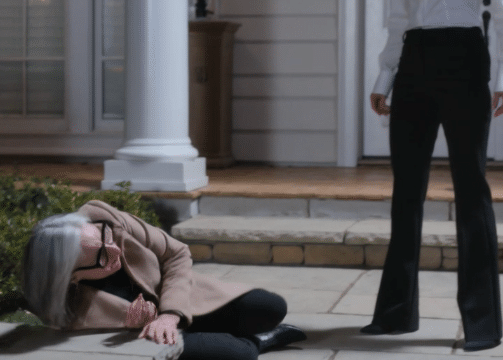
Act I
The library was so quiet that the slap sounded like a gunshot.
For one second, nobody moved.
Books lay scattered across the gray carpet. A chair scraped somewhere between the study tables. A girl at the end of the aisle covered her mouth with both hands, her eyes wide with horror.
And on the floor beside the shelf, Maya Reyes slowly lifted her head.
A thin red mark touched the corner of her mouth. Her shoulder-length brown hair had fallen across her face. Her light blue shirt was wrinkled where her back had hit the wooden bookshelf.
Above her stood a man in a navy suit, breathing hard like he was the one who had been attacked.
“I was reaching for a book,” he snapped, loud enough for the nearby students to hear. “How dare you accuse me?”
Maya stared up at him.
A few seconds earlier, she had been browsing the upper shelves in the legal ethics section, looking like any other student trying to survive midterms. He had approached from behind too quietly, too confidently, raising one hand toward the books as if he belonged there.
Then he crossed a line no stranger had the right to cross.
Maya had spun around and shoved him away.
“What the hell did you just do?” she demanded. “How dare you touch me?”
His mask broke instantly.
The fake innocence vanished. His face hardened. He stepped forward and struck her across the face in front of everyone.
Now the whole aisle was watching.
The man adjusted his tie as if the suit alone could make him innocent. He looked expensive, polished, untouchable. The kind of man who had spent years walking through rooms where people moved aside before he asked.
But Maya did not stay down.
Her hand pressed against the carpet. Her breathing steadied. Something in her eyes changed, not into panic, but into focus.
The students saw it happen.
The man did too.
Maya rose so fast he barely had time to step back. She planted her foot, turned, and drove one sharp kick into the side of his face. The impact knocked him sideways, and he hit the carpet between the scattered books with a heavy thud.
Gasps tore through the library.
For the first time since entering the aisle, the man looked stunned.
Maya stood over him, chest rising, eyes cold.
He pushed himself up slowly, wiping at his mouth. His fists clenched. His pride was bleeding worse than his lip.
Maya did not retreat.
“Today,” she said, her voice cutting cleanly through the silence, “I’m going to teach you a lesson you’ll never forget.”
The students thought the lesson had already begun.
They had no idea it had started three years earlier.
Act II
Before that afternoon, most people at Blackwell University had never heard Maya Reyes speak.
They had seen her moving quietly through campus for two weeks, usually alone, usually carrying a canvas tote and a notebook. She dressed simply. She sat in lecture halls without drawing attention. She asked library staff where old policy archives were kept. She smiled politely, thanked people, and disappeared into the stacks.
Students assumed she was a graduate student.
Faculty assumed she was someone else’s assistant.
That was exactly what she wanted.
Maya had learned early that powerful men were most honest when they thought nobody important was listening.
Three years earlier, her younger sister Elena had been a freshman at Blackwell. She was brilliant, stubborn, and proud in the way eighteen-year-olds are proud before the world teaches them fear. She had earned a scholarship her family celebrated for weeks.
Their mother cried when Elena packed her suitcase.
Their father drove six hours to campus and carried every box up three flights of stairs without complaint.
Blackwell had looked like a dream then. Tall brick buildings. Old trees. Clean glass doors. Professors whose names appeared in journals and news articles.
Then Elena began calling home less.
When she did call, her voice sounded smaller.
She said one professor made her uncomfortable. Then she said he was not just a professor, but a senior administrator with friends everywhere. She said girls warned each other about him quietly, in bathrooms, in group chats, in the corners of parties where music covered the truth.
His name was Dr. Adrian Voss.
Dean of Student Advancement. Major fundraiser. Public face of Blackwell’s “safe campus” initiative.
A man who gave speeches about dignity while students lowered their voices when he entered a room.
Elena filed a complaint after a library incident.
Two weeks later, her scholarship was “reviewed.” Her research assistant position disappeared. Her advisor stopped answering emails. When she tried to appeal, she was told the university had investigated and found “insufficient evidence.”
The letter had been signed by Adrian Voss.
Elena came home before Thanksgiving with two suitcases and a silence that terrified Maya more than tears would have.
Maya was twenty-four then, working nights at a legal clinic and taking classes during the day. She did not have money. She did not have connections. But she had a talent for remembering details other people wanted forgotten.
So she started collecting stories.
At first, they came anonymously. One email. Then three. Then ten.
A student who lost funding after refusing a private meeting.
A former assistant who was told to stay quiet if she wanted a recommendation.
A librarian who reported strange behavior and was transferred to archives within a month.
Every story bent toward the same name.
Adrian Voss.
But Blackwell protected him because he protected Blackwell’s money.
He charmed donors. He flattered trustees. He posed for photos beside scholarship recipients and spoke gently into microphones about opportunity. Parents trusted him because his voice sounded calm. Students feared him because his power was not loud.
It was everywhere.
Maya applied to law school the next year. She chose civil rights and education law. She wrote papers about institutional silence. She interned with investigators who taught her how to build a case that could survive expensive lawyers.
But it was not enough to know what Adrian Voss was.
She needed him to reveal it where everyone could see.
Two weeks before the library confrontation, Maya returned to Blackwell under a temporary research credential. Her official reason was archival work for a legal fellowship.
Her real reason was hidden in her tote bag.
A small recorder.
Copies of old complaints.
And one email from a terrified current student that read, “He’s doing it again.”
That student was sitting at a study table when Maya entered the library.
Her name was Sophie Lang. Nineteen. Pre-law. Scholarship student.
And Adrian Voss had scheduled a “mentorship meeting” with her that evening.
Maya had come to warn her.
But Adrian reached the aisle first.
Act III
Maya did not choose the legal ethics shelf by accident.
She chose it because the aisle was visible from three study tables, a security dome camera, and the circulation desk mirror.
She chose it because Sophie could see her from the corner table.
She chose it because men like Adrian Voss only took risks when they believed their victim had no witnesses who mattered.
For ten minutes, Maya browsed quietly.
She felt him before she saw him.
His footsteps were too measured. His presence pressed into the narrow aisle like a door closing. When he came close behind her and lifted his hand toward the shelf, Maya’s stomach went cold.
It was the same performance Elena had described.
The pretend reach.
The false accident.
The instant denial.
But this time, Maya turned before fear could swallow her.
After she shoved him back and accused him, Adrian made the mistake he had avoided for years.
He hit her in public.
It was not just anger. It was entitlement. The raw shock of a man who had never imagined consequences reaching him in a place he controlled.
Now he stood in the aisle with his fists clenched, humiliated in front of students who had once lowered their eyes when he passed.
“Do you know who I am?” he hissed.
Maya wiped the corner of her mouth with the back of her hand.
“Yes,” she said. “That’s the problem.”
His face twitched.
A student near the study tables lifted her phone. Another did the same. Then another.
Adrian noticed and snapped, “Put those away.”
No one did.
That frightened him more than Maya’s kick.
The library doors opened behind them, and campus security hurried in, followed by a woman in a gray blazer carrying a leather folder.
Professor June Bell, chair of the faculty ethics committee, stopped at the end of the aisle. Her face drained when she saw Maya, Adrian, and the books scattered between them.
“Maya,” she said softly.
Adrian heard the name and frowned.
“You know her?”
Professor Bell looked at him, then at the students recording from behind shelves and tables.
“Yes,” she said. “I know her.”
Maya reached into her tote and pulled out her university credential. It was not a student badge.
It was a visitor credential issued through the Office of General Counsel.
Under her name were four words Adrian had not expected to see.
External Civil Rights Investigator.
The aisle went silent again.
Adrian blinked once.
Then the color left his face.
Maya held the badge at chest height so everyone could see it.
“For the past two weeks,” she said, “I’ve been reviewing harassment complaints suppressed by this office over a period of six years.”
His jaw tightened. “This is absurd.”
“No,” Maya said. “Absurd was thinking no one saved the emails.”
Professor Bell opened the folder.
Inside were copies of reports Adrian had marked closed without interviews. Statements from students who said they had been pressured to withdraw complaints. Messages from staff warning one another never to be alone with him.
And at the top was Elena Reyes’s complaint.
Maya’s voice changed when she saw her sister’s name.
It did not shake. It sharpened.
“My sister trusted this university,” she said. “You made her feel like telling the truth was the mistake.”
Adrian looked around then, searching for someone powerful enough to rescue him.
There was no one.
Only students.
Only cameras.
Only the truth, finally standing close enough to touch.
Then Sophie Lang rose from her table.
Her hands were trembling, but her voice was clear.
“He told me not to bring anyone to the meeting tonight,” she said.
Every head turned toward her.
Sophie swallowed hard and looked at Maya.
“He said opportunities disappear for girls who make things difficult.”
Adrian took one step toward her.
Maya moved between them.
“Don’t,” she said.
And this time, even he stopped.
Act IV
Campus security tried to separate them, but the aisle had already become something bigger than a confrontation.
It had become a trial without a judge.
Students stood shoulder to shoulder between the shelves. Some looked furious. Some looked shaken. A few looked like they were remembering things they had forced themselves to forget.
Adrian pointed at Maya. “She assaulted me.”
Maya did not flinch.
“You struck me first,” she said.
“I defended myself from a false accusation.”
A voice from the crowd answered before Maya could.
“No, you didn’t.”
It came from a young man in a flannel shirt standing near the end of the aisle. He lifted his phone, his face pale but determined.
“I recorded the whole thing.”
Another student raised her hand. “So did I.”
Then another. “I saw him touch her.”
A fourth voice, quieter but firm, came from beside the shelves. “I saw him pretend it was the book.”
The truth did not arrive like thunder.
It arrived in pieces.
One witness. Then another. Then another.
Adrian’s power had always depended on isolation. One girl alone in an office. One complaint buried in a file. One witness convinced it was easier to stay silent.
But a library is not a locked room.
And this time, everyone had seen enough.
Professor Bell turned to campus security. “Escort Dr. Voss to the administrative office. Now.”
Adrian laughed once, ugly and breathless. “You don’t have the authority.”
“No,” Professor Bell said. “But the trustees do.”
She lifted her phone.
On speaker, a man’s voice filled the aisle.
“This is Trustee Alan Whitmer,” the voice said. “Dr. Voss, you are suspended from all university duties effective immediately pending outside investigation.”
Adrian stared at the phone as if it had betrayed him personally.
Professor Bell continued, her voice steady now.
“You were informed last month that an external review was underway. You were warned not to contact potential witnesses privately. You ignored that warning.”
Maya’s eyes stayed on Adrian.
He understood then.
This was not an accident.
It was a trap made of truth, and he had walked into it because arrogance had made him blind.
He turned toward Maya with hatred burning through his polished expression.
“You planned this.”
Maya stepped closer, not enough to threaten him, only enough to make him hear every word.
“No,” she said. “You did. Every complaint you buried. Every student you threatened. Every person you thought would stay scared. I just came back to open the file.”
Sophie began to cry then, silently, one hand pressed over her mouth.
The sound broke something in the crowd.
A young woman near the table whispered, “It happened to my roommate too.”
Another said, “Mine transferred.”
Another said, “We all knew.”
That was the sentence that hurt most.
Not because it accused them.
Because it named the sickness.
We all knew.
Everyone had known in fragments. Rumors. Warnings. Names passed quietly from student to student. A system of survival built by people too young to carry it.
Maya turned to them.
“Knowing is not the same as being safe enough to speak,” she said.
The words landed gently, but deeply.
For the first time, the students were not just witnesses to someone else’s humiliation. They were witnesses to the collapse of a silence they had inherited.
Adrian tried once more.
“You’ll ruin this institution,” he said.
Maya looked around the library, at the shelves, the wide windows, the frightened students, the scattered books, the place that was supposed to protect learning and had protected reputation instead.
“No,” she said. “You already did that.”
Outside the windows, afternoon light fell across the green lawn.
Inside, Adrian Voss was led out past the students he had once expected to impress.
No one moved aside for him.
And for a man like that, it was the first real consequence he had ever felt.
But Maya still had one promise left to keep.
Act V
The hearing took place six weeks later in the largest auditorium on campus.
It was supposed to be closed.
It did not stay that way.
By then, the library video had traveled across campus, then beyond it. Not because people wanted spectacle, but because the recording showed something Blackwell could no longer deny. It showed a powerful man crossing a line, striking the woman who confronted him, and then trying to hide behind his title.
For once, the university could not bury the story beneath careful language.
Students demanded transparency. Alumni threatened to withdraw donations. Faculty signed statements. Former students came forward with names, dates, emails, and memories they had once been told would not matter.
Elena Reyes arrived wearing a black blazer and carrying a folder of her own.
Maya met her outside the auditorium.
For a moment, neither sister spoke.
Elena looked older than she had when she left Blackwell, but steadier too. There were still shadows in her face from everything the university had taken from her, but there was something else now.
A quiet fire.
“I don’t know if I can do this,” Elena whispered.
Maya squeezed her hand.
“You already did the hardest part,” she said. “You survived him.”
Inside, Adrian Voss sat at a long table with two attorneys. His suit was perfect. His expression was composed. But the room no longer bent around him.
When Elena testified, she did not dramatize her pain. She did not perform it for sympathy. She simply told the truth in a clear voice.
She spoke about the complaint.
The retaliation.
The scholarship letter.
The meeting where an administrator told her that “misunderstandings” could follow young women for the rest of their lives.
Then she placed a printed email on the table.
It was from Adrian Voss to a former associate dean.
Subject line: Reyes issue.
The message was short.
“Remove her from funding review. Make it look procedural.”
The auditorium went completely still.
Adrian’s attorney shifted in his chair.
Maya watched from the front row, her hands folded tightly in her lap. She had imagined this moment for years, but revenge did not feel like triumph. It felt heavier. Sadder.
Because justice could expose the wound, but it could not return the stolen years.
Still, it mattered.
By the end of the day, Adrian Voss was terminated for cause. His name was removed from university programs. The state opened an inquiry into retaliation and civil rights violations. Several administrators resigned before the final report was released.
But the most important change did not happen in a headline.
It happened in the library.
The legal ethics aisle was repaired. The fallen books were reshelved. The carpet was cleaned. At first glance, nothing looked different.
Then students began leaving notes inside the books.
Not public accusations. Not rumors.
Messages of solidarity.
You are not alone.
I believe you.
Speak when you’re ready.
We’ll stand with you.
Professor Bell found the first one tucked inside a volume on institutional responsibility. She cried in her office for ten minutes before calling Maya.
Months later, Blackwell opened a survivor advocacy center funded not by Adrian’s donors, but by alumni who had demanded better. Elena returned, not as a student, but as the first speaker in a campus forum on accountability.
She stood at the podium and looked out at the room.
“My sister did not save me by fighting one man in one aisle,” Elena said. “She saved me by refusing to let the university call silence peace.”
Maya sat in the back, away from the cameras.
She still had a faint scar near the corner of her mouth. Most people never noticed it. Elena did.
After the speech, the sisters walked to the library together.
Students moved around them, laughing softly, carrying coffee, arguing about exams and papers and weekend plans. Ordinary campus life had returned, but it felt different now.
Less innocent.
More honest.
When they reached the aisle, Elena stopped.
For a second, Maya thought the memory would be too much.
But Elena stepped forward and ran her fingers along the spines of the books.
“This is where it happened?” she asked.
Maya nodded.
Elena looked down at the carpet, then back at her sister.
“You were scared,” she said.
Maya smiled faintly.
“Terrified.”
“But you stood up anyway.”
Maya looked toward the wide windows where sunlight poured across the tables.
“No,” she said softly. “We all did.”
At the end of the aisle, Sophie Lang was studying with two other students. She looked up, saw Maya, and gave a small nod.
Not gratitude exactly.
Something stronger.
Recognition.
The kind passed between people who know what it costs to tell the truth and do it anyway.
Maya nodded back.
The library was quiet again, but not like before.
Before, the silence had belonged to fear. It had lived in lowered eyes, deleted messages, warnings whispered too late.
Now the quiet felt different.
It felt protected.
It felt earned.
And somewhere between the shelves where Adrian Voss had once believed power would save him, the lesson he never forgot remained plain for everyone who passed through.
A title can open doors.
A reputation can silence a room.
But truth, once witnessed, does not go back on the shelf.