Act I
Emily Carter said her own name twice because the first time seemed to vanish into the chandelier light.
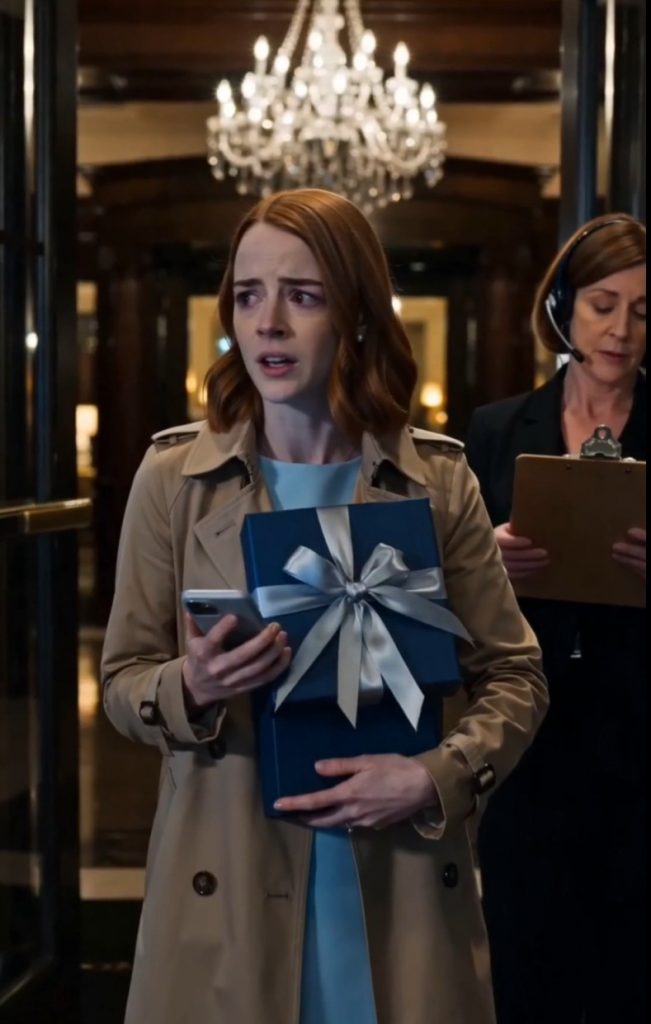
“Emily Carter,” she repeated, holding her phone in one hand and a blue gift box in the other. “It should be there.”
The event planner looked down at her wooden clipboard, lips pressed into a thin professional line. Behind her, guests in silk gowns and dark tuxedos drifted through the luxury hotel lobby, their laughter rising beneath crystal chandeliers and dark wood paneling.
Rain streaked the glass doors behind Emily.
The whole city looked blurred and cold outside, but inside the hotel everything glowed.
Gold candles. White roses. Champagne trays. A gift table covered in sequins, bright enough to make every wrapped box look expensive.
Except Emily’s.
Her blue box was small, neat, tied with a silver ribbon. She held it with both hands now, as if it were the only thing keeping her upright.
The planner checked the list again.
Then she shook her head.
“I’m sorry,” she said, soft but firm. “Your name is not here. Maybe you’re at the wrong wedding.”
Emily stared at her.
Wrong wedding.
As if she had wandered into the wrong life by accident.
From the gift table, a blonde woman in a gold satin gown turned to watch. Her arms folded slowly across her chest. Another blonde woman, seated across from the table in a strapless beige dress, leaned forward with sudden interest.
Emily lifted her phone to her ear.
Her hand trembled once before the call connected.
“I’m at the hotel,” she said, her voice breaking. “They say I’m not invited.”
The voice on the other end laughed.
Not loudly.
Worse.
Quietly, like the humiliation had already been planned and enjoyed in advance.
“You really think you’d be invited?”
Emily closed her eyes.
A single tear slid down her right cheek.
The planner looked away, embarrassed but unwilling to intervene. The guest in gold tilted her head with a polished expression of fake sympathy.
Emily lowered the phone.
For a moment, she looked exactly like what they wanted her to be.
Rejected. Small. Too late to matter.
Then she walked to the gift table.
Her heels made no sound against the thick carpet. She placed the blue box carefully among the crystal carafes, white candles, and gold-wrapped presents from people whose names had been printed in calligraphy.
The blonde woman in gold smiled.
“Miss Carter,” she said, her voice dripping with sweetness, “I’m so sorry.”
Emily rested her left hand on the box.
“I’m fine.”
The woman seated across the table stared at the silver ribbon.
“You’re leaving?”
Emily slid her hand slowly off the lid.
“Of course.”
Then she turned and walked out into the rain.
A chauffeur in a black suit held open the rear door of a luxury car waiting beneath the amber hotel lights.
“Back to the office, Miss Carter?”
Emily paused before getting in.
“No.”
She turned her head toward the hotel entrance.
The tear was gone.
So was the sadness.
A cold, almost invisible smile touched her lips.
“Because inside that box,” she said, “was not a wedding gift.”
Act II
Two years earlier, Emily Carter had stood in that same hotel lobby beside her father and believed she would one day be married there.
Not because she was a romantic in the obvious way.
Emily did not dream in lace and music. She dreamed in blueprints, contracts, old buildings restored instead of demolished. Carter House Hotel had been her father’s masterpiece, a historic property rescued from bankruptcy and rebuilt into one of the most elegant venues in the city.
Arthur Carter used to say the hotel had a soul.
Emily believed him.
She had grown up running through its half-finished hallways while workers installed marble and electricians hung chandeliers. By seventeen, she knew which ballroom had the best acoustics. By twenty-five, she knew the profit margins better than the board. By thirty, she was the one quietly saving the hotel from every bad deal her father was too trusting to question.
Then Arthur got sick.
Not suddenly, not dramatically. Just a slow fading that made him sit longer in his office chair and forget names he used to remember. Emily became his shadow. She managed meetings, reviewed vendor contracts, negotiated with lenders, and still found time to bring him soup when he refused to eat.
Her younger stepsister, Cassandra, arrived only when cameras did.
Cassandra had been born beautiful and treated it like a credential. She loved the hotel, but only as scenery. She loved the chandeliers, the suites, the terrace views, the way staff lowered their voices when she entered a room wearing diamonds she never bought herself.
She called Arthur “Daddy” in public.
In private, she called him “difficult.”
Emily endured it because family had always been her father’s weakness, and she loved him too much to make him choose.
Then Cassandra got engaged to Nathan Whitmore.
Nathan was handsome, well-connected, and empty in the way some men are when they have lived too long on charm. He came from a family with old portraits and new debt. He spoke warmly to Arthur, politely to Emily, and with barely concealed calculation to the hotel’s financial director.
Emily noticed.
She always noticed.
A month before Arthur died, he asked Emily to meet him in his private office after closing. Rain was tapping against the windows that night too. He sat behind the mahogany desk, thinner than she wanted to admit, with a sealed envelope in front of him.
“I made mistakes,” he told her.
Emily reached for his hand. “Dad.”
“No, listen to me.”
His voice was weak, but his eyes were clear.
“I let people flatter me when I should have listened to you. I let Cassandra treat this place like an inheritance instead of a responsibility. And Nathan…” He paused. “Nathan is not marrying into this family for love.”
Emily said nothing.
She already knew.
Arthur pushed the envelope toward her.
“I changed the trust.”
Her breath caught.
“The hotel stays with you,” he said. “Not Cassandra. Not the board. Not anyone who will carve it into pieces and sell the bones.”
Emily stared at him.
“She’ll hate me,” she whispered.
“She already hates anything she can’t own.”
Those were the last business words Arthur Carter ever said to his daughter.
He died three weeks later.
The new trust documents vanished before probate.
Cassandra cried beautifully at the funeral.
Nathan held her waist like a man guarding an investment.
And Emily, still grieving, soon found herself locked out of board meetings by people who told her there had been “confusion” around her father’s intentions.
The invitations to Cassandra’s wedding arrived six months later.
Everyone important received one.
Investors. Judges. donors. influencers. Half the hotel’s preferred clients.
Emily received nothing.
Not even out of courtesy.
And that was when she understood.
They did not merely want her absent from the wedding.
They wanted her erased from the story before the truth arrived.
So Emily stopped begging for a seat at the table.
She prepared something better.
Act III
The blue box had taken three weeks to assemble.
Inside it was no crystal vase, no silver frame, no handwritten blessing for the bride and groom.
There was a flash drive.
There were copies of court-stamped filings.
There was a notarized letter from Arthur Carter’s longtime attorney, who had disappeared from the city after being threatened by Nathan’s family and had only recently agreed to testify.
And beneath everything, wrapped in white tissue paper, was the original trust amendment.
Arthur’s signature was at the bottom.
So was Cassandra’s witness signature.
That was the part Cassandra did not know Emily had found.
Cassandra had witnessed the document. She had known exactly what Arthur wanted. Then, after his death, she helped Nathan bury it.
Emily had discovered the proof inside a storage room behind the old bridal suite, in a locked cabinet her father used for sentimental things no one else valued. His letters. old hotel photographs. Emily’s childhood drawings of the lobby. And one envelope marked: For my daughter, when the room turns against her.
She had cried when she opened it.
Then she had stopped crying.
Because grief was private.
Justice required organization.
On the night of the wedding, Emily did not expect to be welcomed. She knew Cassandra too well. She knew Nathan even better.
That was why her phone was recording before she stepped into the lobby.
“Emily Carter,” she said at the entrance, letting the planner repeat the denial clearly.
Your name is not here.
Maybe you’re at the wrong wedding.
Then came Cassandra’s voice on the phone, cruel and careless.
You really think you’d be invited?
Perfect.
Emily had needed one final piece.
Public exclusion from an event hosted at the hotel Cassandra was falsely claiming through the family trust.
By the time she placed the blue box on the gift table, her heartbreak was real, but it was no longer steering her.
The blonde guest in gold did not know she was standing beside evidence.
Her name was Vivian Hart, one of Cassandra’s bridesmaids, a woman whose family donated to museums and destroyed waiters in restaurants. Vivian had spent the cocktail hour telling anyone who would listen that Emily was “unstable” and “obsessed with the hotel.”
When Emily set down the box, Vivian moved closer.
“Miss Carter, I’m so sorry.”
The tone was poison dipped in sugar.
Emily looked at her.
“I’m fine.”
Across the table, the seated blonde woman in beige watched everything. Unlike Vivian, she did not smile. Her gaze fixed on the box as if she sensed weight beneath the ribbon.
“You’re leaving?” she asked.
Emily almost answered honestly.
No. I’m beginning.
Instead, she said, “Of course.”
Then she walked out.
The moment she reached the car, her chauffeur opened the door and asked if she was returning to the office.
Emily said no because the office no longer mattered.
The next room did.
Inside the hotel, the wedding reception had just begun.
Cassandra was about to make her grand entrance beneath the chandeliers.
And the blue box sat exactly where Emily needed it: on camera, on the gift table, beside the bride’s name cards, waiting for the one person in the room who had enough curiosity to open it.
Act IV
The woman in the beige dress opened the box eleven minutes after Emily left.
Her name was Grace Whitmore.
Nathan’s older sister.
Unlike Nathan, Grace had inherited their mother’s suspicion instead of their father’s appetite for status. She noticed things because she had spent her life watching charming men turn other people into furniture.
She noticed Emily’s tear.
She noticed the way Vivian enjoyed it.
She noticed that Emily did not look surprised when she walked away.
And she noticed that the blue box was too light to be a real wedding gift, but too deliberately placed to be meaningless.
So when Vivian moved toward the ballroom, Grace stayed behind.
She lifted the silver ribbon.
Inside, the first thing she saw was a card.
Not addressed to Cassandra.
Not to Nathan.
To whoever still has a conscience.
Grace went cold.
She opened the envelope.
By the time the bride and groom entered the ballroom to applause, Grace was reading the trust amendment under the golden lobby lights.
By the time Nathan kissed Cassandra for the cameras, Grace had inserted the flash drive into the planner’s laptop behind the gift table.
And by the time Cassandra stepped onto the dance floor, smiling like a queen in white satin, the giant screen above the band changed.
At first, everyone thought it was a wedding montage.
Soft music played. Guests turned toward the screen with champagne in their hands.
Then Arthur Carter’s face appeared.
The room fell into a stunned hush.
He looked thinner than many remembered, seated at his office desk, wearing the navy cardigan Emily had bought him during his final winter. His voice was fragile but unmistakable.
“If you are watching this,” he said, “then someone tried to silence my daughter.”
Cassandra’s smile disappeared.
Nathan’s hand tightened around hers.
On the screen, Arthur continued.
“Emily Carter is the rightful trustee and controlling owner of Carter House Hotel. I made this decision with a clear mind, in the presence of legal counsel and witnesses.”
Whispers moved through the ballroom.
Cassandra turned toward the planner. “Turn it off.”
But the planner had gone pale. Her headset crackled uselessly. Grace stood beside the laptop, one hand resting on it, expression hard.
Nathan stepped forward. “Grace.”
She did not move.
The video continued.
“My daughter Emily protected this hotel when I was too sick to see who was circling it. She protected my staff. She protected my name. And if Cassandra or anyone connected to the Whitmore family attempts to challenge this after my death, I ask that every document in the blue box be turned over to the court.”
The bride made a small sound.
It was not grief.
It was panic.
Then the screen showed copies of signatures. Dates. Emails. Financial transfers. Messages between Nathan and an attorney discussing how quickly hotel assets could be refinanced after the marriage.
The applause of minutes earlier curdled into murmurs.
Vivian backed away from Cassandra as if scandal were contagious.
The event planner looked toward the ballroom doors, perhaps expecting Emily to return.
She did not.
That was what made it worse.
Emily had not stayed to plead her case.
She had left the truth to enter without her.
Outside, in the black car across the wet street, Emily watched the first calls come in.
Her attorney.
Then Grace Whitmore.
Then the hotel’s interim board chair.
Finally, Cassandra.
Emily let that one ring.
Rain moved over the window in silver lines. The chauffeur kept his eyes forward, silent and still.
Emily looked at Cassandra’s name glowing on the phone.
Then she answered.
For once, Cassandra spoke first without sounding beautiful.
“What did you do?”
Emily stared at the hotel entrance, where guests were beginning to spill into the lobby in confused clusters.
“I brought a gift,” Emily said.
Cassandra’s breathing shook. “You ruined my wedding.”
“No,” Emily replied. “You used my father’s hotel to celebrate stealing from his daughter.”
The silence on the other end was sharp.
Then Emily added, “That was your mistake.”
Act V
By midnight, the wedding was no longer a wedding.
The band packed up without playing another song. Guests slipped out in waves, some pretending they had early flights, others openly whispering into phones. The gold-sequined gift table remained in the lobby under chandelier light, now stripped of romance and covered in evidence bags.
Police were not storming the hotel.
Real consequences rarely arrive that dramatically.
They arrived as attorneys in raincoats. Emergency injunctions. Board members pulled from bed. Security instructions changed in the system. Access cards deactivated while candles still burned beside the crystal carafes.
Nathan tried to leave through the side entrance.
Grace stopped him.
Not physically. She did not need to.
She simply stood in his path and said, “If you run, you make the documents look worse.”
He hated her for being right.
Cassandra remained in the bridal suite for almost an hour, still in her gown, surrounded by flowers that had cost more than some families’ rent. Vivian stayed with her until the hotel’s legal counsel asked who had repeated false statements about Emily to guests.
Then Vivian remembered an urgent headache and left.
Near one in the morning, Emily returned.
She entered through the front doors in the same tan trench coat, damp at the shoulders, her light blue dress visible beneath it. This time, no one stopped her.
The event planner stood near the lobby desk, clutching her clipboard like a shield.
“Miss Carter,” she said quietly.
Emily looked at her.
The planner swallowed. “I’m sorry.”
Emily’s expression did not change.
“For what?” she asked.
The woman had no answer ready.
That was good.
It meant she had to think.
Emily walked past her toward the gift table. The blue box sat open now, its silver ribbon loose against the sequins. For a moment, she remembered holding it at the entrance, letting them believe she was fragile because fragile women were easier to underestimate.
Grace Whitmore approached slowly.
“I opened it,” Grace said.
“I know.”
“I wasn’t sure I should.”
“But you did.”
Grace nodded. “My brother is going to say he knew nothing.”
Emily looked toward the ballroom, where Nathan stood surrounded by lawyers, suddenly less handsome beneath real lighting.
“Will you lie for him?”
Grace’s face tightened.
Once, perhaps, she might have.
Not tonight.
“No.”
Emily gave a small nod. It was not warmth, exactly, but it was respect.
Then the elevator doors opened.
Cassandra stepped out in her wedding gown.
Without the crowd, without the music, without the entrance she had planned for months, she looked almost ordinary. Beautiful still, but stranded inside that beauty.
Her eyes were red, though Emily did not know from tears or fury.
“Emily,” she said.
The lobby quieted.
Emily turned.
For years, she had imagined this moment. She had imagined shouting, accusing, demanding Cassandra admit what she had done. But now that it had arrived, she felt strangely calm.
Cassandra walked closer, lifting the hem of her gown to avoid the wet footprints guests had tracked in from the rain.
“You could have come to me privately,” she said.
Emily almost laughed.
“Like you privately removed my name from the guest list?”
Cassandra flinched.
“I was angry.”
“You were greedy.”
The word landed harder because Emily did not raise her voice.
Cassandra’s chin trembled. “Dad loved me too.”
“Yes,” Emily said. “He did.”
For the first time, Cassandra looked truly wounded.
Emily stepped closer.
“That’s why this is so ugly. You were already loved. You just wanted ownership to prove it.”
Cassandra looked away.
Nathan called her name from across the lobby, but she did not move toward him. Perhaps she finally understood that he had married her like a key to a locked room.
Emily picked up the blue box.
Inside, only the white tissue paper remained.
“My father left you money,” she said. “More than enough. He left you his blessing, even when you didn’t deserve his trust. But the hotel was never yours.”
Cassandra whispered, “And now what?”
Emily looked around the lobby.
At the chandeliers her father had chosen. The dark wood panels he had restored. The staff watching from careful distances, waiting to see what kind of owner she would become.
“Now,” Emily said, “we clean up what you tried to sell.”
The next morning, every major decision changed.
The refinancing Nathan had arranged was frozen. The board recognized Emily’s authority pending final court confirmation. Staff contracts were protected. Carter House Hotel issued a simple statement about leadership transition and ongoing legal review.
No mention of a ruined wedding.
Emily refused to feed the spectacle.
But people talked anyway.
They talked about the bride who erased her sister from the guest list. The groom whose deal collapsed before the cake was cut. The mysterious blue box left among the gifts.
Weeks later, when the court confirmed the trust, Emily stood alone in her father’s office after everyone else had gone.
Rain tapped softly against the window.
On his desk sat the blue box, empty now.
Beside it was a photograph of Arthur Carter in the lobby years ago, one arm around Emily’s shoulders, both of them covered in dust from renovations and smiling like the future belonged to honest work.
Emily touched the frame.
For one night, they had made her stand outside her own family’s celebration and told her she did not belong.
But they had forgotten something her father never did.
A name on a guest list is not the same as a legacy.
A locked door is not the same as ownership.
And sometimes the woman they leave crying in the lobby is not there to beg her way inside.
Sometimes she has already placed the truth on the table and walked back into the rain before the whole beautiful lie begins to burn.