Act I
“My aide takes this room.”
The order came from a Brigadier General standing in the middle of a crowded military medical center.
Behind him, an injured aide waited for treatment. But several other soldiers were already occupying the trauma bays, including one whose condition was rapidly deteriorating.
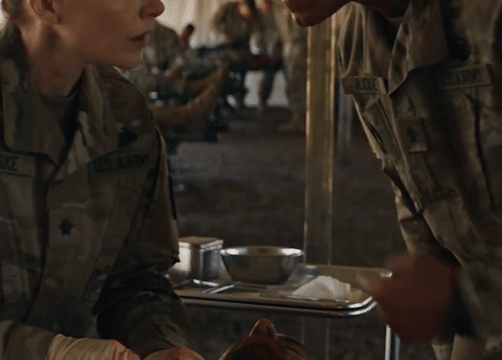
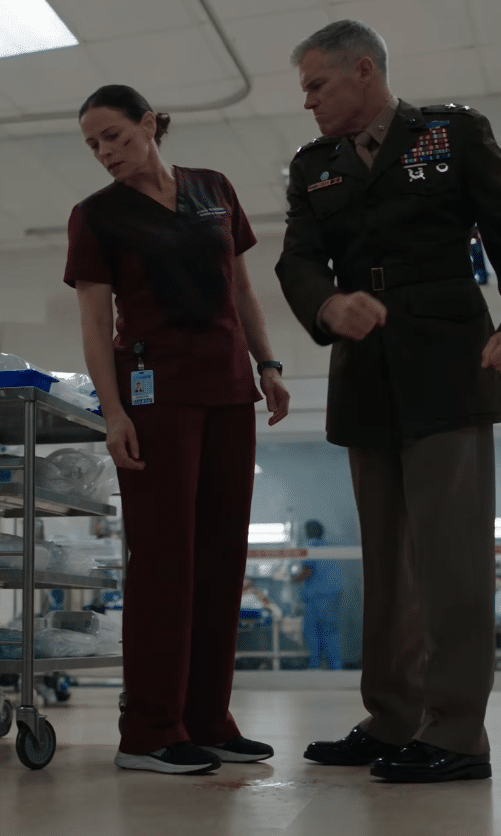
A woman in burgundy medical scrubs stood beside the unstable soldier’s stretcher.
Her black hair was secured in a neat low bun, and her white medical coat hung open over her scrubs. She had been working through a relentless stream of casualties, making difficult decisions with the calm precision of an experienced military physician.
She looked at the general.
“Not while that soldier is unstable.”
The general’s expression hardened.
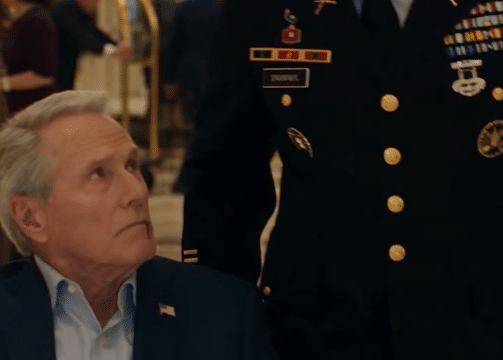
He was 48, impeccably dressed in his service uniform, with visible general-officer insignia, a row of ribbons, and polished shoes.
He was accustomed to giving orders.
He was not accustomed to having them questioned.
“Doctors follow command.”
The woman turned her attention back toward the unstable soldier.
She knew the medical priority.
She knew what was at stake.
And she refused to let someone’s personal connections determine who received lifesaving treatment first.
The general stared at her, his jaw tightening.
Around them, nurses and medical staff continued working, but several had begun watching the confrontation.
The general’s aide waited impatiently.
The doctor remained beside her patient.
Then the general made a decision that would turn an ordinary dispute over medical priority into a scandal no one inside that hospital would forget.
Act II
The Brigadier General believed his rank entitled him to immediate compliance.
His aide was injured, and he wanted the best available trauma room reserved for him.
There was only one problem.
Another soldier needed it more urgently.
The doctor had already assessed the situation. Her decision wasn’t personal, political, or based on anyone’s rank.
It was medical.
The unstable soldier could not safely wait.
But the general seemed incapable of accepting that someone wearing medical scrubs could refuse an officer wearing stars.
He stepped closer to her.
She didn’t move.
His face tightened with anger.
Then, in a sudden display of aggression, he grabbed a cup of water and threw its contents directly into her face.
The empty cup hit the floor.
Before she could react, he struck her hard across the cheek.
Her head snapped sideways.
Her cheek reddened and began to swell, and a faint trace of blood appeared at the corner of her mouth.
A nurse gasped.
The doctor stumbled, trying to maintain her balance.
But the general wasn’t finished.
He followed with a forceful kick to her stomach.
The impact knocked the breath from her lungs, forcing her to fold forward and drop beside the medical cart.
For a moment, the trauma bay fell into stunned silence.
Medical staff stared at the officer.
His aide looked uncomfortable.
Nobody had expected a disagreement over treatment priority to turn into an assault inside a military hospital.
The general stood over the injured physician, apparently satisfied that he had finally established who was in charge.
But the woman was still conscious.
And even as she struggled to recover her breath, her attention returned to the unstable soldier.
The man who had attacked her still didn’t understand the seriousness of what he had done.
Act III
“Doctors follow command.”
The general repeated the words with cold satisfaction.
He looked around the trauma bay, seemingly expecting the staff to fall into line.
But something was wrong.
Nobody appeared impressed.
The nurses were looking at the injured doctor. One of them moved closer to check on her, while another glanced toward the unstable soldier.
The physician slowly pushed herself upright.
Water dripped from her hair and white coat.
Her cheek was swollen, and the corner of her mouth showed a faint trace of blood.
She could barely hide the pain in her abdomen.
Yet she didn’t begin arguing with the general.
She didn’t demand an apology.
She didn’t ask anyone to punish him.
Instead, she looked toward the soldier whose treatment had been interrupted.
That single decision revealed more about her character than any military insignia could have.
She was there to save lives.
The general, meanwhile, was still focused on his own authority.
He adjusted his uniform and looked toward his aide, apparently expecting the medical team to finally surrender the room.
But the atmosphere had changed.
A nurse was already helping the doctor regain her balance.
Another staff member was preparing to continue the patient’s treatment.
The general looked increasingly irritated.
Then, suddenly, the automatic double doors at the far end of the trauma floor opened sharply.
Several people turned.
A decorated senior general entered with four staff officers.
His uniform carried multiple stars and an impressive collection of medals and ribbons.
His polished shoes moved steadily across the hospital floor.
He didn’t stop to question the staff.
He didn’t look toward the waiting aide.
He walked directly toward the injured physician.
And the Brigadier General finally noticed him.
Act IV
The arriving officer carried the unmistakable presence of someone accustomed to commanding at the highest levels.
His face remained outside the camera frame.
The shot showed only his decorated shoulders, multiple stars, formal trousers, and polished shoes as he moved through the trauma floor.
Four staff officers followed closely behind him.
The medical personnel immediately became more attentive.
The woman in burgundy scrubs looked toward the approaching figure.
She remained beside the medical cart, visibly injured but composed.
The senior general continued toward her.
Not toward the Brigadier General.
Not toward the aide.
Toward the doctor.
The distinction was impossible to miss.
The Brigadier General slowly turned his body.
At first, he seemed confused by the arrival.
Then his eyes moved toward the stars on the senior officer’s uniform.
His expression changed.
He recognized the authority represented by those insignia.
This was not someone who could be dismissed with an angry explanation or intimidated by a display of rank.
The senior general kept walking.
His staff officers remained behind him.
The trauma bay seemed to grow quieter with every step.
The Brigadier General looked toward the injured doctor again.
Her wet white coat.
Her swollen cheek.
The blood at the corner of her mouth.
Then he looked back at the approaching commander.
Something was beginning to make sense.
He had just assaulted a woman whose identity and position he had never bothered to establish.
And the person approaching her clearly knew exactly who she was.
Act V
The senior general stopped just beyond the camera’s frame.
The shot remained focused on the Brigadier General.
His expression had changed completely.
Only moments earlier, he had been issuing orders, demanding priority treatment, and reminding everyone that doctors followed command.
Now he seemed unable to move.
His eyes widened.
His mouth opened slightly.
The confidence that had defined his behavior throughout the confrontation began disappearing.
The medical staff watched in silence.
The aide who had originally demanded the trauma room looked toward the senior commander, then back at his own superior.
The injured physician remained outside the final shot.
There was no dramatic announcement of her rank.
No one explained her military history.
No one needed to.
The Brigadier General was beginning to understand that the person he had just assaulted was connected to someone whose authority could make his own position look very small.
He swallowed.
His polished military bearing began to crack.
The senior officer remained just beyond the camera’s view.
Then the Brigadier General finally found his voice.
“Sir… why are you here?”
The question came out differently from every order he had given earlier.
It was no longer demanding.
It was frightened.
And the most important person in the room was no longer the officer who had shouted the loudest.
The man who believed his rank placed him above the rules was about to discover that the woman he had attacked might outrank everyone he had ever dared to challenge.