Act I
“My driver gets your team.”
The Major General’s voice cut through the noise of the battlefield triage station.
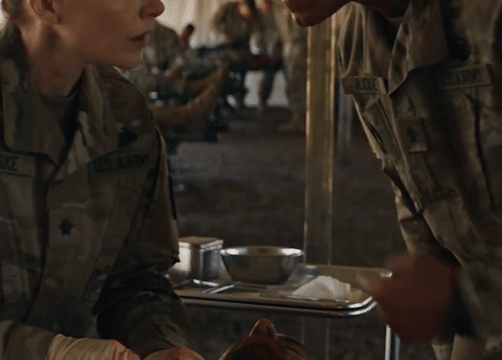
Two wounded soldiers lay on stretchers beneath a canvas awning. One was barely responsive. The other struggled to breathe while a medic worked desperately to stabilize him.
But the officer wasn’t looking at them.
His attention was fixed on a man standing beside a military vehicle. His driver had suffered an injury, but he was conscious, standing on his own feet, and capable of walking.
The woman in gray medical scrubs looked from the driver to the two soldiers.
Her dark-blond hair was pulled into a low bun. An olive medical vest covered her uniform, and her gloved hands still carried the signs of a long shift.
She had been treating casualties since the first ambulances arrived.
“He’s walking. They aren’t.”
The Major General turned toward her.
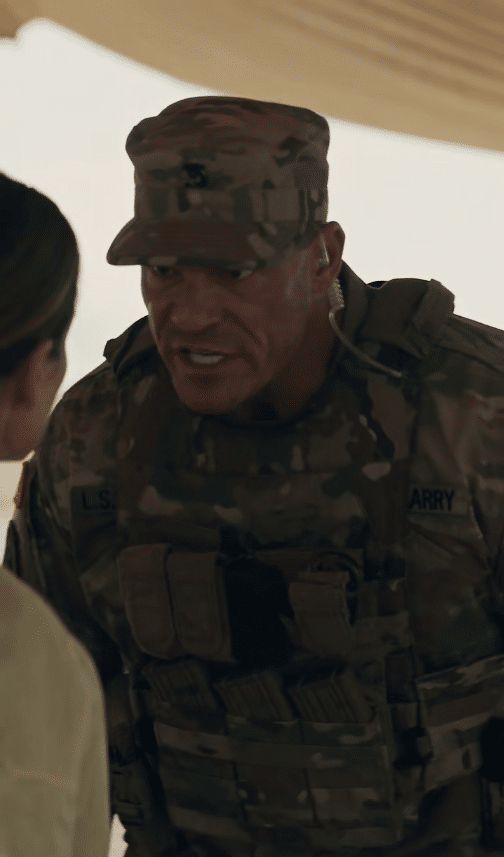
He was 50, wearing a combat uniform, body armor, and muddy boots. His expression suggested that he had never encountered a refusal he couldn’t overcome.
He pointed toward his driver.
“I gave you an order.”
The physician didn’t move.
She had already assessed the wounded soldiers. Both needed immediate attention. Sending her medical team away to treat a man who could walk would put two lives at unnecessary risk.
There was no medical justification for what the general demanded.
But he wasn’t interested in medical justification.
To him, his driver was part of his command. And anything connected to his personal comfort appeared to matter more than the lives of two ordinary soldiers.
The doctor held her ground.
The general stepped closer.
And the next few seconds would reveal just how far he was willing to go to make everyone obey.
Act II
The battlefield triage point was never quiet.
Ambulance engines rumbled nearby. Radios crackled with incoming casualty reports. Medics moved between stretchers while dust and exhaust drifted across the temporary treatment area.
Every available pair of hands mattered.
The physician understood that better than anyone.
She had spent years working in military medicine, learning to make decisions under pressure when there were more patients than resources.
She knew that rank could determine command responsibility.
It could not determine which wounded person would receive treatment first.
That principle was the foundation of triage.
The Major General, however, had a different understanding of the military system.
His driver had served him for years. He knew the man’s family, had trusted him with his movements, and considered him an important part of his personal security.
When the driver was injured, the general had expected the medical team to respond immediately.
He had not bothered to ask about the other casualties.
He had simply decided that his driver should come first.
The physician’s refusal embarrassed him in front of his own personnel.
A few soldiers had heard the exchange. One medic briefly looked up before returning to the patient in front of him.
The general noticed.
His face darkened.
He stepped toward the physician and seized the medical bag from her hands.
Before she could recover it, he threw it onto the ground.
Medical supplies scattered across the dusty surface.
The woman looked down at the bag.
Then she looked back at the general.
She still didn’t raise her voice.
That restraint seemed to anger him even more.
He had expected fear.
Instead, he was facing someone who appeared more concerned about the wounded soldiers than about the officer standing in front of her.
And that was something his authority had never taught him how to handle.
Act III
The slap came without warning.
The general struck the physician hard across one cheek.
Her head snapped to the side. The impact left her cheek red and swollen, and a faint trace of blood appeared at the corner of her mouth.
A nearby medic froze.
Another soldier took an instinctive step forward, then stopped, stunned by what he had just witnessed.
The physician tried to regain her balance.
Before she could straighten, the general drove a hard punch into her stomach.
The air left her lungs.
She folded forward, struggling to breathe, one hand reaching toward the nearby medical cart for support.
The assault had happened in seconds.
There was no battlefield enemy in front of them. No incoming attack. No emergency requiring an officer to use force.
It was simply a senior commander attacking a medical professional because she refused to abandon two critically wounded soldiers.
The general stood over her.
“Rank decides priorities.”
He delivered the words as though they were a law that everyone present had forgotten.
But the physician didn’t look at him.
She looked past him.
The two wounded soldiers were still waiting.
One medic had moved closer to help her, but she gave a small gesture toward the patients, insisting through her actions that their treatment must continue.
Her face was hurting.
Her breathing was unsteady.
Yet her attention remained where it had been from the beginning.
The general followed her gaze and seemed irritated that even now she wasn’t giving him the submission he wanted.
He had thrown her medical bag aside.
He had struck her in front of the entire triage station.
And still, he hadn’t managed to change her decision.
Then a deep engine noise approached from the convoy road.
Several heads turned.
Two command vehicles were coming directly toward the triage point.
Act IV
The vehicles braked hard beside the canvas awnings.
Dust rose around their tires.
The doors opened, and a senior general stepped out with five officers.
He wore a decorated field uniform with high-ranking insignia on his shoulders. His presence was immediately distinguishable from the other personnel around him.
The camera never showed his face.
Only his decorated shoulders, his uniform, and his field boots were visible as he began walking toward the medical area.
The five officers followed behind him.
The medics noticed the arrival first.
One stopped moving for a moment. Another turned fully toward the approaching group.
The physician, still recovering beside the medical cart, lifted her head.
The senior general didn’t stop to inspect the vehicles.
He didn’t ask for a situation report.
He didn’t approach the Major General or his driver.
He walked directly toward the injured doctor.
The Major General turned around.
At first, his expression showed annoyance. He appeared to assume that another commander had arrived to discuss the situation.
Then he noticed the senior officer’s decorations.
His eyes moved toward the insignia on the man’s shoulders.
His posture changed.
The confidence that had allowed him to attack a physician in front of dozens of witnesses began to disappear.
The senior general kept walking.
His five officers maintained their formation behind him.
The Major General glanced toward the woman beside the medical cart.
Then back toward the approaching figure.
He seemed to be trying to understand why a commander of that level would arrive at a battlefield triage station and walk straight toward her.
The answer was becoming increasingly difficult to ignore.
The woman he had treated as an insignificant subordinate was not someone he should have challenged.
And the senior general appeared to know her personally.
Act V
The noise of the battlefield continued around them.
An ambulance idled nearby. A radio crackled. Somewhere beneath the canvas awning, a medic resumed work on one of the critical soldiers.
But the Major General seemed no longer aware of any of it.
His attention was fixed on the decorated officer approaching the physician.
He had spent the entire confrontation believing that his rank made him untouchable.
He had demanded that an entire medical team be diverted for his driver.
He had ignored two critically wounded soldiers.
He had thrown a medical bag to the ground and struck the woman who refused to obey him.
Now, the consequences of that decision were approaching in the form of someone whose authority he clearly recognized.
The senior general continued forward.
His face remained outside the frame.
The physician stayed beside the medical cart, her swollen cheek visible, her breathing still recovering from the blow to her stomach.
The arriving commander was not walking toward the officer who had demanded special treatment.
He was walking toward her.
The Major General’s expression changed from confusion to disbelief.
His jaw tightened.
His eyes widened.
For the first time, he seemed to understand that the confrontation had become something much larger than a disagreement over medical resources.
He looked toward the senior general again.
Then, almost as if the words escaped before he could stop them, he spoke.
“Why… why did he come here?”
The question hung in the air.
The man who had insisted that rank decided priorities now looked terrified of the person whose arrival had changed everything.
And the woman he had assaulted had not needed to reveal a single star on her uniform.
The senior commander had already come looking for her.