Act I
“Watch your chair.”
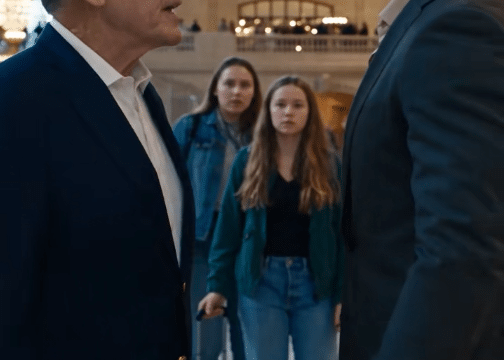
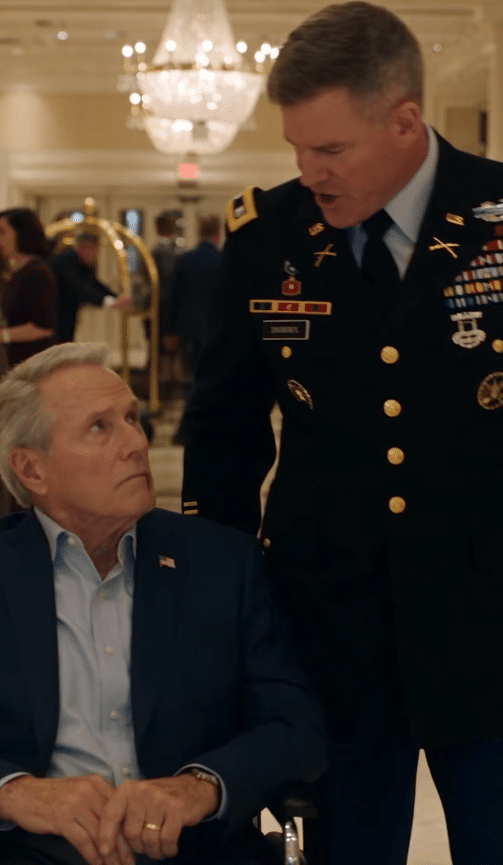
The words came from a tall man in a military dress uniform, his polished shoes stopping inches from a black wheelchair in the middle of a five-star hotel lobby.
The elderly man seated in it looked up.
He was 74, with short silver hair, a charcoal blazer, and a light-blue shirt. His expression was sharp but peaceful, the kind of quiet dignity that made it difficult to imagine him raising his voice at anyone.
A minor collision had brought them face-to-face.
The wheelchair had accidentally brushed against the officer as the older man navigated the crowded marble floor. It was an ordinary mistake in a busy lobby filled with conference guests, military personnel, spouses, and travelers.
The elderly man offered a calm explanation.
“It was an accident.”
But the officer wasn’t interested.
He was a 48-year-old Brigadier General, tall and broad-shouldered, with brown-gray hair and a service uniform decorated with ribbons and visible rank insignia.
He looked down at the wheelchair as though it were an insult to his presence.
The veteran waited patiently.
He had spent enough years around military officers to recognize arrogance when he saw it. He also knew that an accidental bump was not worth an argument.
But the Brigadier General wasn’t finished.
He leaned closer, his expression turning openly contemptuous.
“Being in that chair doesn’t make you special.”
Several people nearby stopped talking.
A hotel employee looked toward the confrontation. Two conference guests exchanged uneasy glances.
The elderly man remained composed.
He didn’t know that the officer was about to turn a minor collision into an act of violence that would bring an entirely different level of military authority through the hotel’s front doors.
Act II
The elderly man had once commanded at the highest level of the United States military.
He was a retired Four-Star General.
For decades, he had served in positions where every decision carried consequences. He had commanded thousands of personnel, worked alongside senior civilian leaders, and earned the respect of people who understood what military service demanded.
But retirement had changed his priorities.
He no longer needed a motorcade to enter a building or a staff officer to arrange his movements. He preferred ordinary clothes, quiet travel, and the freedom to go wherever he wanted without being recognized.
His wheelchair was part of his daily life.
He had never considered it a symbol of weakness, nor did he expect strangers to treat him differently because of it.
He had learned that dignity did not depend on how a person moved.
The Brigadier General, on the other hand, seemed to believe that dignity was something attached to rank, appearance, and public deference.
He was attending a military leadership conference at the hotel. His uniform was immaculate, his decorations prominently displayed, and his posture suggested that he expected people to notice his position.
The collision had irritated him.
The veteran’s calm response irritated him even more.
In his mind, the older man should have apologized repeatedly, moved aside, and accepted whatever treatment the officer decided to give him.
Instead, the veteran simply waited.
He didn’t argue.
He didn’t mention his own service.
He didn’t attempt to compete with the man’s rank.
That quiet refusal to be intimidated was precisely what the Brigadier General couldn’t tolerate.
And in a lobby full of witnesses, he decided to make an example of someone he believed could not fight back.
Act III
The Brigadier General struck first.
His fist connected hard with the elderly man’s cheek.
The veteran’s head snapped sideways. His cheek quickly reddened and began to swell, while a faint trace of blood appeared at the corner of his mouth.
A woman near the reception desk gasped.
The elderly man straightened again in his wheelchair.
He didn’t look away.
The officer stepped backward, creating distance before launching himself forward.
Then he drove a powerful kick straight into the veteran’s chest.
The impact sent the older man backward and out of the wheelchair.
His shoulder and arm struck the polished marble floor.
The wheelchair tipped onto its side beside him, one wheel continuing to spin.
For a moment, the entire lobby seemed to stop.
A luggage cart stood abandoned near the reception area. A hotel employee covered her mouth. Several guests stared in disbelief.
The veteran remained conscious.
He was breathing heavily, one hand holding his torso as he tried to steady himself.
His cheek was swollen.
His blazer had shifted against the floor.
The overturned wheelchair lay beside him.
The Brigadier General looked down at the man he had just kicked out of it.
“Being in that chair doesn’t make you special.”
He delivered the insult with a smugness that made the surrounding silence even more uncomfortable.
Nobody laughed.
Nobody agreed.
The officer had expected the display of force to establish his dominance. Instead, he had exposed something far more revealing about himself.
The elderly man was injured, but he hadn’t begged.
He hadn’t tried to excuse himself.
He hadn’t even answered the insult.
He simply remained conscious and dignified on the floor while strangers began moving toward him.
Then the sound of military vehicles braking outside interrupted the stunned silence.
Act IV
Multiple military SUVs pulled up outside the hotel.
Their arrival drew the attention of guests near the glass entrance.
The doors opened.
A Four-Star General entered the lobby with five decorated senior officers.
His face remained outside the camera’s view.
The visible details were enough to identify his position: four-star shoulder insignia, a dense rack of medals and ribbons, a formal decorated uniform, and polished boots moving across the marble.
The five senior officers followed closely behind him.
The hotel staff immediately recognized that this was no ordinary arrival.
The senior commander scanned the lobby.
Then he saw the overturned wheelchair.
He saw the elderly man lying beside it.
And he saw the injury on his face.
His pace changed.
He moved directly toward the veteran.
The Brigadier General turned at the sound of the approaching group. At first, he looked irritated by the interruption.
Then he noticed the four stars.
His expression shifted.
The senior commander continued forward, his officers following in silence.
The veteran looked up from the floor.
A faint recognition crossed his face.
The Four-Star General stopped near him.
For a moment, the camera showed only the decorated uniform and the overturned wheelchair.
Then the commander turned toward the Brigadier General.
His voice was cold and controlled.
“Who kicked him out of that chair?”
The question landed harder than a shout.
The Brigadier General’s face began to lose its color.
He looked at the four-star insignia.
Then at the elderly man.
Then back at the commander.
Suddenly, the uniform he had worn so proudly seemed to offer very little protection.
Act V
The Brigadier General stood frozen.
Only seconds earlier, he had been the most confident person in the hotel lobby.
He had struck an elderly man in front of dozens of witnesses, kicked him out of his wheelchair, and insulted him while he lay injured on the floor.
He had behaved as though the veteran’s age and disability made him an easy target.
Now a Four-Star General was standing beside the overturned wheelchair, demanding to know who was responsible.
The five senior officers behind him watched without speaking.
The veteran remained on the floor, breathing through the pain.
His expression was controlled.
He didn’t need to announce his former rank.
He didn’t need to explain his military history.
The senior commander already knew him.
And that was what frightened the Brigadier General most.
He looked again at the elderly man.
The charcoal blazer.
The light-blue shirt.
The silver hair.
The face he had dismissed as belonging to an insignificant stranger.
Then he looked toward the Four-Star General, whose attention remained fixed on the victim.
The officer’s confidence collapsed.
He seemed to search desperately for a way to explain what had happened, but every possible excuse appeared inadequate.
The hotel lobby remained silent.
The guests who had witnessed the assault were now watching the Brigadier General instead.
His eyes widened.
His lips parted.
Then the realization became too overwhelming to hide.
“Sir… not him.”
The words came out almost like a plea.
But the damage had already been done.
He had judged a man by his wheelchair and mistaken humility for helplessness.
And now, in front of the very people whose respect he had wanted, the Brigadier General was discovering that the elderly veteran on the marble floor was someone he should have recognized long before he ever raised his hand.