Act I
“Pick that up before I shut this whole stand down.”
The threat rang across the crowded commuter rail platform.
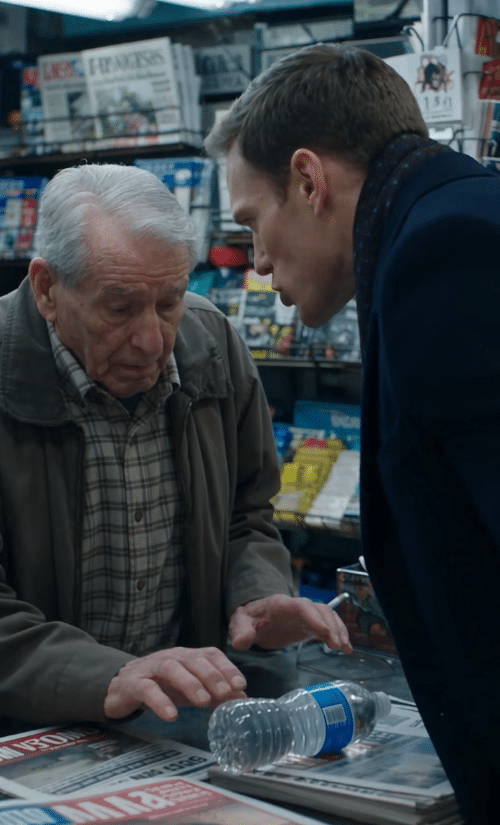
A small bottle of water had fallen beside an elderly man’s newspaper cart, rolling across the concrete before stopping near the polished shoes of a sharply dressed stranger.
The vendor, a 74-year-old man with silver hair and a slightly stooped posture, immediately bent down to retrieve it.
He wore an old brown jacket, a checkered shirt, and worn sneakers. His little stand sold newspapers and bottled water to commuters rushing toward their morning trains. It wasn’t much, but it was how he made a living.
The man standing over him clearly didn’t care.
Dressed in a tailored dark coat, an expensive scarf, and perfectly pressed charcoal trousers, he looked like someone accustomed to having his demands obeyed.
The elderly vendor hurried to pick up the bottle.
But before he could say anything, a woman stepped forward.
She wore a forest-green wool coat, black trousers, and dark boots. Her dark hair was tied into a low ponytail, and a leather shoulder bag rested against her side.
She had been watching the confrontation.
And she had seen enough.
“You don’t threaten someone over a bottle.”
The man slowly turned toward her.
His expression changed from irritation to open contempt.
“And you don’t tell me what I can do.”
The woman remained calm.
The bully moved closer, lowering his voice.
“Wrong platform to play hero.”
Around them, commuters began slowing down. A few passengers exchanged nervous looks, while others pretended to concentrate on the departure boards.
The elderly vendor looked between the two strangers, realizing that the woman had just placed herself in the middle of something dangerous.
But she wasn’t moving.
And the man was about to discover that intimidating strangers was not the same as controlling them.
Act II
The bully was a man who believed that respect could be demanded rather than earned.
His appearance suggested money, influence, and discipline. His expensive scarf and tailored coat were immaculate, and his athletic build gave him an imposing presence.
He carried himself with the confidence of someone who rarely heard the word no.
The elderly vendor, unfortunately, had learned to recognize people like him.
For years, he had worked that platform, opening his newspaper stand before sunrise and staying until the evening rush faded. He had dealt with impatient commuters, rude customers, and people who treated him as though he were invisible.
But this man was different.
He wasn’t simply annoyed by the fallen bottle.
He wanted to demonstrate that he could threaten someone’s livelihood without consequences.
The woman in the green coat understood exactly what was happening.
She could have walked away. She could have boarded the next train and forgotten the entire incident.
Instead, she stayed beside the elderly man.
The bully studied her for another moment.
He seemed offended that someone who knew nothing about him would dare question his authority.
His expression hardened.
Then his patience disappeared.
Without warning, he launched a sudden straight strike toward her face.
The impact snapped her head sideways.
Her cheek quickly reddened and began to swell, while a faint trace of blood appeared at the corner of her mouth.
Several passengers gasped.
But the man immediately followed with a powerful kick to her torso.
The blow knocked the breath from her lungs and forced her backward toward a station column.
Before she could fully recover, he delivered another hard upper-body strike, driving her farther against the column.
The elderly vendor froze.
A passenger near the departure board raised a hand to his mouth. Another stepped backward, terrified that the confrontation might spread.
The bully stood confidently in front of his injured opponent.
He believed he had made his point.
But the woman was already beginning to straighten.
And the look in her eyes was not the look of someone who had surrendered.
Act III
For a moment, the woman leaned against the station column, carefully controlling her breathing.
Her cheek was swollen.
The pain in her torso was obvious.
Yet she refused to lower her gaze.
The bully adjusted his scarf and took a step away, apparently satisfied with the outcome.
He had expected the woman to retreat after the first strike. Instead, she had challenged him again simply by remaining where she was.
That seemed to irritate him even more.
He looked toward the elderly vendor, who was still standing beside his newspaper cart.
The old man appeared frightened and helpless.
The bully had wanted to humiliate him from the beginning. Now he seemed determined to make sure everyone understood who controlled the platform.
But the woman was watching him.
She reached up and gently wiped the small trace of blood from the corner of her mouth.
Her breathing gradually steadied.
There was no panic in her expression.
Only determination.
She had spent enough time observing the man’s movements to understand that his confidence came from believing nobody would challenge him twice.
She wasn’t going to make that mistake.
The elderly vendor looked at her with growing concern.
He wanted her to stop.
He had no idea who she was, why she was willing to endure this humiliation, or why she seemed so unwilling to abandon him.
But he understood one thing.
She had stepped forward when everyone else had looked away.
The bully moved toward her again.
She lifted her eyes.
“One more step.”
The words were quiet, but they carried across the platform.
The man stopped briefly.
Then a mocking expression appeared on his face.
He had mistaken her warning for another opportunity to demonstrate his dominance.
And he was about to make his final mistake.
Act IV
The bully deliberately advanced.
His shoulders tightened, and his movements suggested that he intended to attack again.
The woman watched him carefully.
This time, she wasn’t caught by surprise.
As he came forward, she stepped diagonally off his line of attack.
In one controlled movement, she delivered a short counterstrike into his torso.
The man staggered backward.
His expensive shoes scraped against the platform as he struggled to recover his balance.
The impact seemed to leave him momentarily speechless.
A sudden silence fell over the waiting passengers.
He brought a hand toward his mouth.
When he lowered it, a faint trace of blood marked the corner of his lips.
His expression changed immediately.
For the first time, the confidence disappeared from his face.
He stared at the woman as though he were seeing her for the first time.
She had not chased him.
She had not continued striking him after he stumbled.
Instead, she stepped back into a stable ready stance and waited.
Her movements were controlled, economical, and deliberate.
The difference between them had become impossible to ignore.
He had relied on aggression to frighten someone into submission.
She had relied on patience until she had no choice but to defend herself.
The elderly vendor watched in disbelief.
A commuter slowly lowered his phone. Another passenger moved closer to the newspaper stand, checking that the older man was all right.
The bully touched his mouth again.
His eyes shifted briefly toward the crowd.
Everyone had seen what happened.
And everyone had seen that the woman was still standing.
The man had started this confrontation believing he could make an elderly vendor feel powerless.
Now he was the one struggling to understand how quickly his control had disappeared.
Act V
The platform remained silent.
A train announcement echoed overhead, followed by the distant sound of an approaching commuter train.
But the passengers weren’t watching the tracks anymore.
They were watching the two people standing several feet apart.
The bully stood in the foreground, his dark coat slightly disheveled and a faint trace of blood visible at the corner of his mouth.
His hands slowly came up.
He was still angry.
His pride wouldn’t allow him to admit that the woman had stopped him.
But something had changed.
He no longer moved with the careless confidence he had displayed when he first approached the newspaper stand.
He was measuring her now.
Across from him, the woman in the forest-green coat maintained her ready stance.
Her cheek was swollen, and every breath reminded her of the blows she had taken.
Yet she didn’t look away.
She hadn’t stepped forward to become a hero.
She hadn’t asked for recognition.
She had simply refused to let a vulnerable elderly man be threatened over something as insignificant as a fallen bottle.
Behind her, the vendor slowly reached for the edge of his cart.
His hands were still shaking, but he was no longer alone.
The crowd had finally stopped pretending not to see what was happening.
The bully looked at the woman.
His jaw tightened.
Then he forced a defiant expression onto his face, trying to hide the uncertainty that had replaced his arrogance.
“Fine. Let’s see what you’ve got.”
The woman didn’t answer.
She held her position.
The camera captured the faint blood at the corner of his mouth, then shifted to her steady eyes.
The confrontation wasn’t over.
But the balance of power had changed.
He had threatened an elderly man’s livelihood over a bottle of water. He had attacked the woman who defended him. And now, for the first time, he was facing someone who refused to be intimidated.