Act I
“My son gets the room.”
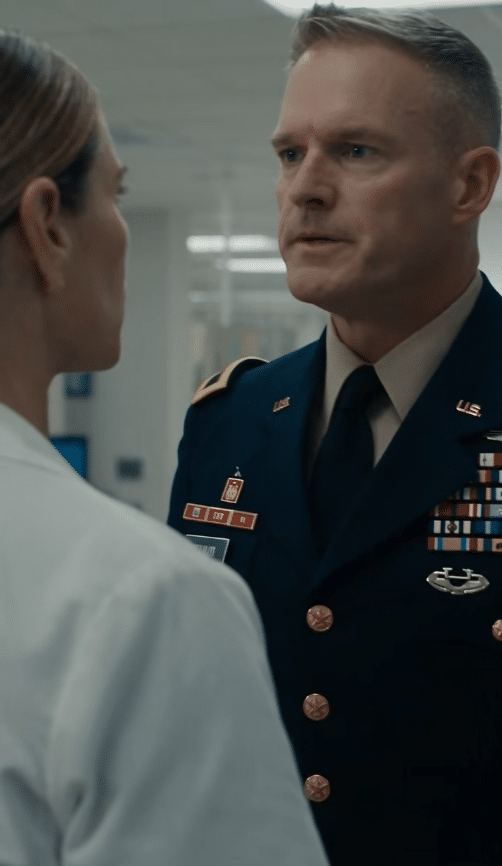
Brigadier General Thomas Vance stood in the middle of Therapy Room Four, pointing toward the padded rehabilitation area where several wounded service members were completing their scheduled sessions.
His son stood behind him, wearing a medical support brace and looking impatient.
Across the room, a female physician in a white medical coat checked the rehabilitation schedule. She was forty-one, with brown hair secured in a low bun and a calm, clinical expression.
She didn’t look impressed by the stars on Vance’s uniform.
“He gets it when this session is finished.”
The general stared at her as though he hadn’t heard correctly.
His son had arrived expecting immediate access to the therapy room. Vance had assumed that his position would make the arrangement simple.
But the doctor had already explained that the room was occupied by service members whose rehabilitation sessions could not safely be interrupted.
One patient was relearning how to walk without assistance.
Another was recovering from a serious leg injury and needed the equipment for a carefully supervised exercise.
The physician refused to displace them.
Vance’s face tightened.
He picked up a water bottle, threw its contents into her face, and dropped the bottle to the floor.
Then he slapped her hard across one cheek.
The sound cut through the room.
Her cheek reddened and began to swell. A faint trace of blood appeared at the corner of her mouth.
Before she could regain her balance, Vance shoved her backward.
She struck one elbow against the edge of a padded therapy bench and fell beside it.
The wounded service members froze.
A physical therapist stopped mid-step. A young soldier gripping a pair of parallel bars stared in disbelief.
Vance stood over the physician.
“Doctors don’t tell generals no.”
The woman steadied herself.
Her expression showed pain, but there was no pleading in her eyes. She checked the room, making sure the patients were safe, then slowly brought herself upright.
She reached for her phone.
“Rehab Wing. Therapy Room Four. Three minutes.”
Vance gave a dismissive laugh.
“Bring your hospital director.”
He believed the matter was about to be settled in his favor.
But three minutes later, a command group would appear at the end of the corridor.
And the first words from the senior general leading it would make Vance question everything he thought he knew about the woman standing in front of him.
Act II
The physician had introduced herself to the rehabilitation staff simply as Doctor Morgan.
She wore gray medical scrubs beneath an open white coat, carried a clipboard, and spent more time watching patients move than looking at the hospital’s administrative charts.
She didn’t demand special treatment.
She didn’t discuss her career history.
And she never used military rank as a substitute for medical judgment.
To the wounded service members, she was the doctor who remembered which patient was afraid of falling, which one needed extra time before attempting another step, and which one pretended not to be in pain because he didn’t want to disappoint his rehabilitation team.
She had a way of making people feel that their recovery mattered.
That was why the staff trusted her.
The rehabilitation ward was not an ordinary hospital department. Many of its patients had returned from deployments with injuries that had changed the direction of their lives.
Some were learning to walk again.
Others were rebuilding strength after surgeries, adapting to mobility equipment, or struggling with the emotional weight of being unable to perform tasks they had once considered effortless.
Progress was measured in small victories.
A few extra steps.
A steadier movement.
The ability to stand without assistance for several seconds longer than the day before.
The therapy room was designed around those needs.
Every session was scheduled carefully because the equipment, staff, and available space were limited.
That morning, the schedule had been especially difficult to rearrange.
Several patients had already been assigned their time slots, and moving them without medical justification could interrupt treatment plans.
Doctor Morgan had reviewed the schedule herself.
When General Vance arrived with his son, she had listened to the request and explained the situation.
His son could have the room when the current session was finished.
It was a reasonable answer.
It was also an answer Vance had never learned to accept.
At forty-nine, he had become accustomed to having doors opened before he reached them. His career had taught him how to issue orders, command attention, and make people understand the consequences of resistance.
His son had grown up watching that authority work.
The young man had learned that his father’s position could solve problems before anyone else had time to object.
The rehabilitation ward was supposed to be another example.
Instead, the physician had treated him like every other patient.
Vance interpreted that as an insult.
What he didn’t know was that Doctor Morgan’s presence in the hospital was connected to a confidential military assignment.
She had not arrived merely to review treatment schedules or observe rehabilitation techniques.
She was there to examine something much larger.
And the name of that assignment had been kept away from almost everyone in the building.
Act III
The military had been quietly investigating the way medical facilities handled wounded personnel when senior officers or their families requested preferential treatment.
The issue was not simply whether someone received a faster appointment.
It was whether the people responsible for medical care could be pressured into abandoning professional judgment.
A hospital might have impressive equipment, detailed policies, and highly trained staff.
But none of those safeguards mattered if a powerful person could walk into a room and force everyone to ignore them.
The confidential evaluation had been designed to examine exactly that vulnerability.
It carried a codename known to only a limited group of senior personnel.
Gray Lantern.
Doctor Morgan was conducting the evaluation.
She had been observing the rehabilitation ward’s operations, examining scheduling decisions, reviewing treatment access, and watching how staff responded when authority and medical necessity came into conflict.
Her assignment required her to remain unobtrusive.
She was not supposed to announce her position or use her hidden authority to influence ordinary decisions.
The purpose was to see what happened when people believed they were dealing with an ordinary medical officer.
That was why she wore the same practical clothing as the rest of the clinical staff.
That was why she didn’t introduce herself with an impressive biography.
And that was why she had refused to reveal anything when Vance challenged her.
The incident in Therapy Room Four had changed the evaluation.
It was no longer simply a question of whether the hospital would protect its patients from preferential treatment.
A senior officer had physically assaulted a medical professional because she refused to displace wounded service members for his son.
The distinction mattered.
Vance had not merely argued with a scheduling decision.
He had demonstrated exactly the kind of coercive behavior the evaluation was designed to expose.
The wounded soldiers had witnessed it.
The therapists had witnessed it.
The staff members who had been too frightened to intervene had witnessed it.
And Doctor Morgan had remained composed long enough to make the call.
She didn’t ask for security.
She didn’t request the hospital director.
She didn’t explain who she was.
She gave a location and a time.
“Rehab Wing. Therapy Room Four. Three minutes.”
That short message was enough.
At the far end of the hospital corridor, a command group was already being assembled.
Vance, meanwhile, was still convinced that he had the situation under control.
He straightened his uniform and glanced at his son.
The young man looked uncomfortable now, but his father seemed to mistake that discomfort for embarrassment.
Vance expected the hospital director to arrive, apologize, and explain why the doctor had been wrong to challenge him.
He had no idea what Gray Lantern meant.
And that ignorance was about to become his greatest problem.
Act IV
The first sign that something had changed came from the corridor.
A therapist near the doorway looked up.
Then a nurse turned toward the entrance.
The sound of several approaching footsteps carried through the rehabilitation ward.
Vance glanced over his shoulder.
A command group had appeared at the far end of the corridor.
At the front walked a senior general.
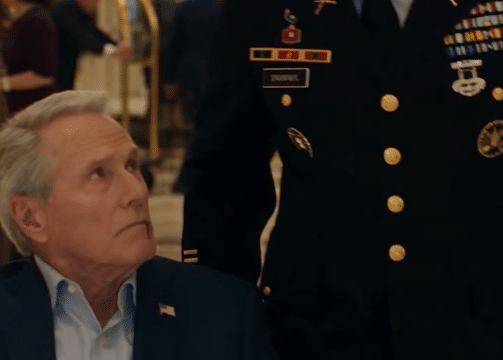
The camera of the moment, if anyone had been recording it, would have captured only the details that mattered: star-covered shoulders, a dense row of ribbons and decorations, and polished boots moving steadily across the hospital floor.
The general’s face was never shown.
He didn’t hurry.
He didn’t need to.
The personnel accompanying him maintained a respectful distance as he approached Therapy Room Four.
Vance’s posture changed almost immediately.
He recognized the level of authority represented by the uniform.
His own rank suddenly seemed much less important.
The general stopped near the entrance and looked toward the scene.
The wounded patients remained in their places.
The medical staff stood silently.
Doctor Morgan was beside the padded bench, her cheek swollen and her elbow marked where it had struck the edge.
She did not rush forward.
She did not explain herself.
The senior general looked at Vance.
“General… step back. Gray Lantern is in progress.”
The words landed harder than any reprimand.
Vance stared at him.
For a moment, he seemed unable to process what he had heard.
Gray Lantern.
He knew enough about confidential command evaluations to understand that the codename was not an ordinary hospital project.
He also understood that the senior general had not arrived to discuss a scheduling disagreement.
He had arrived because something important was happening.
And the person at the center of it was the physician Vance had just assaulted.
Vance looked at Doctor Morgan.
Then at the general.
Then back at her.
He tried to connect the pieces.
Why had she remained so calm?
Why had she made that call without giving her name?
Why had the senior general addressed the situation by using the codename instead of asking for the hospital director?
The answer was becoming clear, but the details remained hidden.
Doctor Morgan’s identity was still not being announced.
Her rank was not being stated.
No one explained her command relationship or revealed the full purpose of her assignment.
The senior general had deliberately used only the approved codename.
That restraint made the moment even more unsettling.
Vance had expected a public argument.
Instead, he had walked into a confidential command operation without understanding that it existed.
And now the people around him were beginning to understand that the doctor he had humiliated was not an ordinary observer.
Act V
Nobody in Therapy Room Four moved for several seconds.
The wounded service members watched the senior general.
The therapists looked between the officer and Doctor Morgan.
Vance stood rigidly, but the confidence that had filled his expression earlier was gone.
He had been accustomed to controlling conversations through rank.
Now he couldn’t even determine what conversation he was part of.
The senior general had not raised his voice.
He had not threatened him.
He had simply told him to step back.
That single instruction carried a weight Vance could not ignore.
Doctor Morgan remained silent.
Her attention briefly moved toward the patients.
One soldier was still holding the parallel bars. Another was seated on a padded bench, his rehabilitation session interrupted by the confrontation.
She had come to the ward to evaluate whether wounded personnel could receive the care they needed without intimidation or favoritism.
The incident had answered part of that question.
But there was something else the senior general’s arrival had made clear.
The evaluation was not over.
In fact, the most important part might only just be beginning.
Vance looked at his son.
The young man no longer seemed interested in claiming the therapy room.
He had watched his father throw water at a doctor, slap her, and shove her into a bench.
He had also watched the medical staff refuse to treat that behavior as normal.
The room had seen everything.
There would be witnesses.
There would be medical documentation.
There would be a record of the scheduled patients, the original request, and the decision Doctor Morgan had made before the assault.
And there would be a command-level review of what had happened.
Vance could no longer dismiss the incident as a disagreement over access.
He could no longer insist that the doctor had misunderstood his authority.
The general’s words had made the situation far bigger than a personal dispute.
Gray Lantern was in progress.
That meant the incident had become part of something Vance had never expected to encounter.
He looked once more at the woman in the white coat.
Her expression remained controlled.
She had not revealed her rank.
She had not announced her identity.
She had not needed to.
The senior general’s words had already changed the atmosphere in the room.
Vance finally understood that the most dangerous mistake he had made was not underestimating a doctor.
It was assuming that the person who refused to obey him had no authority beyond the room.
His voice faltered.
“Gray Lantern…? She’s the one?”
No one answered.
And in that silence, the Brigadier General realized that the woman he had tried to intimidate might have been evaluating the very system he believed he controlled.
The wounded soldiers had come to Therapy Room Four to learn how to stand again.
That afternoon, they witnessed something else: a man with stars on his uniform discovering that rank could not protect him from the consequences of his own behavior.
Doctor Morgan turned back toward the patients.
The work still mattered.
And Gray Lantern was still watching.