Act I
The wealthy woman stole the money because she thought the old woman would never know.
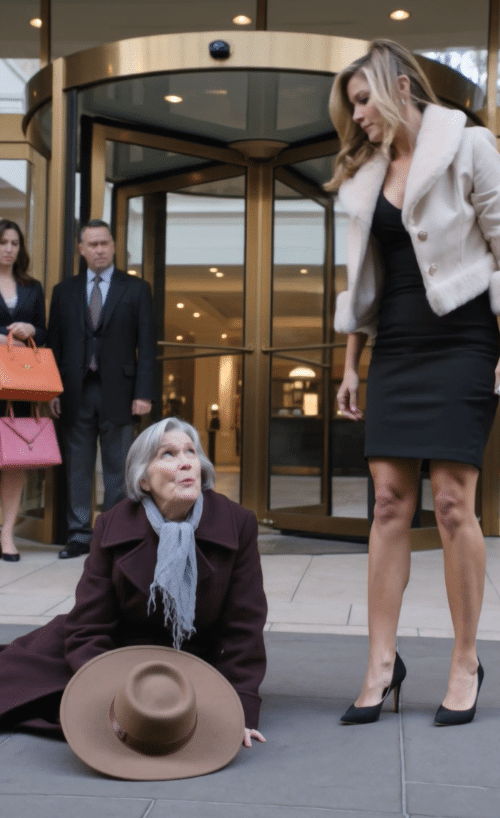
Outside the glittering entrance of one of America’s most exclusive shopping malls, a seventy-six-year-old homeless woman sat on the cold stone pavement, her purple coat faded by years of wear. Her gray scarf was wrapped tightly around her neck, but it did little to protect her from the afternoon wind sweeping between the luxury storefronts.
Her cloudy eyes stared into nothing. They had not followed a passing car, a moving shadow, or a single face all day. In front of her lay an old wide-brim hat, turned upside down with a few wrinkled bills and scattered coins inside.
People passed beneath the bright glass entrance, carrying designer shopping bags and speaking into expensive phones. Some glanced at her. Most looked away before their eyes could meet her face.
Then a woman in a white fur-style coat stopped nearby.
At forty-one, Vanessa Caldwell had perfected the appearance of someone who never had to wait, never had to apologize, and never had to wonder whether she belonged somewhere. Oversized sunglasses covered half her face, and her black dress was tailored to look effortless in the way that only expensive things could.
She looked down at the homeless woman with open disgust.
Vanessa bent as if adjusting her shoe. Her hand moved toward the old hat, quick and practiced. Two fingers slipped beneath a folded bill, then another. She drew the money out and tucked it away as casually as if she had picked up a receipt someone dropped.
She straightened, ready to continue into the mall.
But the old woman turned her head.
“I heard the bills move.”
The words were quiet, but sharp enough to stop Vanessa in her tracks.
For one suspended second, the two women remained still. The elderly woman’s cloudy eyes could not see Vanessa’s expression, but she heard the faint shift of expensive fabric and the sudden, angry breath through the younger woman’s nose.
Vanessa had expected silence. She had expected confusion, perhaps a frightened request for help. She had not expected to be caught.
“Trash,” she snapped. “You don’t even know how much was there.”
A few shoppers slowed near the revolving doors. One man lowered his phone. A door attendant glanced over, then looked toward the security desk as though waiting for someone else to decide whether this was his problem.
The old woman extended one trembling hand toward the hat.
“Please,” she said. “That was all I had.”
Vanessa’s expression hardened. To her, the request sounded less like desperation than accusation. She had spent her entire life treating embarrassment as an injury that someone else had to pay for, and now this woman in a worn purple coat had dared to make her feel exposed.
Vanessa stepped closer.
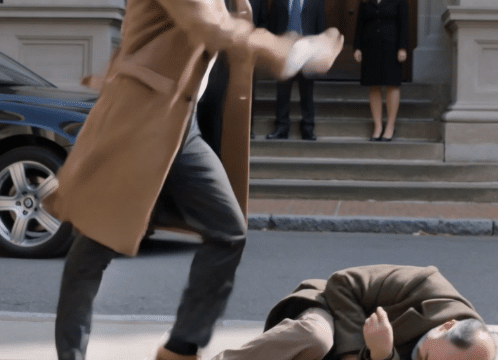
Then she drove her foot into the elderly woman’s chest.
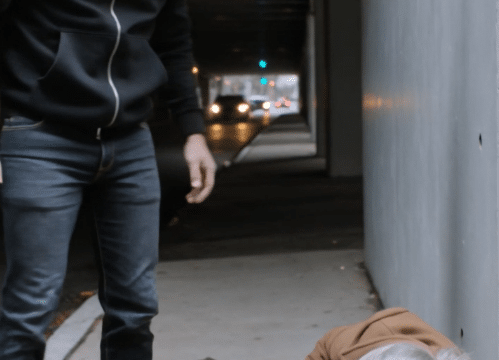
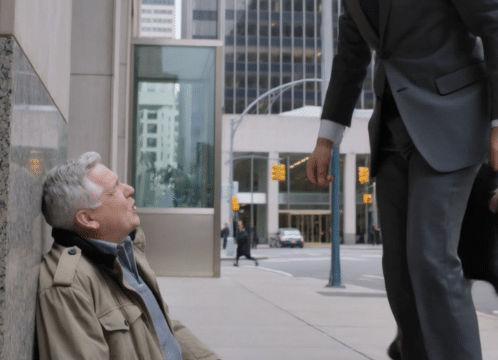
The impact knocked the woman backward onto the stone pavement. The old hat flipped beside her, sending a few coins skittering across the ground. She gasped, struggling to draw breath, and a thin trace of blood appeared along her elbow where it struck the stone.
Her hands searched blindly until her fingers brushed the brim.
She reached for the hat.
Not for Vanessa. Not for the people watching. Not even for the money that had been stolen.
Only for the hat.
Vanessa saw the movement and stepped toward her again. She delivered two more hard kicks, one to the woman’s back and another to her side. The elderly woman curled inward, her breath breaking into painful, uneven gasps.
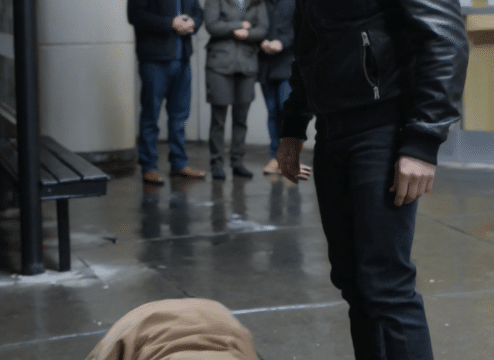
Around them, the entrance filled with horrified silence.
A shopper covered her mouth. Another took two steps backward. The door attendant froze beside the revolving doors, his face drained of color. Nobody came forward.
Vanessa stood over the woman she had just attacked, her expensive coat barely disturbed.
“Sit quietly if you want pity.”
Then a black Maybach braked hard at the curb.
The rear door flew open.
And the man who stepped out was looking straight at Vanessa.
Act II
The man crossed the pavement so quickly that several shoppers instinctively moved out of his way.
He wore a black tailored suit beneath a dark cashmere overcoat. At forty-nine, Richard Sterling was a familiar face to the people who ran the mall, the luxury brands that rented its storefronts, and the executives who attended its private events.
He owned the shopping center.
But the people outside its doors knew him for another reason. Over the previous month, his name had appeared in local news reports announcing a new initiative to connect unhoused people with emergency shelter, medical assistance, and long-term housing support.
The initiative was supposed to begin officially that afternoon.
Richard had come to the mall to meet the outreach team, inspect the entrance area, and make sure the program was more than another polished announcement designed to impress donors.
He had not expected to find its first intended beneficiary lying on the pavement while a crowd watched.
He saw the old woman reaching for her overturned hat. He saw the thin line of blood on her elbow. He saw Vanessa standing above her, still wearing the expression of someone inconvenienced rather than ashamed.
Richard did not ask what had happened.
He moved straight toward Vanessa and struck her once across the face.
The punch landed with a sharp impact. Vanessa staggered sideways, one hand flying to her mouth. When she lowered it, a thin trace of blood marked her lip.
The crowd fell completely silent.
Richard stepped between her and the elderly woman.
For a moment, he looked as though he might say something else with his fists. His shoulders were rigid, and his jaw tightened as he looked down at the woman on the ground. Then he forced his hands open at his sides.
When he spoke, his voice was low and controlled.
“She was the first person I came here to help.”
Vanessa stared at him.
Her anger did not disappear all at once. First came disbelief, then confusion, and finally a flicker of fear as she recognized him.
Richard Sterling was not merely a rich man who happened to be passing by. He was the person whose signature appeared on the mall’s ownership documents, the man whose approval determined which companies could open stores and which contracts would be renewed.
Vanessa had spent years cultivating relationships with people like him. She attended charity dinners, shopped at the mall’s most exclusive boutiques, and made sure her name appeared beside the right people in the right photographs.
She had assumed that the people who mattered would always stand on her side.
Now the owner of the building stood between her and a woman she had treated as worthless.
Vanessa touched her injured lip, unable to reconcile the scene before her with the world she thought she understood.
“To help… her?”
The words emerged as a frightened stammer.
Richard did not answer immediately. He turned his attention toward the elderly woman and lowered himself carefully to one knee, leaving enough space that she would not feel crowded.
“Ma’am, can you hear me?” he asked. “An ambulance is coming. You’re not alone.”
The woman’s face tightened at the word ambulance. Her fingers remained wrapped around the hat’s brim.
“Don’t let them take it,” she whispered.
Richard followed the direction of her hand. The hat lay on its side, a few coins scattered across the pavement and the remaining bills exposed to the wind.
“I won’t let anyone take it.”
He signaled to the nearest security officer to secure the area and call emergency services. This time, the attendant who had stood frozen moved immediately.
But Richard’s anger had not vanished. It had changed direction.
He looked at Vanessa, then at the frightened witnesses, and finally at the grand entrance behind them, where polished glass reflected the afternoon sunlight.
For years, the mall had sold the promise of elegance, safety, and exclusivity. It had trained its staff to recognize important customers and anticipate their needs. It had placed guards at the doors, cameras above the corridors, and expensive signs everywhere reminding visitors that every detail mattered.
Yet a blind elderly woman had been assaulted in front of those same doors while people who saw everything pretended they had seen nothing.
Richard had come to launch a program intended to help people like her.
Now he understood that the first thing he needed to confront was not homelessness alone.
It was the comfortable cruelty that allowed some people to believe that poverty made a human being fair game.
And when he finally asked the woman her name, her answer revealed how little anyone had bothered to learn about her.
Act III
“Eleanor,” the woman whispered.
Richard leaned closer so she would not have to raise her voice.
“Eleanor what?”
She hesitated.
“Just Eleanor is fine.”
The answer unsettled him more than he expected. He had spent the previous weeks reviewing statistics, funding proposals, housing partnerships, and reports filled with categories: unsheltered adults, emergency placements, chronic homelessness, vulnerable populations.
He had approved budgets designed to help thousands of people.
Yet the woman in front of him seemed so accustomed to being overlooked that even her name felt like something she needed permission to share.
When the paramedics arrived, Eleanor recoiled at the movement around her. She could not see who was approaching, and every unfamiliar sound made her fingers tighten around the old hat.
One paramedic introduced herself and explained each movement before making it. She asked where Eleanor hurt, whether she could breathe comfortably, and whether she remembered striking the ground.
Eleanor answered in short phrases. Her chest hurt. Her side hurt more when she tried to move. Her elbow stung.
The paramedic’s expression grew serious, and she told her partner they needed to assess Eleanor carefully for possible chest injuries. The visible blood was slight, but the force of the assault could not be judged by the size of the mark on her arm.
Richard stayed close enough for Eleanor to hear his voice.
“You can take your time,” he told her. “No one is going to rush you.”
A security supervisor approached and quietly informed him that the entrance cameras covered much of the pavement. One camera faced the revolving doors; another captured the curbside lane. The footage would need to be preserved before it was overwritten.
“Do it now,” Richard said. “And make sure the original recordings are retained.”
He then turned toward the witnesses.
“Anyone who saw what happened should give a statement. No one is going to be pressured into changing what they saw.”
Several people avoided his eyes. A woman in a cream-colored coat began crying softly, admitting that she had watched Vanessa take the money but had been afraid to intervene when the violence started.
“I thought security would handle it,” she said.
Richard’s expression remained stern.
“And when security didn’t?”
She had no answer.
The truth was that everyone had been waiting for someone else to become responsible. Each person had found a reason to stay where they were, and every second of hesitation had left Eleanor alone.
Vanessa, meanwhile, had recovered enough to become angry again.
“This is absurd,” she announced, attempting to reclaim the confidence that had deserted her. “She was begging outside a private property. I was trying to move past her, and he attacked me.”
Richard turned toward her.
“You stole money from her.”
“You don’t know that.”
“Then the cameras will tell us.”
Vanessa’s mouth tightened.
She had not considered the cameras. She had assumed that the world would accept her version because her clothes were expensive, her appearance was polished, and the person she had attacked had nothing that suggested influence or importance.
But the security supervisor had already begun coordinating the preservation of the footage. A second officer stood nearby, ready to document the scene.
Richard did not tell them what conclusion to reach. He told them to record what happened.
That distinction mattered.
His punch had been an impulsive act of anger, and he understood that it would have consequences of its own. He would not pretend that owning the mall gave him the right to decide how the law should treat him or Vanessa.
But neither would he allow his own mistake to distract from the assault Eleanor had suffered.
As paramedics prepared to take her for medical evaluation, Eleanor suddenly reached toward the ground.
“My hat,” she said.
A security officer picked it up carefully and asked where she wanted it placed. Eleanor held it against herself, her fingers tracing the worn brim.
“I need to know where it is.”
Richard watched her protect that battered object with the same intensity that other people used to guard jewelry.
He finally understood that the hat was not merely a container for a few dollars. It was the small, fragile center of a life in which almost everything else had become uncertain.
The money inside could be counted. The stolen bills could perhaps be recovered.
But the humiliation of being beaten while strangers watched could not be returned to her in a paper envelope.
And when the security supervisor reviewed the first images from the cameras, the footage revealed something that made Richard’s stomach turn.
Vanessa had not merely taken the money.
She had looked directly at Eleanor before she did it, checked that the woman could not see her, and then stolen from her with deliberate confidence.
The attack had begun long before the first kick.
It had begun with the decision that Eleanor was someone who could be harmed without consequence.
Act IV
By late afternoon, the mall entrance had become the center of an investigation.
The security team preserved the recordings, documented the physical evidence, and provided the relevant footage to responding officers. Witnesses who had initially tried to leave began giving accounts of what they had seen.
The video was clear.
It showed Vanessa pause beside Eleanor, pretend to adjust her shoe, and reach into the overturned hat. It showed Eleanor turn toward the sound and speak. It showed Vanessa lean down, insult her, and launch the first kick.
There was no accidental collision. No stumble. No reasonable confusion about what had happened.
The footage also showed the two additional kicks and Vanessa standing over Eleanor afterward.
When officers began asking questions, Vanessa’s composure fractured. She insisted that Eleanor had insulted her first, then claimed she had been frightened, then suggested the entire encounter had been exaggerated.
But each explanation contradicted the recording.
One officer asked her to describe what she had done with the stolen money. Vanessa said she had not taken anything.
The footage showed otherwise.
Her expensive handbag could not protect her from the truth. Neither could the white coat, the sunglasses, or the practiced tone she had used to dismiss people who served her.
For the first time that afternoon, Vanessa had to answer questions from people who were not impressed by her social position.
Richard gave his own statement as well. He did not conceal the punch. He explained what he had seen when he arrived, what he had done, and what he remembered hearing.
He knew there would be scrutiny. Some would argue that he had acted in defense of Eleanor; others would question whether his response had been excessive. He would have to face those questions without hiding behind the authority of his office.
He accepted that.
What he refused to accept was the idea that his actions should become the entire story.
Eleanor was taken for medical evaluation. Doctors examined her chest and side, treated the injury to her elbow, and monitored her breathing. Her injuries were painful, and the possibility of complications meant that she needed more than a reassuring word from a wealthy stranger.
Richard asked his outreach director to arrange support, but he made one instruction unmistakable.
“Do not treat her like a photograph for a campaign,” he said. “Do not ask her to thank us. Find out what she needs, explain every option, and let her decide.”
The director nodded, visibly chastened.
The initiative had been designed to connect people with services. It had lists of shelters, referral agreements, and a plan for outreach workers to meet vulnerable people around the shopping district.
But a list was not a relationship. A referral was not a guarantee of safety. And a press release did not prove that anyone would be there when a person needed help.
Richard had wanted the launch to demonstrate the mall’s commitment to the surrounding community. Now he saw how easily that commitment could become a performance if nobody questioned what happened beyond the polished entrance.
The next morning, he visited Eleanor where she was receiving care.
She was awake, her cloudy eyes turned toward the sound of his footsteps. Her old purple coat had been set aside while the medical staff treated her injuries. The hat rested within reach.
“Is that the man who came in the car?” she asked.
“Yes,” Richard replied. “My name is Richard.”
“You own the mall?”
“I do.”
Eleanor was quiet for a moment.
“Then you must be used to people listening when you speak.”
The observation was not bitter. That made it worse.
Richard pulled a chair closer.
“Sometimes,” he said. “But that doesn’t mean I always hear what I need to hear.”
She turned her face toward him.
“People walked past me before she came. They heard her, too.”
Richard had prepared himself for anger, perhaps even blame. He had not prepared for the calm certainty of that sentence.
He looked down at his hands.
“I know.”
“No,” Eleanor said softly. “You know now.”
The words settled between them.
She did not ask for a reward. She did not ask him to punish Vanessa personally or make her famous. She wanted to know whether she would be able to sit somewhere safe when she was discharged, whether anyone would explain what would happen next, and whether the people who worked around the mall would keep looking away.
Richard promised that the outreach team would help her explore immediate shelter and longer-term housing options. He also promised that the incident would be reviewed with mall security and management.
But Eleanor was not satisfied by promises alone.
“People make promises when something bad happens,” she told him. “Then they stop coming.”
Richard had no elegant answer.
For once, there was no speech he could deliver that would make the problem disappear. There was only the work he had to do after the cameras were gone.
And Eleanor’s next question forced him to confront the part of the story that money could not solve.
Act V
“What happens to the next woman?” Eleanor asked.
Richard returned to the mall two days later with a different plan.
He did not begin with a press conference or a row of executives standing beneath the shopping center’s logo. He began in a small meeting room with the security supervisor, the door attendants, the outreach director, and the staff responsible for responding to incidents outside the building.
He asked them to reconstruct the afternoon minute by minute.
Who had seen the theft? Who had heard Eleanor speak? Who had the authority to call for help? Why had the staff member nearest the entrance hesitated? What had stopped the bystanders from acting, and what could the mall reasonably do to make intervention safer?
Some answers were uncomfortable.
The door attendant admitted he had been worried about confronting a wealthy shopper without clear authorization. A supervisor acknowledged that staff training focused heavily on theft prevention and customer disputes inside the mall, while incidents involving unhoused people outside the entrance had been treated as someone else’s responsibility.
No single explanation excused what had happened. Together, however, they revealed a system in which employees knew how to protect merchandise more confidently than they knew how to protect a vulnerable human being.
Richard ordered immediate changes to the mall’s response procedures. Staff would receive training on reporting assaults, preserving evidence, contacting emergency services, and safely interrupting threatening behavior. The mall would establish a clear escalation process for incidents at its entrances rather than leaving individual employees to guess what they were allowed to do.
He also required the outreach team to build practical referral pathways, including alternatives when a shelter was full, and to follow up with people who needed more than a leaflet or a brief conversation.
The initiative would not be measured by the number of photographs taken or speeches delivered. It would be measured by whether someone could reach a real person when they needed help.
Vanessa faced the consequences of her own actions through the appropriate legal process. The preserved video and witness statements formed part of the investigation, and her claims that the encounter had been accidental could not survive the evidence.
Richard’s punch was reviewed separately. He did not ask anyone to make the questions disappear, and he did not use his position to dictate the outcome. He had acted out of anger at a brutal attack, but he understood that authority did not grant him immunity from accountability.
For the first time, he had to accept that doing the right thing did not mean every action he took was automatically right.
Meanwhile, Eleanor began working with the outreach team.
She did not trust them immediately. She asked the same questions more than once, wanted each option explained clearly, and refused to be hurried into a decision simply because the people helping her had schedules to keep.
The team learned to slow down.
They helped her access medical follow-up, identify available accommodation, and begin the process of finding a more stable place to live. There were forms, delays, and difficult conversations. There were also people who returned when they said they would.
That mattered to Eleanor more than grand declarations.
Weeks later, Richard visited her again. He found her seated near a community center where the outreach team was helping people connect with housing and support services. Her purple coat was still worn. Her scarf was still gray. Her eyes still could not see the world around her.
But she no longer sat alone beside the mall entrance.
Richard took a seat nearby and told her the team had begun using the incident in staff training—not as a spectacle, and not as a story about a wealthy owner arriving to save the day, but as a reminder of what happens when people mistake vulnerability for permission.
Eleanor listened without interrupting.
“Are they going to remember me?” she asked.
“Yes,” Richard said.
She shook her head slightly.
“Not just my name. I mean, are they going to remember what they did when they saw me?”
Richard took a breath.
“They’ll have to answer for that,” he said. “And we’ll have to keep making sure it doesn’t happen again.”
Eleanor ran her fingertips around the brim of her old hat. The money that had once lain inside it was gone, but the hat had survived the afternoon on the stone pavement. She kept it close, not because it was valuable to anyone else, but because it belonged to a life she was still trying to hold together.
For a while, neither of them spoke.
Outside, people hurried past the community center carrying shopping bags, coffee cups, and the small urgencies of their own lives. Somewhere across town, luxury storefronts continued to shine beneath bright lights. The world had not transformed overnight, and no single act of generosity could repair every failure that had brought Eleanor to the pavement.
But a few people who had once looked away had begun to look again.
The door attendant had learned to call for help rather than wait for permission. The outreach team had learned that a referral was only the beginning of a responsibility. Richard had learned that good intentions meant little if the people they were meant to serve had no way to make themselves heard.
And Eleanor had made one thing clear to everyone who listened: she had never needed to become important before she deserved protection.
The day Vanessa Caldwell stole from her, she had looked at a blind elderly woman and seen someone who could not identify her, challenge her, or make her pay.
She had mistaken silence for helplessness and poverty for insignificance.
Then the mall owner stepped out of his Maybach, and the balance of power changed in an instant.
But that was not the deepest reversal.
The real reversal came later, when the cameras had been reviewed, the witnesses had spoken, and the crowd had moved on. Richard was no longer asking what kind of person would attack someone who could not fight back.
He was asking what kind of world had taught so many people to watch it happen.
And Eleanor, the woman Vanessa had called trash, had become the person who refused to let him settle for an easy answer.
Because dignity should never depend on who owns the building, who arrives in an expensive car, or whose name makes a room go silent.
It should have been there before the first bill was stolen.
Before the first kick landed.
Before anyone had to step out of a Maybach to remind the world that a human being was lying on the ground.