Act I
“I heard that.”
The old man’s voice trembled beneath the bus shelter as a stranger’s fingers slipped into his small plastic food container and stole the few crumpled bills inside.
Rain whispered against the shelter roof. Beyond the wet pavement, the hospital windows glowed against the darkness, their bright reflections stretching across the curb like ribbons of gold. Patients and visitors hurried through the automatic doors, desperate to escape the cold, while an eighty-one-year-old man in a worn brown coat sat shivering near the bus stop.
His milky white eyes stared past the world without seeing it. His dark pants hung loosely around his thin legs, and his shoulders shook beneath his coat. The little container beside him held a handful of coins and what remained of the money he had collected that day.
The man stealing from him wore a black leather jacket and the impatient expression of someone who believed the world owed him better than whatever it had given him.
His name was Derek Mills. At forty-four, Derek had developed a talent for turning every inconvenience into somebody else’s fault. He blamed employers for rejecting him, strangers for disrespecting him, and anyone who asked him to wait for anything. That evening, the sight of an elderly blind man sitting outside a hospital had triggered something uglier than impatience.
Derek had noticed the man’s unfocused eyes. He had noticed the trembling hands and the cheap container. Most importantly, he had noticed that the old man could not watch what he was doing.
So Derek had reached down and taken the money.
Now the old man had heard him.
Derek froze with a bill between his fingers.
“I heard that,” the elderly man repeated, turning his head toward the faint rustle beside him.
For an instant, Derek considered walking away. But the old man’s quiet certainty felt like an accusation, and Derek could not bear the thought of being challenged by someone he had already decided was beneath him.
He leaned closer.
“Trash. What does a blind old man need money for?”
The words landed harder than the rain.
The elderly man swallowed. “Please. That’s mine.”
“Then what are you going to do about it?”
The old man reached toward the plastic container, trying to locate it by the sound of Derek’s breathing. His fingers brushed the wet pavement, and he pulled them back when he felt the stranger move behind him.
A woman waiting beneath the shelter roof covered her mouth. A young man near the curb looked toward the hospital doors, then quickly lowered his eyes. Everyone understood that something cruel was happening.
Nobody wanted to become part of it.
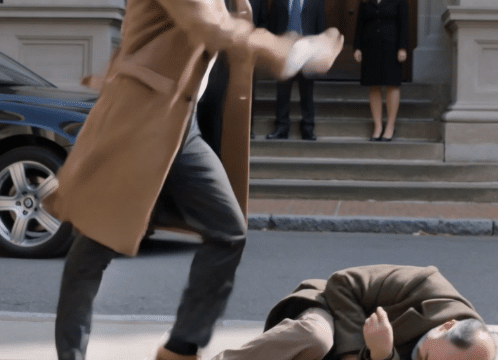
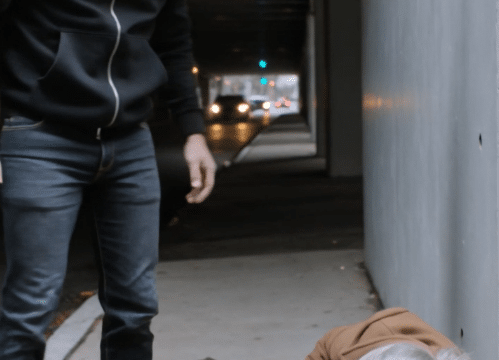
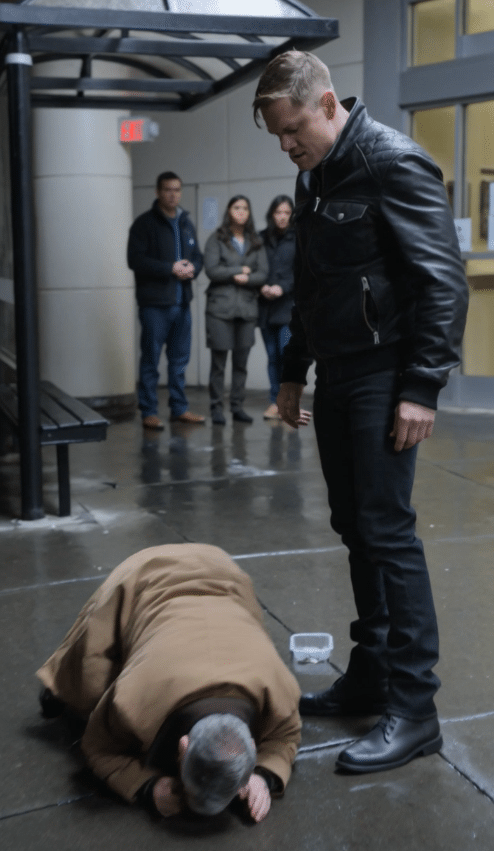
Derek stepped behind the elderly man and drove a hard kick into his back.
The old man pitched forward, landing face-down on the wet pavement beneath the shelter. His breath escaped in a startled gasp. The plastic container slid across the ground, spilling several coins and a few bills into the rainwater near the curb.
A thin trace of blood appeared on his forearm where it struck the pavement.
For a moment, he could only lie there, shaking from cold and pain.
Then he began reaching for the container.
His cloudy eyes stared uselessly toward the lights. His hand swept across the wet ground, fingers searching for the familiar plastic rim. He seemed unaware of the scattered money. All he wanted was to find the one thing that had been within his reach a moment earlier.
Derek watched him struggle.
Then he kicked him twice more, once in the back and once in the side.
The elderly man curled inward, his breath breaking into painful gasps. His fingers continued searching for the container even as his body recoiled from the blows.
Around him, the waiting crowd shrank back.
The woman at the shelter pressed both hands over her mouth. The young man turned pale. A hospital visitor standing a few feet away stared at the scene as though his feet had been nailed to the pavement.
Derek stood over the old man, his jaw tight.
“Stay down and be grateful.”
Then the hospital doors burst open.
A man in a white lab coat came running into the rain.
And the moment he saw the old man on the ground, his expression changed so completely that even Derek took a step back.
Act II
Dr. Michael Hayes had performed emergency surgery on people whose hearts had stopped beating. He had stood in operating rooms while teams fought against seconds, and he had delivered news to families who would remember his words for the rest of their lives.
At thirty-nine, he was one of the hospital’s most respected surgeons.
But the thing he was proudest of was not his reputation in the operating room.
It was the free clinic he had spent six years building.
The clinic occupied a modest section of the hospital’s outpatient wing. It offered basic medical care, referrals, medication assistance, and follow-up appointments to people who had fallen through the cracks of the healthcare system. Many of its patients were uninsured. Some slept in shelters. Others had jobs that paid too little to cover rent and medical bills at the same time.
Michael had started it after watching a patient postpone treatment for months because he could not afford the cost of an appointment. By the time the man reached the hospital, a manageable condition had become a medical emergency.
The patient survived, but the experience changed Michael.
He began asking how many people were suffering outside the hospital’s doors while the hospital’s resources remained just beyond their reach.
That question eventually became the free clinic.
It also changed the way he understood medicine. A doctor could be brilliant in an operating room and still fail a patient who never made it through the front door.
That evening, Michael had been finishing a difficult consultation when a nurse told him that the clinic’s outreach team had been trying to locate an elderly man who was expected for an initial assessment. The man had no reliable phone number, and the team had only a general description.
An older patient. Blind. Frail. Wearing a brown coat.
He had been told to come to the hospital’s outpatient entrance.
Michael had intended to check whether the man had arrived before leaving for the night. He was halfway through the hospital lobby when a commotion outside caught his attention.
At first, he heard only raised voices through the glass.
Then came a sharp impact.
He looked through the entrance and saw an elderly man fall beneath the bus shelter roof. A younger man stood over him.
Michael did not stop to find out whether someone else had called for help.
He ran.
Rain struck his face as he crossed the pavement. His white coat snapped against his legs, and the hospital lights blurred behind him. He saw the old man’s hand searching across the ground. He saw the plastic container lying near his fingers. He saw Derek standing over him as though the assault were nothing more than an argument he had already won.
Michael reached Derek and punched him once in the face.
The impact sent Derek staggering backward. He caught himself against the shelter’s metal frame, one hand flying to his mouth. A thin trace of blood appeared on his lower lip.
Michael immediately stepped between him and the elderly man.
The entire bus stop fell silent.
For a second, Michael’s hands remained clenched. The sight of the old man on the pavement had sent anger rushing through him so quickly that he had acted before thinking through the consequences.
He forced himself to take a breath.
Then he looked at Derek, his face pale with controlled fury.
“He was waiting for the free clinic I run.”
Derek blinked.
He looked at the white coat, then at Michael’s face. He seemed to be trying to reconcile the man who had just punched him with the words he had heard.
“You run it?”
The question emerged as a frightened whisper.
Michael did not answer. He turned toward the elderly man and lowered himself to the wet pavement.
“Sir, my name is Dr. Hayes. I’m a doctor at the hospital. Can you hear me?”
The old man’s head shifted toward the sound.
“Did he take it?”
Michael glanced at the plastic container.
“I see it. We’ll make sure it stays with you.”
“That’s all I have.”
“I understand.”
But as Michael reached toward him, the old man flinched.
The movement was small, almost involuntary. Yet it stopped Michael more effectively than any accusation could have.
This was not simply a man in pain. This was someone who had just been kicked by a stranger and was now bracing himself for another blow, even from someone offering help.
Michael withdrew his hand and explained what he intended to do before moving any closer. He asked permission to assess the man’s injuries and called for the emergency team inside the hospital.
Behind him, Derek began to recover his voice.
“He was sitting in the way,” he protested. “I was just trying to get past.”
Michael turned his head.
“You stole from a blind man.”
“He can’t prove anything.”
Michael’s eyes narrowed.
“You just told everyone here what kind of person you are.”
The witnesses remained frozen, but now their attention had shifted. The same people who had been too frightened to intervene were listening closely, as if the surgeon’s arrival had finally made it possible to acknowledge what they had seen.
Michael looked back at the old man.
“What is your name?”
The man hesitated before answering.
“Samuel.”
“Samuel, I’m going to have our team examine you. You don’t have to move until we’re ready to help you.”
Samuel swallowed, still reaching toward the container.
Michael had treated hundreds of patients.
But when he heard Samuel’s next sentence, he realized that the most serious injury might not be the one the hospital could see.
Act III
“I thought they said I could come,” Samuel whispered.
Michael crouched beside him, keeping his voice steady while rain dripped from the edge of the shelter roof.
“Who said that?”
“The clinic.”
The answer made Michael pause.
Samuel explained slowly, with long gaps between sentences. He had been told that the hospital’s free clinic could assess him, help him address some medical problems, and connect him with services that might make it easier to manage his life.
He had waited for the appointment because he had nowhere else to turn.
He had arrived early, afraid that if he came late, the hospital would send him away.
But he had spent much of the evening outside, unsure which entrance he was supposed to use and whether he was allowed to go inside without someone accompanying him.
“I didn’t want to cause trouble,” Samuel said.
Michael felt a knot tighten in his chest.
“You’re not causing trouble.”
Samuel’s head turned slightly toward him.
“People say that. Then they get tired of me asking questions.”
The emergency team arrived with a wheelchair and medical supplies. They introduced themselves and explained each step before examining him. Samuel winced when they assessed his back and side, and the physician leading the team decided he needed a full medical evaluation rather than a quick check beneath the shelter.
His breathing was painful, and the fall had left him shaken. The thin mark on his forearm was minor in appearance, but the force of the assault meant that no one could safely dismiss his other symptoms.
While the medical team worked, Michael asked a nurse to notify hospital security and preserve any available camera footage. He also requested that the incident be documented accurately and that witnesses be asked for statements.
Derek stood nearby, growing increasingly agitated.
“You can’t just hit me and then act like you’re the hero,” he snapped at Michael.
Michael looked at him.
“You’re right that my actions have to be accounted for. But that doesn’t change what you did to him.”
Derek seemed unprepared for the answer.
He had expected denial, perhaps an attempt to use the hospital’s reputation to excuse the punch. Instead, Michael acknowledged his own responsibility without offering Derek an escape from his.
A security officer arrived and separated Derek from the medical team. The officer began taking accounts of what had happened, including the assault and the theft. The witnesses, now less afraid of being the only people willing to speak, started describing what they had seen.
One woman said she had watched Derek reach into the container.
Another confirmed that Samuel had spoken before Derek attacked him.
The young man who had turned away admitted that he had been close enough to hear the entire exchange.
“I should have done something,” he said quietly.
Michael did not tell him that everything was fine.
“You should have called for help,” he replied. “Next time, don’t wait for someone else to make it safe for you to care.”
The young man lowered his eyes, ashamed.
By then, hospital security had begun reviewing the available footage. It showed Derek reaching into the container, taking money, and turning toward Samuel when the old man spoke. It showed the assault and the witnesses stepping back.
The evidence contradicted Derek’s claim that Samuel had attacked him or obstructed him in a way that justified violence.
Derek had not been defending himself.
He had been caught stealing from someone he believed could not identify him.
As security continued its work, Michael accompanied Samuel inside. The hospital doors closed behind them, shutting out the rain and the cold.
The warmth should have brought relief.
Instead, Samuel seemed overwhelmed by the sounds of the lobby: footsteps, rolling carts, distant voices, and the steady rhythm of hospital equipment. He gripped the plastic container in both hands as though someone might take it from him the moment he relaxed.
A nurse asked if he would like it placed somewhere safe.
Samuel shook his head.
“Please don’t move it without telling me.”
“We won’t,” she assured him.
Michael watched the exchange and wondered how many times Samuel had learned that a simple object could disappear when he could not watch it.
During the medical assessment, the team checked Samuel for injuries caused by the kicks and the fall. They treated his forearm and evaluated the pain in his back and side. The staff also asked about his general health, his access to medication, and whether he had somewhere safe to stay after discharge.
Samuel answered what he could.
Some questions made him uncomfortable. Others revealed problems he had grown used to treating as unavoidable: missed appointments, difficulty obtaining prescriptions, and the exhausting work of navigating services when he could not see signs or read paperwork independently.
Michael listened without interrupting.
He had helped create a clinic to make healthcare more accessible. Yet Samuel had reached the hospital and still found himself waiting outside, unsure whether he belonged inside.
Michael had assumed that providing a free service meant making it available.
Samuel’s experience showed him that availability and access were not the same thing.
A door could be open and still feel impossible to enter.
And when Michael checked the clinic’s appointment records, he discovered a detail that made his concern turn into something far more uncomfortable.
Samuel had been on the clinic’s list for weeks.
Someone had marked his appointment as confirmed.
But no one had made sure he knew how to reach the right entrance—or what would happen if he arrived without assistance.
Act IV
The next morning, Michael sat in his office with Samuel’s appointment record open on the computer.
The information was ordinary. A date. A referral. A note indicating that the patient had been advised to attend the clinic.
There was no evidence that anyone had deliberately turned Samuel away. There was no sinister conspiracy or secret order to deny him care.
The failure was more mundane, and in some ways more troubling.
Several people had assumed someone else would handle the details.
The clinic’s scheduler had entered the appointment. A referral coordinator had marked the case complete. The front desk had been told to expect a patient but had no clear process for identifying someone who could not independently read the signs or navigate the building.
Everyone had performed a small task.
No one had taken responsibility for the whole journey.
Michael called the clinic’s administrative director and asked her to join him.
Together, they reviewed the process from the first referral to the moment a patient arrived. They found gaps in communication, unclear instructions, and no consistent procedure for helping visually impaired patients navigate the entrance.
The clinic was free, but it had not made the path to care simple enough for everyone.
Michael felt the weight of that realization.
He could blame a scheduling system or an understaffed desk. He could say that the hospital served thousands of people and could not anticipate every difficulty.
All of those things might be true.
None of them changed the fact that Samuel had arrived for help and spent hours outside, shivering beneath a bus shelter.
Michael instructed the team to contact Samuel directly, confirm his needs, and arrange a clear plan for future appointments. He also ordered a review of the clinic’s intake and referral process, including how staff communicated with patients who were blind, had mobility limitations, lacked stable housing, or needed assistance navigating the hospital.
The changes would include accessible appointment instructions, a named contact for patients who needed help on arrival, and a clear escalation process when someone appeared for care but could not find the right department.
Most importantly, staff would be expected to confirm that patients understood the arrangements—not merely record that instructions had been sent.
Meanwhile, the investigation into Derek’s assault continued.
The security footage and witness accounts were preserved for the authorities. Derek’s attempt to describe the incident as a minor disagreement collapsed under the evidence. His actions would be handled through the appropriate legal process, not through Michael’s personal influence.
Michael also provided an account of his own punch.
The decision had been made in a rush of anger, and he did not pretend otherwise. He had wanted to stop Derek from harming Samuel again. But being a surgeon, a respected physician, or the director of a free clinic did not give him unlimited permission to use force.
He would answer for what he had done.
That was part of the lesson he wanted the hospital to learn: accountability could not be reserved for people without status.
Later that day, Michael visited Samuel in the hospital.
Samuel was resting, his injuries being monitored by the medical team. The little plastic container had been placed within reach after a nurse explained exactly where it was.
Michael pulled a chair beside the bed.
“Your appointment was on our list,” he told him. “But we didn’t make sure you could get to the right place. That’s our failure, and I’m sorry.”
Samuel remained quiet.
Michael continued, explaining the changes the clinic would make and offering to arrange a staff member to meet him when he was ready to return.
“I don’t want you to feel like you have to manage everything alone just to get medical care.”
Samuel’s fingers rested against the edge of the container.
“Will they be angry if I ask for help next time?”
The question hurt more than Michael expected.
“No,” he said. “And if anyone makes you feel that way, I want you to tell us.”
Samuel turned his face toward Michael’s voice.
“You can’t be there every time.”
Michael had no immediate answer.
Samuel was right. Michael could not personally escort every patient through the hospital. He could not stand at every bus stop or make every stranger behave decently. His presence that night had interrupted the violence, but a system that worked only when a famous surgeon happened to be nearby was not a system anyone could trust.
So Michael did not promise to be everywhere.
He promised to change the way the clinic worked.
And when Samuel finally told him why he had been so desperate to make the appointment, Michael realized the old man had come to the hospital carrying a burden far heavier than the few bills Derek had stolen.
Act V
Samuel had not come to the clinic because he expected someone to rescue him.
He had come because he wanted to remain independent.
For months, his health had been getting harder to manage. He struggled to keep appointments, to obtain the medical advice he needed, and to understand which services were available to him. Living without stable housing made every routine task more difficult, and his blindness turned ordinary obstacles into exhausting negotiations with a world designed for people who could see.
He had finally agreed to seek help because he was frightened that one day his body would simply stop allowing him to manage alone.
That was why he had arrived early.
That was why he had waited beneath the shelter roof.
And that was why, after Derek kicked him onto the wet pavement, he had reached for the little plastic container instead of trying to fight back.
It was not the money itself that mattered most.
It was the knowledge that losing those few bills could mean losing another chance to get where he needed to go.
Michael listened as Samuel explained this, and for once he resisted the urge to respond with a solution before the man had finished speaking.
When Samuel was medically cleared to leave the hospital, the clinic’s team helped coordinate follow-up care and connect him with local services that could address his housing needs. They explained each option, checked that he understood the arrangements, and made sure he knew whom to contact if something went wrong.
There were no miraculous transformations.
The problems that had shaped Samuel’s life did not disappear in a day. Housing availability remained limited, appointments required planning, and every new service involved decisions he had to make for himself.
But this time, the next step was clear.
A clinic staff member met him at the agreed entrance for his follow-up appointment. The receptionist knew he was coming. His instructions were explained aloud, and someone checked that he could find the right department before leaving him to wait.
The difference was not grand.
It was the difference between being told that help existed and being able to reach it.
Michael continued to oversee the changes. The free clinic introduced clearer procedures for patients who needed assistance entering the hospital, and staff began reviewing cases in which a referral had been marked complete without confirming that the patient had actually received care.
He also made the incident part of a broader conversation with hospital staff about the assumptions people made when someone arrived poor, disabled, frightened, or alone.
The goal was not to make Samuel into a symbol of the hospital’s generosity.
It was to ensure that no patient had to endure humiliation before anyone recognized their need.
Derek’s case proceeded through the appropriate channels, supported by the evidence gathered that night. Michael did not ask for special treatment or use his reputation to dictate the outcome. The assault, the theft, and the surgeon’s own use of force were matters to be assessed on their facts.
For Michael, that was important.
He had stepped in because Samuel was being hurt, not because he wanted to become a hero. If the story ended with a famous doctor punching a bully, it would miss the more difficult truth: one person’s dramatic intervention could stop a moment of cruelty, but only consistent action could make the next moment less likely.
Several weeks later, Michael saw Samuel again at the clinic.
The old man wore his brown coat. His white eyes remained unfocused, and his movements were still careful. But when the staff member greeted him by name and explained that his appointment was ready, Samuel did not hesitate at the entrance.
He followed the directions he had been given.
Before he went inside, he turned toward Michael’s voice.
“Doctor?”
Michael stopped.
“Yes, Samuel?”
“You came running that night.”
“I did.”
“Why?”
The question seemed simple, but Michael knew it deserved more than a quick answer.
“Because someone was hurting you, and you needed help.”
Samuel was silent for a moment.
“Most people heard it before you did.”
Michael looked toward the hospital entrance, where patients were coming and going beneath the bright lights.
“Yes,” he admitted. “They did.”
“Why didn’t they come?”
Michael could have blamed fear, uncertainty, or the instinct to wait for someone else. He could have explained that people often froze when confronted with violence.
Instead, he told Samuel the truth.
“I don’t know what every person was thinking. But I know we can’t build a system that depends on someone like me happening to be there.”
Samuel nodded slowly.
“That’s what I was thinking.”
The answer stayed with Michael long after Samuel had gone inside.
The famous surgeon had arrived in the rain wearing a white lab coat, and his anger had changed the balance of power at the bus stop. Derek, who had believed a blind old man could be robbed and beaten without consequence, had suddenly found himself facing someone with authority, resources, and a name people recognized.
But Samuel had never needed Michael to prove that he was worth protecting.
He had needed someone to understand that he was a person before the surgeon arrived.
The hospital lights continued to shine over the wet pavement. Rainwater gathered along the curb, where a few coins had once rolled away from a small plastic container. The shelter roof still dripped in the same steady rhythm, and strangers continued to hurry past with their heads lowered against the weather.
The world had not become fair.
But one clinic had begun to change the way it welcomed people who could not easily navigate its doors. One surgeon had learned to look beyond a patient’s file and ask whether the promised help had actually reached them. And one elderly man who had been treated as if his blindness made him invisible had finally been given the chance to receive care without having to beg for the right to enter.
Derek had asked what a blind old man needed money for.
The answer had been there all along.
He needed it because his life still belonged to him. Because being poor did not erase his plans, his fears, or his right to decide what little he could afford to keep. Because blindness did not make him less aware of cruelty, and homelessness did not make him less deserving of safety.
Michael had rushed into the rain and declared that Samuel was waiting for the free clinic he ran.
The words had shocked Derek because they revealed that the man he had dismissed was connected to someone powerful.
But the deeper truth was more important.
Samuel deserved help even if he had never been on the clinic’s list. He deserved dignity even if no famous doctor knew his name. And he deserved protection even if every witness had continued to look away.
The next time someone stood beneath that hospital shelter, shivering in the rain and asking for help, the clinic would have a clearer process, the staff would know what to do, and someone would be responsible for making sure the person was not left stranded outside.
That was the change Michael could promise.
Not that he would always be there to run into the rain.
But that the door would be easier to find—and that no one should have to prove their importance before someone cared enough to open it.