Act I
“My son is coming down for me.”
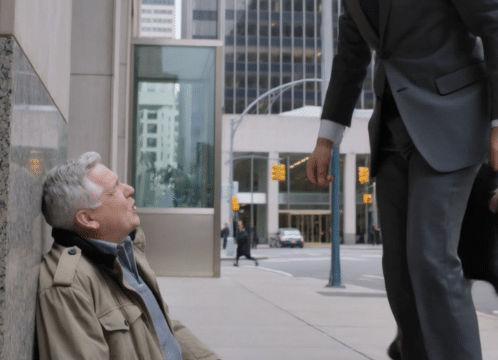
Frank Bennett sat on the edge of a luxury leather sofa beneath a glittering chandelier, his metal crutches resting beside him. His old Army jacket was worn at the cuffs, his gray sweater had begun to pill, and his khaki trousers hung loosely around the leg he had lost years ago.
He looked tired, but not lost.
He had been waiting quietly in the hotel lobby for less than ten minutes, watching guests cross the polished marble floor with rolling suitcases and designer handbags. Some were heading toward the concierge desk. Others were stepping out of the penthouse elevator, speaking into their phones as if the entire building existed to accommodate their schedules.
Frank had no reservation under his own name.
He did not need one.
His son had invited him to visit and promised to meet him downstairs.
Unfortunately, Victor Hale had decided that the old veteran did not belong there.
Victor, the hotel’s forty-five-year-old manager, approached in a perfectly tailored navy suit. His white pocket square sat at a precise angle, his polished shoes reflected the chandelier, and his expression carried the cold confidence of a man accustomed to having his instructions obeyed.
He had noticed Frank the moment he entered the lobby.
The old jacket.
The metal crutches.
The absence of luggage.
To Victor, those details added up to a problem with the hotel’s image.
“Sir, you need to leave.”
Frank looked up.
“I’m waiting for my son.”
“Then wait somewhere else.”
“He’s coming down.”
Victor glanced toward the elevator bank, then back at Frank.
“No guest here is waiting for you.”
Frank frowned.
“I think there’s been a misunderstanding. My son works here.”
Victor gave a short, humorless laugh.
“Your son works here?”
“Yes.”
“And what does he do? Carry bags?”
Frank’s expression tightened.
“That’s not a very respectful thing to say.”
Victor leaned closer.
“Trash. No guest here is waiting for you.”
A couple near the concierge desk exchanged startled looks. A businessman pulling a suitcase slowed, then stopped several feet away.
Frank drew a measured breath.
He had endured worse insults in his lifetime, but that did not make this one acceptable. He had served his country, raised a family, and spent decades working to give his children opportunities he had never possessed himself.
He was not asking Victor for money.
He was not demanding a room.
He was sitting on a sofa while waiting for his son.
“Please,” Frank said, “I don’t want any trouble.”
“Then get up and leave.”
Frank reached for his crutches.
Standing took effort. He positioned the metal supports carefully, leaned forward, and began shifting his weight onto his arms.
Before he could stabilize himself, Victor stepped directly in front of him.
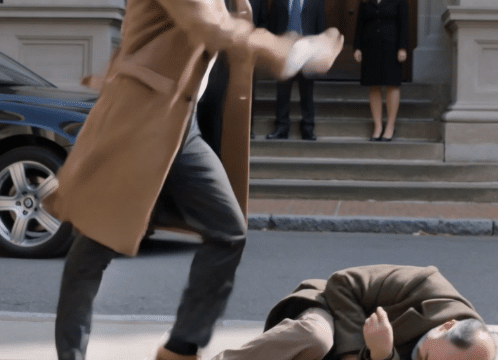
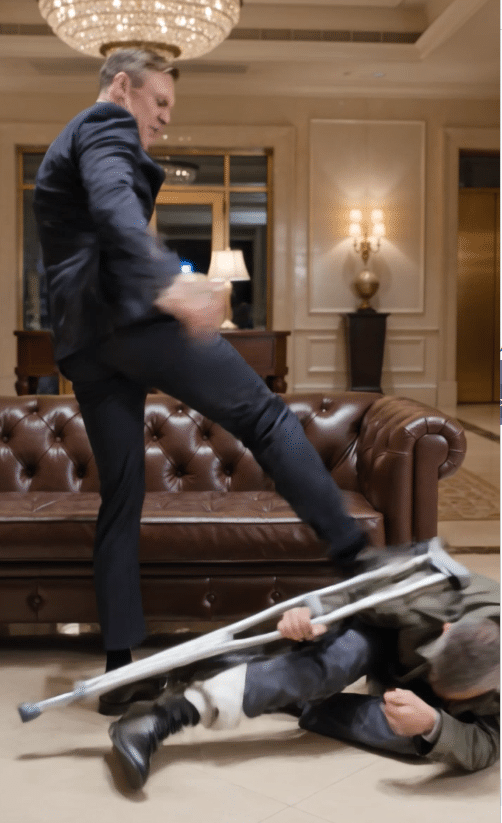
Then the manager drove a forceful kick into Frank’s chest.
The veteran was knocked backward, falling hard beside the sofa. His crutches clattered across the marble, one skidding several feet away. Frank’s elbow struck the floor, scraping the skin and leaving a thin trace of blood.
For a moment, he could barely breathe.
He grimaced, trying to draw air into his lungs while his hand searched blindly for something to hold. His missing leg made it difficult to reposition himself, and the metal crutches that normally gave him independence now lay beyond his reach.
“My son is coming down for me,” he gasped.
Victor stared down at him.
“Trash. No guest here is waiting for you.”
Then he stepped closer and kicked Frank twice more, striking his back and side as the older man curled defensively against the pain.
Guests recoiled.
A woman covered her mouth. A man with a rolling suitcase backed toward the concierge desk. Nobody moved to help while Victor stood over the injured veteran.
The manager straightened his jacket as if he had merely corrected a disturbance.
“Rest outside where people like you belong.”
Frank looked toward his crutches.
He tried to reach them, but pain forced him to stop. His breathing was uneven, and humiliation burned across his face as he realized that dozens of strangers had watched him fall.
Then the penthouse elevator doors opened.
A man in an expensive black suit stepped out, his executive watch catching the chandelier light. He was already moving quickly, apparently heading toward the lobby entrance, when he noticed the gathering near the sofa.
Then he saw the old Army jacket.
His face changed instantly.
“Dad?”
Andrew Bennett rushed across the marble floor and dropped to his knees beside Frank.
He placed himself between his father and Victor, retrieved the nearest crutch, and carefully returned it to Frank’s hand.
“Dad, who did this to you?”
Frank tried to answer, but his breath caught.
Andrew looked at the scrape on his father’s elbow, then at the way he was bracing himself against the pain.
Slowly, he lifted his eyes toward the man standing over them.
“Who did this?”
Victor’s face drained of color.
He recognized Andrew Bennett. Everyone in hotel management did.
Andrew was the hotel’s general manager, the executive responsible for its operations, reputation, and standards. He was also the person whose approval Victor had spent months trying to secure for a promotion.
But the man Andrew was protecting was not a stranger.
He was his father.
Victor stared at Frank, then back at Andrew.
“Your dad?”
The words escaped his mouth as a whisper.
And in that instant, the lobby’s balance of power shifted so completely that Victor could scarcely understand what had happened.
He had believed Frank was a man nobody important would come looking for.
Now the most important person in the hotel was kneeling on the floor, shielding the very man Victor had tried to throw out.
But Andrew’s next decision would reveal something far more consequential than whose family Frank belonged to.
Act II
Andrew Bennett had spent twenty-five years learning how to run hotels.
He had started as a front-desk associate at a modest business hotel, working late shifts and learning how to calm angry guests without making promises the staff could not keep. He moved into operations, then management, eventually earning a reputation for solving problems without humiliating the people caught in them.
He understood that a hotel was more than polished marble and expensive furniture.
It was a place where people arrived tired, frightened, grieving, celebrating, or desperate for a few hours of peace. Some guests came dressed for important meetings. Others arrived after long flights with wrinkled clothes and no patience left for the world.
A good hotel could not judge their worth by the way they looked.
Andrew had learned that principle from his father.
Frank had never been wealthy. He had served in the military when he was young, then spent years working in maintenance and construction, taking whatever honest work he could find to keep his family secure.
He was the kind of man who repaired a neighbor’s broken fence without expecting payment and stayed late to help a coworker finish a difficult job. He rarely talked about his military service, and he never used it to demand special treatment.
When Andrew was a boy, he once asked his father why he kept helping people who never seemed to return the favor.
Frank had answered while repairing the loose hinge on their kitchen cabinet.
“Because you don’t get to choose whether someone deserves basic decency.”
Andrew had carried that sentence into adulthood.
His father had also taught him the value of independence. When Frank lost his leg following a serious medical complication years later, he refused to let the injury become the only thing people saw when they looked at him.
Rehabilitation was difficult.
Learning to move with crutches and adapt to the changes in his body took patience, and there were days when frustration overwhelmed him. Still, Frank insisted on doing as much for himself as he safely could.
He would accept help when he needed it.
He would not accept being treated as though he had become less of a person.
Andrew respected that determination, even when it made him worry.
That was why he had invited Frank to the hotel for a private family visit. Andrew was working at the property that evening, and he wanted to spend time with his father after a demanding week.
Frank had arrived early.
He had called his son from the car, but Andrew was finishing an executive meeting on an upper floor and had asked him to wait in the lobby for a few minutes.
It had seemed like a simple arrangement.
Frank could sit comfortably on the sofa, and Andrew would come down as soon as the meeting ended.
Neither man had imagined that the wait would become an ordeal.
Victor Hale had joined the hotel after building a career in luxury hospitality. On paper, his experience was impressive. He understood scheduling, revenue targets, guest relations, and the precise routines that kept a five-star property running smoothly.
But beneath that professional polish was a belief that luxury depended on exclusion.
Victor thought an upscale hotel had to look exclusive at every moment. He believed the lobby should communicate wealth, confidence, and status before a guest even reached the desk.
Anyone who disrupted that image, in his view, needed to be moved along.
He rarely said that openly.
Instead, he used phrases like “maintaining standards” and “protecting the guest experience.” He corrected junior employees for letting visitors linger in the wrong areas. He complained about people who appeared confused, tired, or poorly dressed. He treated questions as challenges and ordinary delays as evidence that someone did not belong.
His staff had learned to be careful around him.
Some admired his efficiency. Others feared becoming the next person he singled out in front of colleagues.
When Victor saw Frank sitting on the sofa, he did not ask whether the older man needed assistance. He did not check whether someone was meeting him. He did not even begin with a polite question.
He made a judgment.
And once he had made it, he interpreted everything Frank said as defiance.
Now, kneeling beside his father, Andrew understood that this was not a disagreement over access to a private space.
Frank had been assaulted.
Andrew kept his voice low as he checked whether his father could answer questions and whether he was experiencing severe pain. He asked a nearby employee to call emergency medical assistance and instructed the front-desk team to preserve any relevant security footage.
Only after making sure that help was on the way did he turn toward Victor.
“What happened?”
Victor straightened immediately.
“Mr. Bennett, thank goodness. This man refused to leave when I asked him to.”
Andrew looked at his father.
Then he looked at the crutches lying across the floor.
“What did he do before you asked him to leave?”
Victor hesitated.
“He was sitting in the lobby.”
“Was he threatening anyone?”
“No.”
“Was he disturbing the guests?”
“He was making the area look—”
Victor stopped himself.
Andrew’s expression hardened.
“Look what?”
“I was trying to maintain the hotel’s standards.”
“My father was sitting on a sofa.”
Victor glanced toward the guests who had witnessed the attack.
“I understand that it looks bad, but the situation was more complicated than that.”
Andrew’s voice dropped.
“Did you kick him?”
Victor opened his mouth, then closed it.
“I was trying to get him to move.”
“Did you kick him?”
The manager looked toward the concierge desk.
“Yes, but he wouldn’t cooperate.”
Andrew stared at him.
His father had spent a lifetime teaching him that decency was not conditional. Yet here was a senior manager using the appearance of an elderly disabled man as justification for attacking him.
Andrew felt anger rising, sharp and immediate.
But he knew that his first responsibility was not to win an argument.
It was to protect his father, preserve the evidence, and ensure that what happened next was handled properly.
He turned toward the front desk.
“Keep the footage. Identify everyone who witnessed this. No one is to alter the records or pressure the staff.”
Then he faced Victor again.
“You are not going to approach my father.”
For the first time since the assault, Victor appeared genuinely afraid.
Because he had finally understood that this was not a guest complaint he could bury beneath a polished apology.
It was an act of violence in the middle of his own hotel.
And Andrew intended to establish exactly how it had happened.
Act III
The medical team arrived while Andrew remained beside his father.
Frank was examined on the lobby sofa after the responders determined how best to move him. His elbow was treated, and the medical staff assessed his pain before deciding what further evaluation he needed.
Andrew stayed close enough for Frank to see him without feeling crowded.
“I’m sorry,” Andrew said quietly.
Frank turned his head.
“For what?”
“For asking you to wait downstairs.”
“You didn’t kick me.”
“I still should have come down sooner.”
Frank studied his son’s face.
“You were working.”
Andrew looked away.
He had spent years believing that preparation and professionalism could prevent most crises. If a guest complained, he could investigate. If a system failed, he could repair it. If an employee made a mistake, he could establish what happened and prevent it from happening again.
But he could not go back several minutes and remove his father from the floor before Victor attacked him.
That helplessness frightened him more than he wanted to admit.
Frank reached for his hand.
“Andrew. Look at me.”
His son did.
“Don’t turn this into something you blame yourself for.”
Andrew swallowed.
“I won’t.”
It was a promise he was not yet sure he could keep.
When the medical team had finished their immediate assessment, Andrew spoke with the hotel’s security supervisor. He requested that the lobby recordings be preserved, including footage from the concierge desk and the elevator area. He also asked for written accounts from the employees and guests who had witnessed the assault.
The security supervisor agreed and began documenting the incident.
Victor remained nearby, trying to maintain the appearance of authority.
“Andrew, we should discuss this privately,” he said. “I don’t want the guests to misunderstand what happened.”
Andrew turned slowly.
“What do you think they misunderstood?”
Victor lowered his voice.
“You know how quickly these situations can become exaggerated. I was dealing with a person who refused to follow instructions.”
“Were your instructions lawful and reasonable?”
“I was protecting the lobby.”
“From my father?”
“From a situation that was getting out of control.”
Andrew glanced toward Frank.
His father was seated carefully, his face still drawn with pain. One crutch rested against the sofa, and his injured elbow had been wrapped.
“What exactly was out of control?” Andrew asked. “A seventy-two-year-old man waiting for his son?”
Victor’s jaw tightened.
“I didn’t know he was your father.”
Andrew held his gaze.
“You’ve said that twice now.”
“Because it’s relevant.”
“Why?”
Victor appeared caught off guard.
Andrew continued.
“Would you have treated him differently if you had known?”
The manager did not answer.
“Would you have allowed him to sit here? Would you have spoken to him politely? Would you have decided that he was entitled to basic respect?”
Victor’s eyes shifted toward the elevator.
Andrew shook his head.
“My father doesn’t become worthy of decent treatment because he happens to be related to me.”
The words carried across the lobby.
Several guests lowered their eyes. Others watched in silence, no longer pretending they had not seen the assault.
One woman stepped forward and asked whether she could provide a statement. She explained that she had been standing near the concierge desk when Victor ordered Frank to leave. She had seen Frank begin to stand, then watched the manager kick him to the floor.
A second guest confirmed the sequence.
A hotel employee said he had heard Victor’s insults and witnessed the follow-up kicks.
Victor tried to interrupt.
“You don’t have the full context.”
Andrew turned toward him.
“Then the review will establish the context.”
He asked the security supervisor to collect the accounts independently. No witness would be instructed to use particular language, and no employee would be punished for cooperating with the investigation.
He also made clear that Victor was not to contact the witnesses about their statements.
The hotel’s human resources and corporate compliance teams were notified. Victor’s management responsibilities were suspended pending a formal review, and he was removed from direct contact with guests while the incident was investigated.
Victor stared at Andrew.
“You’re suspending me?”
“Pending review.”
“After everything I’ve done for this hotel?”
“This isn’t about your years of service. It’s about what happened tonight.”
“I made a mistake.”
“You made several choices.”
Andrew gestured toward the sofa.
“You chose to judge my father by his clothes. You chose to insult him. You chose to kick him when he tried to stand. Then you kicked him again while he was on the floor.”
Victor’s face reddened.
“I lost my temper.”
“That doesn’t explain why you believed you had the right to do it.”
For a moment, Victor looked as though he might argue again.
Then his gaze returned to Frank.
The old man was listening quietly, not demanding an apology or trying to use Andrew’s position to influence the investigation.
That silence seemed to confuse Victor.
He had expected Frank to plead, threaten, or reveal some hidden status that might explain why he deserved better treatment. Instead, the veteran had asked only to wait for his son.
Victor had invented the rest.
Andrew turned toward the security supervisor.
“Please make sure the relevant records are preserved. I want the investigation to establish what happened, and I want the findings documented.”
Then he knelt beside his father again.
“Dad, can you stand with assistance, or would you rather wait for the medical team?”
Frank took a slow breath.
“Let’s wait.”
“Of course.”
Andrew settled beside him, remaining there until the responders were ready to move him.
Victor stood several feet away, stripped of the authority he had used so casually moments earlier.
He had spent years believing that the hotel’s image depended on keeping the wrong people out.
Now he was about to discover that the hotel’s future depended on whether its leadership was willing to confront the person who had made that belief violent.
Act IV
The investigation began before the lobby had returned to its usual rhythm.
Security preserved the relevant recordings, and the hotel collected witness statements from guests and employees. The footage was reviewed alongside the accounts, allowing the investigators to establish what had happened before, during, and after the assault.
The evidence was consistent.
Frank had entered the lobby and sat on a sofa while waiting for his son. Victor had approached him and ordered him to leave. When Frank attempted to stand with his crutches, the manager kicked him in the chest, knocking him to the floor.
After Frank fell, Victor delivered two additional kicks while the older man struggled to reach his crutches.
The insults were also audible to several witnesses.
There was no evidence that Frank had threatened Victor or posed a danger to anyone in the lobby. The manager’s claim that he had been protecting the hotel from a disturbance could not explain his actions.
The review also examined whether Victor had violated hotel policies on guest treatment, workplace conduct, and the use of force. Corporate leadership required him to provide his account, but he was not allowed to supervise the investigation or influence the witnesses.
As the facts emerged, the hotel’s executives discovered that Victor’s behavior had not always been as professional as his polished appearance suggested.
There had been earlier concerns about his treatment of people he considered difficult or out of place. Some involved dismissive remarks to guests; others described employees being reprimanded for showing flexibility toward people who did not fit his expectations.
Those reports were assessed individually. None was treated as automatic proof of the assault, but they prompted a broader examination of the culture Victor had helped create.
Andrew wanted to know whether staff members had learned to remain silent because they feared challenging him.
He met with the relevant department heads and asked a direct question.
“Do our employees believe they can report misconduct without risking their jobs?”
The answers were uncomfortable.
Some employees said they trusted the formal reporting system. Others admitted they had hesitated to raise concerns about Victor because he had influence over schedules, performance reviews, and promotions.
Andrew took those concerns seriously.
He did not want staff to conclude that the only way to receive fair treatment was to be related to the general manager. If the hotel’s standards mattered only when an executive’s family was involved, then the standards were not worth much at all.
The company clarified its reporting procedures, reinforced its expectations for respectful guest treatment, and reviewed how managers should respond when someone needed additional time, mobility assistance, or a quiet place to wait.
These changes were not intended to prevent staff from enforcing legitimate rules. They were intended to ensure that rules could not be used as a cover for prejudice, intimidation, or violence.
Victor’s position became increasingly difficult to defend.
At a formal review meeting, he insisted that he had been under pressure.
“The lobby was busy,” he said. “I was responsible for maintaining a certain standard.”
A member of the review team asked him what standard justified kicking a seated guest who was trying to stand.
Victor had no answer.
He argued that he had not known Frank was related to Andrew.
The review team returned to the same question.
Would that knowledge have changed his conduct?
Victor said that he would have handled the situation differently.
But he could not explain why.
That answer revealed the core of the problem. He was still describing the incident as an error in judgment about a person’s importance, rather than a failure to recognize that every person deserved basic safety.
The company concluded that Victor’s conduct was incompatible with his managerial responsibilities. Following the formal process, he was dismissed from his position.
Any further legal consequences arising from the assault were left to the appropriate authorities.
Andrew did not announce the decision to the hotel guests. He did not arrange for Victor to be marched through the lobby or use the incident to stage a public humiliation.
The outcome was documented and communicated through the proper channels.
For Andrew, accountability was not about making Victor feel as powerless as his father had felt.
It was about making clear that a manager could not use his authority to assault someone and expect the institution to protect him from the consequences.
Later that evening, Andrew visited Frank at home.
His father was sitting in his familiar armchair, his crutches resting within reach. He looked tired, and he moved more carefully than usual, but he greeted his son with the same calm expression he had worn before the incident.
Andrew sat opposite him.
“The investigation is finished,” he said.
Frank waited.
“Victor has been dismissed. The hotel has preserved the evidence, and the company is making changes to how incidents like this are reported.”
Frank nodded slowly.
“Good.”
Andrew searched his father’s face.
“Are you angry?”
“Of course.”
“Then why don’t you sound angry?”
Frank considered the question.
“Because being angry doesn’t mean I have to spend every minute talking about the man who hurt me.”
Andrew lowered his eyes.
“I keep thinking about what I should have done differently.”
“You’ve done what you needed to do.”
“I should have come down sooner.”
“Andrew.”
His father waited until he looked up.
“You cannot spend your life believing you can prevent every bad thing from happening. You can only decide what you do when it does.”
Andrew sat quietly.
Frank continued.
“You protected me when you arrived. You made sure the truth was recorded. You didn’t let him explain it away. That’s what mattered.”
Andrew nodded, though the memory of seeing his father on the floor would stay with him for a long time.
Then Frank glanced toward the kitchen.
“Now, have you eaten?”
Andrew stared at him.
“Dad, you were assaulted in a hotel lobby.”
“And you’re still my son. Have you eaten?”
For the first time since the incident, Andrew laughed.
It was a small sound, quickly followed by the familiar warmth of being in his father’s company.
But as he left that night, one question remained in his mind.
How many people had been treated like Frank before someone with the authority to act happened to witness it?
Andrew intended to find out.
Act V
Three months later, Frank Bennett returned to the hotel.
He did not arrive with a press crew or a group of executives. He came with his crutches, his old Army jacket, and a small overnight bag because Andrew had invited him to stay for a family dinner.
The lobby was just as elegant as before.
The chandelier glittered above the marble floor. Guests crossed toward the concierge desk with rolling suitcases, and the penthouse elevator opened and closed as staff moved between floors.
But Frank noticed something different.
A young employee at the entrance greeted him and asked whether he needed assistance. When Frank explained that he was meeting his son, the employee checked the arrangements and directed him toward a comfortable seating area without questioning whether he belonged there.
No one stared at his jacket.
No one treated his crutches as a problem.
The employee simply helped him find the place he needed.
Frank thanked him and settled onto the sofa.
A few minutes later, Andrew came down from the upper floor.
He was wearing a dark suit, but the moment he saw his father, his expression softened.
“Hey, Dad.”
“Busy day?”
“Always.”
“Then I won’t keep you.”
Andrew laughed.
“You’re literally here because I invited you.”
“I know. I just don’t want you standing around talking to me when you have a hotel to run.”
Andrew sat beside him.
“I can spare ten minutes.”
“Ten minutes becomes twenty with you.”
“That’s because you tell long stories.”
“They’re good stories.”
“They’re very long stories.”
Frank smiled.
For a few moments, they talked about ordinary things: the family dinner, a repair Frank had been working on at home, and the weather turning colder.
The conversation was not a grand reconciliation with the hotel.
It was something better.
It was proof that Frank could return to a place where he had been hurt without allowing that experience to dictate every moment afterward.
Andrew had thought often about the assault and the investigation. He had reviewed the changes the hotel had made, spoken with employees about reporting concerns, and insisted that managers be evaluated not only on financial performance but also on how they treated people.
Luxury, he had come to believe, was not measured by the distance between the lobby and the penthouse.
It was measured by the standards a hotel upheld when someone vulnerable needed help.
Frank noticed a guest nearby struggling to lift a suitcase over the edge of a small carpeted rise. An employee approached and offered assistance. The guest accepted with relief.
Frank watched the exchange, then turned toward Andrew.
“That’s better.”
Andrew followed his gaze.
“What is?”
“People helping without making a production out of it.”
Andrew smiled faintly.
“That’s what we’re aiming for.”
Frank looked around the lobby.
When Victor had seen him there, he had judged the old jacket, the missing leg, and the absence of a reservation. He had decided that Frank’s presence lowered the hotel’s image.
He had never asked why the veteran was waiting.
He had never considered that the man might be tired after a difficult journey, or that his crutches made standing for long periods uncomfortable, or that he might simply be waiting for someone who loved him.
Victor had looked at the lobby as a stage on which only certain people deserved to appear.
Frank looked at it as a room full of people who all needed something different.
A guest needed a key.
A traveler needed directions.
An older man needed somewhere to sit while he waited for his son.
None of those needs made one person more deserving of dignity than another.
Andrew stood when the elevator chimed.
“Ready to go upstairs?”
Frank reached for his crutches.
“Give me a second.”
Andrew waited without rushing him.
Frank positioned the metal supports, leaned forward, and rose carefully. His movement was slow, but it was deliberate. Once he was balanced, he looked at his son.
“Okay.”
Andrew offered his arm, and Frank accepted it.
They walked toward the elevator together.
As the doors began to close, Frank glanced back across the lobby. The sofa where he had waited remained in its place beneath the chandelier, surrounded by the same marble, leather, and polished brass that had been there on the night of the assault.
The furniture had not changed.
The real change lay in the people responsible for the space.
Andrew knew that a policy could be written in an afternoon, but trust took longer. Guests would not feel safe simply because management promised better standards. Employees needed to see that concerns were heard, that evidence was preserved, and that authority did not place anyone above accountability.
He also knew that his father would never want to be treated as a special case.
Frank had not deserved protection because he was related to the general manager.
He had deserved protection because he was a human being.
And that truth was worth more than every chandelier, marble floor, and penthouse suite in the building.
When they reached the upper floor, Andrew guided his father toward the family dining room.
Frank paused beside the window overlooking the city.
“Your mother would have liked this view,” he said.
Andrew stood beside him.
“She would have complained that the windows needed cleaning.”
Frank laughed.
“She absolutely would.”
For a moment, the memory of the lobby faded into the background. There was only a father and son, sharing a quiet moment above the city, grateful for the ordinary privilege of being together.
Yet Andrew would never forget the sight of his father lying on the marble floor, reaching for a crutch while strangers watched.
Nor would he forget the question Victor had asked when he discovered their relationship.
Your dad?
As though the revelation explained why Frank mattered.
It did not.
Frank had mattered before Andrew stepped out of the elevator. He had mattered while he sat quietly on the sofa. He had mattered when he was insulted, when he fell, and when he struggled to breathe.
His worth had never depended on the identity of his son.
And a five-star hotel was never truly luxurious if it could not understand something so simple.
Because the most important test of a place is not how it treats the wealthy guests arriving through its front doors.
It is how it treats the person it believes has nothing to offer.
That night, Frank had needed only a seat and a few minutes of patience.
Instead, he had been given cruelty.
But when the truth came out, the hotel had a choice: protect the man who abused his authority, or defend the principle that no one should have to prove their importance before receiving basic respect.
This time, it chose the principle.
And as Frank and Andrew disappeared into the elevator, the lobby below continued to welcome travelers from every walk of life.
Some arrived in expensive suits.
Some arrived in worn jackets.
Some came with luggage, and some came with crutches.
They all deserved to enter without fear.
Because a person’s dignity is not a privilege reserved for the people who have important family connections. It is the one thing a hotel, a company, or a society should never make anyone earn.