Act I
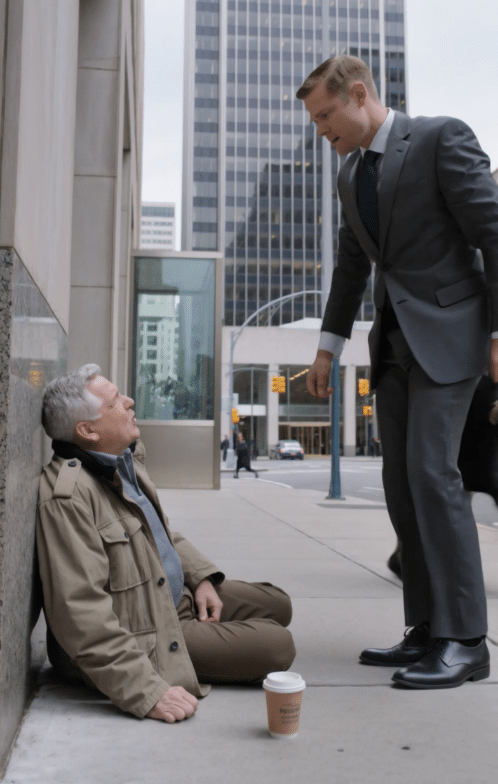
The businessman slipped two crumpled bills out of the old paper coffee cup, glanced at the blind man sitting against the glass tower, and kept walking as if he had done nothing wrong.
The elderly man heard the faint rustle.
His cloudy eyes remained unfocused beneath the brim of his dark knit cap, but his head turned sharply toward the sound. His faded military jacket hung loosely from his shoulders, and his hands trembled in the cold as he reached toward the cup.
“I heard you take it.”
The man in the expensive gray suit stopped.
For a moment, he looked almost impressed that the old man had noticed. Then his expression hardened, and he turned back toward the building wall.
“Trash. You can’t even see your own cup.”
The blind veteran swallowed. He had spent the morning sitting outside the financial district’s tallest tower, hoping to collect enough money for a warm meal. The bills in that cup were not a fortune. They were the difference between getting through the day and going to sleep hungry.
“Please,” he said quietly. “That’s mine.”
The businessman gave a short, disbelieving laugh.
He was thirty-eight, impeccably groomed, and dressed like someone accustomed to having doors opened before he reached them. His blue tie was perfectly knotted. His polished shoes shone against the cold pavement. One hand held his phone while the other still clutched the stolen money.
He looked at the old man’s unfocused eyes and saw no threat, no consequence, and no reason to feel ashamed.
Instead of returning the bills, he snatched the coffee cup away.
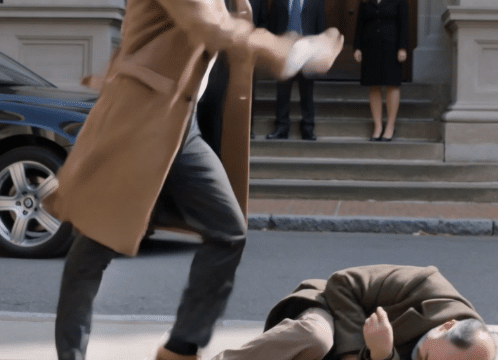
Then he drove a forceful kick into the elderly man’s chest.
The impact sent the veteran sideways onto the sidewalk. His elbow struck the pavement, leaving a thin trace of blood, and a sharp gasp escaped him as pain tightened his face. The paper cup rolled near his hand, scattering a few bills and coins across the concrete.
The businessman stepped closer.
The old man struggled to breathe. His fingers searched desperately for the cup, following the faint sounds of coins settling against the pavement.
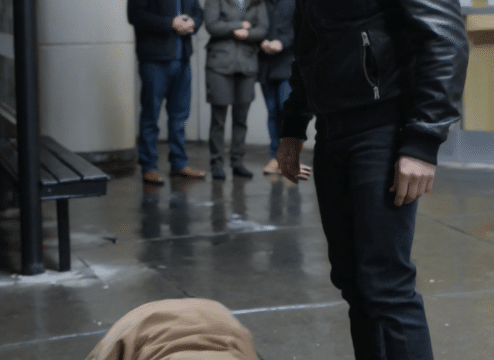
Then the businessman kicked him twice more, striking his back and side as the veteran curled instinctively around himself.
Nearby office workers froze.
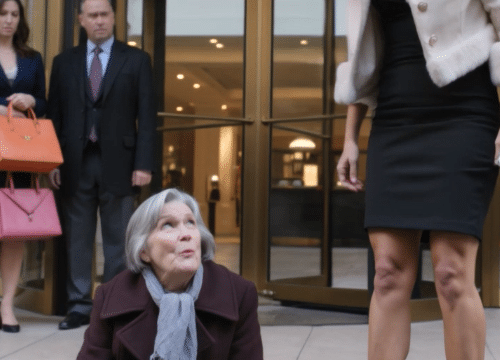
A woman in a dark coat covered her mouth. Two men carrying briefcases stepped backward, their faces pale with shock. Someone whispered for another person to do something, but no one moved.
The businessman looked down at the man he had knocked to the ground.
“Beg somewhere else, old man.”
The veteran did not answer.
He was trying to catch his breath, one trembling hand still reaching toward the paper cup. He could not see the people staring at him, could not see the money scattered beside him, and could not tell how close the businessman stood.
But he could hear every frightened breath around him.
And he could hear the footsteps of people choosing to walk away.
Then a black Rolls-Royce braked hard at the curb.
The rear door flew open, and a tall man in a long black overcoat stepped into the cold morning. He took in the scene in a single glance: the elderly man on the pavement, the scattered money, the businessman standing over him.
The newcomer moved fast.
He crossed the sidewalk and struck the businessman once, hard enough to send him stumbling backward. A thin trace of blood appeared at the man’s mouth as he caught himself, staring in disbelief.
The newcomer immediately stepped between him and the fallen veteran.
Then, without looking away from the man in the gray suit, he spoke in a low, furious voice.
“You stole from a blind man outside my building.”
The businessman blinked.
The tall man wore no visible expression of triumph, only a cold anger that made the silence around them feel heavier than the winter air.
The businessman looked toward the Rolls-Royce, then at the glass tower rising above the sidewalk.
“Your building?”
He had just discovered that the person he had robbed and assaulted was not the only man on that sidewalk whose power he had badly underestimated.
And the owner of the building had seen everything.
Act II
The man in the black overcoat was Nathaniel Cross, the billionaire founder of Crosswell Financial Group and the owner of the tower that dominated the surrounding blocks.
At fifty, Nathaniel had become a familiar figure in financial publications and corporate boardrooms. His company managed major commercial properties and investment portfolios, and his name appeared on charitable foundations, scholarship programs, and public-private development projects.
He was accustomed to conflict.
He had negotiated through hostile acquisitions, watched executives attempt to manipulate contracts, and sat across from people who believed wealth gave them the right to bend every rule in the room.
But nothing in those experiences had prepared him for the sight of a defenseless elderly man being kicked on a public sidewalk while an entire crowd watched.
Nathaniel had been returning from an early meeting when his driver braked at the curb. Through the window, he had seen the businessman standing over the veteran and the old man struggling to reach his fallen cup.
He had barely registered the stolen bills before he saw the kick.
Then came the second and third blows.
By the time the car stopped, Nathaniel was already moving.
Now he stood between the attacker and the victim, his hands clenched at his sides. The businessman was trying to recover his composure, but his expression kept shifting between outrage and fear.
“You hit me,” the man snapped, touching his mouth.
Nathaniel stared at him.
“And you assaulted an elderly man who couldn’t defend himself.”
“He was begging on private property.”
“He was sitting on a public sidewalk outside my building.”
“He was bothering people.”
Nathaniel glanced at the office workers gathered nearby.
“Who did he bother?”
No one answered immediately.
The businessman seized on the silence.
“Look around. This is a major financial district. People are trying to get to work. You can’t let the entrance turn into a shelter.”
Nathaniel’s eyes narrowed.
“So you stole his money?”
“He had no way of knowing.”
The words came out too quickly.
The moment they did, the businessman seemed to realize what he had admitted. His gaze darted toward the witnesses, searching for someone who might pretend not to have heard.
Nathaniel took a slow breath.
“You saw that he was blind.”
“He was sitting there with a cup full of cash.”
“And you decided that made it yours?”
“He shouldn’t be here.”
The old man stirred behind Nathaniel. His hand brushed the pavement, searching for the cup again.
Nathaniel turned slightly and crouched, keeping himself between the veteran and the businessman. He guided the cup within reach without making any sudden movements.
“It’s right here,” he told him gently. “Take your time.”
The elderly man found the rim with trembling fingers and drew it close.
“Did he get all of it?” he asked.
Nathaniel looked at the bills and coins scattered nearby.
“We’ll make sure everything is accounted for.”
The veteran nodded, but he did not look relieved. His breathing remained uneven, and he held his side protectively.
“My name is Walter,” he said after a moment. “Walter Hayes.”
Nathaniel introduced himself, then asked whether Walter could breathe comfortably and whether he wanted medical help.
Walter hesitated.
He had learned to be careful when strangers offered assistance. Some wanted gratitude before they had done anything. Others treated a small kindness as permission to make decisions for him.
“I don’t want trouble,” Walter murmured.
Nathaniel’s expression softened.
“You’re not the one who caused trouble.”
That answer seemed to surprise Walter more than the billionaire’s arrival.
For years, Walter had been sleeping wherever he could find temporary shelter, spending cold mornings outside buildings whose occupants hurried past him without meeting his eyes. His blindness had come gradually after a serious illness damaged his vision, and the loss of his job had followed when he could no longer perform the work he had done for decades.
He had once maintained industrial electrical systems, a job that demanded patience, concentration, and an understanding of how small faults could cause enormous damage.
When his vision began to fail, he tried to adapt. He attended appointments, explored new training options, and searched for work he could still perform.
But medical expenses accumulated. His savings dwindled. A failed rental arrangement left him without stable housing, and a string of setbacks made it harder to recover.
He was not sitting outside the tower because he had never tried to build a life.
He was sitting there because the life he had built had slowly slipped out of reach.
Even so, Walter disliked asking for money. He hated the way some people spoke to him in exaggerated voices, as though blindness had also taken away his intelligence. He hated being treated as a nuisance simply because his circumstances made other people uncomfortable.
That morning, he had been hoping to collect enough for breakfast and a warm drink.
The businessman had taken even that small hope and turned it into a public humiliation.
Nathaniel looked at Walter’s shaking hands, then at the man who had attacked him.
The crowd was growing.
Some people were now openly recording. Others watched with the uncomfortable expression of people who knew they had witnessed something terrible and had done nothing to stop it.
Nathaniel turned toward the nearest building security officer, who had finally hurried outside.
“Call emergency services. Preserve the exterior camera footage, and ask everyone who witnessed this to remain available to give a statement. No one is to interfere with their accounts.”
The officer immediately moved to comply.
The businessman stiffened.
“Wait. You’re making this into a criminal matter?”
Nathaniel rose.
“You stole money and assaulted a man who was already on the ground. What would you call it?”
The businessman looked at Walter, then at the crowd.
For the first time, he seemed to understand that the old man might not be the only person who could tell the story of what had happened.
But Nathaniel had not yet learned the most disturbing part of the incident.
Because when he asked the businessman for his name, the answer connected the sidewalk assault to a much larger problem inside the very tower he owned.
Act III
“Daniel Mercer,” the businessman said at last.
Nathaniel’s expression changed.
He knew the name.
Daniel was a senior investment associate at a financial firm that leased several floors of the tower. His company handled major client accounts, and Daniel had recently been mentioned during a review of its expanding leadership team.
He was not one of Nathaniel’s employees, but he was a tenant whose firm occupied a significant amount of space in the building.
Daniel seemed to notice the recognition.
“Look, Mr. Cross, I know who you are. I’m sure we can handle this privately.”
Nathaniel did not respond immediately.
Daniel took the silence as an opening.
“This was an unfortunate misunderstanding. The old man accused me of stealing, and things got out of hand.”
Walter’s head turned toward the sound of Daniel’s voice.
“You took the money,” he said quietly. “I heard you.”
Daniel ignored him.
“I have a demanding job. I was late for a meeting. I made a mistake.”
Nathaniel looked at the scattered coins beside Walter’s cup.
“A mistake is reaching for the wrong door. You deliberately took money from someone because you believed he couldn’t see you.”
Daniel’s jaw tightened.
“You don’t know what happened before you arrived.”
“Then the footage can show us.”
That silenced him.
The building’s security team began securing the relevant recordings. The cameras covered the entrance and much of the sidewalk, including the area where Daniel had approached Walter.
Nathaniel instructed the security officer to preserve the original files and document who handled them. The witnesses would be interviewed separately, and the company would not rely solely on Nathaniel’s account just because he had arrived during the assault.
He wanted the facts established properly.
Daniel, however, seemed more concerned with the possible consequences for his career.
“Do you have any idea what this could do to my reputation?” he demanded.
Nathaniel looked at him with open disbelief.
“You’re worried about your reputation?”
“I have worked for years to get where I am.”
“And this man has spent the morning trying to get enough money for food.”
Daniel’s face reddened.
“That isn’t my responsibility.”
“No,” Nathaniel said. “You weren’t responsible for solving his life. You were responsible for not stealing from him and kicking him while he was down.”
The distinction was simple, but Daniel could not seem to accept it.
He had spent years in a world where nearly every problem could be managed through negotiation, influence, or carefully chosen language. He knew how to turn a missed deadline into a scheduling issue and a failed investment into a strategic adjustment.
He believed that if he could control the narrative, he could control the consequences.
But the sidewalk offered no boardroom table to hide behind.
The witnesses had seen him take the money. Walter had heard him. The cameras had recorded the assault, and the physical evidence lay scattered beside the cup.
Daniel looked toward the nearest office worker.
“You didn’t see the beginning of it,” he said sharply.
The man hesitated.
“I saw you take the money.”
Daniel turned toward a woman in a dark coat.
“You don’t know what he said to me.”
She lowered her phone slightly.
“I heard him ask for his money back.”
Daniel’s expression hardened.
“You people are making assumptions.”
“No,” Nathaniel replied. “We’re describing what happened.”
The security officer returned to confirm that emergency services had been contacted. Nathaniel asked him to make sure Walter was not left alone while they waited.
A second employee gathered the scattered bills and coins only after the area had been documented, keeping the money together so it could be returned to Walter. No one touched the cup without first checking that Walter was comfortable with the arrangement.
Daniel watched the process with growing frustration.
“You’re treating me like a criminal.”
Nathaniel held his gaze.
“You’re being treated like someone whose actions need to be investigated.”
The businessman gave a bitter laugh.
“You think your money makes you the judge of everyone?”
“No,” Nathaniel said. “That’s why we’re preserving the evidence and allowing the authorities to do their job.”
He paused.
“My money doesn’t make your actions wrong. Your actions do.”
The words landed harder than Daniel expected.
He looked at the Rolls-Royce again, perhaps hoping the vehicle might remind everyone that he was not the only man on the sidewalk with status. But the car now seemed to underline the difference between them.
Nathaniel had power and had used it to protect someone vulnerable. Daniel had enjoyed relative power over a blind man and had used it to take what little he had.
Yet Nathaniel was careful not to confuse the two issues.
He had struck Daniel when he saw the assault, and that decision would not become justified merely because Daniel had behaved cruelly. Nathaniel would have to answer for his own actions as well.
He did not pretend otherwise.
When the security officer asked what had happened, Nathaniel described what he had witnessed, including the punch he had delivered. He did not ask anyone to overlook it because he owned the building.
Then he turned back to Walter.
“Help is on the way. You don’t have to explain anything more until you’re ready.”
Walter’s fingers closed around the paper cup.
“People usually ask me what I did to make someone angry,” he said.
Nathaniel went still.
“Did you?”
“Sometimes. Sometimes they tell me I should be grateful they’re speaking to me at all.”
The billionaire glanced toward the crowd.
Nobody met his eyes.
Walter lowered his head, embarrassed by his own honesty.
“I don’t expect people to give me anything. I just want them to leave me alone if they don’t want to help.”
Nathaniel crouched beside him again.
“You shouldn’t have to accept being hurt just to sit somewhere and ask for help.”
For a moment, Walter said nothing.
Then he asked the question Nathaniel would remember long after the morning was over.
“Will they believe me?”
Nathaniel looked at the cameras, the witnesses, and the security officer documenting the scene.
“They should listen to you,” he answered. “And we’ll make sure the evidence is available.”
But even as he spoke, Daniel was already trying to find a way to make the incident disappear.
He had one more argument left.
And it was the one he believed would protect him from everything else.
Act IV
Daniel waited until the first responders arrived before making his move.
He straightened his tie, wiped his mouth, and tried to speak with the composure of a man who had merely been inconvenienced by an unfortunate confrontation.
“This is being blown out of proportion,” he told one of the security officers. “I have an important meeting. My firm has clients waiting, and I’m not going to stand here all morning because of a homeless man.”
Nathaniel turned toward him.
“His name is Walter Hayes.”
Daniel blinked.
“What?”
“His name is Walter Hayes. You could have asked before you decided he was beneath you.”
Daniel gave an impatient shake of his head.
“Fine. Walter. I don’t know him. I don’t owe him anything.”
Walter sat quietly while the medical team assessed him. He was still in pain, and his arm needed attention, but he remained alert. The responders asked him questions and explained the next steps before helping him move.
Nathaniel made room for them, staying nearby without interfering with their work.
Daniel took the opportunity to step aside.
He called his office and spoke in a low voice, telling someone that a minor altercation had occurred outside the building. He described Nathaniel’s arrival as an overreaction and suggested that the incident might be resolved if everyone stopped treating it as a public spectacle.
But the people on the sidewalk had heard too much for that version to hold.
The security team confirmed that the cameras had captured Daniel approaching Walter, taking money from the cup, and later assaulting him. The footage also showed Walter attempting to reach the cup after he fell.
The witnesses’ statements aligned with the recording.
Daniel had no credible basis for claiming that Walter had attacked him first.
The authorities took statements and handled the incident according to the applicable procedures. Nathaniel provided his account, including his own physical response, and made no attempt to use his position to dictate the outcome.
Meanwhile, the management team for the building began a separate review of the situation. Daniel’s firm was a tenant, and its conduct outside the tower did not automatically make Nathaniel responsible for every decision the firm made.
But Nathaniel could control how the property responded to incidents on its grounds.
He directed the building’s management team to review its procedures for responding when someone vulnerable was being threatened or assaulted outside an entrance. Security staff needed clear guidance on when to intervene, when to call emergency services, how to preserve evidence, and how to assist a victim without treating that person as a nuisance.
He also ordered a review of the firm’s building access arrangements and relevant lease obligations, ensuring that any decision would be based on documented conduct and the applicable agreements rather than personal anger.
Daniel heard about the review later that day.
He was furious.
He had expected Nathaniel to threaten him, perhaps even strike him again. He had expected a confrontation he could describe as a clash between two powerful men.
Instead, the billionaire had documented everything.
There was no private deal to negotiate, no convenient misunderstanding to exploit, and no promise that Daniel’s professional status would shield him from the consequences of his actions.
The investigation moved forward through the proper channels. Daniel’s employer was informed of the incident and the available evidence. The firm conducted its own review of his conduct under its workplace policies, while the authorities handled the assault and theft.
The outcome was not decided by a single angry conversation on the sidewalk.
It followed the evidence.
As the facts became clear, Daniel’s employer placed him on leave and later terminated his employment after its internal process concluded that his behavior was incompatible with the firm’s standards. The legal consequences of the incident were handled separately by the relevant authorities.
For Daniel, the professional collapse was swift enough to feel unbelievable.
He had spent years cultivating the appearance of a man who belonged in every important room. His suit, his title, and his carefully maintained reputation had become part of his identity.
Now the details of the incident could not be erased simply by changing the subject.
But the most important consequence was not Daniel losing his position.
It was what happened to Walter after the ambulance left.
Nathaniel made sure Walter received appropriate medical attention and was given information about local services that could help with housing, meals, and disability support. He asked a member of his outreach team to explain the available options directly to Walter, rather than assuming what the elderly man wanted.
Walter listened carefully.
He accepted assistance with his immediate needs, but he was cautious about promises that sounded too grand. He had heard people speak warmly about helping the homeless before, only to disappear when the next urgent task arrived.
Nathaniel did not promise to solve everything in one afternoon.
Instead, he arranged for a caseworker to follow up with Walter, with Walter’s consent, and made sure the relevant contact details were provided in a way he could access despite his blindness.
Before leaving, Nathaniel asked whether Walter needed anything else.
Walter hesitated.
“Could someone help me replace the money I lost?”
Nathaniel nodded.
“Of course. We’ll account for what was taken, and we’ll make sure the recovered money is returned to you.”
Walter’s shoulders loosened slightly.
He did not ask for a fortune. He did not ask to live in the tower. He wanted the small amount of money that had been taken from him, and he wanted to know that his complaint had mattered.
Nathaniel understood.
The billionaire had arrived on the sidewalk believing he was witnessing one cruel act. By the time the day ended, he had seen something larger: how easily a person could become invisible when everyone around him decided that his suffering was inconvenient.
The tower was built to project strength, success, and stability.
But its entrance had become the place where a blind elderly man was robbed because an office worker believed nobody would defend him.
Nathaniel could not change every person’s instincts.
He could, however, refuse to let the building’s response end with a security report.
And he could ensure that Walter was not forgotten once the crowd dispersed.
Act V
Three weeks later, Walter Hayes returned to the financial district.
The morning was cold again, and the glass tower caught the pale sunlight above the busy sidewalk. Office workers hurried through the entrance, talking into phones and checking their watches.
Walter approached the building with assistance arranged through the local outreach service. He had spent the previous weeks receiving medical follow-up and working with a caseworker to explore more stable housing options.
His circumstances had not transformed overnight.
He was still blind. He still faced the practical difficulties of finding a safe place to stay, managing daily expenses, and navigating a city that rarely slowed down for anyone.
But he had begun to receive help that was concrete rather than ceremonial.
He knew whom to contact when he needed assistance. He had been given information in an accessible format, and someone had followed through on the promises made during that terrible morning.
Most importantly, he had not been treated as though the assault were his fault.
Nathaniel met him near the building entrance, without a camera crew or a group of executives.
“Good morning, Walter.”
Walter turned toward his voice.
“Mr. Cross.”
“How are you feeling?”
“Better. Still sore in places, but better.”
Nathaniel nodded.
“I’m glad.”
Walter stood quietly for a moment, listening to the sounds of the city. Cars passed along the curb. Shoes tapped against the pavement. Somewhere nearby, a revolving door turned with a low mechanical hum.
Then Walter spoke.
“I’ve been thinking about that day.”
Nathaniel waited.
“I keep remembering how many people were there.”
Nathaniel looked toward the entrance.
“I remember.”
“I could hear them. I knew they were watching.”
Walter’s fingers tightened around the paper coffee cup he had brought with him. It was empty now, but he had insisted on carrying it himself.
“I couldn’t see any of them,” he continued. “But I could tell when they stepped away.”
Nathaniel had no easy answer.
He could explain that people sometimes froze when they witnessed violence. He could point out that fear and uncertainty often kept bystanders from acting. He could promise that building security would respond differently in the future.
All of those things might be true.
None of them would erase the loneliness Walter had felt while lying on the pavement, reaching for the only money he had.
So Nathaniel did not offer an excuse.
“I’m sorry you had to experience that,” he said.
Walter nodded once.
“I’m not asking you to make everyone a hero.”
“I know.”
“I just wish someone had said something before you arrived.”
Nathaniel absorbed the words.
That was the part he could not stop thinking about, either. He had arrived in time to see the attack, but the people around Walter had been there from the beginning. They had heard the theft. They had witnessed the insults. They had seen the violence unfold.
Most had been afraid to act.
The building’s new procedures could improve security. Training could help employees recognize emergencies. Clear reporting systems could make it easier to summon assistance.
But a policy could not make every person willing to take the first step.
That required a different kind of decision.
Walter lifted his chin.
“I know people are busy. I know they don’t have money to give everyone. But you don’t have to give someone money to tell another person to stop hurting them.”
Nathaniel nodded slowly.
“No,” he said. “You don’t.”
They stood together for a moment as office workers passed through the entrance.
Then Nathaniel asked Walter what he needed that day.
Walter told him that his caseworker was helping him arrange another appointment and that he wanted to follow up on a possible housing placement. Nathaniel offered to connect him with the outreach team if he needed help navigating the process, but he did not insist on taking control.
Walter thanked him.
Before leaving, the elderly man turned back toward the tower.
“Your building is very tall,” he said.
Nathaniel gave a faint smile.
“It is.”
“Must have taken a lot of work to build it.”
“It did.”
Walter considered that.
“Funny thing about buildings. People look at the glass and the steel and think that’s what makes them strong.”
Nathaniel waited.
“But the building is only as good as what happens inside it. And outside it, too.”
The words stayed with him.
For years, Nathaniel had measured success in projects completed, investments secured, and properties developed. He knew how to calculate a building’s value down to the smallest financial detail.
But Walter had reminded him that ownership carried another responsibility.
A building did not exist only for the people who could afford to enter it. Its reputation was shaped by the way its occupants treated one another, and by what happened at its doors when someone needed help.
Nathaniel could not promise that cruelty would never occur outside his tower again.
He could promise that the people responsible for managing the property would not ignore it, excuse it, or quietly push it out of sight to protect the building’s image.
As Walter prepared to leave, Nathaniel offered his arm as a guide. Walter accepted, and they walked slowly toward the curb, moving at a pace that suited him.
Behind them, the tower’s glass reflected the city.
Daniel Mercer had once believed that a blind man with a paper cup was an easy target. He had assumed that a person without money, influence, or the ability to see him could be robbed without consequence.
He had been wrong.
But the real lesson was not that Walter had eventually found someone richer and more powerful to stand beside him.
It was that Walter should never have needed a billionaire to prove he was worth defending.
The money in that old cup had been modest. The humiliation had been enormous. And the courage required to help had cost the bystanders nothing more than a willingness to stop walking.
Nathaniel Cross could own the tower, control its policies, and hold powerful tenants accountable within the limits of his authority.
What he could not do was purchase the moment when an ordinary person decided that another human being’s suffering mattered.
That choice belonged to everyone on the sidewalk.
And on a cold morning beneath a tower built to represent wealth and power, a blind elderly man had exposed the difference between the two.
Because the measure of a person’s worth is not how much money they carry, how clearly they can see, or how high they stand in the world. It is the dignity they deserve even when they have nothing left to offer—and the courage others show when defending that dignity comes with no reward at all.