Act I
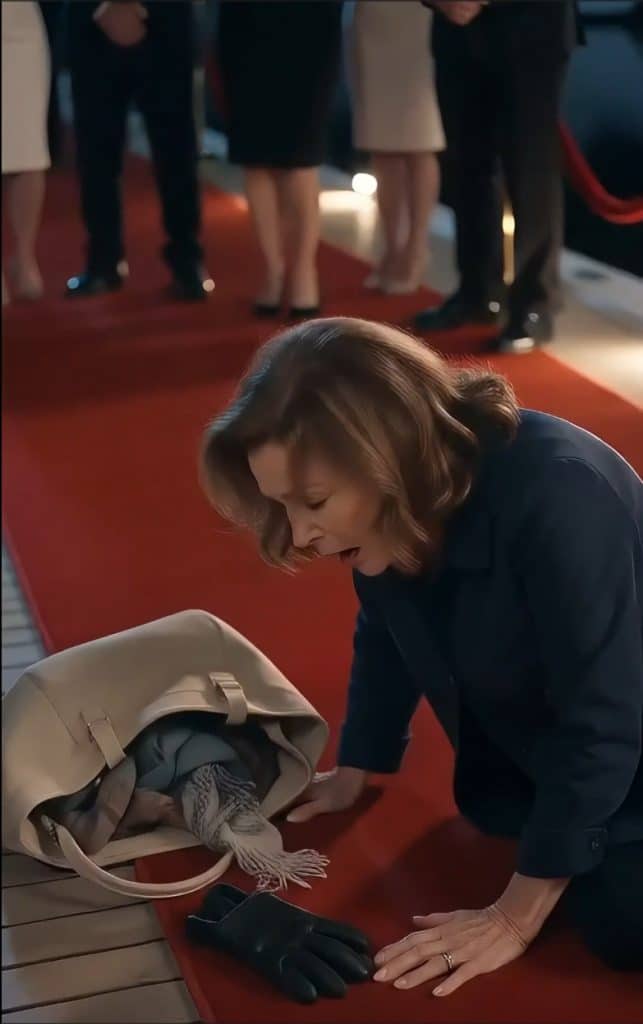
The canvas tote hit the dock before Mrs. Blackwell did.
It struck the polished wooden planks beside the velvet rope, sagged open, and spilled a navy scarf and a pair of old sailing gloves worn thin at the fingers. The gloves slid toward the dock rail, stopping under the warm lights that made the white yachts glow like floating mansions.
Then Mrs. Blackwell fell.
Her elbow scraped lightly against the wood. Her simple navy coat twisted at the shoulder. The wind pulled loose strands of brown hair across her face as she steadied herself with one hand and looked toward the tote.
Not the woman who had slapped her.
The tote.
As if those old gloves mattered more than the humiliation.
The VIP guest stood above her in a white cocktail dress, platinum hair perfectly shaped, diamond bracelet bright against the night. Champagne sparkled in the glass beside her, untouched, steady, as if striking another woman had not disturbed her elegance at all.
“This dock is for owners,” she said coldly, “not women who clean their boats.”
The words stopped every sound around them.
Servers froze with champagne trays. Security guards looked toward one another. Crew members on the yacht stairs went still. Wealthy guests in evening clothes turned from the red carpet and stared at the woman on the planks.
Mrs. Blackwell stayed low, breathing carefully.
She did not answer.
That seemed to please the woman who had struck her.
Her name was Celeste Harrington, and she had spent the evening pretending the yacht club belonged to her because she had been invited onto one of the smaller vessels for a charity cocktail cruise. She believed the velvet ropes existed to separate people like her from people carrying canvas totes.
So when Mrs. Blackwell stepped quietly onto the red-carpeted dock, Celeste saw no diamonds, no designer dress, no visible security.
Only a modest coat.
Flat shoes.
A tote that looked like it belonged to staff.
Then the captain descended the gangway.
Tall, straight-backed, dressed in a navy maritime uniform with gold buttons and a white cap, he came down from the largest yacht at the dock with two crew members behind him.
He stopped in front of Mrs. Blackwell.
Then his voice rang out across the dock.
“Owner on deck. Welcome home, Mrs. Blackwell.”
The guests turned.
Behind them, the largest yacht in the marina glowed under the night lights.
Its name shone in black letters across the stern.
BLACKWELL LEGACY.
Celeste’s champagne glass trembled.
“Blackwell?” she whispered.
Act II
Eleanor Blackwell had learned the sea before she learned luxury.
Her father was not a yacht owner.
He was a dock mechanic in Newport, a quiet man with cracked hands who could listen to an engine cough and know exactly what it needed. Her mother cleaned cabins during summer charter season, folding linen sheets for people who tipped poorly and called the crew by the wrong names.
Eleanor grew up between hulls, ropes, salt, and diesel.
She knew the difference between wind that could be trusted and wind that liked to lie. She knew how to coil a line, patch canvas, scrub teak, and climb aboard without dragging mud across a deck. She knew the people who made beautiful boats possible were rarely invited to stand in photographs beside them.
The sailing gloves in her tote had belonged to her father.
He wore them for twenty years until the seams gave way. When Eleanor was ten, he placed them in her lap and told her, “A boat does not care how rich you are. It only respects the hands that know what they’re doing.”
She never forgot it.
Years later, Eleanor married Thomas Blackwell, heir to a shipping fortune that had grown too polished to remember the docks where it began. Thomas was kind, restless, and ashamed of how his family treated crew as scenery. He met Eleanor during a charity regatta when she corrected his knot in front of three board members and made no apology for it.
He laughed.
Then married her two years later.
Together, they tried to change the Blackwell name from a symbol of inherited privilege into something useful. They funded maritime safety programs, crew scholarships, coastal rescue training, and legal aid for exploited yacht workers whose employers thought international waters meant no consequences.
Then Thomas died suddenly at forty-nine.
The world expected Eleanor to disappear into grief and trustees.
She did not.
She took control.
Quietly at first, then completely.
The largest yacht in the private club’s harbor had belonged to Thomas’s family for decades. It had once carried celebrities, politicians, and guests who drank champagne under stars while crew members slept four to a room below deck.
Eleanor renamed it Blackwell Legacy.
Not to honor wealth.
To challenge it.
The yacht was now used for rescue training, marine research, fundraising voyages, and occasional private events that paid for the foundation’s work. Eleanor kept one rule above all others.
Every crew member entered through the same dock as every guest.
No side gate.
No hidden walkway.
No pretending the boat could float without the people who kept it alive.
That rule made certain club members uncomfortable.
Celeste Harrington was one of them.
She liked the old ways better.
And that night, she mistook Eleanor Blackwell for the kind of woman the old ways had taught her to ignore.
Act III
Celeste had been watching the Blackwell Legacy all evening.
Everyone had.
It was impossible not to.
The yacht rose higher than the others, white and luminous against the black water, its decks lined with soft lights and silent crew moving with practiced precision. The invitation had called it the centerpiece of the annual Harbor Benevolence Gala, but rumors traveled faster than official programs.
Mrs. Blackwell was returning tonight.
The owner herself.
The widow.
The woman who never appeared in society pages unless she was refusing interviews or canceling deals that mistreated workers.
Celeste wanted to meet her.
More than that, she wanted to be photographed with her.
A Blackwell connection could elevate a donor circle, open board invitations, and turn a cocktail-season guest into someone who mattered beyond her husband’s money. Celeste had rehearsed the introduction twice in the car.
Mrs. Blackwell, I’ve admired your foundation work for years.
That was not true.
She had learned about the foundation that afternoon.
But rich people often called quick research admiration.
When Eleanor arrived without ceremony, Celeste did not recognize her.
There was no silk gown. No security detail. No diamond necklace bright enough to announce status from twenty feet away.
Just a middle-aged woman in a navy coat carrying a canvas tote.
Eleanor had come early through the public side of the dock because she wanted to see the event before anyone performed for her. She wanted to know whether guests greeted crew with courtesy. Whether security harassed staff. Whether the club had obeyed the Blackwell Legacy’s equal-access rule.
She was almost relieved at first.
The dock looked beautiful.
Red carpet. Champagne service. Warm lights on polished planks. The water carrying reflections of white hulls and gold lanterns.
Then she saw a young deckhand step aside too quickly when Celeste passed.
Fear has a posture.
Eleanor recognized it.
A few moments later, Celeste saw Eleanor approaching the red carpet near the gangway and blocked her path.
“Staff entrance is that way.”
Eleanor looked at her.
“I’m expected aboard.”
Celeste smiled.
It was a sharp, polished thing.
“By whom?”
“The captain.”
Celeste glanced at the tote.
“The captain does not invite cleaning staff through the owner’s walkway.”
“I’m not cleaning staff.”
“Then dress like it.”
The dock quieted.
Eleanor’s fingers tightened around the tote strap, not in anger, but around the old gloves inside.
“I need to board,” she said.
Celeste stepped closer.
“No, you need to learn where you belong.”
Then came the slap.
Now, with Captain James Calloway standing between them and the name Blackwell Legacy glowing behind his shoulder, everyone understood the mistake.
But Eleanor understood something deeper.
It was not a mistake at all.
It was a revelation.
Act IV
Celeste tried to recover behind a laugh.
It was thin enough to break.
“Mrs. Blackwell,” she said, suddenly sweet, “I had no idea.”
Eleanor slowly picked up the old sailing gloves.
The dock watched her more closely than it had watched the slap.
She brushed a fleck of dust from the worn leather and placed them back into the canvas tote before standing fully.
Captain Calloway moved as if to help, but Eleanor gave the smallest shake of her head.
She would stand on her own.
Only then did she look at Celeste.
“No,” she said. “You didn’t.”
Celeste exhaled, almost relieved.
Then Eleanor finished.
“But you knew I was a woman alone on your dock.”
The water knocked softly against the pilings.
Somewhere behind them, a champagne flute clicked against a tray.
Celeste’s mouth tightened.
“This has been misunderstood. I thought she was interfering with boarding.”
A young crew member near the stairs looked down.
Eleanor saw it.
“What is your name?” she asked.
The crew member blinked.
“Marina, ma’am.”
“Did you see what happened?”
Marina glanced at Celeste, then at the captain.
Captain Calloway’s voice was firm.
“Answer honestly.”
Marina swallowed.
“She stopped you before you reached the rope. You told her you were expected. She hit you.”
Celeste snapped, “She’s crew. Of course she’ll say that.”
Eleanor’s eyes cooled.
“She is crew. That is why I trust her to know what happens on this dock.”
The sentence moved through the guests like wind changing direction.
A security guard stepped forward.
“I saw it too, Mrs. Blackwell.”
Another guest, older and pale with embarrassment, added, “We all did.”
Eleanor turned toward Captain Calloway.
“Preserve dock footage. All cameras. Include audio if available.”
“Yes, ma’am.”
Celeste stiffened.
“Footage? Surely we can handle this privately.”
Eleanor looked across the red carpet, the velvet ropes, the glowing yachts, the guests who had gasped only after the slap was done.
“You made it public when you struck me.”
Celeste’s face flushed.
“I am a guest here.”
“No,” Eleanor said. “You were.”
The word ended the performance.
Captain Calloway gestured to security.
“Mrs. Harrington will leave the dock.”
Celeste stepped back.
“You cannot remove me. I am on the gala committee.”
Eleanor picked up her tote.
“Then the committee needs better judgment.”
Celeste’s lips parted.
“Blackwell?”
This time, nobody answered.
The yacht behind Eleanor had already spoken.
Act V
Celeste Harrington left the yacht club without boarding a single vessel.
Her white dress glowed under the dock lights as security escorted her past the champagne tables and away from the red carpet. Guests watched in silence, the same silence they had offered Eleanor when she fell.
This time, the silence did not protect Celeste.
It exposed her.
Eleanor did not watch her disappear.
She turned to the crew.
“Is everyone all right?”
The question startled them.
People expected owners to ask about reputation first. Damage second. Schedule third. Workers somewhere after that, if there was time.
Captain Calloway’s expression softened for half a second.
“We are now, ma’am.”
Eleanor looked at the spilled contents of her tote.
Marina stepped forward and carefully picked up the navy scarf.
“May I?”
Eleanor nodded.
“Thank you.”
The gloves remained in Eleanor’s hand.
Old leather. Faded seams. Her father’s fingerprints long gone but somehow still present.
The gala was delayed twenty minutes.
Not canceled.
Eleanor refused to let one woman’s cruelty become the whole evening. But before anyone boarded the Blackwell Legacy, she asked for the microphone.
The dock lights warmed her face. Behind her, the yacht stood grand and quiet, more like a witness than a prize.
“I was told tonight that this dock is for owners,” she began.
No one moved.
“My father never owned a yacht. He repaired them. My mother cleaned cabins after guests left their glasses, towels, and arrogance behind. Everything I know about boats, I learned from people who were often asked to enter from the side.”
A few crew members lowered their eyes.
Eleanor lifted the gloves.
“These belonged to my father. He wore them until they nearly fell apart. He taught me that a vessel is only as honorable as the way it treats the hands that keep it afloat.”
The red carpet looked smaller now.
Less impressive.
More like fabric covering planks built by someone else.
“Blackwell Legacy will not host events where crew are treated as scenery,” she said. “No guest, donor, sponsor, or committee member will remain aboard any vessel under my name if they degrade the people who make passage possible.”
The applause did not come immediately.
That was good.
The words needed to settle first.
Then Captain Calloway began clapping.
Crew followed.
Then guests.
Not all of them.
Enough.
The policies changed the next morning.
Celeste was removed from the gala committee and banned from Blackwell vessels. The yacht club opened a review of member conduct after crew submitted years of complaints that had been softened into “personality conflicts.” Equal dock access rules were rewritten into contracts. Crew harassment became grounds for immediate removal. Service corridors remained for logistics, not shame.
Some members complained that the club was becoming political.
Eleanor answered once.
“Dignity is not politics. It is seamanship.”
The phrase spread faster than she expected.
Within months, the Blackwell Foundation launched a program for maritime workers who had been mistreated on private vessels: legal support, training grants, emergency housing, and a reporting network that did not depend on the goodwill of wealthy employers.
Marina became one of the program’s first coordinators.
She still worked aboard the yacht, but now she also trained new crew on boundaries, safety, and how to document abuse without fear of retaliation.
On the first training day, Eleanor placed the old sailing gloves in a glass case near the crew entrance.
Marina looked at them.
“Shouldn’t those be upstairs? In the owner’s salon?”
Eleanor smiled faintly.
“My father would haunt me.”
Below the gloves, a small brass plaque read:
The boat does not move without the hands below deck.
A year later, the yacht club dock looked nearly the same to anyone who did not know where to look.
The yachts still glowed white at night. Champagne still moved on silver trays. Velvet ropes still guided guests. Red carpet still softened the sound of expensive shoes.
But the dock had changed.
Crew members used the main gangway without lowering their heads. Security intervened before insults became scenes. Guests were reminded, firmly and in writing, that invitations could be revoked for mistreating anyone on the dock.
One night, Eleanor arrived again in the same navy coat.
Again with the canvas tote.
This time, a young security guard opened the rope without hesitation.
“Welcome home, Mrs. Blackwell.”
She paused.
“Would you have opened it if you didn’t know my name?”
The guard looked embarrassed.
Then he answered honestly.
“I’m learning to, ma’am.”
Eleanor nodded.
“Good. Learning is better than pretending.”
Captain Calloway waited at the gangway.
“Owner on deck,” he said softly.
She gave him a look.
“James.”
He almost smiled.
“Habit.”
She boarded the Blackwell Legacy as the harbor lights trembled across the water.
Later that evening, she stood alone near the stern where the yacht’s name reflected in the dark.
BLACKWELL LEGACY.
People thought legacy meant what remained after money.
Eleanor knew better.
Legacy was what remained after behavior.
A name on a yacht meant nothing if the dock beneath it taught people to step around cruelty. A fortune meant nothing if it needed side entrances to preserve its beauty. A vessel meant nothing if the crew who carried it were treated as invisible.
The story spread, of course.
A rich guest slapped a modest woman on the dock.
The captain came down.
The woman owned the largest yacht in the harbor.
Blackwell?
It was satisfying because arrogance panicked in public.
But Eleanor did not care for that version.
It made ownership the lesson.
The slap had been wrong before the captain spoke.
The insult had been ugly before the yacht’s name came into view.
The woman on the dock had deserved help before anyone learned she owned what glowed behind her.
That was why she kept the canvas tote.
Not because it was expensive.
It wasn’t.
Not because it was elegant.
It wasn’t that either.
She kept it because it carried the gloves of a man who had taught her the simplest truth about boats, wealth, and people.
Anything beautiful that floats is held up by work most guests never see.
And any owner worthy of the title knows to honor the hands before admiring the shine.