Act I
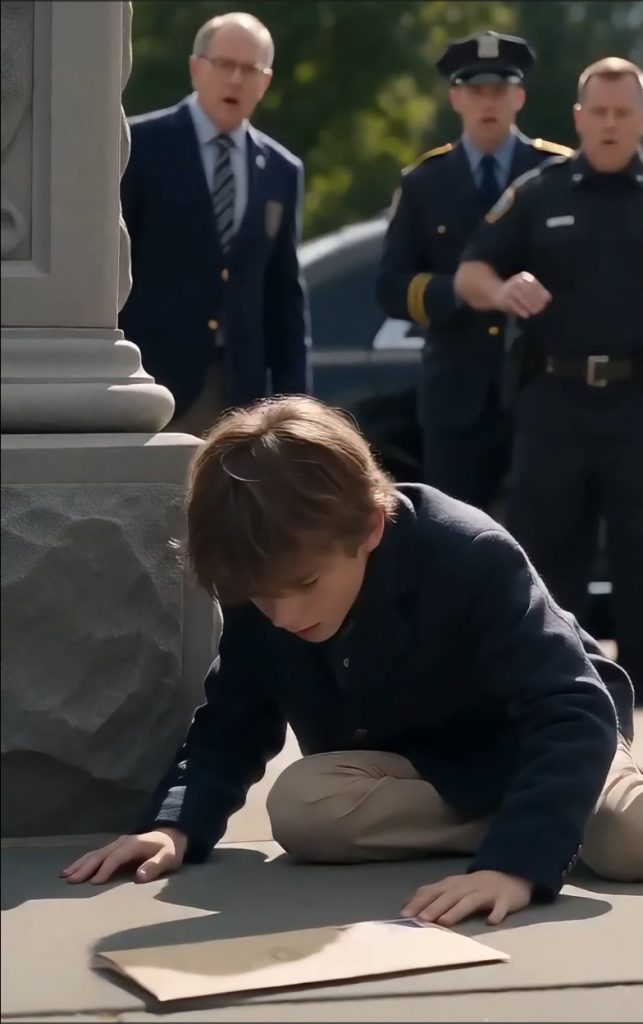
The admission envelope landed face-up on the stone path.
Its cream paper slid across the entrance of Anderson Academy, stopping beneath the shadow of the carved gate pillars. The academy seal caught the morning light first, stamped deep into the flap like a promise no one had bothered to read.
Then the boy hit the ground beside it.
He was thirteen, small for his age, with messy brown hair, blue eyes, an old navy coat, and shoes scuffed white at the toes. One hand braced against the stone path. His palm scraped lightly, but he did not cry out.
The woman who had slapped him stood above him in a white designer coat.
Her sunglasses were dark enough to hide her eyes, but not her contempt. A luxury handbag hung from one arm. Behind her, a black car idled near the curb while her son, dressed perfectly in an Anderson Academy uniform, stood beside the open door in stunned silence.
“This school doesn’t take boys from the street,” she said.
The words cut through the entrance louder than the slap.
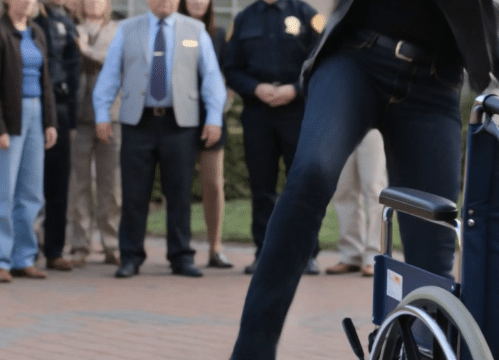
Students in navy uniforms froze near the gates. Drivers stopped unloading trunks. Parents in polished shoes turned from their conversations. Security guards shifted but did not move quickly enough.
Above them, the stone sign read:
ANDERSON ACADEMY.
The boy looked at it.
Then at the envelope.
He reached for it slowly, as if the paper mattered more than his pride.
The woman stepped closer.
“Don’t touch anything else,” she snapped. “You were standing too close to my son’s car.”
A few students whispered.
A few adults looked away.
That was the part the boy would remember later.
Not the slap.
The silence after it.
Then the heavy school gates opened.
Headmaster Collins hurried through with two security guards behind him, his navy blazer buttoned crookedly from the rush, striped tie swinging, silver headmaster pin flashing against his lapel.
He saw the boy on the ground.
Then he saw the envelope.
His face changed.
The headmaster moved past the woman without a word and knelt beside the boy.
“Young Mr. Anderson,” he said, voice trembling with restraint, “your grandfather built this school.”
The entrance fell silent.
The camera of everyone’s attention seemed to tilt from the fallen envelope to the carved stone sign above the gate.
ANDERSON ACADEMY.
The woman’s hand tightened around her handbag.
Her mouth barely moved.
“Anderson?”
Act II
His name was Noah Anderson, but he had spent most of his life trying not to say it too loudly.
Not because he was ashamed.
Because the name belonged to a world he had never really lived in.
His grandfather, Charles Anderson, had founded Anderson Academy seventy years earlier after being denied entry to three elite schools because his parents were poor immigrants and his clothes did not match the children inside the gates.
Charles never forgot the humiliation.
He became a teacher first, then a headmaster, then a fierce believer in the idea that intelligence could come through any door if someone brave enough kept the door open. When he finally built his own school on a stretch of green land outside the city, he carved a sentence into the first boardroom table.
No child shall be measured by the coat he arrives in.
For decades, Anderson Academy lived by that sentence.
Scholarships were not decorations. They were the heart of the place. The founder walked the dining hall himself, sat with students who looked lonely, and kept an old pair of worn shoes in his office to remind trustees what the school was supposed to see first.
Then time did what time does.
It polished memory until it stopped cutting.
Charles Anderson died before Noah was born. His son, Daniel, inherited board influence but not his father’s patience for wealthy politics. Daniel married a public school art teacher named Claire and stepped away from the academy after a bitter fight with trustees who wanted to reduce scholarship seats and expand legacy admissions.
Noah grew up in a small apartment with his mother and father, surrounded by books, secondhand furniture, and stories about a grandfather who believed schools should not belong only to people who could afford them.
Then Daniel died when Noah was nine.
Claire never asked the Anderson estate for money. Pride played a part. Grief played a larger one. She raised Noah quietly, working two jobs and saving every letter Daniel had left behind.
One letter stayed sealed until Noah turned thirteen.
It was from Charles Anderson.
Written years earlier.
If my grandson ever stands at the gate, let him enter as any boy should: not as an heir, not as a symbol, but as a student. Let the school prove it still knows how to welcome him.
Claire cried when she read it.
Noah did not.
He only asked if it meant he could apply.
He studied for a year.
He wrote his entrance essay on the old shoes in his grandfather’s office, though he had never seen them. He wrote that a school should not teach boys to rise above others, but to become strong enough not to need anyone beneath them.
Headmaster Collins read the essay twice.
Then a third time.
The admission committee voted unanimously.
Noah Anderson was accepted on the Founder’s Promise Scholarship, the same scholarship his grandfather had created for children who came with ability, not privilege.
Claire wanted to walk him to the gate on the first day.
But she had an early shift at the clinic.
So Noah came alone.
Old coat.
Scuffed shoes.
Sealed admission envelope.
And a name he hoped would not matter until after someone knew him.
Act III
The woman who slapped him was Victoria Harrington.
She chaired the Parents’ Prestige Council, funded the new dining terrace, and spoke often about “protecting the Anderson standard,” though she had never once asked what Charles Anderson’s standard actually was.
To Victoria, Anderson Academy was not a school.
It was a ladder.
Her son, Preston, had attended since sixth grade. His uniforms were tailored. His tennis coach drove in twice a week. His college consultant had already begun shaping a future that did not yet belong to him.
Preston was not cruel by nature.
That was perhaps the saddest part.
He had learned cruelty the way some children learn manners, by watching the adult closest to them.
That morning, Victoria had arrived angry.
A board meeting was scheduled that week, and Headmaster Collins had rejected her proposal to limit Founder’s Promise seats in the incoming class. She believed scholarship students made the school “less focused.” Collins had told her, carefully, that scholarship students were the reason the academy existed.
Victoria had smiled.
Then started calling trustees.
So when she saw Noah standing near the gate, holding a cream envelope and looking uncertain beside her son’s car, she did not see a child.
She saw the kind of student she wanted removed from the picture.
“What are you doing here?” she asked.
Noah straightened.
“I’m new.”
Victoria looked him over.
“New where?”
“Anderson.”
She laughed once.
It was small and sharp.
“Do you mean the public bus stop?”
Preston shifted beside the car.
“Mom,” he said quietly.
Victoria ignored him.
Noah lifted the envelope.
“I have my admission packet.”
She snatched it from his hand.
“Don’t wave forged papers at me.”
“It’s not forged.”
He reached for it.
That was when she slapped him.
Now, with Headmaster Collins kneeling beside him, the envelope lying between them, and the school crowd watching, the insult returned to the air in a different shape.
This school doesn’t take boys from the street.
Headmaster Collins picked up the envelope with both hands.
He saw the seal.
He saw the name.
Noah Anderson.
Then he looked at the boy’s scraped palm and the red mark forming across his cheek.
Something inside the old headmaster hardened.
Victoria removed her sunglasses slowly.
“I didn’t know who he was,” she said.
Noah looked down.
Collins stood.
“No,” he said. “You didn’t.”
Victoria’s shoulders lowered slightly in relief.
Then Collins finished.
“But you knew he was a child.”
The gate went quiet enough for the idling car to sound loud.
Act IV
Victoria tried to recover the way powerful parents often do.
By turning cruelty into confusion.
“This has been blown out of proportion,” she said. “I thought he was loitering.”
Headmaster Collins looked at the security guards.
“Preserve the gate footage.”
Victoria’s face changed.
“Footage?”
“Immediately,” Collins said.
One guard nodded and moved toward the security office.
Victoria stepped forward.
“Headmaster, surely we can handle this privately.”
Collins turned back to her.
“No. You made it public when you struck a student in front of the school.”
The word student moved through the crowd.
Not boy.
Not stranger.
Student.
Noah heard it and swallowed.
Preston Harrington stared at the ground near his polished shoes. His face had gone pale. He looked younger suddenly, less like the confident academy boy beside the luxury car and more like someone realizing his mother had done something that could not be folded away.
“I’m sorry,” he whispered.
Victoria snapped, “Preston.”
But he did not look at her.
He looked at Noah.
“I’m sorry.”
Noah did not answer.
He did not know how yet.
Headmaster Collins handed Noah the envelope.
Then he faced the crowd.
“Charles Anderson founded this academy after being turned away from schools that judged children by clothing, accent, and wealth. He built these gates to do the opposite.”
His voice grew stronger.
“Every one of you walks under his name. I suggest you remember what it means.”
A few parents lowered their eyes.
Others looked toward the carved stone pillars as if seeing them properly for the first time.
Victoria’s mouth tightened.
“My family has donated millions to this school.”
Collins nodded once.
“And Charles Anderson donated his name, his land, and his life’s work. Yet he still expected to be corrected when he was wrong.”
The sentence landed cleanly.
Victoria had no immediate answer.
A black sedan door opened nearby. A trustee stepped out, having arrived for the morning tour, and froze when he saw the scene. Then another parent moved forward from the crowd.
“She hit him,” the parent said.
A driver near the curb added, “The boy didn’t do anything.”
One of the security guards returned.
“Footage is secured, sir.”
Collins looked at Victoria.
“Mrs. Harrington, you will leave campus immediately. Pending disciplinary review, your access to school grounds is suspended.”
Her face went rigid.
“You can’t suspend me. I’m on the council.”
“Not anymore.”
The words moved through the entrance like a door closing.
Victoria looked at the crowd for support.
The crowd gave her silence.
Not the same silence as before.
This one judged her.
Act V
Noah’s first day at Anderson Academy did not begin in a classroom.
It began in the nurse’s office with a cold pack, a bandage for his palm, and Headmaster Collins sitting across from him as if the head of one of the country’s most prestigious schools had nowhere more important to be.
Noah kept the admission envelope on his lap.
It had a small crease now from the stone path.
Collins noticed him smoothing it with his thumb.
“I can replace that,” the headmaster said gently.
Noah shook his head.
“My mom will want to see the real one.”
Collins nodded.
“She raised a brave young man.”
Noah looked down.
“I wasn’t brave. I fell.”
“You stood back up.”
“That was after everyone knew my name.”
Collins took off his glasses.
“Noah, the failure today was not yours. It was ours.”
The boy looked at him then.
The headmaster’s voice grew quiet.
“This school should have protected you before I reached the gate.”
For the first time that morning, Noah’s eyes filled.
He tried to blink it away.
Collins pretended not to notice because kindness, with teenagers, sometimes means offering dignity instead of attention.
Victoria Harrington’s suspension became a formal ban from campus within a week. The school referred the assault to the proper authorities and required that all further communication about her son go through his father and legal guardianship channels.
But Preston remained enrolled.
That decision caused arguments.
Some parents wanted him removed because punishing the child felt simpler than confronting the culture that had shaped the mother. Noah surprised everyone by speaking first in the student council meeting.
“He didn’t hit me,” he said.
The room went still.
“He said sorry before anyone told him to. That should matter.”
It did.
Preston stayed, but not unchanged. He met with Collins, with counselors, and eventually with Noah, not for a staged apology, but for a real conversation that lasted seventeen uncomfortable minutes.
“I should have stopped her,” Preston said.
Noah looked at him.
“Yeah.”
Preston nodded.
“I know.”
That was all Noah needed from him that day.
The school changed more slowly.
Real change always does.
The Parents’ Prestige Council was dissolved and rebuilt as the Family Partnership Board, with no authority over admissions. Scholarship students were paired with faculty mentors before arrival. Security guards received clear instruction that every student at the gate was to be protected first and verified second. Parent conduct rules became part of the enrollment agreement, written plainly enough that no donor could pretend not to understand.
Most importantly, Headmaster Collins opened the Founder’s Room.
For years, it had been a locked ceremonial space used for trustee dinners and alumni photographs. Inside were Charles Anderson’s desk, old letters, the original school charter, and the pair of worn shoes Noah had written about in his essay.
Collins had the room cleared of champagne tables and reopened as a student study hall.
Noah stood in the doorway the first time he saw it.
The shoes sat in a glass case near the window.
Brown leather, cracked at the sides, the soles thin from use.
Below them was Charles Anderson’s handwritten sentence.
No child shall be measured by the coat he arrives in.
Noah read it twice.
Then he looked down at his own old navy coat.
For a moment, he felt less embarrassed by it.
Months later, Anderson Academy held its annual Founder’s Assembly outside the front gate instead of in the auditorium. Students gathered on the manicured lawn. Parents stood near the stone path. The carved pillars rose behind the podium, and the large sign looked different now, less like a brand and more like a responsibility.
Headmaster Collins invited Noah to speak.
Noah refused three times.
Then his mother told him that courage was not the absence of shaking hands.
So he stood at the podium with the creased admission envelope in front of him.
“My grandfather built this school,” he said.
The crowd listened.
“But I didn’t know him. Not really. I only knew stories.”
His voice trembled once, then steadied.
“I used to think his name meant I had to be impressive. Then I came here and learned something else.”
He touched the envelope.
“A name does not make you belong. People do. The way they open the gate. The way they speak to you before they know who your family is. The way they help you up before someone important tells them to.”
A quiet wind moved over the lawn.
Noah looked toward the students.
“I don’t want Anderson Academy to be a place where someone has to prove they matter before adults protect them. I think my grandfather would hate that.”
Collins lowered his head.
Several teachers did the same.
Noah folded the envelope carefully.
“That’s all.”
The applause began softly, then rose across the lawn.
Noah did not smile much.
But his mother, standing near the back in her clinic shoes, cried into both hands.
Years later, people still told the story of the morning a wealthy mother slapped a poorly dressed boy at the gates of Anderson Academy and then learned he was the founder’s grandson.
They remembered the envelope sliding across the stone.
The carved sign above the gate.
The headmaster’s voice.
Young Mr. Anderson, your grandfather built this school.
And Victoria Harrington’s breathless whisper.
Anderson?
It was a satisfying story because arrogance broke in public.
But Noah never liked that version best.
It made the name too powerful.
The slap had been wrong before anyone read the envelope.
The insult had been ugly before anyone saw the seal.
The boy on the stone path had deserved protection before the headmaster said who his grandfather was.
That was why, years later, when Noah became a senior, he volunteered at the front gate every opening day.
He greeted nervous new students in too-new blazers, scholarship students gripping paperwork, legacy kids pretending not to be scared, and parents trying to hide their own fears behind expensive sunglasses.
Whenever he saw a child standing uncertainly near the entrance, he walked over before anyone asked.
“Hi,” he would say. “You’re in the right place.”
Sometimes that was all a gate needed to become a welcome.
And every time he said it, the old stone pillars seemed a little less like a barrier.
A little more like the promise they were always supposed to be.