Act I
The slap echoed across the marble before anyone understood what had happened.
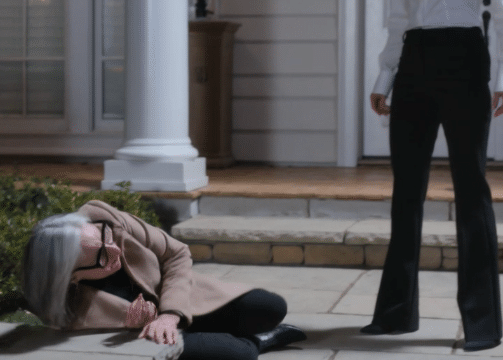
One moment, the elderly man was standing near the curved reception desk with one hand resting on his wooden cane. The next, his head turned sharply, the cane skidded away from his fingers, and his body went down hard onto the polished white floor.
The lobby froze.
Behind the desk, nurses in blue scrubs stopped typing. A receptionist rose halfway from her chair. The glass consultation rooms seemed to hold their breath.
The woman who had struck him did not look shocked.
She looked offended.
Blonde hair swept into an elegant bun, pearl necklace glowing against her beige designer suit, expensive leather handbag tucked under one arm, she stood over him as though he were luggage left in her way.
“Step aside,” she snapped. “This place is not for people like you. If you have no money, don’t dirty the VIP lounge.”
The old man lay on the marble, one hand braced against the floor, his brown blazer twisted at the shoulder. His blue shirt collar had shifted beneath his tie. He looked dazed, but he did not shout. He did not curse. He simply reached once toward where his cane had fallen and missed it.
That small, failed movement unsettled the room more than the slap.
Someone gasped.
The woman turned her head slightly, irritated by the sound.
“What?” she said. “Are we pretending this is a charity ward now?”
No one answered.
Then the elevator chimed.
The doors opened.
A middle-aged doctor in a white coat stepped out with two staff members behind him. He took one look at the man on the floor and began moving fast.
His footsteps cracked across the marble.
“Professor!”
The word hit the lobby like a second impact.
The wealthy woman stiffened.
The doctor dropped to one knee beside the fallen man, one hand steadying his arm with careful respect.
“Professor,” he said, voice low and shaken, “please forgive this disrespect.”
The old man lifted his eyes.
The woman’s hand rose slowly toward her pearl necklace.
“Professor?” she whispered.
And for the first time since entering the hospital, she looked afraid.
Act II
Vivian Ashcroft had never waited in an ordinary room when a better one existed.
That was not how she thought of it, of course.
She called it standards.
She called it efficiency.
She called it knowing one’s worth.
Her husband’s name was carved into donor plaques across the city. Her family attended benefit dinners where surgeons smiled politely, board members remembered her champagne preference, and hospital executives made sure she never had to stand in a line longer than three people.
So when Vivian entered Saint Aurelius Medical Center that morning and saw the VIP reception area crowded with administrators, visiting physicians, and one elderly man in a worn brown blazer standing too close to the private elevator, she felt personally insulted.
She had come for her husband’s consultation.
Not an emergency.
Not even a procedure.
A consultation.
But to Vivian, discomfort was something other people were supposed to absorb on her behalf.
She approached the desk with her handbag held tight and her chin lifted.
“My husband is Charles Ashcroft,” she said. “We were told the Langford Suite would be ready.”
The receptionist checked the screen.
“Yes, Mrs. Ashcroft. We’re preparing the room now. It may be a few minutes.”
Vivian looked around as though the delay had a smell.
That was when she noticed the old man.
He stood quietly near the marble column, leaning slightly on his cane, reading a folded letter. No designer watch. No private nurse. No family member hovering with a leather folder. Just an elderly man in a brown blazer, waiting.
Vivian mistook humility for poverty.
That mistake was old and common in places like Saint Aurelius.
The hospital had been built to look expensive because donors trusted marble more than mercy. But under the marble, hidden beneath years of private suites and gala naming rights, there remained an older promise.
Saint Aurelius began as a teaching hospital.
Its first free clinic was funded by a physician who believed the poorest patient and the richest patient should enter through the same door.
That physician was Professor Elias Merrick.
The man Vivian had just slapped.
He had trained half the senior staff in the city. He had written the hospital’s ethics charter. He had refused honorary titles for decades but accepted teaching rounds every spring because he said young doctors needed to learn that a chart never contained the whole person.
He used the VIP entrance only because the main lobby stairs had been closed for renovation, and his knee was bad that morning.
He had been waiting for Dr. Adrian Vale.
His former student.
The doctor now kneeling beside him.
Vivian knew none of this when she stepped closer and said, “You’re blocking the lounge.”
Professor Merrick had looked up gently.
“I beg your pardon?”
“You heard me.”
“I’m waiting for someone.”
“This is not the public clinic.”
He studied her for a moment, not with anger, but with sadness.
“No,” he said. “I can see that.”
That answer embarrassed her.
So she chose cruelty.
Act III
Dr. Adrian Vale helped Professor Merrick sit up while two nurses brought a chair and a blood pressure cuff.
“Easy, sir,” Adrian said.
The professor gave him a faint look.
“I taught you not to call me sir.”
Adrian’s mouth tightened, caught between relief and fury.
“You also taught me not to argue with patients on the floor.”
“I’m not your patient.”
“Today you are.”
A quiet ripple moved through the staff. Some lowered their eyes, ashamed they had frozen. Others looked toward Vivian with open disbelief.
Vivian recovered enough to speak.
“I had no idea who he was.”
The professor turned his face toward her.
“That should not have mattered.”
The sentence was soft.
It landed harder than an accusation.
Vivian’s cheeks flushed.
“I was under stress.”
Adrian rose slowly.
“Mrs. Ashcroft, you struck an elderly man in a hospital lobby.”
“He was in my way.”
The receptionist flinched at the words.
Adrian’s expression went cold.
“No one in this hospital is your obstacle.”
Vivian looked around, searching for someone important enough to rescue her version of events.
Her husband was not there. The board chair was not there. The donors who laughed at her dinner stories were not there.
Only staff.
Only witnesses.
Only the old man she had mistaken for powerless.
Then the chief administrator arrived, breathless from the east corridor.
“Dr. Vale, what happened?”
Before Adrian could answer, a nurse spoke.
“Mrs. Ashcroft slapped Professor Merrick.”
The administrator’s face changed.
Vivian saw it.
Not shock.
Recognition.
Fear.
Professor Merrick had not simply worked at Saint Aurelius. He had saved it once.
Fifteen years earlier, when the hospital board tried to close its public access program to expand luxury care, Merrick had released his resignation letter to the press. He named every clause in the founding charter they were violating. He returned a lifetime achievement award on live television and said, “A hospital that worships wealth will eventually forget medicine.”
The city listened.
The board backed down.
The program survived.
And the professor became something the wealthy disliked more than a critic.
A moral debt they could not buy.
Adrian looked toward the security desk.
“Pull the lobby footage. Lock it. No internal edits. I want security and legal notified.”
Vivian’s voice sharpened.
“You can’t be serious.”
Adrian turned back.
“I have never been more serious in this building.”
Act IV
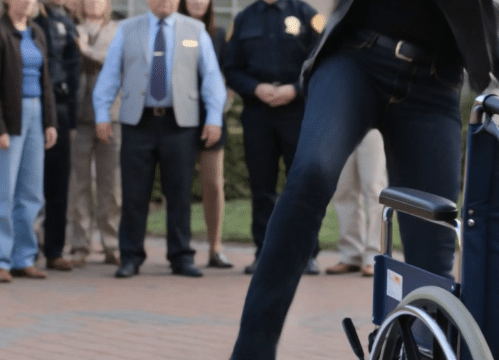
Charles Ashcroft arrived twenty minutes later in a wheelchair pushed by a private aide, wearing the annoyed expression of a man whose schedule had been disrespected.
That expression faded when he saw his wife standing beside security.
“What is this?” he demanded.
Vivian moved toward him.
“Charles, this has been blown completely out of proportion.”
Professor Merrick sat nearby, cane returned to his hand, a nurse gently checking his wrist. He looked tired, but composed.
Charles glanced at him and then away.
“I don’t understand why police are being mentioned.”
Adrian stepped forward.
“Because your wife assaulted a hospital guest.”
Vivian snapped, “He was loitering near the VIP lounge.”
Charles went still.
For the first time, he looked properly at the old man.
Then his face drained.
“Professor Merrick?”
The professor inclined his head.
“Mr. Ashcroft.”
Charles swallowed.
He knew exactly who Merrick was.
Worse, he knew why Merrick was at the hospital.
Saint Aurelius was holding a private review that afternoon on donor influence over clinical access. Professor Merrick had been invited to speak. Charles Ashcroft had spent months lobbying for expanded VIP priority protocols that would give major donors faster access to specialists, private imaging blocks, and reserved consultation suites.
The policy was already controversial.
Now his wife had slapped the man scheduled to argue against it.
In public.
On camera.
Charles closed his eyes briefly.
Vivian whispered, “Charles?”
He did not answer her.
Professor Merrick looked at Adrian.
“Help me stand.”
Adrian hesitated.
“Professor—”
“Please.”
The doctor supported him carefully as he rose. The lobby remained silent while the old man steadied himself on his cane.
He looked at Vivian.
“I have been poor,” he said. “I have been tired. I have been young and invisible. I have been old and inconvenient. None of those things made me less entitled to stand on a hospital floor.”
Vivian’s lips parted, but no words came.
Merrick turned to the staff.
“And none of you should ever be made to choose between courtesy to wealth and protection of a patient, visitor, or colleague.”
Several nurses looked down.
Not because he was scolding them cruelly.
Because he was telling the truth gently, and that was harder to escape.
The administrator cleared his throat.
“Professor, we can move the review to another day.”
“No,” Merrick said. “Today seems appropriate.”
He lifted his cane and took one slow step toward the conference wing.
Adrian moved beside him.
Vivian watched them go, her face pale.
For once, no one opened a door for her first.
Act V
The board review began forty minutes late.
It did not go the way Charles Ashcroft had planned.
The security footage was not shown publicly, but every board member in the room knew what it contained. Vivian’s slap had become more than a personal disgrace. It was evidence of the culture Professor Merrick had come to warn them about.
A hospital that divided human beings too sharply by payment level eventually trained people to mistake wealth for worth.
Professor Merrick spoke seated at the head of the conference table, one hand resting on his cane.
His cheek was still faintly marked.
His voice was steady.
“I am not here to argue against comfort,” he said. “A frightened family may need privacy. A recovering patient may need quiet. But comfort is not the same as hierarchy.”
He looked around the table.
“When a donor believes a lobby belongs to her more than an elderly man with a cane, that belief did not form in a vacuum. It was taught by every policy, every smile, every exception, every door opened for money before need.”
No one interrupted him.
Charles Ashcroft resigned from the access committee before the day ended.
Vivian was banned from the hospital except under supervised patient circumstances. Security filed an incident report. The hospital offered Professor Merrick the option to press charges, and he did not answer immediately.
Instead, he asked whether the receptionist who had frozen would be punished.
Adrian said no.
“She was afraid,” Merrick said. “Make sure she is trained, not blamed.”
That became the line everyone repeated later.
Trained, not blamed.
Within two months, Saint Aurelius changed its VIP access policy. Private suites remained, but medical priority could no longer be influenced by donor status. Staff received authority to remove abusive visitors regardless of wealth. Lobby security protocols were rewritten. A new sign appeared near the curved reception desk, elegant enough for the marble but clear enough for anyone who thought money made them taller.
Respect is not a premium service.
Professor Merrick disliked the sign at first.
“Too polished,” he muttered.
Adrian smiled.
“You prefer something harsher?”
“I prefer people not needing signs.”
But he approved it anyway.
The cane became famous among the staff.
Not because he fell.
Because he came back.
A week after the incident, Professor Merrick returned to Saint Aurelius for teaching rounds. He wore the same brown blazer. The same blue shirt. The same tie. The same wooden cane clicked softly across the marble floor that had held him at his most vulnerable.
This time, the lobby did not freeze.
It moved.
A nurse greeted him by name. The receptionist stood and smiled, nervous but sincere. A security guard nodded. A young resident held the elevator and then looked embarrassed for doing it too eagerly.
Professor Merrick paused at the reception desk.
The same receptionist from that day was there.
Her name was Nora.
“I’m sorry,” she said quietly.
He rested both hands on his cane.
“For what?”
“For not moving sooner.”
He studied her face.
“Will you move sooner next time?”
Her eyes filled.
“Yes.”
“Then we have both learned something.”
She laughed once through tears.
Adrian watched from near the elevator, arms folded, pretending he was not moved.
Professor Merrick saw him anyway.
“Stop hovering, Dr. Vale.”
“I’m ensuring you don’t start another revolution before lunch.”
“That depends on the lunch.”
They walked together toward the teaching ward.
On the way, they passed the VIP lounge.
The door was open.
Inside, a wealthy patient’s family sat beside a construction worker waiting for his wife’s consultation because the public waiting area was full. No one looked pleased about the crowding. No one was supposed to be pleased in a hospital.
But no one told him to leave.
That mattered.
Months later, Vivian Ashcroft sent a handwritten apology.
It arrived on thick cream stationery and used words like regrettable and distress. Professor Merrick read it once, then placed it in a drawer.
Adrian asked, “Will you respond?”
“No.”
“Why not?”
“Because she apologized to my title,” Merrick said. “Not to the man she thought had none.”
That was the final lesson.
The slap had shocked the lobby because the victim turned out to be important.
But Professor Merrick knew the deeper shame.
He should not have needed to be important.
He should not have needed a doctor to kneel, a title to be spoken, a board to panic, or a famous name to make the violence unacceptable.
An old man had been struck.
That should have been enough.
On his last teaching day of the year, he stood before a group of residents in a glass-walled consultation room overlooking the marble lobby.
He pointed his cane gently toward the people below.
Patients. Staff. Families. Cleaners. Couriers. Donors. Children. Elderly visitors reading forms with trembling hands.
“Before you diagnose anyone,” he said, “notice how they are being treated before they reach you.”
The residents wrote that down.
He smiled faintly.
“Good. Now write the part that matters.”
Pens paused.
He looked through the glass at the lobby where he had fallen and risen.
“Medicine begins before the exam room,” he said. “So does disrespect.”
No one forgot it.
And from that day forward, whenever someone in a designer suit raised their voice at the front desk, the staff at Saint Aurelius remembered the sound of a cane clattering across marble.
They remembered the old man on the floor.
They remembered the doctor kneeling.
They remembered the stunned whisper.
Professor?
And they remembered what Professor Elias Merrick taught them without a lecture that morning.
Dignity does not become real when power recognizes it.
It is real before anyone kneels.