Act I
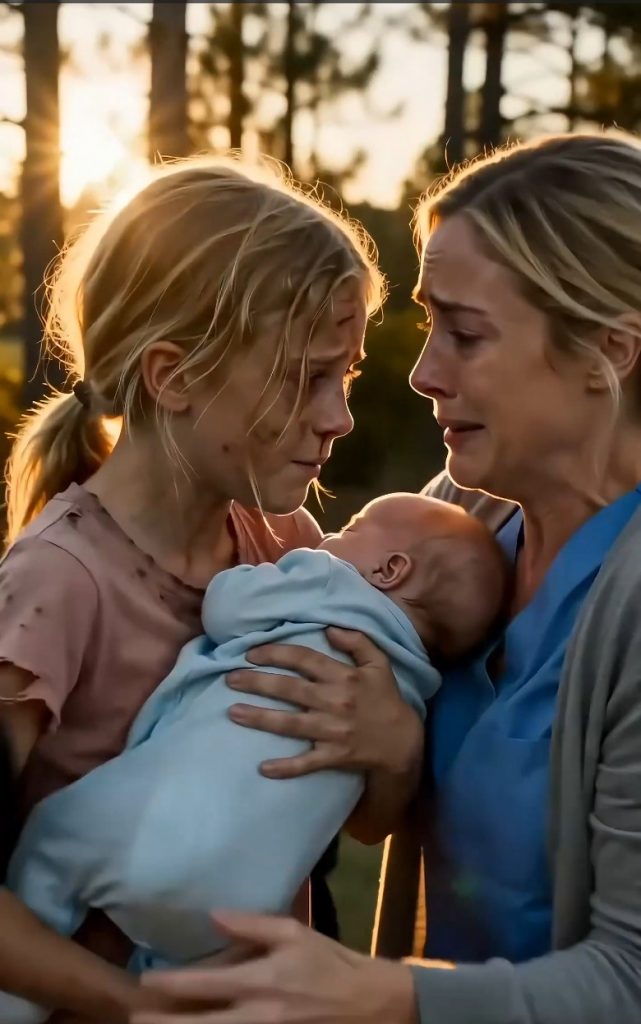
Macy came out of the trees carrying her baby brother like he was the only thing left in the world.
At first, Hannah did not recognize her daughter.
The sun was low behind the pines, turning the roadside gold and making the air look softer than it was. The paved road curved past a grassy shoulder, a quiet line of trees, and a white car parked crookedly near the edge of the woods.
Then the small figure stepped from the shadows.
Messy blonde hair.
Torn pink T-shirt.
Dirt on her face.
A baby in a light blue onesie clutched against her back, his little body still and heavy in the fading light.
Hannah’s breath stopped.
“Macy!”
The girl looked up.
Her eyes were red, hollow, and far too old for seven years old.
Hannah ran so fast one of her shoes slipped on the roadside gravel. Her blue scrubs stuck beneath her gray cardigan, damp with sweat and panic. She had been calling Macy’s name for nearly twenty minutes, first in anger, then in fear, then in the kind of terror that makes a mother’s voice stop sounding human.
“Macy! No!”
Macy did not cry when Hannah reached her.
That made it worse.
She only stood there, swaying, arms locked around the baby as if someone might still try to take him. Her breath came in sharp, exhausted pulls. Leaves clung to her hair. Mud streaked one cheek.
“I have to keep him safe,” Macy whispered.
Hannah dropped to her knees in front of her.
“You did, sweetheart,” she said, voice breaking. “Mommy’s here now.”
She eased the baby carefully into a safer position against Macy’s chest, supporting him with one hand while pulling her daughter close with the other. The baby’s face turned inward, silent against Macy’s shirt. Hannah felt the faint warmth of him and nearly collapsed from relief.
Almost.
Not enough.
Not yet.
“What happened?” Hannah asked.
Macy’s mouth trembled.
Behind them, the white car sat still on the roadside, its windows catching the sunset like blind eyes.
Macy looked at it once.
Then she looked back at her mother.
“Grandma left us in the car.”
Hannah froze.
The wind moved through the pine trees.
The world went silent around the words.
Act II
Hannah Blake had trusted her mother because daughters are trained to make excuses before they are trained to see patterns.
Marjorie Blake had always been difficult.
That was the word people used when they wanted cruelty to sound respectable. Difficult. Strong-willed. Particular. Old-fashioned.
When Hannah was a child, difficult meant dinner plates scraped into the trash if she cried at the table. It meant birthdays turned into lessons about gratitude. It meant apologies that sounded like warnings.
But when Hannah became a mother, she tried to believe Marjorie had softened.
Macy loved her grandmother in the simple, hopeful way children love adults who give them cookies and call them pretty. When Hannah’s second child, Oliver, was born, Marjorie arrived with folded blankets, casseroles, and sharp opinions wrapped in concern.
“You work too much.”
“You’re too tired to think clearly.”
“A baby needs family, not daycare strangers.”
Hannah was a nurse at St. Agnes Medical Center. She worked long shifts, came home with sore feet, and still learned the exact pitch of Oliver’s hungry cry and the way Macy needed her hair braided before school or the whole morning felt wrong.
She was tired.
She was not unfit.
Marjorie never said the word unfit at first.
She implied it.
Then Hannah’s ex-husband, Grant, came back into town after two years of sending birthday cards late and child support later. He had a new girlfriend, a new lawyer, and a sudden interest in custody after learning Hannah’s father had left the children a small education trust.
Marjorie began meeting Grant for coffee.
Hannah found out from a neighbor.
When confronted, Marjorie lifted her chin.
“Someone has to think about stability.”
Hannah stopped asking her to babysit.
That should have been the end of it.
But hospitals do not arrange emergencies around family tension.
That afternoon, Hannah was called in early when the pediatric floor flooded with patients after a school bus accident. No one in her usual circle could take the children. Marjorie appeared at the hospital entrance before Hannah even called her, as if she had been waiting nearby.
“I can watch them for two hours,” she said.
Hannah hesitated.
Macy held her baby brother’s stuffed elephant and looked between them.
Marjorie smiled down at her.
“Grandma will take you for ice cream.”
Hannah wanted to say no.
She should have said no.
Instead, she kissed Macy’s forehead, checked Oliver’s car seat, and said, “Two hours. Then bring them straight back.”
Marjorie nodded.
Her white car pulled away from the hospital at 4:12 p.m.
By 6:03, Hannah was calling her phone.
No answer.
By 6:18, Grant called Hannah.
Not Marjorie.
Grant.
He said, “Mom told me you abandoned the kids with her again.”
Hannah’s blood went cold.
“Where are they?”
He did not answer quickly enough.
That was when Hannah ran.
Act III
Macy remembered the car getting quiet.
That was the part that stayed with her.
Not the shouting. Not Grandma’s angry phone calls. Not the way the road changed from busy city streets to narrow lanes with trees crowding both sides.
The quiet.
Oliver had been fussing at first, small sounds from the back seat. Macy made funny faces at him until he blinked sleepily. Grandma kept talking on the phone, voice sharp and low.
“She does this constantly,” Marjorie said. “Leaves them with me and expects everyone to clean up her mess.”
Macy looked down at her knees.
Mommy did not do that.
Mommy packed snacks. Mommy checked straps. Mommy said thank you even when people did not deserve it.
Then Grandma pulled onto the roadside near the trees.
“I need a minute,” she snapped.
Macy watched her get out.
The door closed.
Grandma walked away with the phone pressed to her ear.
At first, Macy thought she was just outside.
Then minutes passed.
Oliver woke and made a weak little cry.
Macy called, “Grandma?”
No answer.
She looked through the window and saw Marjorie far down the shoulder, arguing into her phone. Then another car pulled up. Macy did not know the man at first because he wore sunglasses, but when he turned, she recognized him from old photos.
Grant.
Her father.
Grandma spoke to him near the trees. Grant looked toward the white car once, then away. His mouth moved fast. He was angry. Grandma was angrier.
Then both adults walked farther down the road, leaving the car behind.
Macy waited.
Oliver cried harder.
The air inside the car felt heavy.
Macy tried the door.
It did not open.
She tried again, panic rising into her throat.
“Grandma!”
Nothing.
She remembered her mother teaching her that if something felt wrong, she could make noise. She could ask for help. She could trust her body when fear said move.
So Macy moved.
She found the emergency latch on her side after fumbling and sobbing, not because she understood cars, but because her mother had once made a game out of practicing safety steps in parking lots. She pushed until the door gave way.
Then she climbed out.
Oliver was still strapped in.
Macy pulled at the buckle with shaking fingers, crying harder each time it stuck. When it finally clicked loose, she gathered him clumsily against her and nearly dropped the stuffed elephant. She shoved it into the pocket of her torn shirt instead.
Voices came from down the road.
Grandma’s.
Grant’s.
Closer.
Macy did not run toward them.
Some part of her knew.
She stepped off the shoulder and into the trees.
Pine needles scratched her legs. Branches caught her shirt. Oliver’s weight pulled at her arms, so she shifted him against her back, then later to her front, carrying him any way she could.
She did not know where she was going.
Only away from the white car.
Away from the grown-ups who left.
Toward the sound of her mother calling her name.
Act IV
The police arrived before Marjorie did.
Hannah sat on the roadside with both children wrapped in emergency blankets, one arm around Macy and the other hand resting lightly against Oliver’s back while paramedics checked him. The baby was breathing. Sleepy, warm, dehydrated, frightened by the noise when he finally woke and cried.
Alive.
That word held Hannah together by a thread.
Macy refused to let go of Oliver’s blue onesie until the paramedic said, “You can keep holding his foot, okay? I just need to listen to him.”
So Macy held his foot.
Her little fingers stayed curled around him like a promise.
A sheriff’s deputy photographed the white car. The engine was off. A child’s cup lay on the back seat. A baby blanket was twisted on the floor. The rear door on Macy’s side hung slightly open.
Hannah watched the camera flashes and felt something inside her turn from fear into fury.
Marjorie returned on foot from the direction of a gravel turnout, Grant behind her.
The moment she saw the police, her face changed.
Not with relief.
With calculation.
“Oh, thank God,” she called. “I was looking everywhere. Macy wandered off.”
Macy flinched.
Hannah felt it.
The deputy did too.
Hannah stood slowly, still holding Oliver against her chest.
“Do not come near them.”
Marjorie stopped.
Her eyes sharpened.
“Hannah, don’t be dramatic.”
The sentence was so familiar that for one second Hannah was twelve years old again, being told pain was performance.
Then Macy spoke from behind the blanket.
“She left us.”
Marjorie’s mouth tightened.
“She’s confused.”
Macy shook her head.
“No.”
Grant stepped forward.
“Everyone needs to calm down.”
Hannah turned on him.
“You were here?”
Grant looked at the deputy instead of her.
“I came when Marjorie called. She said Hannah dumped the kids on her and disappeared.”
“I was at work,” Hannah said.
Marjorie lifted a hand.
“At work again. That’s the problem.”
The deputy’s voice cut through the roadside air.
“Mrs. Blake, why was the vehicle left unattended?”
“It wasn’t.”
Macy looked up.
Her voice was small but clear.
“Yes, it was.”
The deputy crouched at a careful distance.
“Macy, can you tell me what happened?”
Hannah wanted to protect her from every question.
But Macy looked at her mother first, and Hannah nodded through tears.
“You can tell the truth,” Hannah whispered. “I’m right here.”
Macy swallowed.
“Grandma got mad on the phone. Then Daddy came. They talked. Oliver cried. I couldn’t open the door at first. Then I did. I took him because he was scared.”
Grant’s face drained.
Marjorie snapped, “That is not what happened.”
A second deputy approached from the white car holding a small device sealed in a plastic bag.
“Dash camera,” he said. “Still recording.”
Marjorie went still.
Hannah saw it then.
The whole truth, or at least the edge of it.
Marjorie had not simply been careless.
She had been staging something.
A frightened mother. Missing children. A grandmother claiming abandonment. A father suddenly present with an accusation ready before the facts.
The dash camera had been meant to help them.
Instead, it had watched them leave the children behind.
Act V
The video ended the argument.
It showed Marjorie parking near the trees. Showed her stepping out with the phone. Showed Grant arriving nine minutes later. Showed both adults standing far enough from the car that neither child could reach them.
It recorded Marjorie’s voice clearly when she said, “If Hannah wants to play exhausted martyr, we’ll let the court see what happens when the kids are in her care.”
Grant replied, “Not like this.”
Marjorie snapped, “Do you want custody or not?”
Then Oliver began crying.
Neither adult moved toward the car.
Macy did.
The camera caught her small face appearing in the back window, terrified and determined. It caught the rear door cracking open. It caught her pulling Oliver awkwardly into her arms. It caught her looking toward the adults, then toward the trees.
Then she disappeared into the woods with her baby brother pressed against her.
Hannah watched the footage later at the sheriff’s station with a victim advocate beside her and a paper cup of coffee going cold between her hands.
She did not cry during the video.
She had no room left for tears.
When it ended, she said only one thing.
“My daughter saved him.”
The deputy nodded.
“Yes, ma’am. She did.”
Marjorie was charged with child endangerment and obstruction. Grant, who tried to claim he had not understood the children were unattended, lost temporary visitation pending investigation. His lawyer stopped using the word stability.
The court moved quickly after the footage surfaced.
For the first time in months, Hannah sat before a judge and did not have to defend herself against whispers. The evidence spoke louder than Marjorie ever had. Macy’s statement, the dash camera, Hannah’s work records, the hospital call logs, the paramedic report, all of it formed a wall no performance could climb.
The judge granted Hannah sole emergency custody.
A protective order followed.
Marjorie tried to speak as she left the courtroom.
“Macy, sweetheart—”
Macy hid behind Hannah’s cardigan.
Hannah put one hand on her daughter’s shoulder.
“No,” she said.
Just that.
No.
It was one of the most powerful words she had ever spoken.
The weeks after were not simple.
Macy had nightmares about the car. She kept checking Oliver’s crib at night. She packed snacks into her school bag “just in case.” Once, Hannah found her daughter trying to carry Oliver from the living room to the kitchen because he made a sound in his sleep.
Hannah knelt in front of her.
“You don’t have to be his mommy,” she said gently.
Macy’s chin trembled.
“I know.”
But she did not know yet.
Not in her body.
So they worked on it.
Therapy. Patience. Routines. Lots of small promises kept until safety began to feel less like a word and more like furniture in the room.
Hannah changed her shifts. Her coworkers donated hours before she could ask. The hospital’s social worker helped connect her with childcare through a vetted program, and Hannah learned to accept help from people who did not use it as a leash.
Oliver grew louder again.
That was the first good sign.
He laughed when Macy made elephant noises with his stuffed toy. He kicked his feet at bath time. He cried with ordinary baby outrage when his bottle was late, and every time he did, Macy looked startled, then relieved.
A crying baby was still a living baby.
A demanding baby.
A baby safe enough to complain.
One evening, months later, Hannah drove both children back to the wooded roadside.
She asked Macy first.
Macy said yes after thinking for a long time.
They went at sunset.
The pines were still there. The grass had grown taller. The white car was gone, impounded first, then sold after court proceedings ended. Without it, the road looked almost peaceful.
That made Hannah angry for a second.
Then Macy reached for her hand.
They stood together near the shoulder while Oliver slept in his stroller, strapped in safely, his elephant tucked beside him.
“This is where I came out,” Macy said.
Hannah nodded.
“Yes.”
“I was scared you wouldn’t find me.”
Hannah’s throat tightened.
“I was scared too.”
Macy looked up.
“But you did.”
“I did.”
Macy thought about that.
Then she stepped toward the trees and placed something at the edge of the grass.
The stuffed elephant.
Hannah blinked.
“You sure?”
Macy nodded.
“He helped me carry Oliver.”
Hannah did not correct her.
Some objects become brave because children need them to.
They left the elephant there for a few minutes, then Macy changed her mind and picked it back up.
“He can come home,” she said.
Hannah smiled through tears.
“He can.”
As they walked back to the car, Macy stopped.
“Mommy?”
“Yes?”
“Was I bad because I ran away?”
Hannah dropped to her knees right there on the gravel.
“No,” she said, taking Macy’s face gently in both hands. “You were brave because you ran toward help.”
Macy’s eyes filled.
“I didn’t know where help was.”
Hannah pulled her close.
“You found me anyway.”
Golden light spilled through the pine branches. Wind moved softly over the grass. The road remained quiet, but it no longer belonged only to fear.
It belonged to the little girl who emerged from the woods carrying her brother.
To the mother who believed her.
To the truth caught by a camera meant to tell a lie.
And to the simple, unbreakable fact that Macy had already understood what the adults around her forgot.
A child should never have to save a baby.
But when everyone else failed him, she did.