Act I
The heartbeat filled the examination room first.
Steady. Rhythmic. Small.
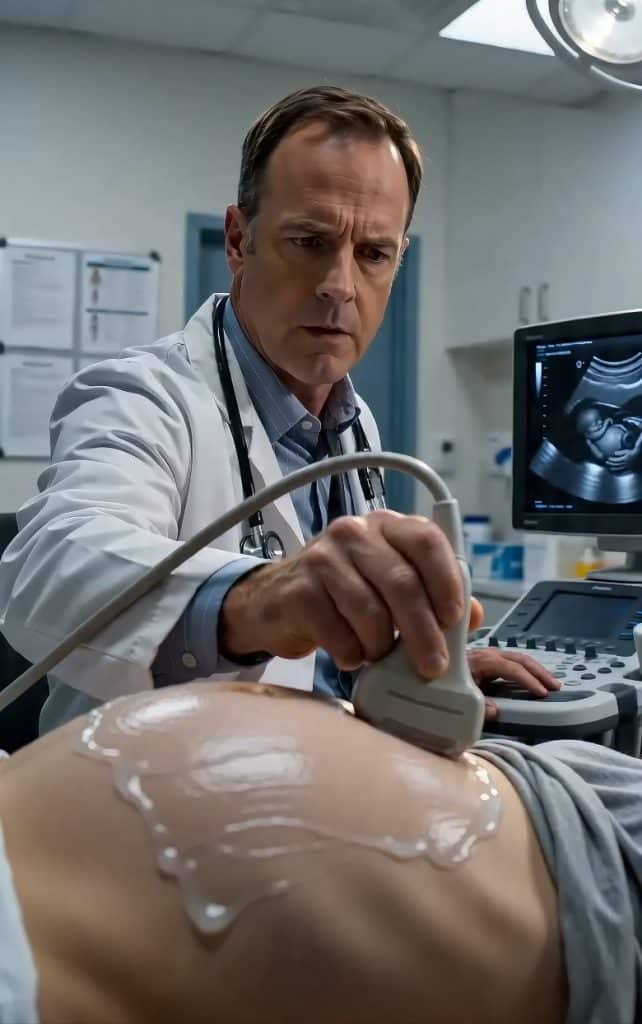
Nora Bennett lay on the padded table with one hand resting beneath the curve of her stomach, trying to breathe through the cold smear of ultrasound gel across her skin. Beside her, her husband, Caleb, sat forward in his chair, fingers locked together, smiling too hard at the glowing monitor.
They were thirty-two weeks along.
Close enough to count down the days.
Close enough for the nursery to have a name painted above the crib.
Close enough for every appointment to feel like proof that the nightmare was finally behind them.
Dr. Elias Ward moved the probe slowly across Nora’s belly. The grainy black-and-white image shifted on the monitor, showing the baby curled inside her, head rounded, spine curved, limbs tucked close.
Caleb exhaled.
“There she is,” he whispered.
Nora smiled faintly.
Then Dr. Ward stopped moving.
The probe froze.
His eyes narrowed at the screen.
The heartbeat continued, suddenly too loud in the sterile room.
Nora’s smile faded. “Doctor?”
He did not answer right away.
He leaned closer to the monitor, adjusting the angle with careful movements. The image sharpened slightly. The baby’s shape stayed clear, but near the upper edge of the scan, close to the placenta, something else appeared.
A small round object.
Too smooth.
Too defined.
Too mechanical.
Dr. Ward tapped a button. Red markers appeared on the screen, circling the strange shape. Two arrows pointed toward it like accusations.
Caleb’s hand moved to Nora’s stomach.
“What problem?” he asked.
Dr. Ward lifted the probe from Nora’s gel-covered belly, his face no longer clinical and calm.
He looked first at Nora.
Then at Caleb.
Then back at the image.
“Listen carefully,” he said. “A lot depends on your answer now.”
The room went cold.
Nora could hear the paper beneath her body crinkle as she shifted. She could hear the low hum of the ultrasound machine. She could hear her daughter’s heartbeat, still strong, still unaware that three adults were staring at the thing beside her.
Dr. Ward lowered his voice.
“Have you had any procedure outside this hospital since your last scan?”
Nora shook her head. “No.”
His eyes moved to Caleb.
“Are you sure?”
Caleb’s face changed so quickly Nora almost missed it.
Almost.
And in that tiny hesitation, before he spoke, before he lied, Nora understood something terrible.
Her doctor was not asking because he suspected a mistake.
He was asking because someone had put something inside her.
Act II
Eight months earlier, Nora had believed Hopewell was a miracle.
Hopewell Women’s Institute sat on a hill outside the city, all glass walls, white orchids, and soft voices. The waiting room smelled like lavender and expensive soap. Nurses spoke as if pain could be managed by lowering the volume.
Nora had gone there after two losses.
She did not like calling them miscarriages. The word felt too small for what it took from her. One nursery half-painted. One tiny pair of shoes returned to a box. One version of herself buried quietly while the rest of the world kept asking when she and Caleb would try again.
Caleb had found Hopewell.
“They’re the best,” he told her. “My father knows the board.”
Nora should have heard the warning in that sentence.
Caleb’s father, Martin Shaw, knew every board that mattered. Hospitals. Banks. Private schools. Foundations with gold letters on marble walls. He was the kind of man who never raised his voice because everyone leaned in before he needed to.
He had never approved of Nora.
She was a public school art teacher from a family that rented houses and fixed cars in driveways. Caleb was the only son of a medical-device billionaire whose name appeared on surgical tools, research grants, and donor wings.
Martin smiled at Nora in public.
In private, he called her “fragile.”
When Nora became pregnant again, Martin changed.
He sent vitamins. Hired a private nutritionist. Offered to pay for a full-time nurse. Suggested, gently, that Hopewell could provide “enhanced prenatal monitoring” because the Shaw family had already suffered enough disappointment.
Nora said no at first.
Caleb said yes for both of them.
“It’s just extra care,” he told her. “Don’t make this about my dad.”
So Nora went.
The early appointments were ordinary enough. Blood pressure. Supplements. More scans than usual. Doctors who smiled but avoided certain questions.
At twenty-four weeks, a Hopewell physician named Dr. Sloane told Nora there was a minor concern with her placenta.
“Nothing dangerous,” she said. “We just want to observe more closely.”
Nora remembered the room being dim.
She remembered a nurse telling her Caleb had already signed the consent forms.
She remembered asking for him, then being told he had stepped out to take a call.
After that, the memory blurred.
A pinch. A sedative she had not expected. A heavy sleep.
When she woke, Dr. Sloane said everything was fine.
Caleb was holding her hand.
“You scared me,” he said.
Nora had apologized.
That was the part she hated remembering now.
She had apologized while something hidden might already have been inside her body.
After that, the baby moved normally. The scans looked normal. Hopewell sent glossy reports that said words like stable, promising, and optimized.
Then Nora insisted on transferring back to her old obstetrician.
Dr. Ward.
He had delivered half the babies in her school district. He remembered her losses without making them the only thing about her. He listened when she said she felt watched.
Caleb resisted the transfer.
Martin called it emotional decision-making.
Nora transferred anyway.
Now, lying under soft clinical lights, with Dr. Ward staring at the ultrasound monitor as if it had just accused someone in the room, Nora finally understood.
Hopewell had not been watching over her.
Hopewell had been watching her.
And Caleb knew more than he had ever admitted.
Act III
“Caleb,” Nora said.
He looked at her too quickly.
“What?”
Her voice shook. “What did you sign?”
He laughed once, but it sounded wrong. “I signed a lot of paperwork. You know how clinics are.”
Dr. Ward did not blink.
“What did Hopewell implant?”
Caleb stood. “Implant? That’s insane.”
“Sit down,” Dr. Ward said.
There was no anger in his voice.
That made it more frightening.
Caleb sat.
Nora turned her head toward the monitor again. The strange object remained there, circled in red, bright against the grainy shadows around her daughter.
“My baby,” she whispered. “Is she hurt?”
Dr. Ward’s expression softened. “Her heartbeat is strong. Her movement looks good. But that object should not be there.”
“What is it?”
He hesitated.
That hesitation nearly broke her.
“It resembles a micro-optical sensor,” he said carefully. “Not a standard medical device. Not anything used in routine prenatal care.”
Nora looked at Caleb.
His face had gone pale.
Dr. Ward reached for the phone on the wall, then stopped. He looked back at Caleb.
“Before I alert hospital security and maternal-fetal medicine, I need one answer. Did anyone from Hopewell tell you this was experimental monitoring?”
Caleb rubbed both hands over his face.
Nora felt the world shift.
“Oh my God,” she whispered.
Caleb lowered his hands. His eyes were wet, but Nora could not tell if it was guilt or fear.
“They said it was safe.”
The words entered the room like poison.
Nora tried to sit up. “You knew?”
“Not like this.”
“You knew something was inside me?”
“I thought it was a sensor. A temporary one. They said it would dissolve.”
“Dissolve?”
Her voice cracked.
Dr. Ward moved closer to the bed, not touching her, but placing himself between Nora and Caleb without making it obvious.
Caleb leaned forward. “Nora, listen to me. My father said it was the best chance to protect her.”
“Protect who?”
“Our daughter.”
“No,” Nora said, tears burning hot. “Your father doesn’t protect. He owns.”
Caleb flinched because it was true.
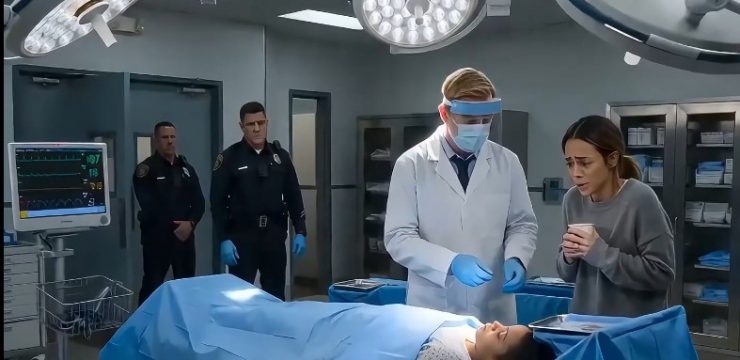
The door opened, and a nurse stepped in with a chart. Dr. Ward gave her one look.
“Get Dr. Raman from maternal-fetal medicine. Now. And call hospital legal. Quietly.”
The nurse glanced at the monitor and went still.
Then she left without asking questions.
Caleb stood again. “You don’t need legal.”
Dr. Ward’s voice sharpened. “A non-consensual device has been identified in a pregnant patient. Legal is the gentlest thing happening right now.”
Caleb’s phone began vibrating on the chair beside him.
Once.
Twice.
Again.
He looked down.
Nora saw the name on the screen.
Dad.
Caleb did not answer.
Then a text appeared.
Do not let Ward remove anything. Bring Nora back to Hopewell.
Nora stopped crying.
A colder feeling replaced it.
She looked at the message, then at Caleb.
“You told him we were here.”
Caleb opened his mouth.
No words came.
Dr. Ward picked up the phone from the chair and read the message. His face hardened.
Then another text arrived.
If she asks questions, remind her of the custody clause.
Nora stared at the screen.
“What custody clause?”
Caleb closed his eyes.
Dr. Ward looked at him.
“Mr. Shaw,” he said quietly, “you need to start talking before your father does it for you.”
Act IV
The custody clause was hidden inside a trust document Nora had never seen.
Caleb explained it in fragments, each one uglier than the last.
Martin Shaw had created a family medical trust after Nora’s second loss. Caleb called it a safety net. The papers, he said, were supposed to guarantee that the baby would have access to the best care if anything happened.
But the real clause was different.
If Nora were deemed medically unstable, mentally unfit, or noncompliant with physician-directed prenatal care, temporary decision-making authority could transfer to Caleb and the Shaw medical trustees.
Nora stared at him.
“You were building a case.”
“No,” Caleb said desperately. “I was trying to keep Dad calm.”
“You let them drug me.”
“I didn’t know they would do that.”
“You let them put something inside me.”
“I thought it was harmless.”
“You let your father threaten custody of a baby who isn’t even born yet.”
Caleb broke then.
Not dramatically.
Quietly.
His shoulders fell, and for the first time since Nora met him, he looked less like Martin Shaw’s son and more like the frightened boy he must have once been.
“He said if I didn’t cooperate, he’d cut us off. He said you’d blame me if anything went wrong again. He said I had already failed you twice.”
Nora’s anger flickered.
Not disappeared.
Never disappeared.
But flickered.
Because Caleb had been manipulated too.
That did not erase what he had done.
Dr. Raman arrived with two nurses and another ultrasound unit. She was calm, sharp-eyed, and fast. She reviewed the scan, then requested an immediate transfer to a higher-risk room for observation. No one spoke of removal yet. No one promised anything impossible.
They focused on Nora.
On the baby.
On safety.
That alone made Nora cry again.
Outside the exam room, raised voices echoed down the hall.
Martin Shaw had arrived.
Of course he had.
He entered like he expected the building to remember his donations.
Silver hair. Charcoal suit. A face carved from certainty.
“Nora,” he said, ignoring everyone else. “This has become unnecessarily emotional.”
Dr. Ward stepped into his path.
“You are not authorized to be in this room.”
Martin smiled faintly. “Doctor, you may want to check whose name is on your new neonatal wing.”
Dr. Ward did not move.
“You may want to check whose patient is on that table.”
The room went silent.
Nora had never loved her doctor more.
Martin’s eyes shifted to Caleb.
“Get your wife dressed.”
Caleb stood frozen.
For once, he did not obey.
Martin’s smile vanished.
“Caleb.”
Nora watched the war happen inside her husband.
A lifetime of obedience against one moment of truth.
Caleb picked up his phone.
Martin relaxed, thinking he had won.
Instead, Caleb unlocked it and handed it to Dr. Ward.
“There are messages,” he said. “Emails too. From Hopewell. From Dad. From Dr. Sloane.”
Martin’s face changed.
Nora saw it.
So did everyone.
Dr. Ward took the phone.
Martin’s voice dropped. “Son, think carefully.”
Caleb looked at Nora, then at the ultrasound monitor still showing their daughter’s heartbeat.
“I am.”
Hospital security arrived two minutes later.
Martin did not shout. Men like him rarely do when they lose control in public. He simply looked at Nora with a kind of cold disappointment, as if she had inconvenienced a dynasty.
“You have no idea what you’re interfering with,” he said.
Nora’s hand moved protectively over her stomach.
For the first time, her voice did not shake.
“My daughter is not an inheritance plan.”
Martin was escorted out before he could answer.
By evening, Hopewell was under investigation.
By midnight, Dr. Sloane had vanished.
And before sunrise, Dr. Ward received the call that made every face in the room go still.
Nora was not the only patient.
There were others.
Act V
The story broke three days later.
Not because Martin Shaw confessed.
People like him do not confess when denial is still available.
The story broke because Caleb gave investigators everything.
Emails. Consent drafts Nora had never signed. Financial agreements between Shaw Medical Systems and Hopewell Women’s Institute. Research notes describing “prenatal environmental monitoring” as if unborn children were products in a controlled trial.
The object inside Nora was not a camera in the way terrified headlines first claimed.
It was worse in another way.
A prototype sensor with optical capability, placed without clear consent, designed to collect internal data for a private device trial hidden behind boutique prenatal care. The company called it innovation.
Nora called it violation.
So did twelve other women once investigators found them.
Some were wealthy. Some were not. Some had been told they needed extra monitoring. Some had been sedated. Some had signed forms so dense and misleading that even lawyers argued over what they meant.
All of them had trusted doctors.
All of them had been used.
Nora stayed under careful observation for the rest of her pregnancy. The device remained stable until her medical team could make the safest plan. Every decision was explained to her. Every form was read aloud. Every doctor who entered the room introduced themselves twice if she asked.
Control returned in inches.
But inches mattered.
Caleb slept in the visitor chair for six nights before Nora finally told him to go home and shower.
He stood in the doorway, ashamed and hollow-eyed.
“I don’t know how to fix this,” he said.
“You don’t fix it,” Nora answered. “You spend the rest of your life never hiding behind fear again.”
He nodded.
She did not forgive him that day.
Forgiveness was not a discharge paper someone handed over because the crisis had passed.
It would have to be earned in ordinary hours.
In truth.
In patience.
In the absence of secrets.
Martin Shaw was removed from his company’s board pending federal charges. Hopewell closed its doors. Dr. Sloane was found two states away and arrested after trying to destroy records. The hospital wing with the Shaw name quietly covered its donor plaque with a temporary sheet until the board could vote to rename it.
Nora did not attend the press conference.
She was busy becoming a mother.
Her daughter was born five weeks later in a room full of light.
Not drama.
Not scandal.
Light.
The baby arrived crying loudly, angrily, beautifully. Dr. Ward stood beside the delivery team, not as the center of attention, but as the steady presence Nora had trusted when trust felt impossible.
When the newborn was placed on Nora’s chest, Nora touched her tiny cheek and began to sob.
Caleb cried too, silently, one hand over his mouth.
“What’s her name?” the nurse asked.
Nora looked at the baby.
Then at Caleb.
They had once planned to name her Margaret, after Martin’s mother. That name belonged to another life.
“Clara,” Nora whispered.
Clear. Bright. Unhidden.
Caleb nodded through tears.
“Clara,” he repeated.
The sensor was removed and preserved as evidence. Nora never asked to see it again. She had seen enough of what powerful people could do when they turned bodies into property and love into leverage.
Months later, Nora took Clara home to the little yellow nursery she had painted herself.
No monitors except the ordinary kind.
No private nurses.
No locked files.
No grandfather waiting in a dark car outside.
Just sunlight on the crib, clean blankets, and Caleb standing in the doorway with a bottle in one hand and fear still teaching him humility.
Nora watched him.
He did not step in without asking.
“Can I hold her?” he said.
It was a small question.
It mattered.
Nora looked down at Clara, asleep and warm against her chest.
Then she nodded.
Caleb crossed the room slowly and took his daughter like he knew trust was fragile, like he knew love was not ownership, like he knew a family could only survive if truth stayed louder than fear.
Later, when Clara was asleep in her crib, Nora stood alone by the window.
For months, she had thought the most frightening moment of her life was the doctor stopping mid-scan and saying there was a problem.
But she understood now that the real terror had existed before that.
In the signed papers she never saw.
In the room where she was sedated.
In the husband who stayed silent.
In the powerful man who believed a baby could belong to a name before she belonged to herself.
Dr. Ward had not created the fear that day.
He had exposed it.
And sometimes exposure is the beginning of rescue.
Years later, Nora would tell Clara the story carefully.
Not the frightening parts first.
The brave parts.
How a doctor looked closer.
How her mother asked questions.
How her father finally told the truth.
How a room full of machines and fear became the place where silence ended.
And how, before Clara was even born, the whole world tried to make decisions about her life.
But her heartbeat kept going.
Steady.
Rhythmic.
Small.
And impossible to ignore.