Act I
The desert road looked endless until the motorcycles blocked it.
Six bikes stood across the asphalt in a rough black line, engines rumbling low under the orange-gold sky. Dust drifted around their tires. The sun hung near the horizon, turning every face into shadow and every secret into something dangerous.
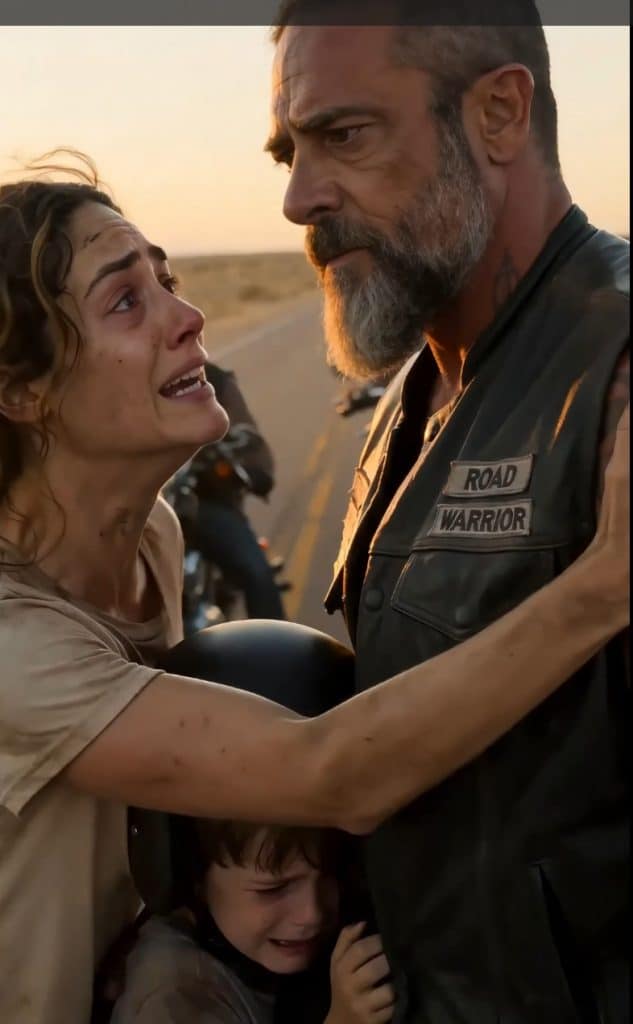
Emma Carter stood in the middle of the road with dirt on her cheek, tears on her face, and one hand locked around her son’s shoulder.
Noah was only five.
Too small for the fear around him.
Too small for the oversized black motorcycle helmet someone had just placed on his head.
His tiny fingers clutched the leather vest of the biker standing in front of him, a broad man with tattooed arms, a gray-streaked beard, and a patch across his chest that read ROAD WARRIOR.
Emma looked into the biker’s hard eyes and broke.
“Don’t take me,” she pleaded. “Just take him.”
The words stunned the men around her.
Even the wind seemed to pause.
Noah sobbed into the biker’s vest, his shoulders shaking under the helmet. He did not understand why his mother was begging strangers to take him. He did not understand why she had pulled him from the back seat of a half-dead sedan three miles back and run barefoot along the shoulder until a pack of bikers surrounded them.
He only understood that his mother was crying like goodbye.
Emma reached toward the biker leader with trembling fingers.
“His name is Noah,” she said quickly, as if the words might be stolen if she did not say them fast enough. “He’s five. He likes pancakes with too much syrup. He’s scared of thunder. Please remember that.”
The biker’s expression tightened.
His name was Jack Mercer, though no one had called him Jack on the road in years. To most people, he was just Mercer. To the men behind him, he was boss, brother, and the reason they were still alive after bad highways and worse decisions.
He looked at Emma like a man who had seen fear before and knew when it was real.
“You want us to take your kid,” he said, voice low, “but not you?”
Emma swallowed hard.
“Yes.”
“Why?”
Her eyes flicked over his shoulder.
Down the road.
Toward the dust rising in the distance.
The rumble came first.
Deep.
Heavy.
Growing.
The bikers turned their heads.
A white semi-truck was barreling toward them from the west, its silver trailer flashing in the sunset. It moved too fast for an empty desert road, too fast for a man who had simply found his family.
Emma’s whole body changed.
Her hand tightened on Noah.
“No,” she whispered.
Mercer saw it.
Not surprise.
Not relief.
Terror.
The truck roared closer, tires grinding over asphalt and gravel. Dust burst around the cab as it slammed to a stop behind the biker line. Air brakes hissed like an animal warning the road to stay back.
The driver’s door flew open.
A man leaned out of the cab, face red with fury.
“That’s my family!” he shouted. “Give me my kid!”
Noah whimpered.
Emma went still.
Mercer did not move toward the truck. He did not hand Noah over. He did not even turn fully away from the mother.
Instead, he looked straight at her.
“Tell me the truth.”
And Emma finally understood that the scariest men on that road might be the only ones willing to listen.
Act II
Three days earlier, Emma had stopped believing anyone would.
Not the motel clerk in Amarillo who looked at her bruised wrist and asked if she wanted to pay cash or card.
Not the state trooper at the gas station who arrived two minutes after Caleb had slipped his arm around her shoulders and smiled.
Not the woman in the diner who saw Noah hiding under the table and chose not to see.
Caleb Reed was good at becoming whatever the room required.
To strangers, he was charming. To officers, he was respectful. To women behind counters, he was exhausted, worried, and just trying to get his wife and son home. He used soft words. Calm words. Words designed to make Emma’s silence look like moodiness instead of fear.
“She hasn’t been sleeping,” he would say.
Or, “She gets confused when she’s stressed.”
Or, worse, “We’re working through some family stuff.”
Family.
He loved that word because it made everything harder to question.
But Caleb was not Noah’s father.
He was not Emma’s husband.
He was the man she had dated for eleven months after Noah’s real father died in a warehouse accident outside Phoenix. At first, Caleb had seemed like a blessing. He fixed the sink. Changed the oil in her car. Taught Noah to throw a baseball. Called Emma brave in a way that made her feel seen.
Then he began correcting her.
Then isolating her.
Then taking the phone “for her own good.”
When Emma finally told him to leave, Caleb smiled so gently it frightened her.
“You don’t get to break up a family,” he said.
That night, he took the spare key from under the flowerpot.
By morning, he had emptied Emma’s savings account.
By afternoon, he had convinced her landlord she was unstable.
By evening, he had Noah strapped into the back seat of his pickup and Emma in the passenger seat, phone gone, wallet gone, highway stretching ahead of them.
Caleb said they were starting over.
Emma knew they were disappearing.
For two days, she watched road signs like they were prayers. She counted exits. Memorized gas station names. Left tiny clues where she could. A napkin with her name and HELP written in pencil. A broken bracelet bead dropped near a restroom sink. A whisper to a cashier that died when Caleb stepped too close behind her.
Every chance vanished before it became one.
Then the pickup overheated outside a desert town with one gas station, two boarded-up shops, and a diner that smelled like burnt coffee.
Caleb slammed the hood shut and swore.
Emma saw the biker group at the pumps.
Seven men in leather vests. Road-worn boots. Beards. Tattoos. Machines that looked like thunder on wheels.
They should have frightened her.
They did.
But then Noah dropped his little plastic dinosaur near one of the bikes, and the biggest man there picked it up with surprising care.
He crouched, held it out, and said, “This yours, soldier?”
Noah nodded.
The man tapped the dinosaur’s head.
“Good guard dog.”
Noah smiled for the first time in two days.
Emma saw that smile.
And she made a decision no mother should ever have to make.
When Caleb went inside the gas station, she grabbed Noah and ran.
She did not ask the bikers for help the way people ask in movies. There was no clear sentence. No perfect explanation. She stumbled toward Mercer with Noah in her arms and said the only thing her fear could find.
“Please. He’s not his father.”
Mercer looked from Emma to the truck stop door, where Caleb had just turned and seen them.
Caleb started running.
Mercer moved first.
Not toward Caleb.
Toward Noah.
He scooped the boy behind him and handed Emma a helmet.
“Put it on him.”
Emma’s hands shook so badly that one of the bikers helped fasten the strap beneath Noah’s chin.
Caleb stopped ten feet away, breathing hard.
Then he smiled.
That calm, poisonous smile.
“Emma,” he said, as if speaking to a misbehaving child. “You’re scaring people.”
Mercer looked at him.
“Funny,” he said. “She looks scared of you.”
Caleb’s smile thinned.
The standoff began there.
At the gas station.
It ended on the desert road when Caleb, unable to force his way through seven bikers, stole a semi-truck from the service yard and came after them like a man who would rather destroy everything than lose control.
Act III
Now he stood in the cab of the truck, shouting into the wind.
“That’s my kid!”
Noah cried harder.
The sound cut through Emma.
She stepped forward, but Mercer lifted one hand without looking at her.
Not harsh.
Just enough.
Wait.
Caleb jumped down from the cab, boots hitting asphalt. Dust swirled around his legs. His black shirt clung to him with sweat, and his eyes were fixed on Noah with a hunger that made Emma’s stomach turn.
“Give him to me,” Caleb demanded.
Mercer tilted his head.
“You got papers?”
Caleb blinked.
“What?”
“Custody papers. Birth certificate. Anything that says he’s yours.”
Caleb laughed once, ugly and sharp.
“I don’t need papers to take my son.”
Emma’s voice broke.
“He’s not your son.”
Caleb’s eyes snapped to her.
The air changed.
Every biker felt it.
The mask dropped for one second, and what showed underneath was not a desperate father. It was rage. Ownership. The fury of a man whose lie had been spoken against in public.
Then Caleb recovered.
“She’s confused,” he said. “She’s been acting paranoid for days. I’m trying to get them home.”
“Home?” Emma whispered.
Her face twisted with something beyond fear now.
“You sold the house.”
Caleb’s jaw clenched.
Mercer turned slightly toward her.
Emma swallowed, her voice shaking.
“He emptied my account. He took my phone. He told people Noah was his. He said if I ran, he would make sure nobody believed me.”
Caleb stepped forward.
“That’s enough.”
Three bikers moved at once.
Not attacking.
Blocking.
Big bodies. Black vests. Boots planted in the road.
Caleb stopped.
His eyes darted across the line of men, calculating, then back to Noah.
“Come here, buddy,” he said, softening his voice. “Come to Daddy.”
Noah buried his helmeted face against Mercer’s side.
“I want Mommy,” he cried.
Something passed over Mercer’s face then.
A memory.
An old wound.
His own daughter had been four when a judge told him she was better off with her mother because Mercer was a biker, because he looked dangerous, because men like him were easier to doubt. He had spent years fighting for weekends, holidays, minutes. Then one night, his daughter called from a motel bathroom and whispered, “Dad, I’m scared.”
No one believed him either.
Not until he arrived himself.
Not until he saw what polite people had ignored.
His daughter was grown now. Safe. Far away. But Mercer had never forgotten the sound of a child whispering from behind a locked door.
He looked at Noah.
Then at Emma.
“Tell me the whole truth,” he said.
Emma wiped her face with the back of her hand.
“He has a gun in the truck,” she whispered.
The bikers went still.
Caleb’s face hardened.
“You stupid—”
He stopped himself too late.
The word hung between them.
No longer worried father.
No longer misunderstood partner.
Just the man Emma had been trying to escape.
Mercer’s voice dropped.
“Hands where I can see them.”
Caleb smiled again, but this time it trembled at the edges.
“You boys think leather makes you law?”
“No,” Mercer said. “But witnesses do.”
He nodded toward one of the younger bikers standing near the shoulder.
The man held up a phone.
Recording.
Caleb’s face changed.
The desert wind blew dust across the road.
Far behind the truck, faint sirens began to rise.
Act IV
Emma almost collapsed when she heard them.
Not because safety had arrived.
Because she had stopped believing it would.
Caleb heard the sirens too. His eyes flicked toward the horizon, then to the truck cab, then to Noah.
Mercer saw the decision form before Caleb moved.
“Don’t,” he warned.
Caleb ran for the truck.
Two bikers surged forward, but Caleb was faster than they expected. He grabbed the cab handle and climbed halfway up, reaching inside.
Emma screamed.
Mercer shoved Noah into the arms of a biker named Hank and moved.
For a man built like a wall, he was fast. He reached the cab before Caleb could pull anything out, grabbed the back of his shirt, and dragged him down onto the road.
Caleb hit the asphalt hard enough to lose his breath, but not hard enough to stop fighting.
He twisted, shouting, clawing at Mercer’s arm.
The bikers closed around him.
No punches. No chaos. Just weight, control, and the kind of discipline that made them more frightening than anger.
“Stay down,” Mercer said.
Caleb spat dust and fury.
“You have no idea what you’re doing.”
Mercer leaned closer.
“I know exactly what a scared woman looks like when no one believes her.”
The sirens grew louder.
Two state patrol cars arrived first, followed by a county sheriff’s SUV. Officers stepped out with hands near their belts, eyes moving quickly over the truck, the bikers, Emma, Noah, and Caleb pinned on the asphalt.
For one terrible moment, Emma feared the old pattern would repeat.
Caleb would speak calmly.
The men in uniforms would see bikers and assume criminals.
They would see a crying woman and assume confusion.
They would see a child in a helmet and assume chaos.
Caleb lifted his head, seizing the moment.
“Officer!” he shouted. “They kidnapped my son!”
Emma’s knees weakened.
Noah started crying again.
Mercer stood slowly and raised both hands.
“Phone’s recording,” he said. “Truck’s stolen. Woman says he’s armed. Kid says he wants his mother. Start there.”
The lead trooper looked at Emma.
Not past her.
At her.
“Ma’am,” he said, “is that your child?”
Emma nodded, shaking.
“Yes.”
“Is that man his father?”
“No.”
The trooper’s gaze moved to Caleb.
“Sir, keep your hands visible.”
Caleb’s confidence cracked.
They found the gun under the truck’s driver seat.
They found Emma’s wallet in Caleb’s pocket.
They found her phone powered off in the glove compartment.
They found Noah’s birth certificate folded inside a file bag on the passenger floor, along with cash, fake rental paperwork, and a handwritten list of small towns across three states.
Caleb stopped shouting after that.
He started bargaining.
Then blaming.
Then saying Emma had misunderstood everything.
But this time, the truth had arrived with dust on it, exhaust around it, and seven bikers standing in the road who refused to look away.
When the officers cuffed Caleb, Noah lifted his head from Hank’s shoulder.
“Is he going away?” he whispered.
Emma crossed the road on unsteady legs. Hank lowered Noah carefully into her arms, helmet and all.
She held him so tightly he squeaked.
“I’m sorry,” she sobbed. “I’m so sorry, baby.”
Noah clung to her neck.
“Can we go home?”
Emma closed her eyes.
Home was gone.
The old house. The account. The life she had tried to protect. Caleb had ripped through all of it.
But Noah was warm in her arms.
Breathing.
Here.
“We’ll make a new one,” she whispered.
Mercer turned away then, pretending to check his bike so no one would see what that sentence did to his face.
Act V
The sun disappeared before the road cleared.
By then, the desert had turned purple at the edges, and the heat was finally loosening its grip on the asphalt. The semi-truck sat silent on the shoulder, its stolen engine cooling. Caleb was gone in the back of a patrol car. The bikers remained because none of them wanted to leave until Emma and Noah were safe.
A female deputy wrapped Emma in a blanket and handed Noah a bottle of water.
He drank half, then looked up at Mercer.
“Can I keep the helmet?”
For the first time all evening, one of the bikers laughed.
Mercer crouched in front of him.
“That helmet weighs more than your head, little man.”
Noah touched the matte-black side of it.
“It made me brave.”
Mercer’s expression softened.
“No,” he said. “You were already brave. The helmet just helped everybody else notice.”
Noah seemed to think about that seriously.
Then he nodded.
The deputy told Emma there was a shelter contact waiting in the next town, someone who could help with emergency housing, documents, and a protective order. The words sounded practical and impossible at the same time.
Emma listened.
Signed forms.
Answered questions.
Kept one hand on Noah the whole time.
Before she climbed into the patrol car, she turned back toward Mercer.
“I thought you were going to take him,” she said.
Mercer rested one hand on his handlebar.
“You asked me to.”
“I know.”
“Why?”
Emma looked down at Noah, now half asleep against her hip.
“Because I thought if Caleb took me, at least Noah might disappear with someone who wouldn’t hurt him.”
The bikers went quiet.
Mercer’s face hardened, but not at her.
At the world that had taught a mother to think that was her best option.
“You don’t hand your kid to strangers unless every familiar face has failed you,” he said.
Emma’s eyes filled again.
“I didn’t know what else to do.”
“You ran toward help,” Mercer said. “That counts.”
For some reason, that broke her more than pity would have.
She covered her mouth and cried silently while Noah slept against her.
Hank removed the oversized helmet gently from the boy’s head. Noah stirred, frowned, then settled again when Emma kissed his hair.
Mercer handed Emma a folded card.
No logo. No official title. Just a phone number and the words Road Warrior Relief Fund.
She frowned.
“What is this?”
“My daughter runs it,” Mercer said. “Helps women and kids get back on their feet. Motels. Gas. Court rides. Whatever falls between the cracks.”
Emma stared at him.
“You do this often?”
Mercer looked toward the darkening road.
“More often than we should have to.”
The patrol car door opened.
Emma held the card like it was something fragile.
“Thank you,” she whispered.
Mercer nodded once.
Then Noah lifted his sleepy head.
“Bye, dinosaur man.”
Mercer blinked.
The other bikers grinned.
“Dinosaur man?” Hank muttered. “That’s your new road name.”
Mercer ignored him with great dignity.
“Bye, soldier,” he said to Noah.
The patrol car pulled away slowly, red and blue lights washing over dust, chrome, leather, and the long empty road.
Emma looked through the rear window until the bikers became silhouettes against the last glow of sunset.
For the first time in three days, she let herself breathe without listening for Caleb’s footsteps.
Weeks passed.
Then months.
Caleb’s case moved through the court system with the usual slowness, but this time Emma was not alone in the hallway. Mercer’s daughter, Abby, sat beside her during the first hearing. A shelter advocate helped replace documents. A retired teacher watched Noah during appointments. Hank drove them once to pick up donated furniture and spent twenty minutes arguing that every child needed a dinosaur lamp.
Noah loved the lamp.
He still asked for too much syrup on pancakes.
Still hated thunder.
But he stopped hiding under tables when men raised their voices.
That took longer.
Healing did.
One afternoon, nearly a year after the desert road, Emma drove Noah to a community fundraiser outside a veterans’ hall. Motorcycles lined the parking lot, shining under a bright blue sky. Noah pressed his face to the window.
“Mommy,” he breathed. “It’s them.”
The Road Warriors were cooking burgers, collecting backpacks for families in shelters, and looking exactly as intimidating as ever to anyone who did not know better.
Mercer saw Emma first.
Then Noah.
The boy ran to him with the reckless joy of a child who had decided a giant bearded biker was part of his safe world.
Mercer crouched just in time.
Noah crashed into him.
“You got big,” Mercer said.
“I’m six now.”
“That explains it.”
Noah pulled something from his pocket.
A small plastic dinosaur.
Scuffed. Green. Familiar.
“I brought him back,” Noah said.
Mercer looked at the toy, then at Emma.
Her eyes were bright, but she was smiling.
“He wanted you to have it,” she said.
Mercer accepted the dinosaur with the solemnity of a medal.
“I’ll guard him.”
Noah nodded.
“He’s scared of thunder too.”
Mercer’s throat moved.
“Then we’ll be scared together.”
That evening, as the sun lowered behind the hall, Emma watched Noah sit on a picnic bench between bikers twice his size, eating a burger with ketchup on his chin and laughing at something Hank said.
For a moment, the memory of the desert returned.
The road.
The truck.
The dust.
Her own voice begging strangers to take her child because she thought love meant letting go.
Now she understood something different.
Love had not been the goodbye.
Love had been running.
Screaming.
Trusting the right stranger for one impossible minute.
Love had been telling the truth when fear told her silence was safer.
Mercer walked up beside her, the plastic dinosaur tucked into the pocket of his vest.
“He looks good,” he said.
Emma watched Noah laugh again.
“He is.”
“And you?”
She looked out at the road beyond the parking lot. It stretched west into open country, not empty this time, not threatening.
Just open.
“I’m getting there,” she said.
Mercer nodded.
No speeches.
No pity.
Just the quiet respect of someone who knew surviving was not a single act, but a long road you had to keep choosing.
Noah ran back to her then, sticky hands and all, and wrapped both arms around her waist.
“Can we have pancakes tomorrow?” he asked.
Emma laughed.
“With too much syrup?”
He grinned.
“Too much.”
She kissed the top of his head.
“Then yes.”
Behind them, motorcycles gleamed in the sunset, no longer a wall across a desert highway, but a line of guardians parked beside a place where broken families came to begin again.
And for the first time in a long time, when Emma looked at the road ahead, she did not see escape.
She saw the way home.