Act I
The Golden Retriever would not let go.
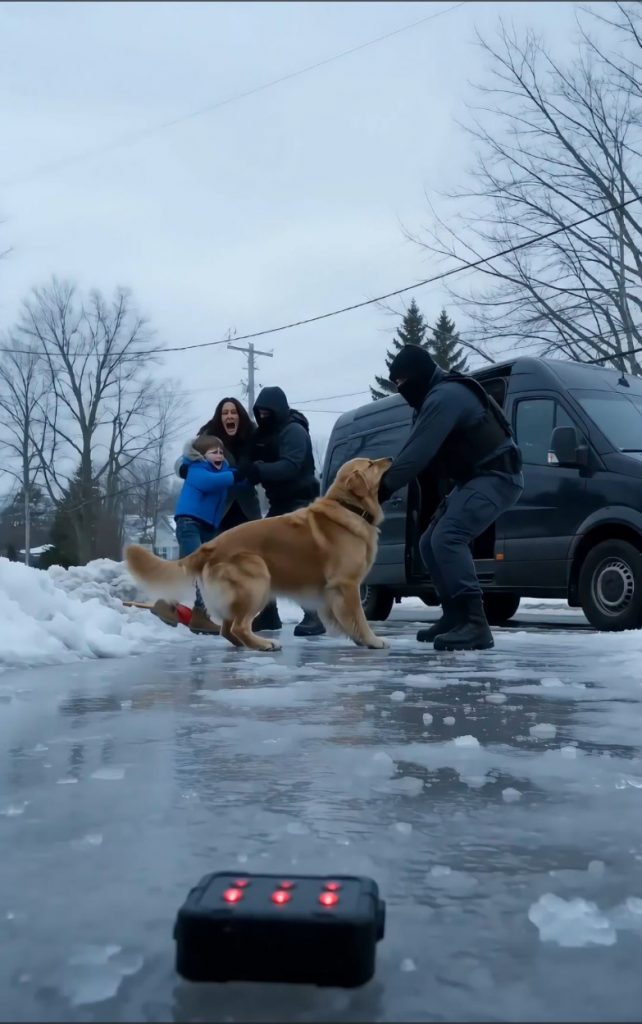
His teeth were locked around the sleeve of Noah’s bright blue winter parka, pulling with such frantic force that the little boy slid backward across the icy driveway. His boots scraped through slush. His arms flailed. His small voice cracked in confusion.
“Let go! Let go!”
But Cooper only barked harder.
The dog’s golden coat was dusted with snow, his black collar jingling as he pulled again. His paws slid on the frozen concrete, but he kept his body low and strong, dragging Noah away from the curb like the road itself was on fire.
Across the driveway, Noah’s mother, Rachel, had her back turned.
She was shoveling the heavy ridge of dirty snow left by the plow, gray coat buttoned crookedly, dark hair whipping across her cheek in the cold wind. The scrape of her green shovel drowned out the first few barks.
Then Noah fell.
His knees hit the ice with a dull thud. His parka yanked open near the chest, and something small and black slipped from an inner pocket.
It hit the frozen driveway with a metallic clink.
Cooper stopped pulling.
Noah stared down.
The object was square, no bigger than a matchbox, with three tiny red lights blinking in a steady pattern.
Beep.
Beep.
Beep.
Rachel finally turned.
“Noah?”
The dog stepped over the boy like a shield, facing the street now, his teeth bared, his bark changing into a deep warning growl.
Rachel dropped the shovel.
At the curb, a black van with tinted windows screeched to a stop.
For half a second, the entire neighborhood seemed frozen. Snowbanks. Bare trees. Gray sky. The quiet rows of suburban houses watching with blank winter windows.
Then the van’s sliding door snapped open.
Two men in dark clothes jumped out.
Rachel ran before she fully understood what she was running toward.
“Stay away from him!”
One man moved toward her. The other moved straight for Noah.
Cooper lunged between them, barking so fiercely that the man hesitated. Noah scrambled backward, crying now, one hand clutching Cooper’s collar.
The first man grabbed Rachel’s wrists before she reached her son.
She fought hard, twisting against him, boots slipping in the slush.
“Somebody help!” she screamed. “Help!”
The second man reached past Cooper and seized Noah by the back of his parka.
Noah screamed for his mother.
Cooper launched himself forward, slamming into the man’s arm and clamping down on the thick sleeve of his jacket. The man stumbled, dragging Noah only inches before the dog’s full weight pulled him sideways.
The van waited with its door open.
The black device beeped faster on the ice.
And Rachel realized, with a terror colder than the snow beneath her feet, that this had not started with the van.
It had started inside her own house.
Act II
Two months earlier, Cooper had refused to sleep downstairs.
That was the first sign.
Rachel told herself the dog was getting older, clingier, maybe anxious from the cold weather. Cooper was seven, with a white patch forming around his muzzle and the patient eyes of an animal who had seen Noah through fevers, nightmares, and the first day of kindergarten.
He had been Noah’s dog since the boy was four.
Or maybe Noah had been Cooper’s boy.
No one in the Hayes house was entirely sure.
Cooper followed Noah from room to room. He waited outside the bathroom door. He slept beside the boy’s bed every night, one paw stretched toward the frame as if keeping watch even in dreams.
After Rachel’s divorce, that watchfulness became sharper.
Noah’s father, Daniel Hayes, had money, influence, and the kind of polished sadness that impressed family court mediators. He owned a chain of medical supply warehouses. He wore expensive coats and spoke softly in offices. He described Rachel as “overwhelmed” and “emotionally reactive.”
Rachel described Daniel differently.
Controlling.
Cold.
Dangerous when no one was watching.
But Daniel had never left proof. Only patterns.
He made surprise visits. Sent gifts Noah did not ask for. Asked the boy questions about Rachel’s schedule. Once, after a supervised pickup, Noah came home with a new stuffed bear that played a recorded message in Daniel’s voice.
Daddy is always close.
Rachel threw it away after Noah fell asleep.
The custody case had become ugly. Daniel wanted expanded visitation. Rachel wanted restrictions. The judge wanted everyone to act reasonable, which was the sort of request that always favored the person better at pretending.
Then Cooper began sniffing Noah’s coat.
Every morning.
Every night.
He shoved his nose against the same blue parka until Noah giggled and pushed him away.
“Coop, stop! It tickles!”
Rachel washed the coat. Cooper still sniffed it.
She checked the pockets. Nothing.
At least, nothing she noticed.
The inner chest pocket had always been tight and almost useless, a little zippered space Noah never used. Rachel had forgotten it existed.
Cooper had not.
A week before the van arrived, Daniel called Rachel with the calm voice he used when he wanted her to feel cornered.
“I’d like Noah this weekend.”
“You know that’s not the schedule.”
“He’s my son.”
“And the court order says—”
“The court order is temporary.”
Rachel gripped the phone.
“Daniel, stop.”
There was a pause.
Then he said, very softly, “You keep making this harder than it needs to be.”
The next morning, Cooper barked at the blue parka hanging by the back door.
Not once.
For nearly ten minutes.
Rachel was late for work. Noah was crying because the noise scared him. The school bus was coming. She grabbed the coat, zipped it up, and told herself the dog was reacting to a squirrel outside.
She kissed Noah on the forehead.
She sent him to school.
She did not know Daniel had visited the school office the day before with a court document old enough to be useless but official enough to confuse a substitute secretary.
She did not know he had asked to leave “a winter note” in Noah’s cubby.
She did not know the note had not mattered.
Only the coat had.
And Cooper, who did not understand custody agreements or court orders or adult lies, understood one thing perfectly.
Noah smelled wrong.
Act III
The man dragging Noah cursed as Cooper pulled against him.
The dog’s teeth were locked onto the sleeve, not the skin, but the force was enough to break the man’s grip for one flashing second. Noah slipped, hit the slush, and rolled toward the snowbank.
Rachel saw him fall.
Something in her went silent.
She twisted hard, drove her shoulder backward, and broke one wrist free from the man holding her. He grabbed again, but she kicked against the ice, threw her weight down, and both of them stumbled.
“Run, Noah!” she screamed.
Noah tried.
His boots slipped. His hood fell over one eye. He crawled toward Cooper, sobbing so hard he could barely breathe.
The abductor near the van lunged again.
Cooper turned on him with a bark that sounded nothing like the gentle dog who carried stuffed animals around the living room. The man stopped, just long enough for Rachel to reach Noah.
She threw herself over her son.
The second man grabbed at her coat.
Then a voice thundered from across the street.
“Hey!”
A garage door had opened.
Mr. Alvarez, the retired firefighter from next door, stood in his driveway holding a snow shovel like a weapon. Behind him, his wife had a phone pressed to her ear.
“The police are coming!” she shouted.
The men hesitated.
That hesitation saved them.
Not Rachel and Noah.
The abductors.
Because Cooper was still pulling, still barking, still blocking them from getting a clean grip on the boy.
The driver inside the van shouted something sharp.
The man holding Rachel released her and ran for the open door. The other ripped his sleeve from Cooper’s teeth and scrambled backward, nearly falling on the ice.
Cooper chased them to the edge of the driveway, but stopped when Rachel called his name.
“Cooper! Here!”
The dog spun back instantly.
The van door slammed.
Tires shrieked.
The black van tore away down the residential street, fishtailing once before disappearing around the corner.
For one second, only the beeping remained.
Fast.
Thin.
Terrible.
Rachel looked down at the device lying near the slush.
Three red lights.
Blinking.
Noah clung to her neck.
“Mommy, what is that?”
Rachel could not answer.
Mr. Alvarez reached them, breathing hard. He looked at the device, then at the tire marks, then at Cooper standing over Noah with snow on his muzzle and fury still in his eyes.
“Don’t touch it,” he said.
Rachel nodded, though her whole body was shaking.
Mrs. Alvarez came running with a blanket. She wrapped it around Noah and Rachel together, then knelt and pressed one trembling hand to Cooper’s head.
“Good boy,” she whispered. “Oh, you good, good boy.”
Cooper did not lean into the praise.
He kept staring down the street.
Within minutes, sirens cut through the winter air.
By then, Rachel had already understood the worst part.
The van had not been searching the neighborhood.
It had come straight to them.
Act IV
The police found the tracker still active.
An officer in thick gloves placed it into an evidence bag while another took photos of the driveway, the ice, the tire marks, the abandoned shovel, and the torn black fabric still damp from Cooper’s mouth.
Rachel sat in the back of an ambulance with Noah in her lap.
He was wrapped in two blankets, his face blotchy from crying, one hand buried in Cooper’s fur. The dog sat on the ambulance floor between Rachel’s boots, refusing to leave the child.
A detective named Mara Collins crouched near the open doors.
“Rachel,” she said gently, “who had access to Noah’s coat?”
Rachel’s answer came too fast.
“His father.”
The detective’s eyes sharpened.
“Daniel Hayes?”
Rachel nodded.
“He was at the school this week. I didn’t know until now. He must have put it in the coat.”
A uniformed officer nearby exchanged a look with Collins.
Rachel caught it.
“What?”
Collins hesitated.
“We already have Daniel in the system.”
Rachel’s chest tightened.
“For what?”
“He called in a report forty minutes ago saying you had threatened to disappear with Noah.”
Rachel stared at her.
The cold seemed to vanish.
“He what?”
“He claimed he was concerned for the child’s safety. Said you were unstable after the custody hearing.”
Rachel laughed once, a broken sound with no humor in it.
“He planned this.”
Collins did not contradict her.
That was the first mercy.
No one told Rachel to calm down. No one told her there were two sides. No one suggested Daniel was just a worried father.
Because this time, there was a tracker.
There was a van.
There were witnesses.
There was Cooper.
By evening, police had found the van abandoned behind a closed auto shop six miles away. Inside were zip ties, a child’s blanket, fake license plates, and a printed photograph of Noah walking from school to the bus line.
Rachel nearly got sick when Detective Collins told her.
Daniel was arrested before midnight at his lawyer’s office, where he had arrived voluntarily to “assist with locating his son.”
He wore a wool coat and a concerned expression.
Both failed him.
The men from the van were caught two days later after traffic cameras traced the stolen plates. One of them had worked security for one of Daniel’s warehouses. The other had a record Daniel’s lawyer tried very hard to call irrelevant.
Phone records did the rest.
Messages.
Payments.
A schedule of Noah’s school routine.
A note that read: coat confirmed.
Rachel read that line in the police summary three times.
Coat confirmed.
Not child.
Not Noah.
Coat.
Her son had been reduced to the thing carrying the signal.
That was when she finally cried in front of the detective.
Not quietly.
Not politely.
She cried with her whole body while Cooper pressed against her knees and Noah slept on the couch beside them, exhausted from fear.
The custody hearing happened ten days later.
Daniel tried to look wounded.
He tried to look misunderstood.
He tried to look like a father being punished for loving his child too much.
But the prosecutor placed the evidence on the table.
The tracker.
The texts.
The van footage.
The old school sign-in sheet.
Then Rachel’s attorney showed the court a still image from the neighbor’s security camera.
Cooper standing between Noah and the men in black.
Rachel’s hand over her son.
The van door open behind them.
The judge looked at it for a long time.
Daniel stopped looking wounded.
Act V
Winter stayed longer than usual that year.
Snow melted, froze, and melted again. The driveway remained scarred by tire marks until March, when rain finally washed the last dark curves from the concrete. For weeks, Rachel could not step outside without seeing the van in her mind.
Noah struggled too.
He stopped wearing the blue parka.
Rachel did not make him.
He slept with the lights on. He asked every morning whether Cooper could come to school. He startled at delivery trucks, snowplows, and any car with dark windows.
Cooper stayed close.
Closer than before.
At night, he slept across Noah’s doorway, huge and golden and immovable. During the day, he followed the boy from room to room, his nails clicking softly on the floorboards, his ears lifting at every unfamiliar sound.
The neighborhood changed around them.
Mr. Alvarez installed a brighter porch light without asking. Mrs. Alvarez started walking over with soup, muffins, and excuses to check in. Parents at the school organized a new pickup policy after realizing how easily Daniel had manipulated the office.
People said they were sorry.
Rachel accepted some apologies.
Not all.
Some had watched Daniel charm his way through meetings and believed him because he looked calmer than she did. Some had called the divorce “messy” when Rachel tried to explain the danger. Some had mistaken her fear for bitterness.
She no longer had the energy to make everyone comfortable.
At the final custody emergency hearing, Daniel’s parental rights were suspended pending criminal proceedings. Rachel was granted sole temporary custody, then stronger protections after the investigation expanded.
Daniel stared at her across the courtroom as if she had betrayed him.
Rachel stared back.
For once, she did not look away.
Afterward, outside the courthouse, Noah asked if his dad was mad.
Rachel crouched in front of him on the cold steps.
“Yes,” she said honestly. “But his feelings are not your job.”
Noah looked down.
“Did Cooper know he was bad?”
Rachel brushed snow from the shoulder of his new red coat.
“Cooper knew something was wrong.”
“He saved me.”
“Yes.”
Noah thought about that for a moment.
Then he whispered, “I didn’t say thank you.”
Rachel smiled through sudden tears.
“I think he knows.”
But Noah insisted.
That night, he sat on the kitchen floor with Cooper’s big head in his lap and fed him bits of plain chicken from a bowl Rachel pretended not to see.
“Thank you,” Noah said solemnly.
Cooper swallowed the chicken and licked his hand.
It was a very Cooper answer.
Spring came slowly.
The dirty snowbanks disappeared. The bare trees began to show tiny green buds. The driveway became just a driveway again, at least to anyone passing by.
To Rachel, it would always be the place where fear arrived in a black van.
But it also became the place where Cooper refused to let fear win.
On the first warm Saturday in April, Rachel took Noah and Cooper outside to draw with sidewalk chalk. Noah drew a sun, a spaceship, and a giant yellow dog with a cape.
“That’s Cooper,” he explained.
Rachel tilted her head.
“He looks very muscular.”
“He’s a superhero.”
Cooper lay nearby with his paws stretched out, watching the street with lazy seriousness.
Rachel sat on the driveway beside her son. For the first time in months, the concrete did not feel like evidence. It felt warm beneath her hand.
A delivery van slowed near the curb.
Noah stiffened.
So did Rachel.
Cooper lifted his head.
The driver checked a house number, realized he was at the wrong address, and continued down the street.
Noah exhaled.
Rachel placed a hand gently on his back.
“You did good,” she said.
“I got scared.”
“I know.”
“Cooper did too?”
Rachel looked at the dog.
Cooper had already lowered his head again, though one ear remained pointed toward the road.
“Maybe,” she said. “But being scared doesn’t mean you aren’t brave.”
Noah looked at his chalk drawing.
Then he added a smaller figure beside the dog.
A boy in a red coat.
Holding the dog’s leash.
Rachel watched him draw the leash carefully, connecting them.
Not because Cooper needed one.
Because Noah did.
That evening, when the sky turned soft and pink, Rachel stood at the kitchen window and watched her son chase Cooper across the yard. Noah’s laugh rose into the cooling air, bright and real.
For months, Rachel had thought safety meant locks, cameras, court orders, and police reports.
Those things mattered.
But now she understood safety was also this.
A dog who noticed what adults missed.
A neighbor who opened his garage door.
A mother who stopped apologizing for being afraid.
A child laughing again in a yard where no van waited at the curb.
Cooper bounded back toward the house, muddy paws flying, tongue out, proud of nothing and everything.
Noah ran after him, shouting, “Wait for me!”
Rachel opened the back door before they reached it.
Cooper rushed inside first, shook mud across the entryway, and looked delighted with himself.
Rachel stared at the mess.
Then at the dog who had once dragged her son across the ice and exposed the tiny machine meant to steal him.
She laughed.
It surprised her.
Noah laughed too.
Soon they were both laughing, and Cooper wagged his tail like he had planned the whole thing.
Maybe he had.
Rachel knelt to wipe his paws, and Cooper pressed his forehead briefly against her shoulder.
It felt like a promise.
Not that nothing bad would ever happen again.
No one could promise that.
But that love would bark, pull, fight, warn, and refuse to let go when danger came too close.
Outside, the last of the winter melted quietly from the edges of the driveway.
Inside, the house was warm.
And Cooper slept that night at Noah’s door, one golden ear raised toward the dark, still listening.