Act I
At first, everyone thought the dog was just causing trouble.
It was a cold, wet afternoon on Mercer Avenue, the kind of gray city day when people walked fast with their collars up and their eyes lowered. Rain had stopped only minutes before, leaving the street black and shining, every parked car reflected in the pavement like a distorted memory.
The silver Toyota sat along the curb with water beading on its trunk.
And the German Shepherd was losing its mind.
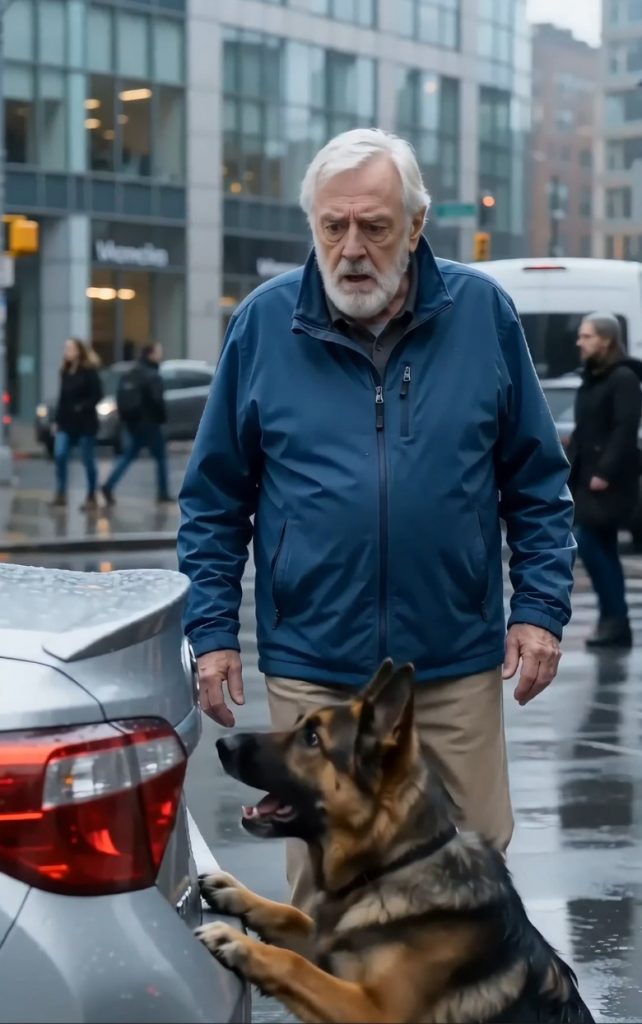
It slammed both front paws against the rear of the car, claws scraping the metal near the Toyota badge. Its barking cut through traffic, sharp and frantic, so urgent that several pedestrians turned their heads.
Then they kept walking.
A man in a maroon jacket glanced over, shook his head, and disappeared into the crowd.
The dog did not care.
It dropped to all fours, pressed its wet nose against the trunk seam, then bit at the gap near the latch as if it could tear the car open by force. Its ears were pinned forward, its body trembling with purpose.
This was not play.
This was warning.
Across the sidewalk, an elderly man slowed his steps.
His name was Henry Walsh, seventy-one years old, retired school custodian, widower, and the kind of man most people no longer noticed unless he was in their way. He wore a dark blue jacket over a plaid shirt, tan trousers damp at the cuffs, and an expression that had spent too many years learning caution.
He watched the dog bark, scratch, bite the trunk seam, then turn toward him.
Their eyes met.
The Shepherd barked once directly at Henry.
Then it jumped back against the Toyota.
Henry’s first thought was that the dog might bite him.
His second thought was worse.
What if it was right?
He stepped closer.
The dog dropped down again, whining now, not at Henry but to him. It looked from his face to the trunk, then back again, as clearly as any creature without words could beg.
Open it.
Henry’s breath caught.
He looked around for the owner. No one was coming. No one was running toward the car with keys. No one was shouting for the dog to stop.
Just traffic. Rainwater. Moving feet. A city pretending not to hear.
Henry reached for the trunk latch with one trembling hand.
The dog went silent.
That silence frightened him more than the barking.
His fingers found the latch.
A click.
The trunk lifted with a heavy creak.
Henry leaned forward and looked inside.
All the color drained from his face.
“Oh my God,” he whispered.
Because curled in the dark trunk, barely conscious but still breathing, was a little girl clutching a red ribbon Henry had not seen in eleven years.
And stitched into that ribbon was his daughter’s name.
Act II
Henry had spent eleven years trying not to look at red ribbons.
They had been Clara’s favorite when she was a child. Red ribbons in her hair for school photos. Red ribbons tied around birthday gifts. Red ribbons wrapped around the handle of the old lunchbox Henry packed for her every morning before his shift at Edison Middle School.
Clara Walsh had grown up bright and stubborn, with a laugh that filled the apartment and a temper that arrived fast but never stayed long.
She wanted to become a nurse.
Then she wanted to become a lawyer.
Then, at twenty-three, she became a mother.
Henry remembered the day she told him. She stood in his kitchen with rain on her coat, twisting a red ribbon around her finger the way she did whenever she was scared.
“I know it wasn’t planned,” she whispered.
Henry had taken her hands and said, “Most miracles don’t make appointments.”
For three years, life was hard but full.
Clara worked nights. Henry babysat during the day. Little Sophie slept in a crib by the window, reached for Henry’s beard with tiny fingers, and laughed every time the kettle whistled.
Then Clara met Adrian Pike.
He was charming at first. Clean jacket, careful words, flowers for Clara and a stuffed bear for Sophie. Henry mistrusted him immediately, but he could not explain why without sounding like the jealous old father Clara accused him of being.
“He’s helping us,” Clara told him.
“Helping people doesn’t usually require them to control everything,” Henry answered.
That was their first real fight.
It was not their last.
Adrian moved Clara and Sophie across town. Then he stopped letting Henry visit without calling first. Then Clara’s phone went quiet for days at a time.
One winter evening, Clara arrived at Henry’s door alone.
Her face was pale. Her hands shook. She pressed a small envelope into Henry’s palm and told him not to open it unless something happened.
“What do you mean something?” he asked.
But Clara only kissed his cheek and whispered, “Take care of Sophie if I can’t.”
The next morning, both Clara and Sophie were gone.
Adrian told police Clara had left him. He said she was unstable, said she had taken the child, said Henry was confused by grief and anger. There were no signs of a struggle, no clear witnesses, no evidence strong enough to hold anyone.
The case faded.
That was what Henry hated most.
Not that people were cruel. Cruelty at least had a face.
Indifference had no face at all.
It just moved on.
The envelope Clara had given him contained copies of bank withdrawals, a list of names, and one photograph of Adrian standing beside a silver Toyota with a dent near the left taillight. On the back Clara had written two words.
Not his.
Henry never understood what it meant.
For years, he carried that photograph in his wallet until the creases nearly split it in half.
He searched shelters. He posted flyers. He walked past schools at dismissal time, ashamed of the hope that made him scan every child’s face.
Then his health failed. His wife died. His friends stopped asking.
The world shrank to his small apartment, a cheap pharmacy umbrella, and the ache of not knowing.
Until that wet afternoon on Mercer Avenue.
Until the German Shepherd.
Until the trunk opened.
The little girl inside was older now, not three but fourteen, with damp hair stuck to her forehead and gray tape marks on her sleeve where someone had restrained her wrists without caring how scared she was. Henry did not look at those marks long.
He looked at the ribbon in her hand.
Red, faded, frayed.
CLARA.
The girl’s eyes fluttered.
The German Shepherd pushed forward and whined.
Henry’s knees almost gave out.
“Sophie?” he breathed.
The girl’s lips barely moved.
“Grandpa?”
Henry’s whole world stopped.
Then someone behind him shouted, “Hey! Get away from that car!”
And Henry turned to see Adrian Pike running through the rain.
Act III
Adrian looked older, but evil had preserved something in him.
The same smooth face. The same controlled hair. The same eyes that never seemed to warm, only calculate. He was dressed in a black overcoat, one hand inside the pocket, walking fast but trying not to look like he was running.
Henry stepped in front of the open trunk.
The German Shepherd lowered its body beside him and growled.
Adrian stopped.
His eyes flicked to the dog, then to Sophie, then to Henry.
For one second, the mask slipped.
Then he smiled.
“Mr. Walsh,” he said, breathing hard. “You need to step away. My niece has medical issues.”
Henry stared at him.
“My granddaughter was missing for eleven years.”
Adrian sighed as though Henry had embarrassed him in public.
“That is not your granddaughter.”
From inside the trunk, Sophie made a small frightened sound.
The dog barked so violently that a woman across the street screamed.
People finally stopped.
Phones came out. A cyclist braked hard. The man in the maroon jacket who had walked past earlier turned back, his face changing as he realized he had ignored something terrible.
Henry kept one hand on the trunk lid, as if holding it open could keep the truth from being shoved back into darkness.
“What did you do to Clara?” he asked.
Adrian’s smile vanished.
“Careful.”
That one word told Henry everything.
The dog moved before Adrian could take another step. It placed itself between him and the car, teeth visible now, not attacking, just promising.
A young woman in a delivery vest ran toward them with her phone to her ear.
“Police are coming!” she shouted. “Ambulance too!”
Adrian looked around.
The crowd was growing.
That was when Sophie spoke again, weakly but clearly enough for everyone nearest the car to hear.
“He’s not my uncle.”
Adrian’s face went cold.
Henry turned back to her.
Sophie was trying to lift her head. Her hand still gripped the ribbon, but now Henry saw something else around her wrist.
A bracelet made of braided red thread.
Clara used to make those.
She would sit at Henry’s kitchen table for hours, braiding thread into little bracelets and saying every knot held a promise.
Henry leaned closer.
“Sophie, where is your mother?”
Her eyes filled with tears.
“She told me to find you,” Sophie whispered. “She said the dog would know.”
Henry looked at the Shepherd.
The dog’s damp collar had a small metal tag swinging beneath its throat.
He reached for it carefully.
The name on the tag was Rosie.
Henry’s breath caught again.
Rosie had been the name of Clara’s childhood dog, a gentle mutt who slept under Sophie’s crib when she was a baby.
Clara had named this Shepherd after home.
After memory.
After the one place she still believed her daughter might reach.
Adrian started backing away.
“Don’t let him leave!” Henry shouted.
The crowd shifted.
For years, Adrian had counted on private fear. Closed doors. Quiet threats. People minding their own business.
But now he was standing in the middle of a wet city street, surrounded by witnesses, while a missing girl breathed in the open air and a German Shepherd blocked his path like judgment with teeth.
Sirens grew louder.
Adrian ran.
Rosie ran faster.
Act IV
The police caught Adrian half a block away.
Rosie did not bite him. She did not need to. She drove him toward two officers by cutting off every turn, barking with such disciplined force that one of the officers later asked if she had been trained.
Sophie answered that question from the ambulance.
“My mom trained her,” she whispered. “For emergencies.”
Henry sat beside her, wrapped in a thin foil blanket someone had put over his shoulders though he had not noticed being cold.
He could not stop staring at Sophie.
There were pieces of Clara in her face. The shape of her mouth. The stubborn lift of her chin. The way her eyes held fear without surrendering to it completely.
Paramedics checked her gently. She was weak, frightened, and dehydrated, but alive. Henry held her hand the entire time, terrified that if he let go she would vanish again.
Rosie sat at the ambulance doors and refused to move until Sophie reached down and touched her head.
“She saved me,” Sophie said.
Henry swallowed hard.
“She saved both of us.”
A detective arrived, a woman named Marisol Grant, who listened more carefully than most people Henry had met over the years. Henry showed her the old photograph from his wallet with the silver Toyota and the dented taillight.
The detective compared it to the car.
Same dent.
Same plate frame.
Different license plate.
Inside the Toyota, officers found false documents, old maps, a prepaid phone, and a locked metal case beneath the passenger seat. In the glove compartment was a parking receipt from a private storage facility outside the city.
When Detective Grant asked Sophie about it, the girl began to shake.
Henry felt rage rise in him, clean and frightening.
The detective’s voice softened.
“You don’t have to tell us everything right now.”
Sophie looked at Henry.
“My mom is there,” she whispered.
Everything moved after that.
Police cars pulled away from Mercer Avenue with lights flashing through the gray rain. Henry rode in the ambulance with Sophie because she would not let go of his sleeve. Rosie was allowed to ride too after Sophie became upset at the idea of leaving her behind.
Detective Grant followed the lead to a row of storage units near the industrial district.
There, in a small rented office attached to the property, they found Clara.
Alive.
Not untouched by the years. Not free from fear. Not the young woman Henry had last seen in his doorway with rain on her coat.
But alive.
She had been working under a false name, forced by Adrian into helping him hide money and forge ownership papers tied to stolen cars and fraudulent guardianships. He had kept Sophie away from her for long stretches, using the child as a leash stronger than any chain.
Clara had spent years pretending to comply while memorizing routes, names, codes, and habits.
Then she trained Rosie in secret.
A bark at danger. A return to Sophie. A scratch at any closed compartment. A run toward strangers when no family could help.
On the day of the rescue, Adrian had panicked after learning police were getting close to one of his accounts. He locked Sophie in the trunk for transport, planning to leave the city before nightfall.
But he made one mistake.
He underestimated the dog.
Rosie broke free from Clara near the storage office, tracked the Toyota through traffic, and found it parked on Mercer Avenue before Adrian could return.
Then she barked until the right person finally listened.
When Henry saw Clara again, he did not recognize her at first.
She stood between two officers, wrapped in a blanket, her hair shorter, her face older, her eyes fixed on the ambulance.
Then she saw him.
“Dad?”
Henry made a sound that was almost a sob.
Clara ran to him.
For eleven years, Henry had imagined this moment in a thousand ways. He had planned speeches. Apologies. Questions. Anger.
But when his daughter reached him, all he could do was hold her and whisper, “I knew you didn’t leave.”
Clara broke in his arms.
“I tried to come home,” she cried. “I tried so many times.”
Sophie reached for her mother from the stretcher.
Clara turned and saw her daughter safe.
Then Rosie pushed between all three of them, tail wagging for the first time that day.
And in that strange, rain-soaked reunion beside an ambulance, the family Adrian had buried alive in lies began breathing again.
Act V
The city remembered the dog before it remembered the people.
By morning, videos of Rosie clawing at the Toyota had spread across news sites and social media. Commentators called her a hero. Strangers left dog treats outside the animal hospital where she was checked and cleaned. Someone painted a mural of a German Shepherd beside a silver car with the words Listen When They Bark.
Henry saw none of it that first day.
He sat in a hospital room between Clara and Sophie, afraid to sleep.
Every time he closed his eyes, he saw the trunk opening. He saw the ribbon. He heard Sophie whispering Grandpa from the dark.
Clara slept only after Henry promised not to leave the room.
Sophie slept with Rosie on the floor beside her bed, one hand dangling over the side, fingers buried in the Shepherd’s fur.
The legal process was slow, but this time the truth had witnesses.
Adrian Pike was charged with kidnapping, unlawful confinement, fraud, identity theft, and other crimes tied to a network that had preyed on vulnerable families for years. Detectives found records Clara had hidden piece by piece, small acts of resistance that finally became a map.
Henry gave his statement three times.
Each time, he began the same way.
“The dog knew before any of us did.”
But privately, he blamed himself.
For the years he could not find them. For every birthday missed. For every holiday when he had set out three plates in his mind and eaten alone in silence.
Clara refused to let that guilt settle.
One evening, after Sophie had fallen asleep, Clara took Henry’s hand.
“Dad, he made me believe you stopped looking,” she said.
Henry’s eyes filled.
“Never.”
“I know that now.”
“I should have done more.”
“You kept the envelope,” Clara said. “You kept the photo. You stopped on that street when everyone else walked by.”
Henry looked toward Rosie, asleep beside the bed with one ear still half-raised, guarding even in dreams.
“No,” he said softly. “She stopped me.”
Weeks later, Clara and Sophie moved into Henry’s apartment.
It was too small for three people and a heroic German Shepherd, but no one complained. Henry bought a folding bed for the living room. Clara taped Sophie’s drawings to the refrigerator. Sophie placed Rosie’s blanket beside the front door so the dog could watch the hallway.
The first morning they were home, Henry made pancakes.
He burned the first batch.
Sophie ate them anyway.
“They taste like smoke,” she said.
Henry lowered his head in shame until he saw her smiling.
Then Clara laughed.
It was not the same laugh from before. It carried cracks now. But it was real, and Henry felt something inside him unclench for the first time in eleven years.
Spring came slowly.
Court dates filled the calendar. Therapy appointments followed. Detectives called with updates. Some nights Sophie woke from dreams and Rosie climbed onto the bed without being asked.
On better days, they walked together through the park.
People recognized Rosie.
Children asked to pet her. Adults thanked her as if she understood every word. Rosie accepted the praise with patient dignity, then returned to Sophie’s side.
One afternoon, Henry took Clara and Sophie back to Mercer Avenue.
The silver Toyota was gone. The rain was gone too. Sunlight touched the same curb where the city had nearly ignored a miracle.
Sophie stood very still.
Clara put an arm around her shoulders.
“We don’t have to stay,” Henry said.
Sophie shook her head.
She crouched beside Rosie and wrapped both arms around the dog’s neck.
“I want to remember that this is where we got found,” she said.
Henry turned away, pressing one hand over his mouth.
For years, Mercer Avenue had been just another street, loud and indifferent, full of strangers who looked through one another.
Now, to Henry, it was sacred ground.
Not because something terrible had almost happened there.
Because something good finally did.
A dog refused to be dismissed.
An old man refused to walk away.
A trunk opened.
A lie ended.
Months later, when Adrian was led into court, he looked smaller than Henry remembered. Without control, without secrecy, without fear as his private weapon, he was only a man trying not to meet the eyes of the family he failed to destroy.
Clara testified first.
Then Henry.
Then, through a victim advocate, Sophie gave her statement.
She did not look at Adrian once.
She looked at Rosie, lying calmly near the courtroom wall with special permission from the judge.
“My dog barked,” Sophie said. “And my grandpa listened.”
That was enough.
After the sentencing, Henry walked out of the courthouse with Clara on one side, Sophie on the other, and Rosie leading them toward the sunlight.
The city roared around them.
This time, Henry did not feel invisible.
Sophie slipped her hand into his.
“Grandpa?”
He looked down.
“Yes, sweetheart?”
“Can we get Rosie a red ribbon?”
Henry’s throat tightened.
Clara smiled through tears.
That evening, they tied a bright red ribbon gently beside Rosie’s collar. The Shepherd sat proudly in the middle of the living room while Sophie declared it official.
Henry looked at the ribbon, then at Clara, then at the granddaughter he thought he had lost forever.
For eleven years, red had been the color of grief.
Now it was the color of return.
And Rosie, the dog who had clawed at a trunk until the world finally paid attention, rested her head on Sophie’s lap as if to say she had known all along.
Some doors are locked by fear.
Some by lies.
And some only open because love refuses to stop barking.