Act I
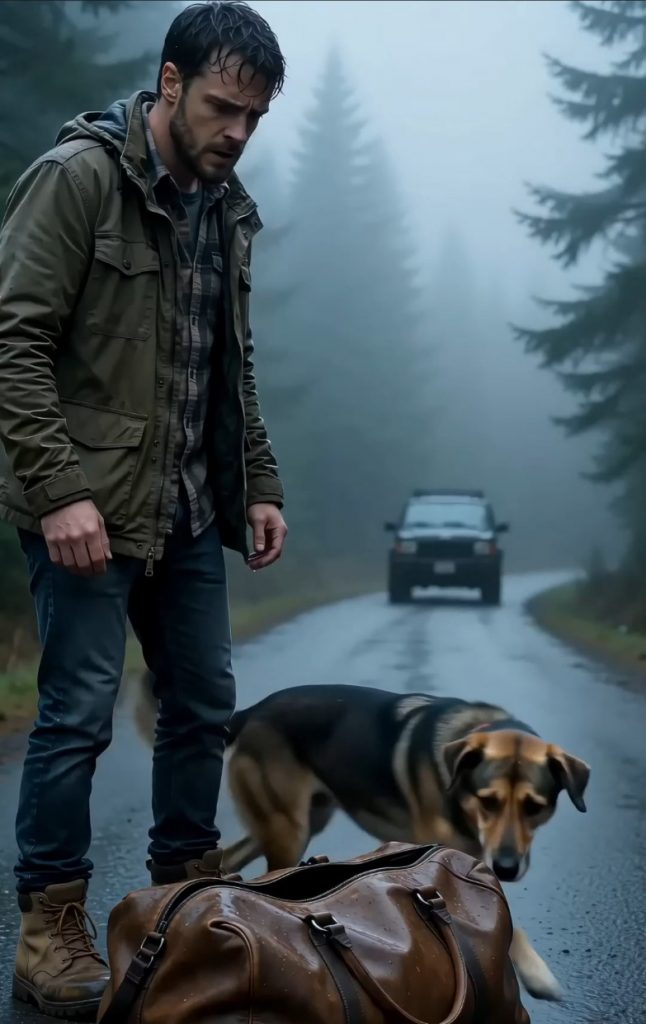
The dog was standing in the middle of the road when Nathan Cole saw the bag.
At first, he thought it was a dead animal.
The shape was low and dark against the wet asphalt, rain sliding over it in silver streaks. Fog pressed between the pine trees on both sides of the narrow road, thick enough to swallow the black SUV parked ahead on the shoulder.
Nathan slowed his truck.
The dog turned toward him.
It was a medium-sized mutt with tan-and-black fur plastered damp against its body, floppy ears pinned back, and a red collar flashing against the gray morning. It did not bark. It did not run.
It looked at Nathan like it had been waiting for the first decent person to stop.
Nathan killed the engine and stepped out.
Rain tapped against his olive jacket. His boots sank slightly into the wet gravel at the edge of the road. The forest smelled like pine, mud, and something metallic from the storm.
“Hey,” he called softly. “You okay?”
The dog ignored the question and circled the bag.
A brown leather duffel.
Large. Heavy-looking. Soaked through.
Its zipper was partly open, but not enough to show what was inside.
The dog pushed its nose against the seam, whimpered, then grabbed the side of the bag in its teeth and tugged hard. The leather scraped across the road with a wet, ugly sound.
Nathan’s stomach tightened.
“Easy,” he said, taking a step closer. “What is that?”
The dog released the bag and planted one paw on top of it. Then it looked straight into Nathan’s eyes and whined again.
Not hungry.
Not lost.
Begging.
Nathan crouched, but stopped short of touching the zipper.
The black SUV sat twenty yards ahead, half-hidden in the fog. No headlights. No movement. One rear door slightly open.
Then, from somewhere near the SUV, came the faint creak of a car door shifting in the wind.
Nathan froze.
The dog lowered its head and gave a low growl.
Nathan looked from the SUV to the bag, then back to the dog.
Rain slid down his face. His breathing quickened.
He reached for the zipper with two careful fingers and pulled it open just one inch more.
Inside, beneath a folded gray blanket, he saw a tiny hand.
For one breath, the whole forest went silent.
Then the dog whimpered again.
And Nathan understood.
The bag was not abandoned.
Someone had left it there to disappear.
Act II
Nathan Cole knew this road better than he wanted to.
Route 17 cut through eleven miles of pine forest before it reached the old county line. Most people avoided it after dark. The shoulders were narrow, the curves were blind, and in bad weather the fog came down so thick that headlights became useless.
But Nathan drove it every Friday.
Not because it was faster.
Because ten years earlier, his younger sister Emma had vanished from that same road.
She had been nineteen. Stubborn, laughing, always late, always borrowing Nathan’s truck and returning it with the gas tank empty. She had taken Route 17 after a closing shift at the diner and never made it home.
Her car was found near mile marker six.
Door open.
Purse still inside.
No Emma.
For weeks, search parties combed the forest. Volunteers brought dogs. Police taped off ditches and questioned men at gas stations. Nathan walked until his boots split, calling his sister’s name into the trees until his voice failed.
Nothing.
Then the town slowly moved on.
His mother never did. She kept Emma’s room untouched. His father stopped speaking at dinner. Nathan became a volunteer firefighter because standing still inside grief felt impossible.
Every Friday, he drove the forest road and stopped near the place where Emma’s car had been found.
He never admitted what he was doing.
Not to friends.
Not to himself.
He called it routine. Habit. A strange kind of penance.
That morning, he had nearly taken the highway instead. The rain was bad, the fog worse, and he was already late for a repair job outside town.
Then he saw the dog.
Now Nathan knelt in the road beside a leather duffel bag, staring at the impossible shape hidden inside.
A child.
Small. Wrapped in a gray blanket. Still.
His hands went numb.
“No,” he breathed. “No, no, no.”
The dog pressed against his shoulder, whining frantically.
Nathan forced himself to move.
Training took over before panic could. He opened the bag wider, carefully, his mind refusing to name the horror of what he was seeing until he found proof that hope was still allowed.
The child moved.
Just barely.
A tiny shudder beneath the blanket.
Nathan’s chest seized.
“Okay,” he whispered, his voice breaking. “Okay, you’re alive. I’ve got you.”
He lifted the child from the bag with shaking hands. A little girl, no more than two years old, cold and limp with exhaustion but breathing. Her cheeks were pale. Her dark hair stuck damply to her forehead. Around one wrist was a soft yellow bracelet with faded plastic letters.
M A Y A.
The dog immediately stood on its hind legs, trying to reach her. Not attacking. Not panicking.
Checking.
“You know her?” Nathan asked, though the answer was already clear.
The dog licked the edge of the blanket and let out a sound so mournful Nathan almost couldn’t bear it.
He pulled the child against his chest and carried her to his truck, shielding her from the rain with his body. He laid her across the passenger seat, turned the heat up high, and grabbed the emergency blanket from behind the seat.
His phone had one bar.
He dialed 911.
The call crackled.
“Emergency services, what is your location?”
“Route 17,” Nathan said quickly. “About a mile south of marker six. I found a child in a duffel bag. She’s alive. There’s a black SUV here. I need an ambulance and police now.”
The dispatcher’s voice sharpened. “Sir, are you safe?”
Nathan looked through the rain-streaked windshield.
The black SUV sat in the fog.
Still.
Watching, somehow.
“I don’t know,” he said.
The dog stood in the road beside the open duffel, wet and trembling, refusing to leave it.
Then Nathan noticed something inside the bag he had missed before.
A folded envelope.
His name was written across it.
Act III
Nathan did not open the envelope at first.
He told himself it was because he needed to watch the child. Because the ambulance was coming. Because the dog was still growling at the SUV, and every instinct in Nathan’s body told him the forest was not empty.
But the truth was simpler.
He was afraid.
His name on that envelope did not belong there.
Nathan Cole.
The handwriting was shaky, but familiar enough to pull ten years of grief straight through his ribs.
Emma.
He knew it before he touched the paper.
The sirens were still distant when he finally opened it with wet fingers.
Inside was a single page wrapped around a silver necklace.
Nathan’s throat closed.
The necklace had a tiny crescent moon pendant. He had bought it for Emma on her sixteenth birthday from a mall kiosk because it was all he could afford. She wore it every day until the night she disappeared.
Nathan unfolded the letter.
Nate,
If you found this, it means Ranger did what I trained him to do.
The dog’s ears lifted at the name.
Ranger.
Nathan looked through the windshield at the trembling animal outside.
His sister’s dog.
He read on.
Her name is Maya. She is mine. She is your niece. Please don’t let them take her back.
Nathan stopped breathing.
For ten years, he had imagined every ending to Emma’s story except this one.
Alive long enough to have a child.
Alive long enough to write to him.
Alive somewhere close enough to know he still drove this road every Friday.
The letter blurred in his hands.
I tried to come home. I tried more than once. They told me if I ran, they would hurt her. The sheriff’s office has people inside it. Don’t trust anyone who arrives alone. Don’t give Maya to anyone except state police or the woman from child services named Lara Venn. She helped me hide this letter.
Nathan’s eyes snapped toward the SUV.
The rear door was no longer open.
It had closed.
Slowly.
Without wind.
His pulse hammered.
In the passenger seat, Maya made a tiny sound in her sleep. Nathan pulled the emergency blanket higher around her.
Ranger backed toward the truck, still growling.
Nathan kept reading.
They use the old mill cabins past the creek. That’s where they keep women who have nowhere to go and children nobody is supposed to ask about. I kept Maya hidden as long as I could. If I don’t make it to you, she has to.
Tell Mom I didn’t leave.
Tell Dad I heard him calling.
Tell yourself it wasn’t your fault.
Nathan pressed the page against the steering wheel and bent over it.
Rain beat against the roof. The heater roared. Somewhere ahead, the black SUV sat like a closed fist in the fog.
For ten years, guilt had lived inside Nathan as if it had a right to be there.
He had blamed himself because Emma had called him that night and he had missed it. One call. Three minutes before she vanished. He was at a bar with friends, music too loud, phone face down on the table.
By the time he called back, she was gone.
Now her letter sat in his hands, telling him the thing no one else had been able to.
It wasn’t your fault.
The first police cruiser appeared through the fog.
Nathan’s relief died almost instantly.
It was a county sheriff’s vehicle.
Alone.
Act IV
Nathan locked the truck doors.
Ranger jumped into the cab through the open driver’s side door before Nathan could stop him, landing muddy and soaked on the floorboard. He pressed his body between Maya and the window.
The sheriff’s cruiser stopped behind Nathan’s truck.
A man stepped out in a tan raincoat, one hand resting near his belt. Deputy Carl Voss. Nathan knew him. Everyone did.
Carl had been one of the first officers on Emma’s case ten years ago.
He had stood in Nathan’s parents’ kitchen, hat in hand, and promised they would find her.
Nathan looked at the letter.
Don’t trust anyone who arrives alone.
Carl approached the driver’s window.
Nathan lowered it two inches.
“Morning, Nate,” Carl said, breath fogging in the cold. “Dispatcher said you found a kid.”
Nathan’s face stayed blank.
“Ambulance coming?”
“Road’s washed near the bridge. Might take a while.” Carl leaned slightly, trying to see past him. “I can take her from here.”
Ranger growled low from the floorboard.
Carl’s eyes flicked down.
Something ugly moved across his face before he covered it.
“Dog yours?”
Nathan did not answer.
Carl smiled without warmth. “Open the door.”
Nathan’s hand tightened around the steering wheel.
Behind Carl, another sound rose through the rain.
Not sirens.
An engine.
The black SUV had started.
Its headlights came on, two pale circles cutting through the fog.
Carl looked over his shoulder.
Just for a second.
Nathan moved.
He shoved the truck into reverse, slammed one hand against the horn, and backed hard enough that Carl stumbled away from the window. Ranger barked once, loud and sharp. Maya cried weakly beneath the blanket.
“Hold on,” Nathan whispered.
He swung the truck across the narrow road, blocking the lane between the SUV and the child. The tires hissed over wet asphalt.
Carl shouted something, but Nathan couldn’t hear him over the rain and his own heartbeat.
Then real sirens came.
More than one.
From the opposite direction.
State police.
An ambulance.
A dark sedan with blue emergency lights tucked behind the grille.
The SUV hesitated.
That hesitation saved them.
Two state police vehicles burst through the fog and boxed the SUV before it could turn around. Doors opened. Voices shouted. Carl froze in the road, no longer in control of the scene he thought he had contained.
A woman in a navy raincoat ran toward Nathan’s truck.
She held up both hands.
“Nathan Cole? I’m Lara Venn. Child Protective Services. Emma sent me.”
Nathan stared at her through the rain.
She was breathing hard, her hair plastered to her face, but her eyes went straight to Maya with such visible relief that Nathan knew before she showed him her identification.
This woman had been afraid they would be too late.
Lara looked at Ranger.
The dog stopped growling.
“Good boy,” she whispered.
Ranger whined and pressed closer to Maya.
Paramedics reached the truck next. Nathan unlocked the doors with trembling fingers but did not let go of the child until Lara touched his arm.
“We’re not taking her away from you,” she said. “We’re keeping her alive.”
That broke through him.
He nodded and stepped back as they lifted Maya gently into a warm blanket and carried her to the ambulance. Ranger tried to follow, and Lara opened the door wider.
“He comes too,” she said.
Nathan watched the dog jump in beside the child.
Across the road, state police had Deputy Carl Voss on his knees with his hands restrained behind him. Near the SUV, two men were being removed from the vehicle. One of them kept his face turned away.
Nathan recognized him anyway.
Elliot Crane.
Owner of the old mill cabins.
Church donor. Youth baseball sponsor. The man who had once organized a search party for Emma.
Nathan felt the world tilt.
For ten years, the monster had worn a neighbor’s face.
Then Lara came back to him, holding something sealed in a plastic evidence sleeve.
Another letter.
This one had been found under the SUV’s front seat.
Nathan knew the handwriting before she spoke.
“We believe your sister was in that vehicle this morning,” Lara said gently.
Nathan looked at her.
The rain seemed to stop touching him.
“Was?”
Lara’s expression tightened with grief, but not hopelessness.
“She may have escaped into the woods before they left the bag. State police are searching now.”
Nathan turned toward the trees.
The pines stood dark and endless, fading into fog.
For the first time in ten years, he did not call his sister’s name in memory.
He called it because she might still answer.
“Emma!”
Act V
They found Emma at dusk.
Not far from the creek, hidden under a fallen pine where Ranger had kept circling until the search team followed him back into the trees. She was cold, exhausted, and barely able to stand, but alive.
Alive.
Nathan reached her just as the paramedics were helping her onto a stretcher.
For a moment, he did not recognize her.
Ten years had changed her face. Fear had hollowed her cheeks. Her hair was shorter than he remembered. There were lines near her eyes that should not have been there yet.
But then she looked at him.
And she was nineteen again.
His little sister.
“Nate,” she whispered.
Nathan dropped to his knees in the mud beside her.
He reached for her hand like he was afraid she might vanish if he moved too fast.
“I’m here,” he said. “I’m here.”
Emma’s eyes filled.
“Maya?”
“She’s alive. She’s safe. Ranger stayed with her.”
A sound came out of Emma that was half sob, half prayer.
Nathan bowed his head over her hand.
“I missed your call,” he said, the old guilt rushing out before he could stop it. “Em, I missed it. I’m so sorry.”
She squeezed his fingers with what little strength she had.
“No,” she whispered. “I called because I knew you’d come looking.”
He looked up at her.
“You did.”
“I knew you’d never stop.”
That was when Nathan broke.
Not loudly. Not dramatically. Just a man folding under the weight of a decade, rain on his face, mud on his knees, his sister’s hand finally real in his.
The investigation that followed swallowed the county whole.
The old mill cabins were searched. Records were seized. Deputy Voss was arrested along with Elliot Crane and others who had hidden behind uniforms, charity boards, and polite smiles. Women who had disappeared into the cracks of the system were found. Children were identified. Names were returned to people who had been treated like they had none.
The story spread beyond the town.
But Nathan did not care about cameras or headlines.
He cared about a hospital room where Emma slept under clean blankets while Maya recovered down the hall with Ranger curled beside her bed.
Their parents arrived just after midnight.
Nathan met them outside Emma’s room.
His mother saw his face and knew before he spoke. She covered her mouth, knees weakening. His father, older and smaller than Nathan remembered, gripped the wall like the building had moved beneath him.
“She’s alive,” Nathan said.
His mother made a sound that had waited ten years to leave her body.
When they entered the room, Emma woke.
For a moment, no one moved.
Then her father crossed the space in three broken steps and took her face in his hands.
“I called for you,” he whispered.
Emma cried.
“I heard you.”
Weeks later, when Emma was strong enough, Nathan drove her back to Route 17.
Not to the exact spot where the duffel had been found. She was not ready for that. Maybe she never would be.
Instead, they stopped near the place where her car had been discovered ten years earlier.
The rain was gone. Sunlight filtered through the pine branches. The road looked smaller in daylight, less like a nightmare and more like a road that had been forced to carry one.
Ranger sat in the back seat with Maya, who was wrapped in a yellow sweater and clutching a stuffed fox someone from the hospital had given her.
Emma stared through the windshield.
“I used to dream about this road,” she said.
Nathan kept his hands on the wheel.
“So did I.”
“I thought if I ever came back, I’d hate it.”
“Do you?”
Emma was quiet for a long time.
Then she looked back at Maya.
“No,” she said. “Not anymore.”
Nathan understood.
A place could hold terror.
But it could also hold the moment terror ended.
Months passed.
Emma moved into the small guest cottage behind Nathan’s house. Their parents visited every day at first, then every other day, learning slowly how not to hover. Maya grew stronger. She laughed more. She followed Ranger everywhere, feeding him cereal piece by piece despite everyone pretending not to notice.
On Fridays, Nathan no longer drove Route 17 alone.
Sometimes Emma came with him.
Sometimes Maya.
Always Ranger.
They never passed the curve without the dog lifting his head, alert and watchful, as if part of him would forever remember the weight of that wet leather bag and the rain on the road.
One autumn afternoon, Nathan stopped at the shoulder and opened the truck door.
Ranger hopped out first.
He sniffed the grass where the asphalt met the forest, then looked back at Nathan with those amber-brown eyes.
The same eyes that had begged him to understand.
Nathan crouched and scratched behind his ears.
“You did good, boy,” he said.
Ranger leaned into him, tail moving slowly.
Behind them, Maya giggled from Emma’s arms.
The forest was quiet now.
Not empty.
Not haunted.
Just quiet.
Nathan looked down the wet, winding road and thought of all the years he had driven it with guilt sitting beside him like a passenger. He had believed he was returning to the place where his sister disappeared.
But that had never been the whole truth.
It was also the place where her daughter was found.
The place where a dog refused to give up.
The place where a brother finally learned that love, even after ten lost years, can still arrive in time.