Act I
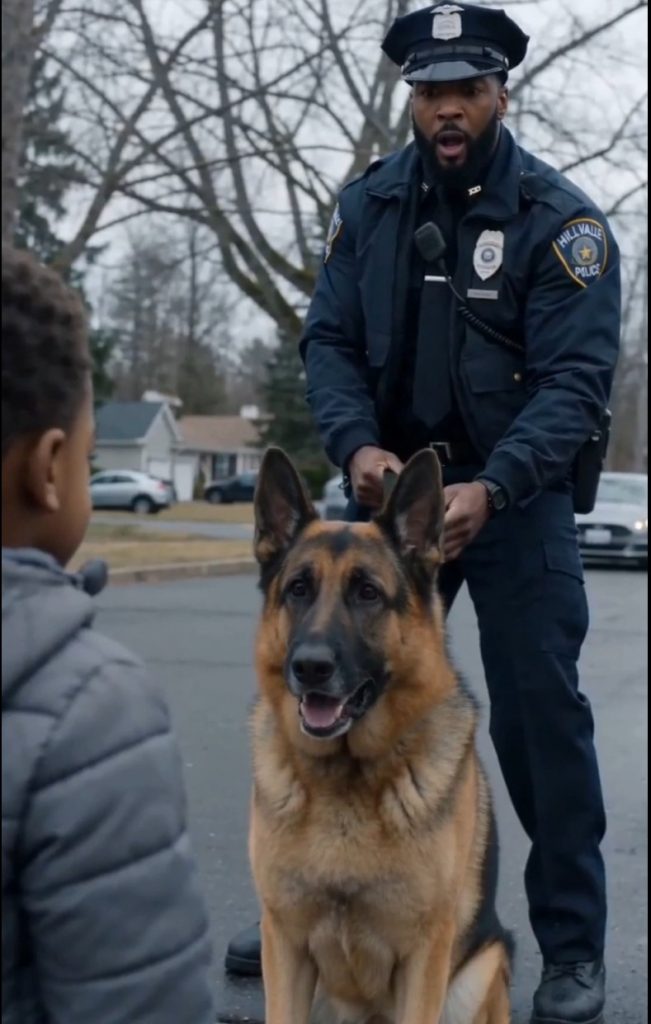
The officer was losing control of the leash.
His boots scraped against the asphalt as he leaned back with all his strength, knees bent, both hands locked around the thick black strap. The German Shepherd at the end of it lunged so hard his front paws lifted off the pavement, his body rigid, his bark tearing through the quiet suburban street.
“Back!” the officer shouted. “Get back! Now!”
But the little boy did not move.
He stood in the middle of the road under the gray winter sky, a small figure in a dark quilted jacket, blue shirt showing at the collar, denim jeans brushing the tops of his shoes. Bare trees lined the street behind him. Parked cars sat along the curbs. Every house seemed suddenly too far away.
The dog barked again, teeth showing, powerful chest straining against the collar.
The officer’s patch read HILLVALE POLICE.
His face was twisted with urgency, dark hair damp with sweat despite the cold. He looked from the dog to the boy and back again, terror flashing beneath the command in his voice.
“Kid, move!”
The boy only looked at the dog.
Not at the teeth.
Not at the leash.
At the eyes.
His face was soft, almost sad, with the strange calm of someone seeing an old friend after a long time apart.
The dog lunged once more.
The officer braced for disaster.
Then the boy opened his mouth and spoke one word.
“Max.”
The street went still.
The bark stopped instantly.
The German Shepherd froze with his front legs planted and his ears sharp. For one breath, he stared at the child as though the name had reached somewhere deeper than training, deeper than fear, deeper than the leash.
Then his body changed.
His muscles loosened. His mouth closed. Slowly, impossibly, the dog lowered himself onto the pavement. His tail began to move against the asphalt, soft and rhythmic.
The officer’s grip went slack.
His jaw fell open.
Because Max did not obey strangers.
Max did not sit for children.
And Max had not heard that voice in two years.
Act II
Officer Mateo Reyes had seen Max calm under gunfire, sirens, fireworks, and storms.
He had also seen Max refuse food for three days after they found him.
The dog had arrived at Hillvale Police not as an official K9, not at first. He had been found outside an abandoned service station on the edge of town, injured, filthy, and guarding the back door of an empty building as if someone had ordered him to stay there until the world ended.
Animal control could not get near him.
Two officers tried and failed.
Mateo had not been on duty that afternoon, but he heard the call come over the radio and drove out anyway. He found the dog standing in weeds beside the cracked concrete, ribs showing beneath a matted black-and-tan coat, eyes locked on every hand that moved too quickly.
Everyone said the same thing.
Dangerous.
Unmanageable.
Too far gone.
Mateo looked at the dog and saw something else.
Not gentleness. Not yet.
Loyalty with nowhere to go.
It took two hours for him to get close enough to clip a leash onto the collar. The collar had been expensive once, thick black leather with a small metal plate scratched nearly blank. Only one word could still be read.
MAX.
No owner came forward.
No microchip matched.
No missing dog report had survived in the system under that name.
So Max stayed.
For weeks, he barely slept unless Mateo sat beside his kennel. He barked at men in heavy boots. He trembled at the sound of slamming doors. He stared at small children from behind the chain-link fence with an intensity no one could interpret.
Eventually, the department brought in a retired K9 trainer named Hal Morrison, who took one look at Max and shook his head.
“That dog wasn’t trained for police work,” Hal said.
Mateo frowned. “Then what?”
Hal watched Max press his nose against the kennel gate, eyes fixed on a stuffed bear lying on a shelf in the evidence room.
“He was trained to protect someone.”
That sentence stayed with Mateo.
Over time, Max improved. He learned Mateo’s commands. He passed basic control tests. He never became friendly, exactly, but he became reliable. Serious. Watchful. A dog who seemed to carry a private grief no one could name.
Mateo trusted him more than most people.
But that morning on Briar Lane, Max had broken pattern.
The call had seemed routine at first. A large dog loose near a residential street. Children nearby. Possible danger. Mateo arrived to find Max already tense in the back seat of the cruiser, ears forward before the door even opened.
That should have been impossible.
Max had not seen the boy yet.
But he had smelled something.
Mateo clipped the leash to Max’s collar and stepped out, scanning the quiet road. The houses were plain and close together, their lawns brown from winter, their porches empty. A silver sedan idled crookedly by the curb with its driver-side door open.
Then a little boy stepped into the street.
Alone.
Small.
Calm.
Max erupted.
Mateo had never felt anything like it. The dog did not pull like he wanted to attack. He pulled like something inside him had been ripped open. Barking, straining, desperate, all muscle and sound.
Mateo shouted for the child to move.
The child did not.
And then the boy said the name.
Max.
Not like a guess.
Not like he had heard Mateo say it.
Like he had said it every night before falling asleep.
That was when Mateo remembered the cold case file.
The one every officer in Hillvale knew but no one liked to mention.
The missing child from Oak Street.
The boy who vanished with his mother’s dog.
Act III
His name had been Caleb Brooks.
Four years old when he disappeared.
The posters had shown him with round cheeks, bright brown eyes, and a red winter hat pulled too low over his curls. In the corner of the same poster, half cropped from the photo, was a German Shepherd lying beside him on a living room rug.
The dog’s name was Max.
Everyone in Hillvale had seen that poster.
For six months, it hung in grocery stores, church lobbies, gas stations, schools, and the front window of the police department. Then the weather faded the paper. New notices covered old ones. People stopped saying Caleb’s name as often because hope, when it is wounded too many times, learns to whisper.
Caleb had disappeared two winters earlier after a custody exchange that never happened.
His mother, Danielle Brooks, had been waiting outside the Hillvale library when her former partner failed to bring Caleb back. At first, everyone thought it was a family dispute. Then calls went unanswered. The apartment was emptied. The car was found abandoned three counties away.
No child.
No father.
No dog.
Danielle never stopped searching.
She came to the department every Friday for almost a year, carrying new photos, old toys, names of towns she had heard in rumors, scraps of information that mostly led nowhere. Mateo had been a patrol officer then. He remembered her sitting in the lobby with a folder clutched against her chest, polite to everyone, begging with her eyes long after her voice had run out.
Then one day, she stopped coming.
Not because she stopped loving her son.
Because grief had finally made her body fail.
She moved in with her sister outside Hillvale and left Caleb’s room untouched.
The case stayed open.
But open is not the same as alive.
Now Mateo stood on Briar Lane, staring at the child in front of him, and felt the past rise like a siren.
The boy had grown. Of course he had. His face was thinner than the poster. His hair was longer. His eyes were older than any four- or five-year-old’s eyes should be.
But the shape of him was there.
And Max knew.
The dog’s tail thumped softly against the asphalt.
The little boy took one step forward.
Mateo tightened his grip out of instinct. “Easy.”
Max did not move except to lower his head.
The boy walked closer, slow and certain. He lifted one small hand and placed it on the dog’s forehead, right between the ears.
Max closed his eyes.
A sound came from him then, low and broken, not a bark, not a whine, but something that made Mateo’s throat tighten before he understood why.
The boy whispered, “You found me.”
Mateo forgot how to breathe.
From inside one of the nearby houses, a curtain shifted.
A woman’s voice called sharply, “Eli?”
The boy flinched.
Not at the dog.
At the voice.
Mateo turned toward the house.
A woman stood on the porch of a pale yellow home three doors down. She wore a long gray coat and held a phone in one hand. Her face was pale, but not with worry. With calculation.
“Eli,” she said again, softer now. “Come back here.”
The boy did not move.
Mateo straightened.
“Ma’am,” he called, keeping his tone controlled, “is this your child?”
The woman smiled too quickly.
“My nephew. He wanders. I’m so sorry, officer.”
Max rose from his sitting position.
This time he did not bark.
He placed his body between the woman and the boy.
Mateo felt the leash tighten again, but not with chaos.
With warning.
The woman’s smile faltered.
And the boy, still touching Max’s fur, said quietly, “My name isn’t Eli.”
Act IV
The street seemed to narrow around those five words.
Mateo looked down at the child.
“What is your name?”
The boy’s fingers curled gently into Max’s coat. His eyes stayed on the woman at the porch, but his voice was clear.
“Caleb.”
The woman stepped down from the porch immediately.
“He gets confused,” she said. “He watches videos, makes up stories. Kids do that.”
Mateo lifted one hand.
“Stay where you are.”
She stopped, but only because Max had taken one slow step forward.
No growl.
No snarl.
Just a silent, immovable line.
The woman looked at the dog with fear she could not hide.
That fear told Mateo more than her words had.
He reached for his radio.
“This is Reyes. I need backup to Briar Lane. Possible missing child recovery. Send a supervisor and medical.”
The woman’s face changed.
Not completely. She tried to hold it together, tried to remain the concerned relative, the innocent homeowner, the adult in control. But panic moved behind her eyes like something trapped.
“Officer, this is ridiculous,” she said. “I have documents.”
“I’m sure you do,” Mateo replied.
His voice had gone flat.
That frightened her more than shouting would have.
The first neighbor opened a front door. Then another. People were watching now from porches, windows, driveways. The quiet street that had seemed empty moments earlier began filling with witnesses.
Caleb leaned closer to Max.
Mateo crouched carefully, keeping himself at the boy’s level while still watching the woman.
“Caleb,” he said gently, “do you know that dog?”
The boy nodded.
“He slept by my bed.”
“How long ago?”
Caleb’s face tightened in concentration, as if time had become a room with too many locked doors.
“Before we left Mommy.”
Mateo felt the words land.
Before we left Mommy.
Not before Mommy left.
Not before Mommy died.
Before we left Mommy.
The woman snapped, “Enough. He doesn’t know what he’s saying.”
Max’s ears lifted.
Mateo stood.
“Ma’am, keep your hands visible.”
A patrol car turned onto the street, then another. The sound of approaching sirens stayed low, controlled, but every person on Briar Lane heard them.
The woman looked toward the open sedan by the curb.
Mateo saw it at the same time.
The car was packed.
Blankets. Bags. A small backpack in the passenger seat.
She had been leaving.
Maybe that morning. Maybe in the next ten minutes. Maybe because Max had somehow found the street before she could disappear again.
“Caleb,” Mateo said, “were you getting in that car?”
The boy nodded once.
“She said we had to go before the man came back.”
“What man?”
The woman’s voice cracked. “Don’t answer that.”
Mateo moved one step toward Caleb, placing his body between the child and the porch.
The backup officers arrived fast. One moved toward the sedan. Another approached the woman. A sergeant began asking sharp, quiet questions into a phone.
The woman kept talking.
Papers. Guardianship. Misunderstanding. Family emergency.
Words came out of her in a rush, polished at first and then messy. She claimed Caleb’s father had left him with her. She claimed she did not know the boy was missing. She claimed his mother was unstable, then corrected herself when Mateo’s eyes hardened.
But the more she spoke, the less real she sounded.
Caleb said almost nothing.
He did not need to.
Max had done the first impossible thing.
The boy’s name did the second.
Within minutes, the sergeant received confirmation. Caleb Brooks had distinguishing marks listed in the file. A tiny crescent-shaped birthmark near his left shoulder. A small scar under his chin from a fall when he was two.
A female officer knelt beside the boy and spoke softly to him. With Mateo shielding the view, she checked only what was needed, carefully and respectfully.
Her eyes lifted to the sergeant.
“It’s him.”
For a moment, no one moved.
Even the bare trees seemed to hold still.
Then Mateo heard a sound behind him.
The woman from the porch had sat down hard on the step, her hands trembling as an officer stood beside her. She no longer looked like a relative. She looked like someone whose lies had run out before the road did.
Max pressed his head against Caleb’s chest.
The boy wrapped both arms around the dog’s neck.
And for the first time since Mateo arrived, Caleb began to cry.
Not loudly.
Not dramatically.
Just enough to show that the calm had not been fearlessness.
It had been survival.
Act V
Danielle Brooks arrived at Briar Lane wrapped in a coat she had clearly thrown on without thinking.
Her sister drove, because Danielle’s hands were shaking too hard to hold a wheel. She stepped out before the car had fully stopped, one hand over her mouth, eyes searching the street with terror and hope fighting across her face.
Mateo stood near the curb.
Beside him, Caleb sat on the back step of an ambulance with a blanket around his shoulders. Max lay at his feet, body pressed close, head raised like he would challenge the whole world before letting anyone take the child again.
Danielle saw the dog first.
“Max?”
The German Shepherd lifted his head.
His tail moved once.
Then Danielle saw the boy.
The sound she made was not a word. It was years of prayers, birthdays, empty rooms, folded pajamas, unanswered calls, and one mother’s heart trying to restart all at once.
Caleb looked up.
For a second, confusion crossed his face. Memory is a fragile thing in a small child, especially when adults have spent years trying to rename the truth.
Danielle stopped several feet away.
She did not grab him. She did not rush him. Every instinct in her body wanted to, but love held itself back because he had already lost too much control over his own life.
“Caleb,” she whispered. “It’s Mommy.”
The boy stared.
His lips parted.
Then Max stood, walked to Danielle, and pressed his nose into her hand.
That was what broke the wall.
Caleb slid off the ambulance step and ran.
Danielle dropped to her knees on the asphalt, arms opening just in time to catch him. She held him like someone holding the only piece of the world that mattered, rocking once, twice, then going completely still as if any sudden movement might wake her from it.
“I found Max,” Caleb whispered into her coat.
Danielle closed her eyes.
“No, baby,” she said, voice breaking. “Max found you.”
The officers turned away out of respect.
So did the neighbors.
Even Mateo looked down at the leash in his hand, blinking against something he refused to call tears while standing in uniform.
The investigation would stretch far beyond that morning.
The woman on the porch was not Caleb’s aunt. Her name was Marla Voss, a former acquaintance of Caleb’s father. Records found inside the packed sedan suggested she had helped keep the boy hidden across several towns, changing names, changing schools, avoiding doctors, leaving whenever anyone asked too many questions.
Caleb’s father was found two days later in another county.
The case that Hillvale had almost buried came back to life with warrants, interviews, custody hearings, and evidence pulled from places no one had searched hard enough the first time.
But none of that was what the town remembered most.
They remembered the dog.
They remembered Max, who had vanished with a little boy and somehow survived long enough to be found, trained, and placed into the hands of the one officer who would bring him back to the right street on the right morning.
They remembered the way he barked like a threat, then sat like a promise.
They remembered the boy standing in the road, unafraid, whispering one name into the chaos.
In the weeks that followed, Caleb stayed close to his mother. He spoke little at first. He slept with lights on. He asked the same questions more than once, testing whether the answers would change.
Danielle answered every time.
Yes, you are home.
Yes, I looked for you.
Yes, Max is safe.
Yes, I always loved you.
Max was officially retired from active police work after the reunion, though Mateo joked that the dog had made the decision without asking the department. The truth was simpler. Max had completed the only mission that had ever mattered to him.
At the small ceremony outside Hillvale Police, reporters came with cameras. The chief gave a speech about persistence, community, and the importance of never closing the door on a missing child.
Max ignored all of it.
He sat beside Caleb, tail sweeping the pavement whenever the boy leaned against him.
Mateo stood nearby in his dark navy uniform, silver badge catching the pale light. When Danielle approached him afterward, she tried to thank him, but the words failed before they formed.
Mateo shook his head.
“I held the leash,” he said softly. “He did the rest.”
Danielle looked at Max.
Then at her son.
“No,” she said. “You both did.”
Winter slowly loosened its grip on Hillvale.
The trees along Briar Lane grew small green buds. The house where Caleb had been kept went dark, then sold, then changed until the neighborhood stopped lowering its voice every time someone passed it.
But people still paused at the spot in the road where it happened.
Not because there was anything to see.
There was no mark on the asphalt. No plaque. No permanent sign that a child’s life had turned back toward home there.
Only a quiet street.
Barely any traffic.
The kind of place where terrible secrets can hide behind ordinary doors.
And the kind of place where, sometimes, truth comes running on four legs.
Months later, Caleb and Danielle visited the police station with a drawing. It showed a brown-and-black dog, a little boy, and a man in a blue uniform holding a leash. Above them, in careful uneven letters, Caleb had written:
MAX FOUND ME.
Mateo pinned it beside his desk.
Every time he looked at it, he remembered that morning—the barking, the strain in his arms, the small boy who refused to move, the impossible silence after one whispered name.
He had thought he was holding back danger.
But Max had not been trying to attack the child.
He had been trying to reach him.
Because love, when it is loyal enough, can look terrifying to anyone who does not know the story.
And Max had carried that story all the way home.